CONTENTS 8 10 31
FOREWORD by Christian Siriano INTRODUCTION by Rachel Syme MARILYN AND THE ART OF PUBLICITY PHOTOGRAPHY ‘Starhead F999’ by David Wills
57
MARILYN AND THE PRESS ‘Public Exposures’ by David Wills
84 86 104 116 136 144 162 178 192 208 228 250 262 278 292 298 318 330 340 342 345
THE PHOTOGRAPHERS by Louie Conway
ANDRÉ DE DIENES JOSEPH JASGUR BRUNO BERNARD JOHN FLOREA EVE ARNOLD PHILIPPE HALSMAN ALFRED EISENSTAEDT ELLIOTT ERWITT MILTON GREENE SAM SHAW GEORGE BARRIS CECIL BEATON RICHARD AVEDON HENRI CARTIER-BRESSON BRUCE DAVIDSON BERT STERN ALLAN GRANT CONTRIBUTING WRITERS ENDNOTES PICTURE CREDITS
INTRODUCTION By Rachel Syme
IN
May of 2022, the actress, reality TV star, and lingerie mogul Kim Kardashian arrived at the Metropolitan Museum of Art for their annual Met Gala, wearing another woman’s dress. The dress was 60 years old, made of delicate beige marquisette fabric embellished with over 6,000 hand-sewn crystals,1 and had only been worn in public once before, also in Manhattan, also on the night of a grand party. Marilyn Monroe wore the dress first, in May of 1962, to appear onstage at Madison Square Garden in New York City for a birthday gala honouring John F. Kennedy. When Monroe put on the gown, designed specifically for her by the Hollywood dressmaker Jean Louis (based on a sketch by the designer Bob Mackie, when he was still just starting out)2 she was 35 years old, and, though she didn’t know it, in the last year of her short life. She wore it specifically in the hopes that it would be an event, though, of course, Monroe was by then so famous that she was an ongoing event no matter what she had on; she was pursued, ceaselessly, by cameras, by journalists, by powerful men, by studio nabobs, by fans, by fawners and hangers-on. Even when Monroe was just beginning her career, as a young contract player in the studio system, the amount of fan mail she amassed (several thousand letters a week by 1952)3 was startling to executives who assumed she might be just another disposable – or at least interchangeable – bottle blonde. The outpouring was less shocking to Monroe, who had been hyper-aware of her ability to captivate since she was a teenager. “When I was eleven, the whole world was closed to me, and I just felt I was on the outside of the world,” she told Life magazine editor Richard Meryman in the summer of 1962, during a six-hour conversation that would come to be known as ‘the last interview’. “Suddenly, everything opened up…It was just sheer pleasure. Every fellow honked his horn, you know, workers driving to work, waving, you know, and I’d wave back. The world became friendly. All the newspaper boys when they delivered the paper would come around to where I lived, and I used to hang from the limb of a tree, and I had sort of a sweatshirt on. I didn’t realize the value of a sweatshirt in those days.”4
10
Previous spread: Marilyn at the Ambassador Hotel in New York City, March 1955. Marilyn’s long-time make-up artist and friend, Allan ‘Whitey’ Snyder, snaps the actress on the set of Niagara in 1952.
dress, which she borrowed from the Ripley’s Believe It or Not! archives and which, to this day, remains the most expensive celebrity dress ever sold at auction,27 felt like an easy quotation, but not necessarily one grounded in historical context. Kardashian claimed to wear the dress to honour the theme of the Costume Institute’s exhibition that year, which covered the history of American fashion. “What’s the most American thing you can think of?” she told Vogue. “And that’s Marilyn Monroe.”28 But that gown, like Monroe herself, has so much more to it than just a vague perfume of voluptuous Americana. When Monroe wore the dress, she was in the middle of an intense transitional period, undergoing the effortful, sometimes painful process of attempting to moult from one stage of her life into the next. Around a year before, Monroe’s five-year marriage to Arthur Miller had fallen apart, and she had undergone a gallbladder surgery that required a lengthy recovery period that kept her off-screen for several months. When she was finally ready to go back to work, she had not stepped onto a film set in nearly a year. As such, she wanted to be purposeful about her next move. Her last film had been the rugged drama The Misfits (1961), a harsh, caustic Western written by Miller and directed by John Huston, in which she’d played a wounded divorcee named Roslyn Taber who is so sensitive to the world that she feels physical pain after she witnesses a group of cowboys capturing and killing wild horses. Monroe was excellent in the role – her anxiety practically vibrates off the screen – but she found the shoot emotionally depleting. Monroe, who stated over and over throughout her career that her abiding goal was to be considered an artist, wanted to keep taking dramatic roles that could challenge her and push her craft forwards. But she also had a contract to fulfill with Twentieth Century-Fox, where executives had always pushed her to lean into her comedic persona. At the studio’s behest, she met with the screenwriter Nunnally Johnson,29 who sold her on the idea of doing a remake of the 1940 screwball comedy My Favorite Wife, in which she’d play a woman who is rescued from an island after being stranded there for five years, only to find upon coming home that her husband has remarried and moved on. Johnson assured Monroe that the film – to be called Something’s Got to Give – would play perfectly to her talents (Monroe’s particular flair for playing daffy, charming women, who nevertheless always seem a bit out of step with the world, was an ideal fit for a role that required her to act like she’d been out to sea for half a decade), and the two drilled into the details of the film over several glasses of champagne. Johnson later described the evening as “the most enchanting three hours with her”.30 Around the same time, in early 1962, Monroe bought herself a cosy threebedroom Hacienda-style bungalow in Brentwood, Los Angeles – the first house she’d ever owned that was completely her own. To fill up the house, she took a week-long trip to Mexico, where she scoured furniture stores and artists’ stalls for decorative items. Monroe was slowly, cautiously, attempting to move
22
Opposite: Photo by Gene Kornman, 1952. Above: International beauty advertisements from the USA, the UK, France and Australia, featuring (in most cases) Fox studio publicity photographs.
47
Opposite: Photo by Gene Kornman, 1952. Above: International beauty advertisements from the USA, the UK, France and Australia, featuring (in most cases) Fox studio publicity photographs.
47
orphanages, she garnered both sympathy and fascination from the public. Girls and women, in particular, appreciated Marilyn as someone who inhabited a singular niche in Hollywood – succeeding against the odds to achieve the dream of success and fame. This was inspirational. Also, her honesty and frankness in press interviews made her seem approachable, relatable, and ‘real’. In her seminal years of 1951 and 1952, Marilyn was aswarm with photographers as she stepped into the spotlight – presenting an Oscar at the Academy Awards, receiving a ‘Most Promising Newcomer’ award of her own, attending the premiere of Monkey Business, and stealing the show at the Miss America pageant. Marilyn revelled in the attention, working the press to her advantage and extracting maximum pictorial potential by being something of an exhibitionist – appearing in strapless gowns and halter-neck dresses with the most daring plunge imaginable at the time. Curvy, sassy and sexy, she was the embodiment of a certain American dream. Referring to those starlet days, Time magazine described Monroe as looking like “a glass of milk with some lipstick near the rim.”3 But it wasn’t just her appearance that captivated. Associated Press journalist Bob Thomas recalled her as being “a terrific interview. She was very bright, witty, responsive, and very easy to talk to. She was an interviewer’s dream”.4 The dream had a downside, however, as Marilyn expressed to journalist Sid Ross for Parade magazine in 1952: “All this publicity makes me a little shy and afraid. I’m afraid that people will expect too much of me. […] I’m beginning to feel like a piece of statuary that people are inspecting with a magnifying glass, looking for imperfections.”5 While her fears and feelings of insecurity never subsided, Marilyn soldiered on, determined to reach the heights of Hollywood stardom. As her popularity continued to grow, studio executives gave Marilyn the choice role of Lorelei Lee in Gentlemen Prefer Blondes (1953). As a result of its success, a Hollywood milestone honour came her way when her signature, hand, and shoe prints were preserved in cement at Grauman’s Chinese Theatre on 26 June 1953. She was just 27. In the stellar company of her Blondes co-star
61
Opposite: Starlet Marilyn Monroe attends the LA Press Club opening, 13 June 1947. Photo by R. O. Ritchie. Above: The original press caption read, “September 12, 1952, Atlantic City, New Jersey. Marilyn Monroe, currently Hollywood’s most explosive blonde, led the classic ‘Miss America’ pageant down the Boardwalk at Atlantic City this year. Marilyn was not, of course, a contestant, but she garnered the lion’s share of the cheers.”
“I think sexuality is only attractive when it’s natural and spontaneous.” — Marilyn Monroe
“I think sexuality is only attractive when it’s natural and spontaneous.” — Marilyn Monroe
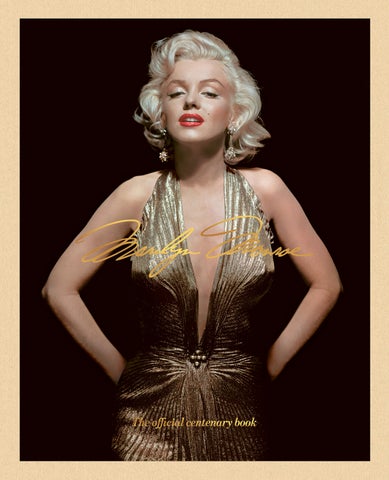
Cover image: courtesy of Blow-Up Archive
© 2026 ACC Art Books Ltd World copyright reserved ISBN: 978 1 78884 352 2 Marilyn Monroe 100 published in 2026 by ACC Art Books in association with the Marilyn Monroe Estate The right of ACC Art Books to be identified as author of this work has been asserted by them in accordance with the Copyright, Designs and Patents Act 1988 All rights reserved. No part of this publication may be reproduced, stored in a retrieval system, or transmitted in any form or by any means electronic, mechanical, photocopying, recording or otherwise, without the prior permission of the publisher A CIP catalogue record for this book is available from the British Library The author and publisher gratefully acknowledge the permission granted to reproduce the copyright material in this book. Every effort has been made to trace copyright holders and to obtain their permission for the use of copyright material. The publisher apologises for any errors or omissions in the text and would be grateful if notified of any corrections that should be incorporated in future reprints or editions of this book. Publisher: James Smith Senior Editor: Alice Bowden Designers: Mariona Vilarós Capella, Craig Holden Production Manager: Simon Walsh Reprographics Manager: Corban Wilkin EU GPSR Authorised Representative: Easy Access System Europe Oü, 16879218 Address: Mustamäe tee 50, 10621 Tallinn, Estonia Email: gpsr@easproject.com Tel: +358 40 500 3575
Printed in China by C&C Offset Printing Co. Ltd for ACC Art Books Ltd, Woodbridge, Suffolk, UK www.accartbooks.com