Contents Begin Again Hammad Nasar, Sarah Victoria Turner and Amy Tobin 08
The All and Nothing Practice of the No-Self: Li Yuan-chia and friends Nicola Simpson 28
The Beginning of the End: Li Yuan-chia’s ink painting and artistic universe Lesley Ma 36
Constellations of the Cosmic Sarah Victoria Turner 46
PLATES 1 – 13 65
Crossing Borders and Boundaries at the LYC Ysanne Holt 82
The LYC Press: Li Yuan-chia as book maker and publisher Gustavo Grandal Montero 134
The Event of Place: the LYC alongside Little Sparta and the Merz Barn Elizabeth Fisher 86
Friendship as Method Amy Tobin 156
Space | Time | Life Hammad Nasar 92
PLATES 14 – 34 113
Homesickness Luke Roberts 128
Of Cultural Ancestry Annie Jael Kwan 184
Translocality and Crafting Ecologies of Belonging: the LYC as cosmic point and an intimate aesthetics of care Diana Yeh 192
The Museum’s Message Nick Sawyer in conversation with Harriet Aspin 198
No Endings Hammad Nasar, Sarah Victoria Turner and Amy Tobin 202
A Chronology Harriet Aspin 216 Exhibitions at the LYC Harriet Aspin 220 Picture Credits 224 Additional Captions 225 Authors 226 Afterword Andrew Nairne 227 Acknowledgments 228
Fig.6 Winifred Nicholson, Roman Road (Landscape with Two Houses), 1926. Oil on canvas, 126.5 × 189.5 cm
14
Making New Worlds
Begin Again
15
Fig.6 Winifred Nicholson, Roman Road (Landscape with Two Houses), 1926. Oil on canvas, 126.5 × 189.5 cm
14
Making New Worlds
Begin Again
15
The Beginning of the End: Li Yuan-chia’s ink painting and artistic universe Lesley Ma
Li Yuan-chia’s art has often been considered enigmatic. From Guangxi, the hinterland of China, to Taipei, Bologna, London and finally Cumbria in Northern England, his trajectory was, and still is, unusual in the annals of contemporary art. A participant in modernist art groups that operated mostly outside of the mainstream, Li maintained a highly individual practice that manifested in diverse expressions, from ink abstractions and wood reliefs to participatory installations and community projects. By the early 1960s, he had identified the cosmic point, ‘the beginning and the end of everything’, as the conceptual core of his art.1 The first decade of Li’s career, from 1949 to 1962, when he was primarily making ink paintings in Taipei (Figs. 15–21), allows us to trace some of the underlying philosophies and strategies that would shape his broader art practice. A refugee of the Chinese Civil War, Li made art the centre of his life as soon as he arrived in Taipei from mainland China in 1949. A war-torn childhood and adolescence, compounded with the trauma of migration and the political uncertainty in Taiwan, shaped Li’s outlook. Graduating in 1955 from Taipei Normal College, a training ground for elementary school teachers, his time in that institution provided stability, and a network of individuals with similar backgrounds and experiences. Against the backdrop of Cold War geopolitics and the conservatism of the Nationalist government, artists like Li navigated cultural nationalism while exploring the possibilities of personal transcendence. In their spare time, Li and like-minded friends studied with Li Chung-shan (Li Zhongsheng) (1911–84), an artist with a progressive bent throughout his career from 1930s Shanghai and Tokyo to post-war Taiwan who introduced his pupils to surrealism and expressionism. Their interest in the European avant-garde stemmed both from the alternative approaches these movements offered to the stifling academic styles, and the perceived affinities to aspects of East Asian art.2 Most notably, the spirited, gestural marks in abstract paintings by artists like Wassily Kandinsky (1866–1944) struck a chord with Li and many of his peers because of their visual connections to Chinese calligraphy and ink painting. The sense of freedom conveyed in European abstraction also seemed to align with the classical ink painting style of xieyi (‘writing one’s mind’) that encouraged unbridled expressions of the artistic mind. These visual and intellectual linkages created the basis for Li and his friends to understand European modernism within
36
Fig.15: Li Yuan-chia, Untitled, 1954–61. Ink and paint on paper, 53.5 × 39.5 cm
37
44
Fig.20: Li Yuan-chia, Untitled, 1954–64. Ink and paint on paper, 54.5 × 39.3 cm
Fig.21: Li Yuan-chia, Untitled, 1954–61. Ink and paint on paper, 39 × 54 cm
45
44
Fig.20: Li Yuan-chia, Untitled, 1954–64. Ink and paint on paper, 54.5 × 39.3 cm
Fig.21: Li Yuan-chia, Untitled, 1954–61. Ink and paint on paper, 39 × 54 cm
45
12. Liliane Lijn, Cosmic Flares II, 1966. Polymer lenses on perspex in painted metal frame, lights and detachable programmed digital switching controller, 65.8 × 190 × 11.5 cm
79
12. Liliane Lijn, Cosmic Flares II, 1966. Polymer lenses on perspex in painted metal frame, lights and detachable programmed digital switching controller, 65.8 × 190 × 11.5 cm
79
The LYC Press: Li Yuan-chia as book maker and publisher Gustavo Grandal Montero
Fig.56 Li Yuan-chia, Calligraphic Book, 1963. Paint on fabric on paper, 10.5 × 46 cm
134
Alongside its extremely active exhibition programme, the LYC Museum & Art Gallery ran a major publishing operation under the imprint LYC Press. In addition to around 100 catalogues documenting every exhibition at the gallery, the museum published artists’ books, poetry, yearbooks and the magazine LYC Arts. All the publications shared a square format of 14 × 14 cm and were designed and printed by Li Yuan-chia. Publications were in fact the medium that Li used for the longest period of time in his practice, and arguably also the one in which he was the most prolific. The book allowed Li to connect different media and ideas, and bring the diverse elements in his work together. It was a versatile tool for communication and interaction, a container for words and images and a vehicle for distributing them. These publications did not just document art but often became art – distributed outside of the Museum – an alternative form putting Li’s own work and that of the LYC’s friends in the public domain, and engaging new audiences. Li’s engagement with book making and publishing predates the LYC. During his time in Italy, in the early 1960s, he produced handmade scrolls and concertinas, as well as a print portfolio. Even more significant, from the point of view of Li’s use of printed matter in his practice, are the series of books produced after his arrival in England in 1966. Li was responsible for the concept and design of the publications made to accompany his solo exhibitions at the Lisson Gallery in London. These were the first he made in the 14 cm square format, commercially printed in relatively large editions. After his move to Cumbria, he self-published catalogues for the exhibitions he organised to take place in his studio, continuing this format. Li’s involvement with printed matter stopped in 1983. This overview of books made or published by him over the previous two decades is based on a survey of three institutional collections: the John Rylands Library, Chelsea College of Arts Library and Tate Library.1
135
Fig.92 David Nash, LYC Sweepings, 1982. Charcoal and earth, unframed 27.5 × 31.5
Fig.92 David Nash, LYC Sweepings, 1982. Charcoal and earth, unframed 27.5 × 31.5
intimate aesthetics of care for his own survival and that of others. 13 This emerged from enforced journeys through discrepant modernities.14 By ‘following his work’, we might learn how to keep his legacy alive, not only by recognising his world making, but also as we ‘expand’ artistic histories by mindfully enacting our own forms of citation, which sustain his path of crafting an ecology of belonging through an ethics of care.15
i Yuan-chia, unpublished poem, c. 1968 L My research project ‘Responding to Anti-Asian Racial Violence through Community Care, Solidarity and Creative Resistance’ began in June 2020, and was funded from November 2020 by Resourcing Racial Justice, and SASS and SCC HEIF funds, City, University of London. It looks at this in more detail and builds on earlier research, ‘Becoming East and Southeast Asian: Race, Ethnicity and Youth Politics of Belonging’, funded by the British Academy in 2015. 3 Hammad Nasar, ‘Cumbrian Cosmopolitanisms: Li Yuan-chia and Friends’, British Art Studies, issue 12 (May 2019), https://doi.org/10.17658/issn.2058-5462/ issue-12/hnasar; Raymond Williams, Keywords: A Vocabulary of Culture and Society (London: Fontana, 1976), p. 76. 4 For example, his ‘extension’ of the multiples concept entailed subverting its defining principle – in the catalogue accompanying the exhibition of the work Mathematics, he wrote, ‘It is very important for you to understand that all these new works have been completely finished by my own hands’. See Diana Yeh, ‘Under the Spectre of Orientalism and Nation: Translocal Crossings and Discrepant Modernities’, in The Reception of Chinese Art Across Cultures, ed. Michelle Ying-ling Huang (Cambridge: Cambridge Scholars Publishing, 2014), pp. 228–54. See also his works and writings on 'toyart’. 5 See for example, the Black Artists and Modernism research project, and Nicola Simpson’s blog response to the Li Yuan-chia study day, Stuart Hall Library, London, 2017, https://iniva.org/blog/2017/03/10/ li-yuan-chia-study-day-stuart-hall-library-13february-2017/ 6 See George E. Marcus, ‘Ethnography in/of the World System: The Emergence of Multi-Sited Ethnography’, Annual Review of Anthropology 24 (1995), pp. 95–117. 7 Diana Yeh, ‘Utopia Beyond Cosmopolitanism: A Translocal View of Li Yuan-chia’, View Point: A 1 2
Diana Yeh
196
Retrospective of Li Yuan-chia (Taipei: Taipei Fine Arts Museum, 2015), pp. 15–69. 8 Li Yuan-chia, Water + Colour = 56/7 = Li Yuan-chia (Banks: LYC Press, 1977). 9 Ibid. 10 James Clifford ‘Traveling Cultures’ in The Cultural Geography Reader, eds. Timothy Oakes and Patricia L. Price (London: Routledge, 2008). 11 Quoted in Guy Brett, ‘Space – Life – Time’, in Li Yuan-chia: tell me what is not yet said, p. 46, ed. Guy Brett and Nick Sawyer (London: Institute of International Visual Arts, 2000), p. 147. The word ‘threat’ is used to reflect a perception in public or dominant discourse. 12 Quote marks indicate perceptions or terminologies prevalent in public or dominant discourse 13 Here I am drawing on Sara Ahmed’s work on feminist citation – see Sara Ahmed, Living a Feminist Life (Durham, NC: Duke University Press, 2017). She writes: ‘Citation is how we acknowledge our debt to those who came before; those who helped us find our way when the way was obscured because we deviated from the paths we were told to follow. In this book, I cite feminists of color who have contributed to the project of naming and dismantling the institutions of patriarchal whiteness.’ (p. 17). I have often felt my work on Li obscured as an interdisciplinary feminist scholar of colour whose work deviates by not only challenging but also flouting the discourse and disciplinary boundaries of art history. 14 See Lisa Rofel, ‘Discrepant Modernities and Their Discontents’, Positions: East Asia Cultures Critique 9, issue 3 (2001), pp. 637–49, https://doi. org/10.1215/10679847-9-3-637 15 G eorge E. Marcus, ‘Ethnography in/of the World System: The Emergence of Multi-Sited Ethnography’. Hammad Nasar, ‘Cumbrian Cosmopolitanisms: Li Yuan-chia and Friends’.
Fig.99: Li Yuan-chia, Untitled, 1993. Hand-coloured black and white print, dimensions unknown
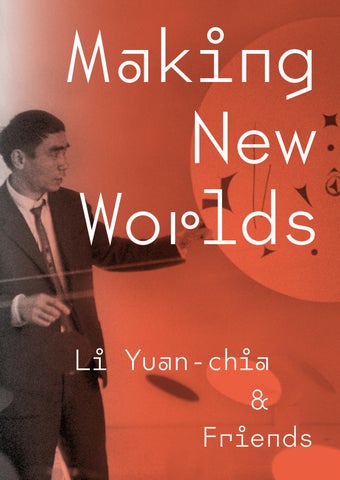
This is the first book to centre the extraordinary activity at the LYC Museum & Art Gallery in Banks, Cumbria, between 1972 and 1983. The LYC was the single-minded effort of the artist Li Yuan-chia, who moved to the rural north of England by way of London, Bologna, Taipei and Guangxi in China. In Making New Worlds: Li Yuan-chia & Friends, which accompanies an eponymous exhibition at Kettle’s Yard, the curators Hammad Nasar, Sarah Victoria Turner and Amy Tobin establish Li’s work at the LYC as a form of world making – connecting his cosmic conceptual art practice to his interest in participation and friendship as well as his engagement with nature and the landscape. Their account is accompanied by nine shorter texts, by Harriet Aspin with Nick Sawyer, Elizabeth Fisher, Ysanne Holt, Annie Jael Kwan, Lesley Ma, Gustavo Grandal Montero, Luke Roberts, Nicola Simpson and Diana Yeh, that trace the diverse threads and ramifications of Li’s work and the artists associated with the LYC. Richly illustrated, with reproductions of rarely seen archival material, Making New Worlds offers a fresh account of Li’s practice and his contribution to twentieth-century British art.
9 781904
561781