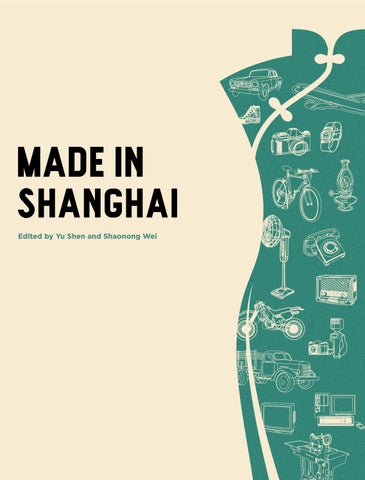
Edited by Yu Shen and Shaonong Wei
CONTENTS
6
Introduction 6
From the Trade Port to the Financial and Trade Center
14 Shanghai Manufacturing and Design under the Planned Economy 20 Shanghai Design Since the Beginning of Reform and Opening Up
34
Daily Life
116
National Image
142
Transmission and Reception
160
Export Trade
184
Communications and Transportation
01
02
03
Figure 01 The “White Chrysanthemum” trademark of Shanghai Xinhua Chemistry Industry Dyeing Factory Figure 02 The “Garden” trademark of Shanghai Foh Sing Mill Figure 03 The “Golden Rooster” trademark of Shanghai Woo Ho Weaving Factory Figure 04 The “Dapeng” trademark of Shanghai Wing On Textile Mfg. Co., Ltd.
10
04
to make a rapid return, reinvesting the capital in production. In the manufacturing processes of such products as textiles, textile printing and dyeing, food, cosmetics, cultural and sports goods, and small electrical appliances, the product design focused on the possibility of mass production and the use of technologies. While designs often copied similar Western products, logo design, brand image design, packaging design, and advertisement design greatly matured (Figure 01, 02, 03, 04). In the late 19th century and early 20th century, the national industrial manufacturers grew up at war with foreign capital. Through numerous failures, they gradually explored a set of commercial communication modes suitable for modern China, particularly for Shanghai. Shanghai manufacturing embarked on a path of rather comprehensive modern brand consciousness from the beginning. Entrepreneurs fully researched the market for foreign products, marketing methods, and brand propagation methods. With an open mind, they promoted their brands positively and openly. In addition to advertising their products in all areas of life, they made appropriate use of Chinese national sentiments and applied them skillfully to current affairs. Boycott has been a unique weapon in China’s economic history. The first movement to boycott foreign goods began after the outbreak of the Sino-Japanese War in 1894. In the long 40 years afterward, the boycott of Japanese and American products became ingrained in national consciousness, creating development opportunities for China’s long-suppressed manufacturing industry. In 1925, the Shanghai General Chamber of Commerce 11
42
The advertisement of Sean You Zoo & Co., Ltd.
1930
In 1911, Shen Jiucheng, Chen Wanyun, and Fang Zhida jointly established Sean You Zoo & Co., Ltd., whose name roughly translates as ‘three friends company’. Candlewicks, an early product of the company, was ordered largely by foreign businessmen due to the product’s high quality and low price. In 1916, the company began to produce towels with a triangular logo. In 1922, the company also successfully designed and mass produced a one-piece quilt cover. In this poster, designer Zheng Mantuo depicts an everyday scene from modern life, as characterized by the design of the bathroom in the background. Each of the company’s featured products, such as quilt covers, curtains, carpets, and sofa covers, comes with a brief introduction below the picture. Chen Wanyun also hired artists, including Ye Qianyu, to paint posters for his advertising department. At the time, Zhang Leping, writer of the famous cartoon ‘A Vagrant Life of Sanmao’, was employed as a draftsman in the advertising department of the company. 43
The Seagull 4A and Seagull 4B Cameras
1965, 1967
74
The Seagull 4B camera positioned itself
or exposure. They formed the ‘face’ of the
as a ‘staple good’, which meant it should
camera. This design was quickly imitated
be easy to operate, simple in structure,
by other domestic cameras.
clear in imaging, inexpensive, and suitable for mass production. In short, the Seagull 4B would be a ‘universal camera’. The camera was developed in 1967 and a total of 1,272,977 were sold between 1969 and 1989, with an annual maximum of 850,000. It was exported to Japan under the brand of TEXER and to Germany under KALIMAR by means of manufacturing consignment. It was uncommon to sell cameras without any changes to structure or appearance. Because of its ‘staple’ positioning, the Seagull 4B camera featured little complex modeling. Its color was black, and its machine case was made of aluminum with some textured design. As with foreign twin-lens reflex cameras, one lens was used for view finding and the other for exposure, meaning the two lens were relatively independent. However, because of branding, the two lens were designed in a figure of eight, regardless of view finding 75
The Racecar with Electronic Photographing
1980s Toys with a sense of the future were popular in an era that did much to advocate the progression of science. As the representative of speed, the racecar naturally became the subject of toy designs. The shape of this toy was characteristic of the Tu-154 aircraft, made in the Soviet Union, which had an engine in its vertical tail. At the time, China had a great number of this kind of plane, which presumably influenced the designer of this toy. Consequently, the engine at the tail emitted a red flash when the toy car was running, while the decorative horizontal lines emphasized the car’s speed.
170
The Beilei 15-Key Mini Piano
1978
The Beilei mini-piano was produced in 1935 by the Shanghai Health Industry Society, later renamed the Shanghai No.8 Toy Factory. In the late 1970s, a series of products were manufactured, reaching the standards of the international toy industry: non-toxic, and fire-proof. After 1983, the Chinese toy industry began to produce pattern-embedding products, which were popular in foreign countries, by importing advanced equipment as well as utilizing silk screen printing and photoengraving equipment. In addition, the use of new technologies, such as thermo-printing and bleaching, improved the quality of these products. The successful development of non-toxic fast-drying ink and the introduction of plywood polishing machines also ensured the quality of the wooden toys. 171
The Shangke SK640 Single-engine City Bus
early 1980s
The SK640 single-engine bus was the first vehicle to use the Jiefang chassis and engine, which would become key players in Chinese bus production. It was relatively mature in its specifications. Consequently, all of China’s early limousines were designed using this model. With a highly malleable design, the bus was one of the few vehicles that could be mass-produced. It also boasted a variety of variations, such as the group bus and the long-distance bus. After numerous designs, the fully formed SK640 came to symbolize Chinese buses entering into the new era. In the 1980s, it became the primary form of public transportation in China, especially in the south. 188
189
The C919 Mainline Airliner
2017
After the design and manufacture of the ARJ-21 regional jet, COMAC began work on a medium-to-short-range civil transport aircraft, which later became the C919 airliner. It is the first Chinese mainline plane with independent intellectual property rights under the latest international airworthiness standards. The C stands for ‘China’ as well as ‘COMAC’, the 9 means ‘forever’, while the number 19 refers to the plane’s maximum capacity – 190 passengers. As of February 26, 2018, there have been 815 orders for the plane from 28 customers. A large number of advanced composite materials and aluminium-lithium alloys were used in the C919, giving the plane a lighter weight. The design ensures that cabin noise remains 204
below 60 decibels. The C919 is also expected to reduce carbon emissions to half those of similar planes. The cockpit is equipped with four-sided windscreen glass, an advanced technology and currently only used by the latest Boeing 787s. It has a wide range of vision and a relatively small front-window opening, which simplifies the fuselage and reduces aerodynamic drag on the aircraft’s head.
205
Based on the industrial manufacturing history of Shanghai over the past 100 years, this book introduces the development of Chinese design throughout the different eras of the People’s Republic of China, from the planned economy stage to the later economic reforms and the opening up of the country to trade. We detail industrial-product design, packaging design, poster design, and other related subjects. The characteristics of each era are discussed in the following five sections: daily life, national image, transmission and reception, export trade, and communication and transportation. We approach each design from numerous perspectives, exploring its development as well as how it altered tastes and trends. These products were not just a symptom of change; they also answered social needs and spurred development, keeping China apace with production methods in Europe and giving ordinary citizens access to mass-produced luxuries like TVs, radios and cosmetics. The work of Shanghai designers was fundamental in turning China into the thriving economy we see today.
ISBN: 978-1-78884-013-2
Ă‹xHSLHSIy840132zv;:%:+:!:!
ÂŁ30.00/$40.00
www.accartbooks.com