12 6
13 7
12
13
18
Western civilization raises monsters that neither human strength nor wit can overcome, whose depredations are a thousandfold more terrible than those of the river-horse on the banks of the White Nile. Sir Alfred E. Pease, The Book of the Lion (1913)
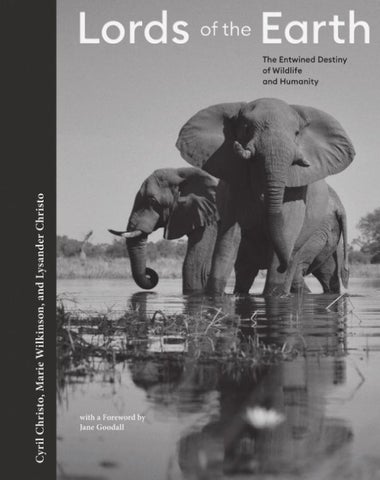
Lords of the Earth: The Entwined Destiny of Wildlife and Humanity Cyril Christo, Marie Wilkinson, and Lysander Christo
In June of 2014, while Lysander, our eight-year-old, was watching elephants from the top of our car in the Samburu reserve in northern Kenya, a baby elephant, not more than a few months old, came to us and kissed the insignia of two elephants greeting, trunks wrapped around each other, on the side of our vehicle, acknowledging that the baby recognized who she was—an elephant. It was an ecstatic moment bonding us to this innocent being, but also a fabulous affirmation of our solidarity. Was the sight of our son the catalyst for this exquisite event? Was it the presence and relative safety of the Samburu Reserve and the Samburu people who still honor the elephant that allowed such an uncanny encounter? A baby elephant once left its mother to stroke the entire length of our car in Amboseli in 2006, when Lysander was only one year old. Seven years later, a baby elephant reaffirmed its place in the world and said hello to the human species and opened its heart to those of us who can only marvel at the power and wonder this species instills in all of humankind. Kenya transfixed me, as it does so many, ever since I first set foot there at age 15 when I climbed Mount Kenya, struggling in pouring rain through the vertical bog of mud for nine straight hours. Kenya is derived from the Kikuyu word Kerenyaga, meaning mountain of splendor. To fall asleep at 13,000 feet and then the next day to be awed by the peaks of Batian and Lenana, named after Maasai medicine men, will remain the preeminent memory of youth, because to climb Mount Kenya was an immense rite of passage. Its shimmering snow, now threatened by climate change, was a challenge that formed the genesis of my fascination with Africa’s life forms. The vines dangling from the rainforest canopy at the base of the mountain, the giant lobelias glistening in the early m ountain dew like shrouds of ghosts of long-gone men, these are visions that haunt one for a lifetime. Later Marie and I would climb Kilimanjaro in June 2000, seduced by the same growths, bringing in the dawn of a new m illennium. Kilimanjaro was first discovered for Europeans by the German Lutheran missionary Johannes Rebman, who
19
thought the mountain was a cloud. He was so awestruck that he knelt and prayed to the glory of God. He saw the mountain on May 11, 1848, which was interesting for me because May 11 happens to be my birthday. He asked the locals what that substance was on the summit and they answered that whatever it was turned to water and that those who had climbed to the top had frozen their limbs in the effort. The substance could only be snow. It seems like an apparition, almost a ghost: the magnitude of that venture and its sentinel presence, like a messenger overlooking the place where man was born, transfixes one’s place on Earth forever. Between the snow and its famed glacier vanishing owing to the vagaries of an overbearing civilization, bringing once eternal waters to its elephant herds below, and the tribes and fauna at its base, Kilimanjaro is fast changing like the rest of an inimitable and increasingly fragile continent—the heart of the world. One of the most transfixing texts I have ever read on Africa was written by Henno Martin, a German native who, during World War II, survived in the wilds of Namibia for two years to avoid imprisonment. His book The Sheltering Desert published in 1983 questioned the priorities of advanced civilization. He saw firsthand what it meant to live in the wild, watching leopards and hyenas hunting and scavenging in the deserted wilderness: “The conditions of civilized life were dangerously unbalanced; they demanded primarily an antlike cooperation, yet in man there was a subconscious urge to live the life of a beast of prey. It seemed quite likely to us that one day our whole civilization would be destroyed by this contradiction.… We had slid so readily into the life of primitive hunters that we came to the conclusions that underneath the veneer modern man still had a ‘Stone-age soul’, which was difficult to reconcile with the civilized life he was leading. Could that contradiction be resolved? In view of man’s steadily increasing powers of destruction it was a vital question.” In northern Namibia, the isolated and seminomadic pastoralist “red ochre” Himba people live surrounded by the chromatic rapture of the Namib desert, whose bewitching boulders and sands are the world’s oldest, dating back 55 millions years. Ungulates like oryx and giraffes can go without water for weeks, although it seems a little bit of a miracle that they can survive at all. Despite the fact that the desert’s name means “place of no people,” the Himba are able to survive in what seems a combination of paradise and inferno. Traveling through the dry riverbeds of this region, where lions, rhinos, and elephants still roam, means moving through a landscape of utter magic. Largely avoiding the modern world, the Himba keep their goats, sheep, and cattle in enclosures called kraal, in line with their herding ethos. One fellow called Rutjani said “it does not seem strange to me that I should protect animals. I have learned to do so from my parents. If they go we will suffer a great loneliness of the spirit.” Traveling in the near-lunar landscape of Kaokoland twenty years ago, we were charged at full speed by a mother elephant accompanied by another member of her family and a calf. We had turned a corner and taken her by surprise. The other adult fled parallel to our car, escorting the calf away, while the mother bore down on us, maybe at 40 kilometers an hour, ears flailing like two mad sails. We didn’t have time to turn around and backed up as fast as we could, hoping we wouldn’t get stuck in the sands. After a few hundred yards she slowed down and eventually stopped before returning to her family. It was the closest call we had ever had. In this unforgiving, sidereal world of almost Martian beauty we watched women leading their cattle to the Kunene River on the Angolan border. It was here, on ground as sacred as memory itself, that we learned about a megadam the World Bank was slated to build, 535 feet tall, at a cost of $500 million. The Himba, who regularly pray to their holy fire, would see their way of life radically upturned by this Moloch of the modern world. For a people who depend on the humblest of seeds, seeds collected by ants underground during the rains and brought to dry above ground, this invention of technological society would assuredly doom one of the most timeless civilizations on Earth. As one elder exclaimed, “the Kunene is a living organism and needs to be protected. All will die under the water, the Baynes dam will affect us. It’s our grazing area, farming is our livelihood. Different species, wildlife, most graves will be under water.” Another elder expressed his great concern, a concern sounded all over Africa by traditional tribes whose world is being eroded by the extraction and subjugation of machine-made society. “We want to
Man is an actor. He acts all manner of men, and each one is a lie. Only the animal in him is real. William Saroyan
32
33
40
41
58
59
130
131
146
147
162
Must there then, even in Africa, be no live creature standing in direct contact with God? Isak Dinesen, Shadows on the Grass (1960)
Epilogue Cyril Christo
Alone amongst the continents, wrote Isak Dinesen, “Africa…will teach it to you: that God and the Devil are one.” We are looking for life in our solar system as far away as Pluto, but here on Earth one species, humankind, is challenging not only the megafauna of the second largest continent, Africa, but the entire global immune system of the planet and its countless species. Economic and environmental scourges are straining the social fabric among traditional tribes and pastoralists as never before. In our first book Lost Africa: The Eyes of Origin we listened to elders voice their concerns about climate change and the ravages of globalization, which have never been graver. Foreign investment in Africa, particularly from China, is coming at a great cost. Road implementation, oil exploration, lumber extraction, and the bushmeat trade in the Congo Basin threaten the rainforests across the continent. Many peoples are losing their connection to the earth and its animals, upon which folklore, myth, and their connection to the ancestors depend. Animals which were considered messengers and intermediaries from the world of the spirits are threatened as never before. The bedrock of human origins, the anima and organic tapestry invested in life’s myriad forms incarnates a much more integral and coherent relationship to existence than the mesmerizing yet shallow network of the computer-generated reality that so dominates our lives. It was Brian Eno who said something that many would consider quite startling: “There is not enough Africa in the computer.” In Africa, our connection with the larger foundation of who we are in the world is unique on Earth. It is not a more primitive continent. Africa is still a place where humanity’s anchor to its past provides an eon-old looking glass into prehistory and the organic template that formed us. It is the place that even Leonardo da Vinci in his ineffable prophecies and his concern for man’s relationship to nature wrote about when he said that “All men shall find refuge in Africa.”
163
After the devastating wars of the nineteenth century, Europe saw fit to turn to and carve up the second-largest continent, just as the Industrial Revolution was exploding and the great explorers of the Victorian age were journeying to find the source of the Nile and Africa’s deepest secrets. It is no coincidence that Africa provided a haunting refuge, a little-known alien planet in the mind of modern industrializing man. Now China has been added to the mix and continues to carve it up for the “benefits” of the capitalist juggernaut. The search for oil in the Great Lakes region of Africa, specifically in the Virunga Mountains, where the British-based oil company Soco is looking to dig for reserves in fragile mountain gorilla habitat, is indicative of how ruthless modern man’s lust for c ommodities has become. What menace will the Uganda–Tanzania oil pipeline bring its people and the rest of the organic world? Can the rainforests of Africa withstand palm oil plantations? Can the Selous survive the ravages of a dam and Tanzania’s need for electricity? Especially after the total desecration of Africa’s greatest elephant population in the second decade of this century? The lust for oil playing out between Namibia and Botswana, adjacent to the largest inland delta on Earth, the Okavango, indicates that humanity still does not respect what is at stake. The possible pollution of waters in this Eden of Africa would affect birds, ungulates, and the largest population of elephants, at over 120,000, on the entire continent. The extant Bushmen and Tswana communities would be affected as well, as their drinking water would be spoiled probably forever. We are sacrificing the “first things of life,” as Laurens van der Post warned us, the very soil that makes meaning and life irreplaceable, to obtain things that have no greater value than what the money system can confer. But these things we are so fixated on, such as oil and money and diamonds and coltan, are limited in their supply. By mining them, we undermine the ecological matrix of the world. Ultimately, we have to ask: what is the source of life? For the indigenous peoples of the world, many of whom are found in Africa, it was and still is a relation to Creation. They find the answer not by smashing atoms into each other, but by seeing into the ground of existence with the heart. Subjugation and extraction, the twin evils of modernity, continue to tear at our original home. Several years ago in South Africa, after seeing the famed white lions of Timbavati, we met an elephant researcher. She had been examining vegetation and elephant diets along their migration paths for years. One night, after the great privilege of watching a white lioness and her cub eating a kudu in the wild, we returned to camp and spoke with Michelle Henley. She told us of her concern for the elephants’ future back in 2010, before the world got wind of the elephant crisis. She believed that our ability to save what remains of Earth lies with a poetic understanding of the world, with an emotional connection to life and not just with science. Facts, figures, statistics, and algorithms were but a small part of reality and not the answer to the human dilemma. That some in Africa are willing to sacrifice the very wildlife they are paid to protect, for money, exemplifies the divide in the human heart. That some presidents are willing to sacrifice hundreds of thousands of its indigenous peoples to so-called progress, for modern dams, typifies the perfidy of human rights violations across the globe, where every week indigenous activists are killed for trying to save their environment from money, perfidy, and abject greed. Mirella Ricciardi wrote a lovely statement for us in Lost Africa that should serve as an admonition of what is at stake: “Until Africa finds her 21st century identity, until her new form emerges, her people and her land will first have to pass through the birth pangs of purgatory. The agony will last as long as is needed. In the confusion and disorientation of readjustment, human and wildlife will lose their direction, many will perish, the Earth will be badly damaged and those who survive will be changed forever.” In the recent, second phase of the elephant slaughter that took hold around the time of the global e conomic recession in 2008, some in China saw fit to make ivory emblematic of their newfound status in society. The C hinese demand for ivory and the Vietnamese demand for rhino horn have ravaged what is left of an imponderable continent. The hunger for lion bones in Laos and Vietnam desecrates the lion across the continent, just like the tiger in Asia. What the economic Moloch of modern industrial society has done in the last decade is to eradicate much of what was once the great miracle of the world: Africa’s wildlife. Every time we have been to East Africa, the cover of Time magazine highlighted the advance of robots. One piece on “Singularity” underscored the possibility that human mind and machine would meld by 2040. Mankind’s recent venture to Mars to look for life exemplifies the divide in the human condition. Is that the kind of world we want when we know next to nothing of life on Earth? There are so many questions about life on this small planet that would exceed even Darwin’s capacity for wonder. Can elephants and whales truly communicate? As we discover radical new questions about the organic world, we are ironically becoming more violent towards it. Everywhere