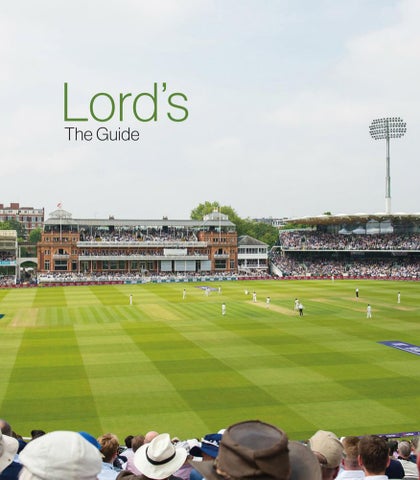
Contents Introduction 5 The Grace Gates 6 The Coronation Garden 7 Museum, Library and Archive 8 The Pavilion 12 Thomas Lord 14 The Long Room 16 The Writing Room 20 The Committee Room 22 The Dressing Rooms 24 The Roof Terrace 26 The Warner Stand 28 The Grand Stand 30 The Compton and Edrich Stands 32 The J.P. Morgan Media Centre 34 The Mound Stand 36 The Playing Area 38 The Nursery Ground 40 The Father Time Weather Vane 42 Allen Stand and Harris Garden 44 The Real Tennis Court 46
Lord’s: The Guide
lord's-aw15_OP.indd 3
3
05/03/19 08:44
4
Lord’s: The Guide
lord's-aw15_OP.indd 4
05/03/19 08:45
Inscription on the Grace Gates, erected in honour of the great cricketer, 1922. A portrait of William Gilbert Grace (1848–1915), painted by Archibald Stuart-Wortley, 1890. The greatest cricketer of his generation, Grace revolutionised the technique of batting.
The Grace Gates The W.G. Grace Gates traditionally welcome visitors to Lord’s. Erected in 1923 by the Bromsgrove Guild, they were designed by MCC’s architect Sir Herbert Baker as a memorial to the great cricketer. More than a century after his death, he remains instantly recognisable as one of the most famous of all cricketers.
Sketch of the Grace Gates by an unknown artist, 1923. The construction of the new Tavern pub and banqueting suite in 1967 meant the gates had to be moved 13 feet from their original position. 6
William Gilbert Grace was one of five brothers (three of whom played cricket for England). He burst onto the cricket scene, making his first century aged only fifteen, and went on to dominate the game for almost 40 years. He attracted serious notice at Lord’s in 1868, when he scored a brilliant century for the Gentlemen against the Players, and in 1871 he became the first cricketer ever to reach 2,000 runs in a season. In 1873 Grace was the first to achieve the double of 1,000 runs and 100 wickets in a season, a feat he achieved each year until 1878. He captained Gloucestershire for 25 years, twice leading the side to the County Championship, and played in 22 Test Matches against Australia, often as Captain. Among them was the first Test played in England in 1880, in which he scored the first Test century in England. As well as being a great cricketer, Grace was a larger-than-life character, not averse to bending the Laws when it suited him. Many of the stories told about him refusing to walk when given out are true – he knew that people had come to see him bat!
Lord’s: The Guide
lord's-aw15_OP.indd 6
05/03/19 08:45
The Coronation Garden The Coronation Garden was laid out in 1953, the year of Elizabeth II’s coronation, and is the most popular of picnic spots at Lord’s. Before play begins, rugs and baskets are laid out on the grass. From lunchtime onwards parties of Members and friends can be found enjoying the leafy surroundings, as generations of cricket watchers have done before. Several benches are dedicated to famous players. Even some trees form memorials to cricketers past, most recently the eucalyptus dedicated to the great Australian all-rounder Keith Miller. Below: Picnickers enjoying the Coronation Garden during the 2017 England v South Africa Test Match.
Right: The north-west corner of the Coronation Garden, with the Club’s famous Thomas Lord roller in the background.
Lord’s: The Guide
lord's-aw15_OP.indd 7
7
05/03/19 08:45
Museum, Library and Archive In 1864 MCC owned only two pictures when its Treasurer, Sir Spencer Ponsonby- Fane, persuaded the Committee to enhance the appearance of the Pavilion. At the latest count the Club’s collection – the biggest in the world dedicated to cricket – numbers around 80,000 items. These are housed primarily in the Archive, Library and Museum. Originally opened in 1953 by HRH the Duke of Edinburgh and the Bishop of London, the Museum was known as the Imperial Cricket Memorial Gallery. It was dedicated to those cricketers all around the globe who had given their lives in wartime.
Above: Displays on the ground floor of the MCC Museum celebrate many of the great cricketers through the history of the game. Above right: On major match days the Museum’s upstairs workroom is sometimes opened to visitors. 8
Right: Sir Alastair Cook and Graeme Swann present the 2009 Ashes winning ball to the MCC Museum. Cook took the last catch of the Ashes Series to dismiss Michael Hussey of Australia from the bowling of Graeme Swann, sealing England’s series win at The Oval.
Lord’s: The Guide
lord's-aw15_OP.indd 8
05/03/19 08:45
Right: Members enjoying the MCC Library’s facilities during the 2018 England v India Test Match. Below: Indian items on display in the Museum workroom during the 2018 England v India Test Match.
‘The Lord’s Library has been spectacularly renovated, revealing a treasure trove of information for any cricket enthusiast.’ Peter Oborne, Wounded Tiger (Simon & Schuster, 2014)
Lord’s: The Guide
lord's-aw15_OP.indd 9
9
05/03/19 08:45
The new Warner Stand, completed in 2017, filled with spectators on a Test Match day. Its height has been carefully calculated to sit well with the collection of buildings at Lord’s, particularly the Grade II* listed Pavilion.
The Warner Stand Until 1958 all spectator stands at Lord’s were identified by a letter of the alphabet, running clockwise around the Ground. What is now known as the Warner Stand was ‘A’ enclosure and amounted to no more than a few rows of covered seating. This was because the ‘coach mound’ – a raised area of grass lined with trees – stood behind it; tradition dictated that for some of the oldest fixtures visitors could watch the match from horse-drawn carriages parked there.
Demolition of the old ‘A’ enclosure in 1957 prior to the construction of the original Warner Stand, designed by Kenneth Peacock, the following year. 28
The 1950s stand was itself replaced in 2015–17, and the current construction continues an innovative tradition of architecture at Lord’s. It sports a canopy of translucent tensile fabric supported on American White Oak beams, ensuring that spectators benefit from both shade and natural light. The canopy is the first use of this kind of fabric in Europe. Both stands honoured a man whose connection with Lord’s spanned almost 70 years and is almost unparalleled in its significance and wideranging contribution to cricket. Sir Pelham ‘Plum’ Warner was a player for both Middlesex and England. He was also an influential administrator (President of MCC), Test Selector and Tour Manager on the infamous ‘Bodyline’ tour to Australia in 1932–3. Warner also made a noted literary contribution to the game. He was the author of How We Recovered the Ashes, the book that cemented cricket’s association with the Ashes, and editor of the famous Cricketer magazine from 1921 to 1962.
Lord’s: The Guide
lord's-aw15_OP.indd 28
05/03/19 08:45
Right: Pelham Warner and his MCC team for the Club’s first full overseas tour to Australia in 1903–4. Below: The magnificent roof canopy of the new Warner Stand is the latest example of innovative architectural design at Lord’s. The canopy is formed from translucent tensile fabric – the first use of this kind of fabric in Europe. Sustainability is also important, with solar thermal and photovoltaic roof panels incorporated to generate hot water and electricity.
Lord’s: The Guide
lord's-aw15_OP.indd 29
29
05/03/19 08:45
The Grand Stand The first Grand Stand to be constructed on this site was opened in 1867. It included the first dedicated accommodation for the press at Lord’s. The stand was funded by a private consortium led by MCC’s then Secretary R.A. Fitzgerald; it proved so profitable that after two years the Club opted to purchase it back. The Stand underwent many alterations and extensions during its life before it was finally demolished at the end of the 1925 season.
Above: The Grand Stand during preparations for the 2018 England v India Test Match. Right: Father Time stands above the scoreboard on Sir Herbert Baker’s Grand Stand, in a photograph from the 1966 England v West Indies Test Match. 30
MCC chose Sir Herbert Baker as the architect to design its replacement. He had already worked at Lord’s as designer of the Grace Gates (p.6) and would continue to be involved with MCC until his death in 1946. Baker made his name as a young architect in South Africa, and also worked with the renowned Edwin Lutyens in New Delhi. His new Grand Stand opened in time for the England v Australia Test Match in June 1926. It was a visually striking building, with the now famous Father Time weather vane perched above the central scoreboard (p.42). The current Grand Stand, designed by Nicholas Grimshaw, was completed in 1998. It is constructed entirely of pre-fabricated sections and has a lower terrace around 100 metres in length; the superstructure is supported on just three concrete columns. Today’s Grand Stand holds 6,200 spectators and has twenty hospitality boxes.
Lord’s: The Guide
lord's-aw15_OP.indd 30
05/03/19 08:45
‘It is greatly in its favour that it has dignity, and blends in well with the Pavilion.’ E.W. Swanton, Follow On (Collins, 1977)
Left: L’Heure du Thé by Jacques-Emile Blanche (c.1928) shows perambulation during an Eton v Harrow match. Sir Herbert Baker’s Grand Stand appears in the background. The Eton v Harrow match, first played at Lord’s in 1805, remains an annual fixture.
Below: A dramatic sunset behind the Grand Stand during a Middlesex v Essex Twenty20 match in 2017. Middlesex won by 72 runs.
Lord’s: The Guide
lord's-aw15_OP.indd 31
31
05/03/19 08:45
The J.P. Morgan Media Centre In 1999 the Lord’s skyline acquired a dramatic addition in the shape of the new Media Centre. With the Ground scheduled to host the ICC World Cup Final, it was clear that the existing media facilities, concentrated in the Warner Stand and the north turret of the Pavilion, were far from adequate to accommodate the more than 200 journalists, photographers and broadcasters expected to attend.
Above: A close-up view of the J.P. Morgan Media Centre. Prior to its construction most of the media were housed in the old Warner Stand, while the Test Match Special broadcasting box was in the north turret of the Pavilion. 34
The Nursery End offered the only possible prospect of a view from behind the bowler’s arm without disturbing the Grade II* listed Pavilion. The site came with challenges, however; the gap between the Compton and Edrich Stands was very small and access to the playing area for ground staff was still required. Clearly the new design would have to ‘float’ above the existing buildings.
The concept, created by Future Systems architects, involved a ‘pod’, constructed at the Pendennis shipyard in Cornwall and designed to rest on two reinforced concrete supports. The final Centre was widely acclaimed and won several awards, including the prestigious Stirling Prize for Architecture in 1999. Twenty years on, Lord’s prepared to host its fifth Men’s World Cup Final in 2019. The J.P. Morgan Media Centre was closed over two winter periods for refurbishment, to enable an even greater number of press to attend.
Right: MCC Chief Executive Guy Lavender in conversation with Jonathan Agnew in the Test Match Special box during the England v India Test Match in 2018.
Lord’s: The Guide
lord's-aw15_OP.indd 34
05/03/19 08:46
Right: Cleaning the window of the Test Match Special commentary box, 2017. Below: Cricket writers and journalists fill the J.P. Morgan Media Centre during the 2018 England v India Test Match. On any match day there is space for more than 100 print and online journalists, together with broadcasting studios for television and radio and a working area for photographers.
Lord’s: The Guide
lord's-aw15_OP.indd 35
35
05/03/19 08:46
England captain Heather Knight lifts the 2017 ICC Women’s World Cup as her team-mates celebrate victory in the Final at Lord’s.
48
Lord’s: The Guide
lord's-aw15_OP.indd 48
05/03/19 08:46