A HANDBOOK FOR OFFBEAT EXPLORERS, ARMCHAIR ADVENTURERS AND ADMIRERS OF THE WEIRD, MYSTERIOUS A N D FANTASTIC. A MOST PECULIAR JOURNEY.
“PETER ASHLEY SCAVENGES TO TELLING EFFECT.” Iain Sinclair
Peter Ashley is an aficionado of English culture, having collaborated on, edited and written books such as English Allsorts, Railway Rhymes, and Unmitigated England. He spins historical fact into gripping stories, and his passion for the oddities that make this nation unique presents itself on every page.
LONDON PECULIARS
A ‘Peculiar’ can be defined as something that has eccentric or individual variations to the general or predicted pattern. And, as it turns out, London is overflowing with them. This book will accompany you around the capital, guiding you from the tent-shaped tomb designed for Victorian explorer Sir Richard Burton by his widow, Isabel Arundell; to what may be the last surviving porters’ rest in London; to a stone niche by a long-demolished foundling hospital where almost 15,000 infants were discarded over the course of the 18th century. Sometimes heroic, sometimes tragic, often amusing and always unexpected, these Peculiars bring colour to the fabric of London. Whether you are a lifelong resident or a visitor passing through, adventure is guaranteed. Lose yourself in Peculiar.
LONDON PECULIARS
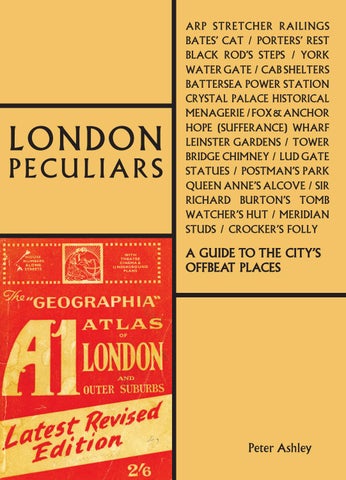
ARP STRETCHER RAILINGS BATES’ CAT / PORTERS’ REST BLACK ROD’S STEPS / YORK WATER GATE / CAB SHELTERS BATTERSEA POWER STATION CRYSTAL PALACE HISTORICAL MENAGERIE /FOX & ANCHOR HOPE (SUFFERANCE) WHARF LEINSTER GARDENS / TOWER BRIDGE CHIMNEY / LUD GATE STATUES / POSTMAN’S PARK QUEEN ANNE’S ALCOVE / SIR RICHARD BURTON’S TOMB WATCHER’S HUT / MERIDIAN STUDS / CROCKER’S FOLLY
LONDON PECULIARS
1. London Creatures
10
2. London Souls
20
3. London Trade
42
4. London Moves
60
5. London Letters
76
6. London Riverside
90
7. London Ventilating
108
8. London Miscellany
116
A GUIDE TO THE CITY’S OFFBEAT PLACES Peter Ashley
ISBN: 978-1-85149-918-2
ËxHSLIPBy499182zv&:,:*:^:& £15.00/$19.95
www.accartbooks.com
London Perculiars Jacket.indd 1
Peter Ashley
01/03/2019 10:09
I N T RO D U C T I O N Opposite: A glance down Carmelite Street revealed a regal wave from the other side of the Thames. This was a photographic mural placed on Sea Containers House to celebrate The Queen’s Diamond Jubilee in 2012. Taken by an unknown photographer at Buckingham Palace in 1977, it became the largest ever photo of the Royal Family Previous spread: Far left: The coffee bean grinder sign at Berry Bros. & Rudd. See page 48 Left: An architectural trademark transformed into bridge guardian. See page 18 Right: Virtually redundant, the line-up of telephone boxes in Carey Street at the rear of the Law Courts on the Strand Far right: The contents of this cast-iron channel above the platforms of Sloane Square Underground station is the River Westbourne, now mainly invisible except for where it decants into the Thames at Chelsea
Knowing my prediliction for these things, I was once asked by English Heritage to take photographs and write books about curiosities in the capital city. I decided to call the subject London Peculiars, getting mixed up with London Particulars, which are, of course, dense fogs obscuring everything. Peculiars they became, in the sense of “having eccentric or individual variations to the general or predicted pattern”, although a great many did indeed emerge from their past as if a fog had cleared to reveal them. This handbook is a much more manageable and completely revised version of the two originals, taking the best of both and adding more Peculiars that have subsequently manifested themselves. These things have a much wider audience now, thanks to the instant gratification of the internet. But I can look back and remember the diverse ways I came to learn of these Peculiars, and indeed still do. Sometimes they were the result of a pub conversation, sometimes even overhearing things like “Have you seen those dummy house fronts in Bayswater?” As Iain Sinclair said in his essay ‘Bright Lights on Ordinary Ghosts’ that prefaced my first volume: “He listens to rumours in pubs and he runs those rumours to ground”. Rumours became fact; unexpected discoveries were found in hidden corners; friendly cab drivers pointed down alleyways. A baroque Thames embarkation point marooned in a public park 300 feet from the river; council flat railings made from ARP wartime stretchers that I was told were an urban myth, until I found them for myself; a lion asleep on the tomb of a sadistic menagerist in a
6
7
I N T RO D U C T I O N Opposite: A glance down Carmelite Street revealed a regal wave from the other side of the Thames. This was a photographic mural placed on Sea Containers House to celebrate The Queen’s Diamond Jubilee in 2012. Taken by an unknown photographer at Buckingham Palace in 1977, it became the largest ever photo of the Royal Family Previous spread: Far left: The coffee bean grinder sign at Berry Bros. & Rudd. See page 48 Left: An architectural trademark transformed into bridge guardian. See page 18 Right: Virtually redundant, the line-up of telephone boxes in Carey Street at the rear of the Law Courts on the Strand Far right: The contents of this cast-iron channel above the platforms of Sloane Square Underground station is the River Westbourne, now mainly invisible except for where it decants into the Thames at Chelsea
Knowing my prediliction for these things, I was once asked by English Heritage to take photographs and write books about curiosities in the capital city. I decided to call the subject London Peculiars, getting mixed up with London Particulars, which are, of course, dense fogs obscuring everything. Peculiars they became, in the sense of “having eccentric or individual variations to the general or predicted pattern”, although a great many did indeed emerge from their past as if a fog had cleared to reveal them. This handbook is a much more manageable and completely revised version of the two originals, taking the best of both and adding more Peculiars that have subsequently manifested themselves. These things have a much wider audience now, thanks to the instant gratification of the internet. But I can look back and remember the diverse ways I came to learn of these Peculiars, and indeed still do. Sometimes they were the result of a pub conversation, sometimes even overhearing things like “Have you seen those dummy house fronts in Bayswater?” As Iain Sinclair said in his essay ‘Bright Lights on Ordinary Ghosts’ that prefaced my first volume: “He listens to rumours in pubs and he runs those rumours to ground”. Rumours became fact; unexpected discoveries were found in hidden corners; friendly cab drivers pointed down alleyways. A baroque Thames embarkation point marooned in a public park 300 feet from the river; council flat railings made from ARP wartime stretchers that I was told were an urban myth, until I found them for myself; a lion asleep on the tomb of a sadistic menagerist in a
6
7
THE CRYSTAL PALACE PREHISTORIC MENAGERIE THICKET ROAD, SYDENHAM
222 STRAND TEMPLE
CRYSTAL PALACE
Below: Megalosaurus. Designed and sculpted by Benjamin Waterhouse Hawkins Previous spread: “Double chips, please.” The fish that once announced a restaurant
Restored, painted and given fresh ferns to tear away at are the original prehistoric animals that were placed on this Sydenham
Below: The astounding vestibule of 222 Strand
Whilst photographing the Royal Courts of Justice on the Strand, I inadvertently stepped backwards and found a slimy flying fish staring
hillside when the Crystal Palace was re-assembled here in 1852.
at me as it flapped down a tiled wall. I was in the vestibule of the Law
The mastodon was so big that the Victorians did what they always
Courts branch of Lloyds, and looking around I was confronted by a
did when confronted by something large and exciting: 21 of them
highly polished display of Doulton ware decorative tiles and mosaics.
sat down inside it to have dinner.
Designed and painted by John H. McLennan, the majolica subjects include the grotesque fish, lions’ heads, acanthus leaves and curious
Together with a few newer friends, they line the water’s edge of a
half-naked men flexing their muscles. It’s a mix of Baroque and Islamic
small lake surrounded by thoughtfully placed paths, which facilitate
styles, conceived in 1883 not for Lloyds but for the original business
good views of them munching and silently roaring up into the trees.
here, the Palsgrove Hotel. McLennan was a star at Royal Doulton; he
I imagine that most people bringing their children here don’t realise
was still in his teens when he arrived at the Lambeth Studios in 1877 and
that the originals are over 150 years old, and not some Jurassic
only a year later he won a silver medal at an Alexandra Palace exhibition.
Park spin-off to feed the current dinosaur craze. These pale green creatures with their baleful lizard eyes are an intriguing remembrance
It’s no longer a bank, and at the time of writing the owners are
of what once stood here on one of London’s highest points, a site that
looking for a new tenant. One hopes that it will at least be a
still mourns the extinction of another dinosaur, the Crystal Palace.
restaurant again, so that these remarkable decorations can be seen in an appropriate context – preferably one serving flying fish.
12
13
THE CRYSTAL PALACE PREHISTORIC MENAGERIE THICKET ROAD, SYDENHAM
222 STRAND TEMPLE
CRYSTAL PALACE
Below: Megalosaurus. Designed and sculpted by Benjamin Waterhouse Hawkins Previous spread: “Double chips, please.” The fish that once announced a restaurant
Restored, painted and given fresh ferns to tear away at are the original prehistoric animals that were placed on this Sydenham
Below: The astounding vestibule of 222 Strand
Whilst photographing the Royal Courts of Justice on the Strand, I inadvertently stepped backwards and found a slimy flying fish staring
hillside when the Crystal Palace was re-assembled here in 1852.
at me as it flapped down a tiled wall. I was in the vestibule of the Law
The mastodon was so big that the Victorians did what they always
Courts branch of Lloyds, and looking around I was confronted by a
did when confronted by something large and exciting: 21 of them
highly polished display of Doulton ware decorative tiles and mosaics.
sat down inside it to have dinner.
Designed and painted by John H. McLennan, the majolica subjects include the grotesque fish, lions’ heads, acanthus leaves and curious
Together with a few newer friends, they line the water’s edge of a
half-naked men flexing their muscles. It’s a mix of Baroque and Islamic
small lake surrounded by thoughtfully placed paths, which facilitate
styles, conceived in 1883 not for Lloyds but for the original business
good views of them munching and silently roaring up into the trees.
here, the Palsgrove Hotel. McLennan was a star at Royal Doulton; he
I imagine that most people bringing their children here don’t realise
was still in his teens when he arrived at the Lambeth Studios in 1877 and
that the originals are over 150 years old, and not some Jurassic
only a year later he won a silver medal at an Alexandra Palace exhibition.
Park spin-off to feed the current dinosaur craze. These pale green creatures with their baleful lizard eyes are an intriguing remembrance
It’s no longer a bank, and at the time of writing the owners are
of what once stood here on one of London’s highest points, a site that
looking for a new tenant. One hopes that it will at least be a
still mourns the extinction of another dinosaur, the Crystal Palace.
restaurant again, so that these remarkable decorations can be seen in an appropriate context – preferably one serving flying fish.
12
13
THE WESTMINSTER BRIDGE LION WESTMINSTER
Opposite: Keeping watch over Westminster Bridge Below: Publicity material for the Lion Brewery
This white Coade stone lion stares imperiously out at Lambeth, an Aslan-like figure impervious to the crowds passing by his plinth. Coade stone isn’t stone at all, but a ceramic substitute manufactured in Lambeth from 1769 until 1821, initially under the auspices of the firm’s eponymous founder, Eleanor Coade. Its unique selling point was that delicate decoration could look as if it had been individually carved when it was actually mass produced, a great boon for the builders and architects of a rapidly-expanding London. So the lion is in fact an immense piece of pottery. We are often told that the ‘recipe’ for this magic substance was lost sometime after the manufacturing process was moved out of London to Stamford in Lincolnshire, but the British Museum has apparently successfully cracked the Coade Code. This isn’t the only deceptive thing about this magnificent beast. Sculpted by W.F. Woodington in 1837, he is the largest of three redpainted lions that once padded around the skyline of the Lion Brewery, which stood a little further downstream by the Charing Cross railway bridge. The brewery was blitzed in the war, and after the area was cleared in 1950 for the Festival of Britain, the site was occupied by the Royal Festival Hall. Mr. Woodington thoughtfully carved his initials and the exact date on one of the lion’s paws: ‘24th May 1837’, less than a month before Queen Victoria succeeded to the throne.
18
19
THE WESTMINSTER BRIDGE LION WESTMINSTER
Opposite: Keeping watch over Westminster Bridge Below: Publicity material for the Lion Brewery
This white Coade stone lion stares imperiously out at Lambeth, an Aslan-like figure impervious to the crowds passing by his plinth. Coade stone isn’t stone at all, but a ceramic substitute manufactured in Lambeth from 1769 until 1821, initially under the auspices of the firm’s eponymous founder, Eleanor Coade. Its unique selling point was that delicate decoration could look as if it had been individually carved when it was actually mass produced, a great boon for the builders and architects of a rapidly-expanding London. So the lion is in fact an immense piece of pottery. We are often told that the ‘recipe’ for this magic substance was lost sometime after the manufacturing process was moved out of London to Stamford in Lincolnshire, but the British Museum has apparently successfully cracked the Coade Code. This isn’t the only deceptive thing about this magnificent beast. Sculpted by W.F. Woodington in 1837, he is the largest of three redpainted lions that once padded around the skyline of the Lion Brewery, which stood a little further downstream by the Charing Cross railway bridge. The brewery was blitzed in the war, and after the area was cleared in 1950 for the Festival of Britain, the site was occupied by the Royal Festival Hall. Mr. Woodington thoughtfully carved his initials and the exact date on one of the lion’s paws: ‘24th May 1837’, less than a month before Queen Victoria succeeded to the throne.
18
19
WATCHER’S HUT, WANSTEAD OVERTON DRIVE
WANSTEAD
Opposite: The churchyard and watcher’s hut behind St. Mary’s Church on Overton Drive in Wanstead
Wanstead can easily be missed as you arrive in London off the M11 and negotiate the Redbridge roundabout. To either side of Eastern Avenue are quiet suburban streets, in and around which are many reminders of 18th-century development that took advantage of the proximity of the popular coaching route to and from Colchester. To the south are Overton Drive and the church of St. Mary the Virgin, built 1787–90 by Thomas Hardwick in precisely-jointed ashlar. Walk round to the south side and a large leafy churchyard opens up, filled with interesting tombs under the trees. And, hidden amongst the shrubberies, is this curious tapering stone sentry box, built in memory of the Wilton family in 1831. This is a watcher’s hut, where a sentry would have guarded the churchyard. This was a time of body snatchers, when fresh corpses for medical research were hard to come by unless removed from their graves at the earliest opportunity, under the cover of darkness. Corpses were invaluable for dissection in anatomy lectures, and those responsible for these unholy thefts quickly became known as ‘resurrectionists’. The only legal supply of bodies at this time were the remains of those sent to the gallows by a court. A watchman was paid to sit in the sentry box and look out for the light of a swaying lantern, and to listen for the first sharp incision of a spade into mouldering soil. The year after the arrival of this shelter, the Anatomy Act of 1832 was passed, which brought the unsavoury and ghoulish practice to an end. But what an elegant solution this is, for what is after all just an opensided hut. Imagine what we would have to put up with here today if an invasion of body snatchers became popular again. I suppose the best a night watchman could hope for would be something pressed out of durable plastic, looking rather like a Portaloo.
28
29
WATCHER’S HUT, WANSTEAD OVERTON DRIVE
WANSTEAD
Opposite: The churchyard and watcher’s hut behind St. Mary’s Church on Overton Drive in Wanstead
Wanstead can easily be missed as you arrive in London off the M11 and negotiate the Redbridge roundabout. To either side of Eastern Avenue are quiet suburban streets, in and around which are many reminders of 18th-century development that took advantage of the proximity of the popular coaching route to and from Colchester. To the south are Overton Drive and the church of St. Mary the Virgin, built 1787–90 by Thomas Hardwick in precisely-jointed ashlar. Walk round to the south side and a large leafy churchyard opens up, filled with interesting tombs under the trees. And, hidden amongst the shrubberies, is this curious tapering stone sentry box, built in memory of the Wilton family in 1831. This is a watcher’s hut, where a sentry would have guarded the churchyard. This was a time of body snatchers, when fresh corpses for medical research were hard to come by unless removed from their graves at the earliest opportunity, under the cover of darkness. Corpses were invaluable for dissection in anatomy lectures, and those responsible for these unholy thefts quickly became known as ‘resurrectionists’. The only legal supply of bodies at this time were the remains of those sent to the gallows by a court. A watchman was paid to sit in the sentry box and look out for the light of a swaying lantern, and to listen for the first sharp incision of a spade into mouldering soil. The year after the arrival of this shelter, the Anatomy Act of 1832 was passed, which brought the unsavoury and ghoulish practice to an end. But what an elegant solution this is, for what is after all just an opensided hut. Imagine what we would have to put up with here today if an invasion of body snatchers became popular again. I suppose the best a night watchman could hope for would be something pressed out of durable plastic, looking rather like a Portaloo.
28
29
34
35
34
35
ST. PANCRAS GARDENS PANCRAS ROAD
KING’S CROSS ST. PANCRAS
Opposite: The Soane family vault, complete with a Soanian dome surmounting the pillars Below: A K6 Soanian-domed telephone box Below right: The highly-Victorianised Norman church of St. Pancras
St. Pancras Gardens sit just to the north-west of St. Pancras International railway station. Originally this was the churchyard of St. Pancras Old Church, which lays claim to being one of the earliest Christian sites in the country. These days it’s more of a park for Camden dog walkers, but although the tombs are now somewhat sparse, there is one that still has an echo through to our times. Architect Sir John Soane designed a vault for his wife in 1815, which, before his own interment in 1837, also became the grave of his eldest son. The roof is a classic Soanian dome, which in the 1920s became a great influence on Sir Giles Gilbert Scott’s new red telephone boxes, one of the finest pieces of industrial design. In 1866, the Midland Railway needed to appropriate a section of the churchyard for their lines into St. Pancras station, and another architect, Arthur Blomfield, deputed one of his staff to superintend the respectful removal of many hundreds of coffins and bones.This was Thomas Hardy, who later wrote of the experience in his poem The Levelled Churchyard: ‘We late-lamented, resting here, / Are mixed to human jam’. Indeed both Hardy and Blomfield witnessed a coffin breaking open to reveal one skeleton and two skulls.
36
37
ST. PANCRAS GARDENS PANCRAS ROAD
KING’S CROSS ST. PANCRAS
Opposite: The Soane family vault, complete with a Soanian dome surmounting the pillars Below: A K6 Soanian-domed telephone box Below right: The highly-Victorianised Norman church of St. Pancras
St. Pancras Gardens sit just to the north-west of St. Pancras International railway station. Originally this was the churchyard of St. Pancras Old Church, which lays claim to being one of the earliest Christian sites in the country. These days it’s more of a park for Camden dog walkers, but although the tombs are now somewhat sparse, there is one that still has an echo through to our times. Architect Sir John Soane designed a vault for his wife in 1815, which, before his own interment in 1837, also became the grave of his eldest son. The roof is a classic Soanian dome, which in the 1920s became a great influence on Sir Giles Gilbert Scott’s new red telephone boxes, one of the finest pieces of industrial design. In 1866, the Midland Railway needed to appropriate a section of the churchyard for their lines into St. Pancras station, and another architect, Arthur Blomfield, deputed one of his staff to superintend the respectful removal of many hundreds of coffins and bones.This was Thomas Hardy, who later wrote of the experience in his poem The Levelled Churchyard: ‘We late-lamented, resting here, / Are mixed to human jam’. Indeed both Hardy and Blomfield witnessed a coffin breaking open to reveal one skeleton and two skulls.
36
37
BERRY BROS. & RUDD ST. JAMES’S STREET
GREEN PARK
Opposite: One of the window shutters in Pickering Place Below: The alley leading to Pickering Place
It’s very easy to walk past Pickering Place without noticing it’s there. I only spotted it because a chap came out onto St. James’s Street like someone striding out of a brick wall in a Harry Potter film. It is very narrow, opening into London’s smallest square, where the last duel in England was fought. But that’s not the Peculiar. Going back down the alley, I noticed that the walls were lined with glossily-painted wooden panels. Closer inspection revealed that some of them had dissected parts of lettering on them in signwriters’ gilt: the same style that graces the frontage of Berry Bros. & Rudd, next door at No. 3 St. James’s Street. I assumed that they were doors to some additional storage space. Berry Bros. can trace its history back to 1698, making it undisputedly one of the oldest wine merchants in the world, although the sign tells of a previous business as a grocer selling teas and coffees. The cellars spread out underground as far as Pall Mall; at 8,000 square feet, they are the largest working cellars in London. That’s space for 10,000 bottles. But this is no off-licence; you don’t come in here and ask for a bottle of Blue Nun, as evidenced by the sloping wooden floors, oak panelled walls and a curious sit-on weighing machine that has endured the likes of Byron, Evelyn Waugh, Churchill and a naked Beau Brummell (he insisted on this déshabillé so that the measuring would be accurate). On the pretext of checking the case rate on some obscure Burgundy, I asked about the wooden-lined alley next door. ‘They are our window shutters, sir.’ What a wonderful thing: heavy boards daubed in countless coats of dark green paint, slid in order into grooves running down the alley. Sadly, they’re not used on the windows now, but they are still a Peculiar worth searching for. And do seek out the shop; although now mainly based at 63 Pall Mall on the corner, the original is still there to be seen at 3 St. James’s Street.
48
49
BERRY BROS. & RUDD ST. JAMES’S STREET
GREEN PARK
Opposite: One of the window shutters in Pickering Place Below: The alley leading to Pickering Place
It’s very easy to walk past Pickering Place without noticing it’s there. I only spotted it because a chap came out onto St. James’s Street like someone striding out of a brick wall in a Harry Potter film. It is very narrow, opening into London’s smallest square, where the last duel in England was fought. But that’s not the Peculiar. Going back down the alley, I noticed that the walls were lined with glossily-painted wooden panels. Closer inspection revealed that some of them had dissected parts of lettering on them in signwriters’ gilt: the same style that graces the frontage of Berry Bros. & Rudd, next door at No. 3 St. James’s Street. I assumed that they were doors to some additional storage space. Berry Bros. can trace its history back to 1698, making it undisputedly one of the oldest wine merchants in the world, although the sign tells of a previous business as a grocer selling teas and coffees. The cellars spread out underground as far as Pall Mall; at 8,000 square feet, they are the largest working cellars in London. That’s space for 10,000 bottles. But this is no off-licence; you don’t come in here and ask for a bottle of Blue Nun, as evidenced by the sloping wooden floors, oak panelled walls and a curious sit-on weighing machine that has endured the likes of Byron, Evelyn Waugh, Churchill and a naked Beau Brummell (he insisted on this déshabillé so that the measuring would be accurate). On the pretext of checking the case rate on some obscure Burgundy, I asked about the wooden-lined alley next door. ‘They are our window shutters, sir.’ What a wonderful thing: heavy boards daubed in countless coats of dark green paint, slid in order into grooves running down the alley. Sadly, they’re not used on the windows now, but they are still a Peculiar worth searching for. And do seek out the shop; although now mainly based at 63 Pall Mall on the corner, the original is still there to be seen at 3 St. James’s Street.
48
49
HOOVER BUILDING
This is ’30s Art Deco architecture at its finest. Designed in 1931-5 by
WESTERN AVENUE, PERIVALE
most offensive of the modernistic atrocities along this road of typical
PERIVALE
Wallis, Gilbert & Partners, Nikolaus Pevsner said it was ‘Perhaps the bypass factories’ 20 years after it was built. Few would agree with this condemnation now, particularly as the similar and nearby Firestone tyre factory, by the same architects, was illegally bulldozed in 1980. If the sun’s out, I can’t go by it on the A40 out of London without stopping and photographing it again, thinking of all those sleek saloons careening out to Chiltern country houses in the ’30s, the driver perhaps giving it a cursory glance but his passenger thinking ‘Actually, we need a Hoover vacuum cleaner’. What looks like an
Right: Advertisement for a Hoover Model 50 Cylinder Cleaner Below: Main factory frontage
50
aerodrome terminal (page 42) is in fact the canteen, designed by J.W. MacGregor in 1938, and behind the main Hoover Building frontage is now a cleverly-positioned Tesco superstore. Every little helps.
51
HOOVER BUILDING
This is ’30s Art Deco architecture at its finest. Designed in 1931-5 by
WESTERN AVENUE, PERIVALE
most offensive of the modernistic atrocities along this road of typical
PERIVALE
Wallis, Gilbert & Partners, Nikolaus Pevsner said it was ‘Perhaps the bypass factories’ 20 years after it was built. Few would agree with this condemnation now, particularly as the similar and nearby Firestone tyre factory, by the same architects, was illegally bulldozed in 1980. If the sun’s out, I can’t go by it on the A40 out of London without stopping and photographing it again, thinking of all those sleek saloons careening out to Chiltern country houses in the ’30s, the driver perhaps giving it a cursory glance but his passenger thinking ‘Actually, we need a Hoover vacuum cleaner’. What looks like an
Right: Advertisement for a Hoover Model 50 Cylinder Cleaner Below: Main factory frontage
50
aerodrome terminal (page 42) is in fact the canteen, designed by J.W. MacGregor in 1938, and behind the main Hoover Building frontage is now a cleverly-positioned Tesco superstore. Every little helps.
51
LIBERTY
TWININGS
GREAT MARLBOROUGH STREET OXFORD CIRCUS THE LEE, BUCKS. GREAT MISSENDEN
216 STRAND
Below left: Liberty store in Great Marlborough Street Below right: The Admiral Howe figurehead from HMS Impregnable, now at The Lee in Buckinghamshire
It is perhaps well-known that the Liberty store just off Regent Street was built in 1922-24, utilising the timbers from two Royal Navy
TEMPLE
Twinings’ flagship shop, still at the Golden Lyon
Opposite the Law Courts on the Strand is the original Twinings shop, where you can still buy fine teas (including the evocatively named
warships: HMS Impregnable and HMS Hindustan. The former was the
‘English Breakfast’, so redolent of a crisply folded newspaper and
last wooden warship built, commissioned in the 1860s and formerly
the aroma of pipe tobacco) and fruit and herb infusions. The two
called HMS Howe after Admiral of the Fleet, Lord Howe (1726-
Chinese men and the lion are made from that ubiquitous material,
99). The figurehead was taken to The Lee in Buckinghamshire and
Coade stone (see the South Bank Lion on Westminster Bridge,
erected outside the back entrance to the Manor, home of Captain Ivor
pages 18-19), and have lounged above the shop door since 1787.
Stewart-Liberty. On his death in 1952, it was moved to Pipers, where
The lion, commissioned by Richard Twining, the founder’s grandson,
it could be seen at the gate, until more recently when it was housed
reminds us of the original Twinings store: The Golden Lyon of 1707.
in a wooden shed.
Richard Twining had persuaded William Pitt to reduce the Surrender Tax on tea, which at this time was exclusively imported from China,
My father told me that not long after its original positioning by the
hence the arrival of these beautifully-painted figures.
road, he rode his bicycle up from Great Missenden station and
58
ended up in the ditch in fright, having seen this be-wigged head
Twinings has the oldest commercial logo still in use. Here in the flagship
staring at him. His acetylene bike lamp went out and refused to
store you can sample flavours at the Loose Tea Bar, experience a
re-light, and he continued his way in the dark to Lee Common,
masterclass with a Tea Ambassador, or make sure you’re well
doubtless wondering what he had actually witnessed.
stocked-up with Earl Grey, Lady Grey, or a Salted Caramel infusion.
59
LIBERTY
TWININGS
GREAT MARLBOROUGH STREET OXFORD CIRCUS THE LEE, BUCKS. GREAT MISSENDEN
216 STRAND
Below left: Liberty store in Great Marlborough Street Below right: The Admiral Howe figurehead from HMS Impregnable, now at The Lee in Buckinghamshire
It is perhaps well-known that the Liberty store just off Regent Street was built in 1922-24, utilising the timbers from two Royal Navy
TEMPLE
Twinings’ flagship shop, still at the Golden Lyon
Opposite the Law Courts on the Strand is the original Twinings shop, where you can still buy fine teas (including the evocatively named
warships: HMS Impregnable and HMS Hindustan. The former was the
‘English Breakfast’, so redolent of a crisply folded newspaper and
last wooden warship built, commissioned in the 1860s and formerly
the aroma of pipe tobacco) and fruit and herb infusions. The two
called HMS Howe after Admiral of the Fleet, Lord Howe (1726-
Chinese men and the lion are made from that ubiquitous material,
99). The figurehead was taken to The Lee in Buckinghamshire and
Coade stone (see the South Bank Lion on Westminster Bridge,
erected outside the back entrance to the Manor, home of Captain Ivor
pages 18-19), and have lounged above the shop door since 1787.
Stewart-Liberty. On his death in 1952, it was moved to Pipers, where
The lion, commissioned by Richard Twining, the founder’s grandson,
it could be seen at the gate, until more recently when it was housed
reminds us of the original Twinings store: The Golden Lyon of 1707.
in a wooden shed.
Richard Twining had persuaded William Pitt to reduce the Surrender Tax on tea, which at this time was exclusively imported from China,
My father told me that not long after its original positioning by the
hence the arrival of these beautifully-painted figures.
road, he rode his bicycle up from Great Missenden station and
58
ended up in the ditch in fright, having seen this be-wigged head
Twinings has the oldest commercial logo still in use. Here in the flagship
staring at him. His acetylene bike lamp went out and refused to
store you can sample flavours at the Loose Tea Bar, experience a
re-light, and he continued his way in the dark to Lee Common,
masterclass with a Tea Ambassador, or make sure you’re well
doubtless wondering what he had actually witnessed.
stocked-up with Earl Grey, Lady Grey, or a Salted Caramel infusion.
59
LONDON MOVES
60
61
LONDON MOVES
60
61
HEATH ROAD, TWICKENHAM TWICKENHAM
Opposite and previous spread: A brief moment in the sun for a painted wall sign after a poster hoarding was removed Below: A 1950s Armstrong Siddeley
It’s a little unfair to include this great rarity, because it was very quickly painted over and probably obliterated forever. Like many London ghost signs though, could it suddenly reappear, as it did for me? These automobile names from the distant past (with the obvious exception of Vauxhall) had a few brief moments in the sun when a poster hoarding was taken down on the corner of Tennyson Avenue. This remarkable sign must have been painted before the Second World War. Surviving virtually intact under all those exhortations to buy baked beans and washing powder, the clue to the date comes from ‘Terraplane’, a product of the American Hudson Motor Company, which last produced a car under this stand-alone name in 1937. The other names are a roll-call of now vanished stalwarts of the British motor industry: Standard, Riley, Singer and the posh Armstrong Siddeley.
78
79
HEATH ROAD, TWICKENHAM TWICKENHAM
Opposite and previous spread: A brief moment in the sun for a painted wall sign after a poster hoarding was removed Below: A 1950s Armstrong Siddeley
It’s a little unfair to include this great rarity, because it was very quickly painted over and probably obliterated forever. Like many London ghost signs though, could it suddenly reappear, as it did for me? These automobile names from the distant past (with the obvious exception of Vauxhall) had a few brief moments in the sun when a poster hoarding was taken down on the corner of Tennyson Avenue. This remarkable sign must have been painted before the Second World War. Surviving virtually intact under all those exhortations to buy baked beans and washing powder, the clue to the date comes from ‘Terraplane’, a product of the American Hudson Motor Company, which last produced a car under this stand-alone name in 1937. The other names are a roll-call of now vanished stalwarts of the British motor industry: Standard, Riley, Singer and the posh Armstrong Siddeley.
78
79
FOX & ANCHOR
DOG & DUCK
CHARTERHOUSE STREET
BATEMAN STREET
FARRINGDON
Sunlight and shadow in the Fox & Anchor porch
The Fox & Anchor is a classic late Victorian pub with mahogany doors, etched glass and the ghosts of market porters who once
TOTTENHAM COURT ROAD
A superbly florid exhortation to drink seltzer at the Dog & Duck
In a classic narrow Soho pub, this mirror dominates the wall opposite the bar. There was once a vogue for reproducing pub mirrors, but
swung in from Smithfield Market. A little bit posher now, with
they could never compare to this glorious original for Struve’s
‘boutique bedrooms’, on this day the porch was as remarkable
Brighton Seltzer. John Constable and Dante Gabriel Rossetti drank
for the tricks that low winter sunshine plays as it seeks its way to
at this bar, but since the present building was only built in 1897, we
highlight forgotten corners, as it was for the beautiful Art Nouveau
should really perhaps mention author George Orwell and chanteuse
tiling. Probably made by Doulton’s down in Lambeth, the richness
Madonna.
of colour and design still appears as fresh as the day the pub furnishers carefully fitted the tiles into place.
80
81
FOX & ANCHOR
DOG & DUCK
CHARTERHOUSE STREET
BATEMAN STREET
FARRINGDON
Sunlight and shadow in the Fox & Anchor porch
The Fox & Anchor is a classic late Victorian pub with mahogany doors, etched glass and the ghosts of market porters who once
TOTTENHAM COURT ROAD
A superbly florid exhortation to drink seltzer at the Dog & Duck
In a classic narrow Soho pub, this mirror dominates the wall opposite the bar. There was once a vogue for reproducing pub mirrors, but
swung in from Smithfield Market. A little bit posher now, with
they could never compare to this glorious original for Struve’s
‘boutique bedrooms’, on this day the porch was as remarkable
Brighton Seltzer. John Constable and Dante Gabriel Rossetti drank
for the tricks that low winter sunshine plays as it seeks its way to
at this bar, but since the present building was only built in 1897, we
highlight forgotten corners, as it was for the beautiful Art Nouveau
should really perhaps mention author George Orwell and chanteuse
tiling. Probably made by Doulton’s down in Lambeth, the richness
Madonna.
of colour and design still appears as fresh as the day the pub furnishers carefully fitted the tiles into place.
80
81
YORK WATER GATE VICTORIA EMBANKMENT GARDENS
EMBANKMENT
Previous spread: Nautical decoration on the north side, opposite Buckingham Street Opposite: Stranded high and dry in Victoria Embankment Gardens
On John Roque’s map of Georgian London, Buckingham Street is shown coming down to the River Thames from the Strand, finishing at the stairs of the York buildings, at the water’s edge. The engraved lines of the rippling river can be seen lapping at an indication of steps running down into the water. Here was built an archway to provide an embarkation point from the gardens of the Duke of Buckingham’s mansion, built in the same year, 1626. It was left standing when the house was demolished 50 years later, and it is still there, a wonderful showpiece for the baroque with lots of rustication and sculptured nauticalia. This isn’t a building that’s been taken down piece-by-piece and removed from the river’s edge to become an agreeable diversion in a public park. Here it’s the river that moved. The York Water Gate is exactly where it’s always been, its present position explained by Sir Joseph Bazalgette’s construction of the Victoria Embankment between 1864-70, which created a new shoreline 330 feet away and housed both a new sewer and the underground railway. If one ignores the incongruous plant pots in front of it, something of its busy grandeur still remains in the shadow of the trees. One can imagine the shouts from watermen as they jostled for position, the flashing of brightly coloured silks as the Duke of Buckingham and his entourage promenaded their way onto a decorative barge.
92
93
YORK WATER GATE VICTORIA EMBANKMENT GARDENS
EMBANKMENT
Previous spread: Nautical decoration on the north side, opposite Buckingham Street Opposite: Stranded high and dry in Victoria Embankment Gardens
On John Roque’s map of Georgian London, Buckingham Street is shown coming down to the River Thames from the Strand, finishing at the stairs of the York buildings, at the water’s edge. The engraved lines of the rippling river can be seen lapping at an indication of steps running down into the water. Here was built an archway to provide an embarkation point from the gardens of the Duke of Buckingham’s mansion, built in the same year, 1626. It was left standing when the house was demolished 50 years later, and it is still there, a wonderful showpiece for the baroque with lots of rustication and sculptured nauticalia. This isn’t a building that’s been taken down piece-by-piece and removed from the river’s edge to become an agreeable diversion in a public park. Here it’s the river that moved. The York Water Gate is exactly where it’s always been, its present position explained by Sir Joseph Bazalgette’s construction of the Victoria Embankment between 1864-70, which created a new shoreline 330 feet away and housed both a new sewer and the underground railway. If one ignores the incongruous plant pots in front of it, something of its busy grandeur still remains in the shadow of the trees. One can imagine the shouts from watermen as they jostled for position, the flashing of brightly coloured silks as the Duke of Buckingham and his entourage promenaded their way onto a decorative barge.
92
93
BATTERSEA POWER STATION QUEENSTOWN ROAD
BATTERSEA PARK
The classic silhouette from Grosvenor Road on the north bank of the Thames
I once regularly saw this vast London Peculiar from a train slowing-up across the Thames as it approached Victoria station. It was always so sad to see it deteriorating from neglect, the interior torn apart and
HAMMERSMITH BRIDGE HAMMERSMITH
Below: Detail of a bridge pylon decoration Below right: Lyle’s Golden Syrup label
This is the second bridge to stand here; the first suffered from thousands of people rushing from one side to the other during the University Boat Race, of which this is the mid-point. Bazalgette’s
the cranes that once lifted coal from barges leaning over the water
replacement design raided the style catalogue for castles and
like skeletal herons. What I didn’t realise was that Battersea was
portcullises, horses and lions, crowns and sea shells and many,
originally two power stations – one two-chimney structure built in the
many oak leaves. The real Peculiar though, for me, is that its
1930s and another identical one in the ’50s that gave it the fantastic
construction (1883-7) coincides with the arrival in grocers’ shops
four-chimney outline. The exterior was designed by Sir Giles Gilbert
of Lyle’s Golden Syrup. Surely either architect or tin designer were
Scott (phone boxes, Liverpool Cathedral) and is still the largest brick
suddenly impressed with the other’s idea of a gold and green finish.
structure in Europe. Since its decommissioning in 1983, successive
These are the original colours for the bridge, being reinstated in a
developers have been and gone, but now it does appear to be coming
2000 renovation after an IRA bomb attack.
back to life, albeit with the views now disturbed by the steel and glass apartments of Power Station Park. The chimneys were in such a bad state that they were taken down and rebuilt. What a temple to industry this would have made: the turbine hall once again humming with giant dynamos and lit with arcing flashes of electricity (I imagine), showing us just how awe-inspiring these powerhouses once were.
94
The bridge from the Hammersmith shore
95
BATTERSEA POWER STATION QUEENSTOWN ROAD
BATTERSEA PARK
The classic silhouette from Grosvenor Road on the north bank of the Thames
I once regularly saw this vast London Peculiar from a train slowing-up across the Thames as it approached Victoria station. It was always so sad to see it deteriorating from neglect, the interior torn apart and
HAMMERSMITH BRIDGE HAMMERSMITH
Below: Detail of a bridge pylon decoration Below right: Lyle’s Golden Syrup label
This is the second bridge to stand here; the first suffered from thousands of people rushing from one side to the other during the University Boat Race, of which this is the mid-point. Bazalgette’s
the cranes that once lifted coal from barges leaning over the water
replacement design raided the style catalogue for castles and
like skeletal herons. What I didn’t realise was that Battersea was
portcullises, horses and lions, crowns and sea shells and many,
originally two power stations – one two-chimney structure built in the
many oak leaves. The real Peculiar though, for me, is that its
1930s and another identical one in the ’50s that gave it the fantastic
construction (1883-7) coincides with the arrival in grocers’ shops
four-chimney outline. The exterior was designed by Sir Giles Gilbert
of Lyle’s Golden Syrup. Surely either architect or tin designer were
Scott (phone boxes, Liverpool Cathedral) and is still the largest brick
suddenly impressed with the other’s idea of a gold and green finish.
structure in Europe. Since its decommissioning in 1983, successive
These are the original colours for the bridge, being reinstated in a
developers have been and gone, but now it does appear to be coming
2000 renovation after an IRA bomb attack.
back to life, albeit with the views now disturbed by the steel and glass apartments of Power Station Park. The chimneys were in such a bad state that they were taken down and rebuilt. What a temple to industry this would have made: the turbine hall once again humming with giant dynamos and lit with arcing flashes of electricity (I imagine), showing us just how awe-inspiring these powerhouses once were.
94
The bridge from the Hammersmith shore
95
TRAFALGAR SQUARE EX-POLICE POST CHARING CROSS
Opposite: The pigeon-haunted kiosk on the south-east corner of Trafalgar Square Below: The blue police post in Eastcheap, now removed
Auxiliary police stations have all but disappeared from the London scene. Once, the Metropolitan copper on the beat kept in touch with his nick from strategically-placed miniature offices. The police box crowned with its flashing blue light is still familiar to us, but only because it’s the transport-of-choice for Doctor Who. The evidence can still be found of some of these outposts, and here in the south-east corner of Trafalgar Square is a particularly welldisguised example. Its interior is inside one of four lamp pillars that sit at the extremities of the square. There’s just about room for an averaged-sized policeman and his truncheon, but on my visit I was disappointed to find the lantern base now functions as a refuge for the Square’s cleaners and their newspapers.The polygonal bronze lantern is not, as London myth would have it, one of a series taken from Nelson’s flagship HMS Victory, but the panopticon design is unique to the lamps in the square, believed by its designer to provide, like a diamond, more light from its multiple refraction. Once upon a time in Eastcheap there stood a perfect example of a simple column that once held a telephone for use by constables on their beats in the City of London (left). An incoming calI set the little light flashing on and off to alert them. Sadly, it was removed and all that was left was a little patch of tarmac on the pavement. I wonder why it couldn’t have been left there; even if it was no longer required for police duties, its purpose could have been set out on a little plaque for the future education of those who grew up without these unassuming but bright little pieces of street furniture.
130
131
TRAFALGAR SQUARE EX-POLICE POST CHARING CROSS
Opposite: The pigeon-haunted kiosk on the south-east corner of Trafalgar Square Below: The blue police post in Eastcheap, now removed
Auxiliary police stations have all but disappeared from the London scene. Once, the Metropolitan copper on the beat kept in touch with his nick from strategically-placed miniature offices. The police box crowned with its flashing blue light is still familiar to us, but only because it’s the transport-of-choice for Doctor Who. The evidence can still be found of some of these outposts, and here in the south-east corner of Trafalgar Square is a particularly welldisguised example. Its interior is inside one of four lamp pillars that sit at the extremities of the square. There’s just about room for an averaged-sized policeman and his truncheon, but on my visit I was disappointed to find the lantern base now functions as a refuge for the Square’s cleaners and their newspapers.The polygonal bronze lantern is not, as London myth would have it, one of a series taken from Nelson’s flagship HMS Victory, but the panopticon design is unique to the lamps in the square, believed by its designer to provide, like a diamond, more light from its multiple refraction. Once upon a time in Eastcheap there stood a perfect example of a simple column that once held a telephone for use by constables on their beats in the City of London (left). An incoming calI set the little light flashing on and off to alert them. Sadly, it was removed and all that was left was a little patch of tarmac on the pavement. I wonder why it couldn’t have been left there; even if it was no longer required for police duties, its purpose could have been set out on a little plaque for the future education of those who grew up without these unassuming but bright little pieces of street furniture.
130
131
LEINSTER GARDENS BAYSWATER
Opposite: 23-24 Leinster Gardens, the houses that are all front
The postman knocks in vain at the doors of 23-24 Leinster Gardens, where the glass and woodwork of sightless windows are only grey and white paint. No twitching curtains, no lamps lit at dusk – what you see here is literally all there is. In the late 1860s, the Metropolitan Railway extended their operations west from Edgware Road to Gloucester Road. Early underground railway engineering was ‘cut-and-cover’, which meant that instead of deep tube tunnelling, cuttings were excavated at the surface and then covered over. This method facilitated a wider, airier environment, essential when the locomotive power was still steam engines. So the Metropolitan cut and covered its way through the quiet streets of Paddington and Bayswater, fully expecting to pull down a section of stuccoed terrace in Leinster Gardens. But the locals were enraged that their street should suffer such an indignity and demanded that the frontages of the houses concerned should be retained, keeping up appearances at street level. So now the trains serving the District and Circle Lines trundle underneath, their passengers unaware of the film set above their heads. Up in Leinster Gardens, one of the two hotels next door joins in on the fun by extending their balcony flowers in front of the neighbouring trompe l’œil windows. Probationers at Paddington Green Police Station are allegedly sent round to them in order to conduct spurious enquiries, whilst presumably senior officers hide around the corner sniggering.
132
133
LEINSTER GARDENS BAYSWATER
Opposite: 23-24 Leinster Gardens, the houses that are all front
The postman knocks in vain at the doors of 23-24 Leinster Gardens, where the glass and woodwork of sightless windows are only grey and white paint. No twitching curtains, no lamps lit at dusk – what you see here is literally all there is. In the late 1860s, the Metropolitan Railway extended their operations west from Edgware Road to Gloucester Road. Early underground railway engineering was ‘cut-and-cover’, which meant that instead of deep tube tunnelling, cuttings were excavated at the surface and then covered over. This method facilitated a wider, airier environment, essential when the locomotive power was still steam engines. So the Metropolitan cut and covered its way through the quiet streets of Paddington and Bayswater, fully expecting to pull down a section of stuccoed terrace in Leinster Gardens. But the locals were enraged that their street should suffer such an indignity and demanded that the frontages of the houses concerned should be retained, keeping up appearances at street level. So now the trains serving the District and Circle Lines trundle underneath, their passengers unaware of the film set above their heads. Up in Leinster Gardens, one of the two hotels next door joins in on the fun by extending their balcony flowers in front of the neighbouring trompe l’œil windows. Probationers at Paddington Green Police Station are allegedly sent round to them in order to conduct spurious enquiries, whilst presumably senior officers hide around the corner sniggering.
132
133
A HANDBOOK FOR OFFBEAT EXPLORERS, ARMCHAIR ADVENTURERS AND ADMIRERS OF THE WEIRD, MYSTERIOUS A N D FANTASTIC. A MOST PECULIAR JOURNEY.
“PETER ASHLEY SCAVENGES TO TELLING EFFECT.” Iain Sinclair
Peter Ashley is an aficionado of English culture, having collaborated on, edited and written books such as English Allsorts, Railway Rhymes, and Unmitigated England. He spins historical fact into gripping stories, and his passion for the oddities that make this nation unique presents itself on every page.
LONDON PECULIARS
A ‘Peculiar’ can be defined as something that has eccentric or individual variations to the general or predicted pattern. And, as it turns out, London is overflowing with them. This book will accompany you around the capital, guiding you from the tent-shaped tomb designed for Victorian explorer Sir Richard Burton by his widow, Isabel Arundell; to what may be the last surviving porters’ rest in London; to a stone niche by a long-demolished foundling hospital where almost 15,000 infants were discarded over the course of the 18th century. Sometimes heroic, sometimes tragic, often amusing and always unexpected, these Peculiars bring colour to the fabric of London. Whether you are a lifelong resident or a visitor passing through, adventure is guaranteed. Lose yourself in Peculiar.
LONDON PECULIARS
ARP STRETCHER RAILINGS BATES’ CAT / PORTERS’ REST BLACK ROD’S STEPS / YORK WATER GATE / CAB SHELTERS BATTERSEA POWER STATION CRYSTAL PALACE HISTORICAL MENAGERIE /FOX & ANCHOR HOPE (SUFFERANCE) WHARF LEINSTER GARDENS / TOWER BRIDGE CHIMNEY / LUD GATE STATUES / POSTMAN’S PARK QUEEN ANNE’S ALCOVE / SIR RICHARD BURTON’S TOMB WATCHER’S HUT / MERIDIAN STUDS / CROCKER’S FOLLY
LONDON PECULIARS
1. London Creatures
10
2. London Souls
20
3. London Trade
42
4. London Moves
60
5. London Letters
76
6. London Riverside
90
7. London Ventilating
108
8. London Miscellany
116
A GUIDE TO THE CITY’S OFFBEAT PLACES Peter Ashley
ISBN: 978-1-85149-918-2
ËxHSLIPBy499182zv&:,:*:^:& £15.00/$19.95
www.accartbooks.com
London Perculiars Jacket.indd 1
Peter Ashley
01/03/2019 10:09