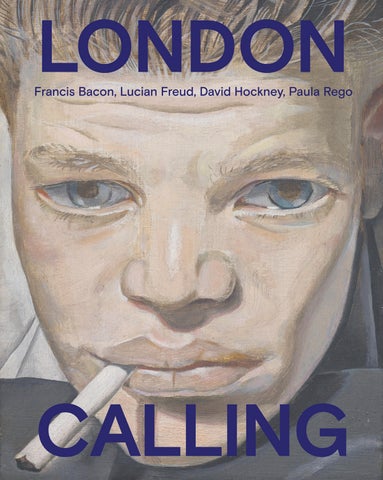
Foreword London Calling The School of London and Modern British Painting
Elena Crippa & Thijs de Raedt
Francis Bacon Michael Andrews Frank Auerbach Eva Frankfurther Leon Kossoff ‘Patterns of Human Existence’ Towards a School of Real London Circa 1976 Sanjukta Sunderason
R.B. Kitaj David Hockney Sylvia Sleigh Lucian Freud Sandra Fisher Francis Bacon and Parallel Movements Thijs de Raedt
Denzil Forrester Paula Rego Celia Paul Lynette Yiadom-Boakye Many Modest Lives The School of London and the Family in Britain After 1945 Gregory Salter
Exhibited Works
6
12 26 40 48 54 60
70 80 90 100 104 118 126 134 146 156 162
170 180
Bus Stop, East London, 1974
Bus Stop, East London, 1974
40
Michael Andrews
Michael Andrews (1928-1995) was born in Norwich and studied at the Slade School of Fine Art. He was a central figure in the circle around Francis Bacon, Lucian Freud and the infamous Colony Room Club in Soho during the 1950s and 1960s. More than the other painters of this group, he was interested in existential questions and
41
human interaction. Like Bacon, he was inspired by reproductions of paintings, photographs and memories but he also combined his own observations with a dreamy imagination, giving some of his paintings a mysterious quality, as if they depict an impossible reality. Michael Andrews, Self-Portrait, 1959
46
47
Michael Andrews, The Colony Room I, 1962
46
47
Michael Andrews, The Colony Room I, 1962
60
Leon Kossoff
Leon Kossoff (1926-2019) was born and raised in London. In addition to his classes at Saint Martin’s School of Art, he and fellow student Frank Auerbach attended evening classes with the painter David Bomberg, who encouraged his students to use all their senses to understand their materials.
For Kossoff it was not perception that dictated the handling of paint: for him the act of painting was perception. He developed a method in which paint became matter: encrusted and heavy. He painted over his canvases time and time again, only then to scrape the paint away again until eventually an exciting and compelling image remained.
61
Leon Kossoff, Self-Portrait, c. 1952
Chelsea Bridge and Battersea Power Station, 1962
Chelsea Bridge and Battersea Power Station, 1962
90
David Hockney
David Hockney (1937) studied at the Royal College of Art in London in the late 1950s, where he was part of a new generation of British artists who incorporated abstraction, playfulness and irony into their work. He befriended fellow student R.B. Kitaj, who encouraged him to focus on subjects
91
close to him, including his homosexuality. In the mid-1960s, he exchanged grey London for sunny California, where he developed his hallmark visual language: bold canvases with large areas of bright colours and graphic lines. David Hockney, Man in Shower in Beverly Hills, 1964
94
95
David Hockney, George Lawson and Wayne Sleep, 1972-75
94
95
David Hockney, George Lawson and Wayne Sleep, 1972-75
134
Denzil Forrester
Denzil Forrester (1956) was born in Grenada in the West Indies and moved to London when he was ten years old. He found his subject matter in the 1980s in the reggae and dub subculture in multicultural Hackney and the ever-present threat of police violence. He captured the dynamism of the dance floor in vibrant colours and expressive angular forms.
135
Forrester has incorporated various influences from Western art history into his work but has also developed his own method: making sketches in the dance clubs – each one lasting the duration of a single track – and later working them up into monumental paintings, depicting an urban experience that is unmistakably rooted in London. Denzil Forrester, Dub Dance, 1993
136
137
Denzil Forrester, Funeral of Winston Rose, 1981
136
137
Denzil Forrester, Funeral of Winston Rose, 1981