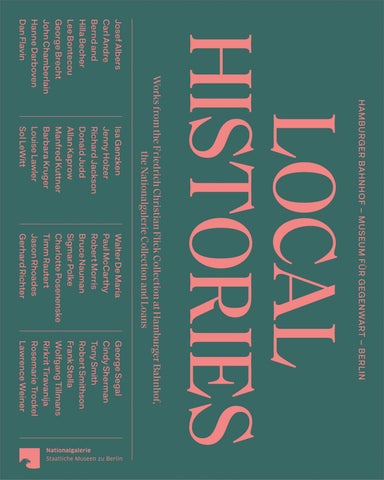
Foreword
With Local Histories we have once again fulfilled our commitment to presenting outstanding works from the Friedrich Christian Flick Collection in special exhibitions and temporary displays, as we have done regularly over the past fifteen years. Since 2004, this extensive collection of contemporary art from Europe and North America has been on long-term loan to the Nationalgalerie – Staatliche Museen zu Berlin. Above all, through the generous donations he made in 2008 and 2014, Friedrich Christian Flick has supported the lasting integration of his collected artworks into the context of the Nationalgalerie’s holdings. In addition to these donations, the curators at the Hamburger Bahnhof have access to more than 1,500 works from the Friedrich Christian Flick Collection for temporary exhibitions. The first major presentation of The Friedrich Christian Flick Collection in the Hamburger Bahnhof (2004) was followed by thematic group shows such as Fast nichts. Minimal Artworks from the Friedrich Christian Flick Collection in the Hamburger Bahnhof (2005), Beyond Cinema: The Art of Projection. Films, Videos and Installations from 1963 to 2005 (2006), “I can’t just slice off an ear every day.” Deconstructing the Myth of the Artist (2008), Architektonika (2011) and moving is in every direction. Environments – Installations – Narrative Spaces (2017). And with monographic exhibitions devoted to Urs Fischer (2005), Richard Jackson (2006), Roman Signer (2007), Wolfgang Tillmans (2008), Bruce Nauman (2010) and Martin Kippenberger (2013), wider audiences have also been introduced to influential artistic practices from the 1960s to the present day. The exhibition Local Histories is further testimony to the Nationalgalerie’s long-standing collaborative relationship with Friedrich Christian Flick and it underscores the collector’s close association with the museum. By exploring the circumstances and conditions under which key works from the Friedrich Christian Flick Collection were created in the second half of the twentieth century, the group show highlights a new facet of this outstanding collection. The focus on friendships and connections between the featured artists and their galleries results in some quite unusual juxtapositions of works, while the dialogue with selected pieces from the collection of the Nationalgalerie confirms how well the two collections complement one another.
The idea for the exhibition project came from an essay by the artist Donald Judd, entitled “Local History”. In this piece from 1964, written in his professional capacity as an art critic, Judd writes about the New York art scene and describes particular works he considers innovative. His analysis of this local scene and its interconnections provided the starting point for our current experiment, which takes works from the Friedrich Christian Flick Collection and the collection of the Nationalgalerie – supplemented by a selection of loans – and resituates them within the context of their creation. It explores questions such as: What kind of art influenced Donald Judd? What connects Konrad Lueg, Sigmar Polke and Gerhard Richter? Which galleries supported Bruce Nauman or Jenny Holzer during the early stages of their careers? The unusual combinations of works in this exhibition provide snapshots of New York and Düsseldorf in the 1960s and 1970s, Cologne in the 1980s, or Berlin and Los Angeles in the 1990s. In this way, viewers gain insight into complex networks of relationships that would be impossible to represent without access to such a large selection of high-calibre artworks. Local History extends over the entire ground floor of the Rieckhallen, which offers approximately 4,500 m2 of exhibition space. This former freight company warehouse was converted to accommodate the Friedrich Christian Flick Collection and to increase the available exhibition space at the Hamburger Bahnhof. Both the museum and the city of
6
Berlin as an art location have benefited from the growing international attention gained by the programme of the substantially enlarged museum. The current exhibition confirms that the Rieckhallen offer ideal conditions in which to present the kind of artworks that have been produced in the second half of the twentieth century and in the recent past. There are not many museums where large-format exhibits such as Carl Andre’s Karlsplatz (1992), Isa Genzken’s and Wolfgang Tillmans’ collaborative work Science Fiction / Hier und jetzt zufrieden sein (2001) or Tony Smith’s sculpture Wall (1964) can be shown to full effect. This applies above all to the expansive installations of Bruce Nauman, whose practice has a particular significance within the exhibition. His fascinating work Nick Wilder Corridor (1970) is on show here and can be conceptually linked to the permanently installed Room with My Soul Left Out, Room That Does Not Care (1984/2010) in the final section of the display. Another highlight of the presentation is an approximately 4 x 24 m wall painting by Richard Jackson, which the artist created on one of the long walls of the Rieckhallen in 2006. The painting was subsequently preserved behind a wall and uncovered for the current exhibition in November 2018. Local Histories also presents a number of smaller – but no less significant – works from the Friedrich Christian Flick Collection that have not been shown here before. These include Sigmar Polke’s recently restored Kartoffelmaschine-Apparat (1969), Allan Kaprow’s action collage Caged Pheasant #I (1956) and John Chamberlain’s sculpture Big E (1962). We would like to thank Matilda Felix, the curator of Local Histories, for developing this impressive and interesting collection display for the Hamburger Bahnhof. Assistant curator Irina Hiebert Grun provided invaluable support in preparing both the exhibition and the accompanying publication. Many thanks are also due to Patrick Peternader, Collection Manager of the Friedrich Christian Flick Collection, as well as to our registrars Ulrike Gast and Johanna Lemke, and our conservators Carolin Bohlmann and Eva Rieß, all of whom have contributed significantly to the success of this exhibition project. We have the NLF Team to thank for not only developing the exhibition graphic design but also designing this catalogue, for which we have found an excellent publishing partner in Kerber Verlag. We are of course highly indebted to all the individuals and institutions who have supported the presentation of these fascinating local histories by lending important artworks or related documentation. Above all, however, we would like to express our sincere thanks to Friedrich Christian Flick for his exceptional art collection, his understanding of our curatorial vision and his continued generosity and support. Udo Kittelmann Director of the Nationalgalerie – Staatliche Museen zu Berlin Gabriele Knapstein Head of Hamburger Bahnhof – Museum für Gegenwart – Berlin
7
p. 9
LEE BONTECOU, Untitled, 1960 pp. 10–11
FRANK STELLA, Sanbornville I, 1966 LEE BONTECOU, Untitled, 1960 JOHN CHAMBERLAIN, Big E, 1962 JOSEF ALBERS, Homage to the Square: On the Way, 1959 pp. 12–13
DONALD JUDD, Untitled, 1991 GEORGE SEGAL, Man Installing Pepsi-Sign, 1973 GEORGE BRECHT, Chair Events, 1961/2013 pp. 14–15
CLAES OLDENBURG, Ray Gun, 1969 ALLAN KAPROW, Caged Pheasant #1, 1956 p. 16
DAN FLAVIN, Untitled, 1976
8
27 Liam Gillick and Rirkrit Tiravanija, “Forget about the Ball and Get on with the Game”, in Parkett, no. 44, 1995, pp. 106–108, here p. 108; reprinted in this publication, pp. 160-167. The article is based on faxes the two artists sent each other; this form of correspondence was chosen due to the geographical distance between them, and provides an indication of the conditions under which the artists were living and communicating with one another in the mid-1990s. For example, Tiravanija asks Gillick: “How are you? I am not certain that you received my last fax to you, I think that was back in March sometime. I have heard that Angela is doing a project in LA., are you away from London at the moment? Are you going to Koln this weekend for Philippe’s opening?” and later, “What is going on in Dijon?” Fax from Rirkrit Tiravanija to Liam Gillick, written in 1995 (Rirkrit Tiravanija Archive, Berlin, inv. no. RTA0695-011689).
158
25 Carl Freedman, for example, notes with regard to the exhibition Traffic that the works labelled relational by Bourriaud are in fact very heterogeneous. See Carl Freedman, “Traffic”, in frieze, no. 28, May 1996, pp. 75–76.
26 See Nancy Spector (ed.), theanyspacewhatever, exh. cat., Solomon R. Guggenheim Museum, New York, 2008.
This first film was followed in 2000 by Vicinato II, a collaborative project by Gillick, Gordon, Höller, Huyghe, Parreno and Tiravanija. In the second film, which is set in the garden of a hotel looking out over Monte Carlo, the artists have their previously recorded conversations re-enacted by four actors. In the five years between the two parts of Vicinato, the term relational aesthetics had become a firmly established reference for the interpretation of these artists’ works. Vicinato is a collaborative project centred on communication about art and the artists’ social relationships. At the same time, the artists use the exchange of views in Vicinato to demonstrate that their relationship is in fact more complex than something that can be reduced to the establishment of relational connections. In doing so, they articulate a concern which – despite the criticisms of the concept of relational aesthetics that have repeatedly been voiced25 – is still relevant today: in the group show theanyspacewhatever at the Guggenheim Museum in New York in 2008, for example, the curator Nancy Spector again staged Bourriaud’s theory as a link between the artistic practices of Bulloch, Cattelan, Gillick, GonzalezFoerster, Gordon, Höller, Huyghe, Pardo, Parreno and Tiravanija. For this exhibition, the artists developed individual works that enabled multiple interconnections. The oscillation between the individual and the group that was thus brought into the exhibition space could not be assigned to a particular artistic movement. Accordingly, the exhibition title suggested by Gillick – theanyspacewhatever – is a term coined by Gilles Deleuze to describe a heterogeneity in the encounter between different perspectives. Tiravanija’s work Chew The Fat was first shown in this context. 26 In a dialogue between Tiravanija and Gillick that was published in Parkett in 1995, the networking process that is initiated within the format of group shows is described as follows: “I have found that the time you spend preparing a piece of work for a show and the way that might engage the other artists involved in the same show is often crucial towards aiding a dialogue. Working on something quite mundane (I’m thinking of chopping food, for example, but it could be shifting beer or building a new space) helps with this discursive process (…).”27 As in Vicinato, there is no single, cohesive argument presented to readers of the Parkett article, nor is there any way of knowing which artist made which statement. Their individual positions therefore take a back seat to a collective stance, without, however, being completely dismantled. The artists avoid the pursuit of consensus and instead emphasise the diversity of
Is this all there is to life?
their approaches. In this respect, works such as Vicinato or Chew The Fat are to be understood as attempts to represent the complexity of artistic communication. The crucial aspect of Tiravanija’s approach is that when he is interviewing fellow artists or encouraging recipients to engage in conversation, he considers the discussion itself an artistic practice. The initiation of communicative situations through everyday activities such as cooking, eating or travelling is an artistic strategy into which Tiravanija signiďŹ cantly integrates the reality of his own life, and above all the personal relationships he maintains within the art world.
Irina Hiebert Grun
159