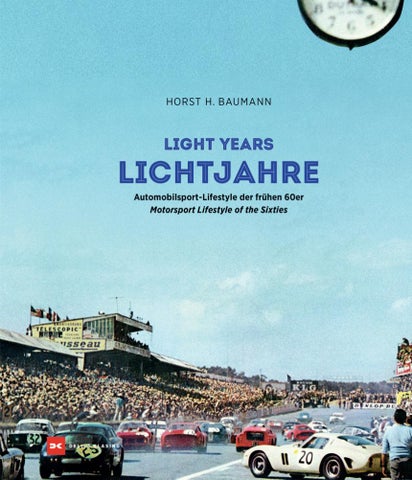
Photography is often described as “capturing light” or “painting with light”. I believe that this idea had a major influence on Horst H. Baumann during his life as an artist and galvanized him to practice “light painting” using different media. This book shows with great clarity his talent in emotionally ensnaring the mood of the moment using the medium of color film. For me, his intense preoccupation with the phenomenon of lasers in his later years is simply a natural extension of this light painting – albeit with a new medium that channels light into a different structure. The coolness of motor racing in the sixties combined with the emotion of color film and the chance for Leica to be in the thick of it make these images here unique. Baumann is a great artist whose life’s work we now honor. In this respect, we are grateful to the Delius Klasing publishing house for bringing these treasures to light again – and I’m delighted that we can support this.
Dr Andreas Kaufmann, June 2020 (Chairman of the Supervisory Board at Leica)
6
Zigarettenpause: Hektische Betriebsamkeit in der Box, entspanntes Warten im Jaguar E-Type CoupĂŠ
Cigarette break: Hustle and bustle in the pits, chilling out in the Jaguar E-type coupĂŠ
7
80
Startaufstellung beim GroĂ&#x;en Preis von Deutschland 1961: Ganz hinten Phil Hill mit seinem Ferrari und Startnummer 4 auf Pole, neben ihm Jack Brabham, der Weltmeister von 1960, auf Cooper mit der Nummer 1, davor Stirling Moss im Lotus mit der Nummer 7. Nur zu erahnen ist Jo Bonnier im Porsche mit der Nummer 8
The grid at the 1961 German Grand Prix: In the background, Phil Hill sits on pole with his No. 4 Ferrari, next to him is the 1960 world champion, Jack Brabham in his No. 1 Cooper, with Stirling Moss and his No. 7 Lotus in the foreground. The blur is very likely Jo Bonnier in the No. 8 Porsche
81
Doppeltes Debßt: Der junge Jackie Lewis, ein Privatier aus England, fährt 1961 in seiner ersten Formel-1-Saison zum ersten Mal auf der Nordschleife. Er qualifiziert er sich mit seinem Cooper 53 auf Position 18 und beendet das Rennen auf einem respektablen 9. Platz
82
Double debut: The young Jackie Lewis, a privateer from England, races on the Nordschleife for the first time during his maiden Formula 1 season in 1961. He qualified his Cooper 53 on 18th and concluded the race on a respectable 9th place.
Geduldsspiel: Die Fahrer warten darauf, dass die Strecke fĂźr das Training zum GroĂ&#x;en Preis von Deutschland 1962 freigegeben wird. Trevor Taylor, mit gelbem Helm und gelbem Rennanzug im Lotus mit der Nummer 6, ist einer von ihnen
Waiting game: The drivers wait for the start of the free practice at the 1962 German Grand Prix. One of them is Trevor Taylor wearing the yellow helmet and overalls in the No. 6 Lotus 83
Zweite Runde: Der Porsche 718-8 GTR Coupé von Dan Gurney/ Jo Bonnier 1962 beim 1000-Kilometer-Rennen auf dem Nürburgring. Die angezeigte Startnummer 84 verweist auf Jim Clark im Lotus, der die Führung vom Start weg übernommen hat Round two: The Porsche 718-8 GTR Coupé of Dan Gurney/Jo Bonnier in 1962 at the 1,000-kilometer race on the Nürburgring. The displayed number 84 refers to Jim Clark in the Lotus, which took the lead from the start
84
85
A British Affair: Gleich vier Formel-1-Asse von der Insel stehen im Jahr 1962 bei der Lombank Trophy in Snetterton an der Startlinie. Direkt vor Baumanns Kamera Pole-Mann Stirling Moss mit der Startnummer 7, neben ihm Jim Clark mit der Nummer 3, gefolgt von Graham Hill (9) und John Surtees (12)
A British affair: Four Formula 1 stars from the British Isles line up to tackle the Lombank Trophy at Snetterton in 1962: In the foreground, pole-sitter Stirling Moss in the number 7 car, next to him Jim Clark in the No. 3, then Graham Hill (9) and John Surtees (12)
169
The New Zealander Bruce McLaren came from humble beginnings. No sooner had he arrived in Europe than he scored a drive with Cooper alongside none other than Jack Brabham. At just 22 years of age, after taking the flag in first place at the United States Grand Prix, McLaren set a record as the youngest Formula 1 winner. This record would remain intact for 44 years. McLaren stayed true to Cooper until the foundation of his own Bruce McLaren Motor Racing squad in 1966. That same year he won the 24 Hours of Le Mans with his compatriot Chris Amon in a Ford GT40. Indeed, McLaren’s lasting impact on the motorsport world was not so much as a driver but more as a designer and team boss.
THE HELMETS The races of the 1960s still retained a lot of charm and familiar ity of the early days of racing – best epitomized by the helmets. The drivers all wore open-faced jet helmets with only aviator or ski goggles as eye protection. This made them more relatable and brought them closer to their fans. In dry weather, they sometimes covered their mouths and noses with a scarf to keep out the dust. Fans could easily identify the drivers, as the facial features of their idols were clearly recognizable even during a race – until the day of the 1968 German Grand Prix, when Dan Gurney donned one of the new full-face helmets.
One of the most popular racing drivers of this era was Graham Hill. In 1958 he contested his first Grand Prix for Lotus at Monaco. In 1960 he switched to BRM and took home his first world championship title in 1962. He remained loyal to BRM until 1966. In 1967 he returned to Lotus with Jim Clark as a teammate, and became world champion for the second time in 1968. Over the course of his career, Graham Hill contested 176 Grands Prix and won 14 of them.
WOMEN AND MECHANICS Drivers and constructors constituted only a small part of the whole racing circus. Although they were the main attraction, their teams were also made up of mechanics and, especially in the sixties, the female protagonists: the companions and wives of the drivers. The women tried to distract themselves from the anxious wait at every race weekend by sitting at the pit wall holding a stopwatch and clipboard and noting the times set by their men. These women represented the feminine side of the sport, adding charm and often an exotic touch.
During the early years of his motor racing career, Sir Stirling Moss devoted himself to flying the British flag and set his cap on British racing cars, despite the fact that they were at times inferior to the German and Italian rivals. In the four years from 1955 to 1958, he finished second in the Drivers’ World Championship, and third in the following three years. Enzo Ferrari stated: “If Moss had let his head rule his heart he would have won the world title he so richly deserved.” Today, he is known as the greatest driver never to have won a world championship. Sir Stirling Moss died in 2020 at the age of 90. Jim Clark personified the 1960s like no other. In 1963 he won seven out of ten Grands Prix to secure his first world champion crown. Clark’s dominance was absolute. He proved almost unbeatable. As long as his Lotus maintained the pace to the flag, victory was assured. His race preparation was especially noteworthy: he and team principal Colin Chapman meticulously tweaked the settings of the car to achieve the perfect setup for each circuit. On 1 January 1968, Clark won his 25th Grand Prix in the Drivers’ World Championship in Kyalami, South Africa, thus breaking the all-time record set by Juan Manuel Fangio ten years earlier. From the day he was born, Sir Jackie Stewart was surrounded by cars. His parents ran a successful Jaguar dealership in Scotland. In 1963 he achieved success during his first sports car season for the Ecurie Ecosse team. The following year, he switched to Ken Tyrrell’s Formula 3 squad and promptly claimed the British title. His career took off: he signed on with BRM in 1965 as a teammate to Graham Hill and celebrated his maiden Grand Prix victory at Monza. Still driving for BRM for the following 1966 season, an accident at Spa almost cost him his life, prompting Stewart to lobby for greater safety on the racetracks. In 1969, at the wheel of a Matra-Ford, he won the first of his three world championships, the last of a golden era.
170
The male supporting actors were the mechanics – regarded by many as the unsung heroes of motorsport. They carried the responsibility for building and transporting the cars and for the boards during the race, which informed the drivers of their position as well as the distance from the hottest pursuer and to the car in front. The whole weekend was spent adjusting, refueling, oiling, cleaning, pushing and changing countless tires. After the races, they packed, loaded and secured everything and transported it home – only to begin all over again. THE CIRCUITS Motorsport in the sixties was mostly characterized by the racetracks: permanent circuits such as Monza with its famous high-speed oval, the Nordschleife of the Nürburgring in the forest-covered hills of the Eifel region, the Circuit Park Zandvoort carved into the dunes of the North Sea coast and Silverstone as a former military airfield. There were also the public roads, parts of which were added to the circuit on race weekends. The most famous of them were the racetracks of Spa-Francorchamps in Belgium’s Ardennes, Le Mans at the Sarthe, Monte Carlo in the Principality of Monaco, and Charade close to Clermont-Ferrand in the heart of Auvergne. SAFETY Racing in the sixties was significantly more dangerous than what we are accustomed to today. Driving mistakes and material shortcomings often had catastrophic effects, with countless drivers having to pay for their courage with their lives. Some became increasingly less willing to blindly accept the risks. For this reason, they founded the Grand Prix Drivers’ Association (GPDA) in 1961, with the aim of creating a drivers’ union and obtain representation within the Commission Sportive Internationale (CSI) and the Fédération Internationale de l‘Automobile (FIA) in matters of safety and entry fees.
172
173
Unbekannte SchÜne: Auch im hektischen Geschehen eines Renn wochenendes findet Horst Baumann immer wieder Momente der Ruhe und erreicht eine beeindruckende Vertrautheit mit seinen Motiven 228
Mysterious beauty: Even in the hectic action of a race weekend, Horst Baumann finds a moment calm to capture a snapshot of deep intimacy
Angeregte Unterhaltung: Lorenzo Bandini ist als Zuschauer mit nach Spa gefahren und tauscht sich mit Michèle Albert aus, die bei der Scuderia Ferrari für die Zeitnahme im Einsatz ist
Lively discussion: Lorenzo Bandini has traveled to Spa as a spectator and exchanges views with Michèle Albert, who is in charge of timekeeping at Scuderia Ferrari
229