This book is dedicated to my beloved sons, Hugo Chulachak and Dominic Puwasawat, that they may enjoy researching their heritage and learn how their great grandfather was dedicated and brave, sensible and a risk taker, beloved both by his father and the last Tsar of Russia.
First edition published in 2017 by River Books Co. Ltd. 396 Maharaj Road, Tatien, Bangkok 10200 Thailand T: (66 2) 622-1900, 224-6686 F: (66 2) 225-3861 E: order@riverbooksbk.com www.riverbooksbk.com
Copyright photographs © as stated Copyright text © Narisa Chakrabongse Copyright collective work © River Books 2017
All rights reserved. No part of this publication may be reproduced, stored in a retrieval system, or transmitted, in any form, or by any means electronic, chemical, mechanical, photocopying, recording or otherwise, without the prior permission of the publisher.
Back cover: The Tsar and Prince Chakrabongse, c. 1903. Prince Chakrabongse, Katya and Chula, 1908.
Editor Narisa Chakrabongse Production supervision Paisarn Piemmettawat Design Narisa Chakrabongse
Frontispiece: Photograph given to his son by King Chulalongkorn and inscribed: To my son Lek as a souvenir of our trip to Naples and our parting there, Chulalongkorn, 1st November 1897.
ISBN 978 616 7339 58 0 Printed in Thailand by Sirivatana Interprint Public Co., Ltd.
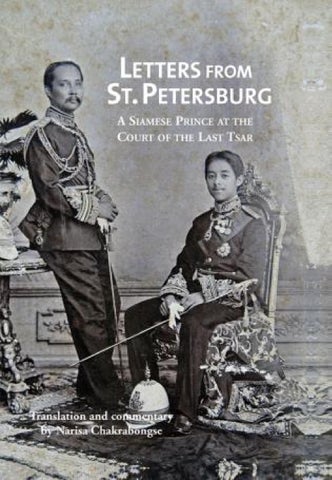
Cover: King Chulalongkorn and Prince Chakrabongse, photographed during the prince’s trip home in 1899.
Contents
Introduction by Narisa Chakrabongse
6
1896
Departures: to Europe & Java
14
1897
The King’s Visit - Studies in England
50
1898
Learning Russian - Life in St. Petersburg
72
1899
Corps des Pages - First Trip Home - Constantinople
122
1900
The Crown Prince’s Visit - King Umberto’s Funeral
154
1901
Exams at the Corps - the Kschessinka Affair - The King’s Trip to Java - Page to the Empress
210
1902
Joining the Hussars - Trip to America - Corps des Pages Centenary
256
1903
Regimental Life - the Great Ball - Second Trip Home
304
1904
Return to Russia - Russo-Japanese War - Military Academy
320
1905
The Hussar Officer - Representing the King Revolution
344
1906-1910 From Russia to Siam - Scandal & Fatherhood The King’s Last Years Appendices Summary of the Letters Selected Bibliography and Photographic Credits Acknowledgements Index
386
426 438 440 442
This book is dedicated to my beloved sons, Hugo Chulachak and Dominic Puwasawat, that they may enjoy researching their heritage and learn how their great grandfather was dedicated and brave, sensible and a risk taker, beloved both by his father and the last Tsar of Russia.
First edition published in 2017 by River Books Co. Ltd. 396 Maharaj Road, Tatien, Bangkok 10200 Thailand T: (66 2) 622-1900, 224-6686 F: (66 2) 225-3861 E: order@riverbooksbk.com www.riverbooksbk.com
Copyright photographs © as stated Copyright text © Narisa Chakrabongse Copyright collective work © River Books 2017
All rights reserved. No part of this publication may be reproduced, stored in a retrieval system, or transmitted, in any form, or by any means electronic, chemical, mechanical, photocopying, recording or otherwise, without the prior permission of the publisher.
Back cover: The Tsar and Prince Chakrabongse, c. 1903. Prince Chakrabongse, Katya and Chula, 1908.
Editor Narisa Chakrabongse Production supervision Paisarn Piemmettawat Design Narisa Chakrabongse
Frontispiece: Photograph given to his son by King Chulalongkorn and inscribed: To my son Lek as a souvenir of our trip to Naples and our parting there, Chulalongkorn, 1st November 1897.
ISBN 978 616 7339 58 0 Printed in Thailand by Sirivatana Interprint Public Co., Ltd.
Cover: King Chulalongkorn and Prince Chakrabongse, photographed during the prince’s trip home in 1899.
Contents
Introduction by Narisa Chakrabongse
6
1896
Departures: to Europe & Java
14
1897
The King’s Visit - Studies in England
50
1898
Learning Russian - Life in St. Petersburg
72
1899
Corps des Pages - First Trip Home - Constantinople
122
1900
The Crown Prince’s Visit - King Umberto’s Funeral
154
1901
Exams at the Corps - the Kschessinka Affair - The King’s Trip to Java - Page to the Empress
210
1902
Joining the Hussars - Trip to America - Corps des Pages Centenary
256
1903
Regimental Life - the Great Ball - Second Trip Home
304
1904
Return to Russia - Russo-Japanese War - Military Academy
320
1905
The Hussar Officer - Representing the King Revolution
344
1906-1910 From Russia to Siam - Scandal & Fatherhood The King’s Last Years Appendices Summary of the Letters Selected Bibliography and Photographic Credits Acknowledgements Index
386
426 438 440 442
INTRODUCTION The letters written between King Chulalongkorn (r. from 1868) and his son Prince Chakrabongse (1883-1920) cover a period of 15 years, beginning in 1896 and ending with the King’s death in 1910. In all, there are some 281 letters. 70 from the King and over 200 from Prince Chakrabongse. The prince was sent to study in Tsarist Russia and thus the letters written from that country provide a fascinating insight into the Corps des Pages1 (where he was enrolled), Tsar Nicholas II2 and the Imperial family, the role that Siam occupied in Russia’s attempts to gain a foothold in the East , and the way Siam hoped Russia could help apply pressure to keep the French3 from encroaching on her borders. While still Tsarevich, Nicholas had visited Bangkok in 1891 as part of his Eastern Tour, which culminated in the opening of the eastern end of the Trans-Siberian railway in Vladivostok in 1893. Although he only stayed in Bangkok for five days, he was lavishly entertained by King Chulalongkorn, establishing a friendship which continued throughout their lives. Prince Chakrabongse Prince Chakrabongse was born on 3rd March 1883. He was the 40th child of the King and the 13th son, although one had only lived a few days. His mother, Queen Saovabha (1861-1919), was half-sister to the King and one of four princesses elevated to queens. When he was born, his mother was only 21 years old and had already had three children: Princess Bahurad, born December 1878, Prince Vajiravudh (18801925), aged three when Chakrabongse was born, and Prince Tribej (1881-1887). In 1887, the year in which Chakrabongse turned four, two of his full brothers died, first his younger brother, Prince Siriraj (1885-1887), aged only one and a half, and, later in the year, Prince Tribej (1881-1887), who was only six. In the previous years, his mother had had several miscarriages. Therefore Queen Saovabha must have been very preoccupied and it is hard to imagine the childhood of these boys brought up in the Grand Palace4. Nevertheless, Chakrabongse seems to have been her favourite child, as the letters will later show. 6
Why was Russia chosen? Clearly the successful trip made by Nicholas to Siam when Tsarevich was one factor, but furthermore King Chulalongkorn could see that after the Paknam Incident6 in 1893, when the country risked becoming a French protectorate, Siam needed a counterweight to the French and British. Accordingly, Prince Damrong7 was sent to represent Siam at the coronation of Nicholas II in 1896. Another factor may well have been that Tsar Nicholas offered to pay for Prince Chakrabongse’s education in its entirety. This was different from in other European countries where the money had to come from the Siamese treasury.
Tsarevich Nicholas (later Tsar Nicholas II) in Thailand in March, 1891. On his left is King Chulalongkorn, on his right, Crown Prince Maha Vajirunhis.
In addition to his full brothers, Prince Chakrabongse had six older half brothers: Prince Kitiyakara Voralaksana, Prince of Chantaburi (1874-1931), Prince Rabi Badhanasakdi, Prince of Rajaburi (18741920), Prince Pravitra Vadhanodom (1875-1919), Prince Chirapravati Voradej (1876-1913), Prince Maha Vajirunhis, Crown Prince (1878-1894) and Prince Abhakara Kiartivongse, Prince of Chumphon (1880-1923), as well as numerous sisters. Just nine months older than him, were Prince Paribatra Sukhumbhand, Prince of Nakhon Sawan (18811944) and Prince Purachatra Jayakara, Prince of Kamphaeng Phet (1881-1936). Prince Chakrabongse was particularly close to several of his brothers, especially the Crown Prince, but in England often saw several more. Later, younger brothers, such as Prince Rangsit Prayurasakdi (1885-1951), followed to Europe and Prince Chakrabongse, when passing through Berlin to St. Petersburg, often met with those studying in Germany, as well as inviting some to Russia, even at dangerous times. King Mongkut (r. 1851-1868), Rama IV, had realised the importance of a wide education, including learning English, but he did not send his children abroad, instead employing the somewhat infamous
The book commemorating the Tsar’s trip to the East in 1890-91 was published by Prince Esper Ukhtomsky, who later met Prince Chakrabongse in St. Petersburg.
Anna Leonowens as governess. It was only in the reign of his successor, King Chulalongkorn, with increasing threats from colonial expansion by Britain5 and France, that the King decided to send his sons abroad. Accordingly, they were sent to learn foreign languages and then to military colleges in England, Germany and Denmark. In 1881, a group of nine Siamese princes were sent to Europe, including the King’s younger brother Prince Svasti Sobhon (1865-1935), then only 16. In 1885, four of the King’s eldest sons were sent to England for a year (Prince Rabi, Prince Kitiyakara, Prince Chira and Prince Pravitra), before returning once again to continue their higher education. In a letter written to his sons in 1885, the King emphasized that the purpose of overseas study was not to become westernized but to become modernized, as he recognised the need for technical expertise. Prince Chakrabongse was the ninth son to be sent to England, following in the footsteps of his full brother Prince Maha Vajiravudh, the Crown Prince. From the account of King Chulalongkorn’s trip to Europe in 1897, it seems that only when the King visited Tsar Nicholas II in August was it decided that Prince Chakrabongse should study in Russia.
King Chulalongkorn’s trip to Europe As part of his efforts to show that Siam was a civilised country and to create alliances through personal friendships among monarchs, in 1897 King Chulalongkorn made an extensive trip to Europe. During the trip, two of his sons, Crown Prince Vajiravudh and Prince Chakrabongse, already studying in England, accompanied their father for certain visits and thereby became acquainted with foreign royalty. Before the trip, the Tsar had spoken highly of the Siamese King to the Austrian Emperor Franz Joseph I (1848–1916), who in turn spoke to the German Kaiser Wilhelm II. As a result these two monarchs treated King Chulalongkorn as a royal equal. The tour began in Italy on 14th May and, after meeting with the Italian King, Umberto I and His Holiness the Pope (Leo XIII 1878-1903), King Chulalongkorn travelled to Switzerland, Austria and Hungary, before resuming his friendship with Tsar Nicholas II at Peterhof. The King then visited King Oscar II in Sweden, King Christian IX in Denmark, Kaiser Wilhelm II in Germany, Queen Wilhelmina in the Netherlands, King Leopold II in Belgium, King Alfonso XIII, under the regency of his mother Queen Maria Christina, in Spain and King Carlos I in Portugal. The Prince of Wales officially welcomed King Chulalongkorn for his five week visit to Great Britain, during which time he called on Her Majesty Queen Victoria at her Isle of Wight residence. The stay in England was particularly long, as many of his sons were being educated there. Because of the strains between Siam and the
7
INTRODUCTION The letters written between King Chulalongkorn (r. from 1868) and his son Prince Chakrabongse (1883-1920) cover a period of 15 years, beginning in 1896 and ending with the King’s death in 1910. In all, there are some 281 letters. 70 from the King and over 200 from Prince Chakrabongse. The prince was sent to study in Tsarist Russia and thus the letters written from that country provide a fascinating insight into the Corps des Pages1 (where he was enrolled), Tsar Nicholas II2 and the Imperial family, the role that Siam occupied in Russia’s attempts to gain a foothold in the East , and the way Siam hoped Russia could help apply pressure to keep the French3 from encroaching on her borders. While still Tsarevich, Nicholas had visited Bangkok in 1891 as part of his Eastern Tour, which culminated in the opening of the eastern end of the Trans-Siberian railway in Vladivostok in 1893. Although he only stayed in Bangkok for five days, he was lavishly entertained by King Chulalongkorn, establishing a friendship which continued throughout their lives. Prince Chakrabongse Prince Chakrabongse was born on 3rd March 1883. He was the 40th child of the King and the 13th son, although one had only lived a few days. His mother, Queen Saovabha (1861-1919), was half-sister to the King and one of four princesses elevated to queens. When he was born, his mother was only 21 years old and had already had three children: Princess Bahurad, born December 1878, Prince Vajiravudh (18801925), aged three when Chakrabongse was born, and Prince Tribej (1881-1887). In 1887, the year in which Chakrabongse turned four, two of his full brothers died, first his younger brother, Prince Siriraj (1885-1887), aged only one and a half, and, later in the year, Prince Tribej (1881-1887), who was only six. In the previous years, his mother had had several miscarriages. Therefore Queen Saovabha must have been very preoccupied and it is hard to imagine the childhood of these boys brought up in the Grand Palace4. Nevertheless, Chakrabongse seems to have been her favourite child, as the letters will later show. 6
Why was Russia chosen? Clearly the successful trip made by Nicholas to Siam when Tsarevich was one factor, but furthermore King Chulalongkorn could see that after the Paknam Incident6 in 1893, when the country risked becoming a French protectorate, Siam needed a counterweight to the French and British. Accordingly, Prince Damrong7 was sent to represent Siam at the coronation of Nicholas II in 1896. Another factor may well have been that Tsar Nicholas offered to pay for Prince Chakrabongse’s education in its entirety. This was different from in other European countries where the money had to come from the Siamese treasury.
Tsarevich Nicholas (later Tsar Nicholas II) in Thailand in March, 1891. On his left is King Chulalongkorn, on his right, Crown Prince Maha Vajirunhis.
In addition to his full brothers, Prince Chakrabongse had six older half brothers: Prince Kitiyakara Voralaksana, Prince of Chantaburi (1874-1931), Prince Rabi Badhanasakdi, Prince of Rajaburi (18741920), Prince Pravitra Vadhanodom (1875-1919), Prince Chirapravati Voradej (1876-1913), Prince Maha Vajirunhis, Crown Prince (1878-1894) and Prince Abhakara Kiartivongse, Prince of Chumphon (1880-1923), as well as numerous sisters. Just nine months older than him, were Prince Paribatra Sukhumbhand, Prince of Nakhon Sawan (18811944) and Prince Purachatra Jayakara, Prince of Kamphaeng Phet (1881-1936). Prince Chakrabongse was particularly close to several of his brothers, especially the Crown Prince, but in England often saw several more. Later, younger brothers, such as Prince Rangsit Prayurasakdi (1885-1951), followed to Europe and Prince Chakrabongse, when passing through Berlin to St. Petersburg, often met with those studying in Germany, as well as inviting some to Russia, even at dangerous times. King Mongkut (r. 1851-1868), Rama IV, had realised the importance of a wide education, including learning English, but he did not send his children abroad, instead employing the somewhat infamous
The book commemorating the Tsar’s trip to the East in 1890-91 was published by Prince Esper Ukhtomsky, who later met Prince Chakrabongse in St. Petersburg.
Anna Leonowens as governess. It was only in the reign of his successor, King Chulalongkorn, with increasing threats from colonial expansion by Britain5 and France, that the King decided to send his sons abroad. Accordingly, they were sent to learn foreign languages and then to military colleges in England, Germany and Denmark. In 1881, a group of nine Siamese princes were sent to Europe, including the King’s younger brother Prince Svasti Sobhon (1865-1935), then only 16. In 1885, four of the King’s eldest sons were sent to England for a year (Prince Rabi, Prince Kitiyakara, Prince Chira and Prince Pravitra), before returning once again to continue their higher education. In a letter written to his sons in 1885, the King emphasized that the purpose of overseas study was not to become westernized but to become modernized, as he recognised the need for technical expertise. Prince Chakrabongse was the ninth son to be sent to England, following in the footsteps of his full brother Prince Maha Vajiravudh, the Crown Prince. From the account of King Chulalongkorn’s trip to Europe in 1897, it seems that only when the King visited Tsar Nicholas II in August was it decided that Prince Chakrabongse should study in Russia.
King Chulalongkorn’s trip to Europe As part of his efforts to show that Siam was a civilised country and to create alliances through personal friendships among monarchs, in 1897 King Chulalongkorn made an extensive trip to Europe. During the trip, two of his sons, Crown Prince Vajiravudh and Prince Chakrabongse, already studying in England, accompanied their father for certain visits and thereby became acquainted with foreign royalty. Before the trip, the Tsar had spoken highly of the Siamese King to the Austrian Emperor Franz Joseph I (1848–1916), who in turn spoke to the German Kaiser Wilhelm II. As a result these two monarchs treated King Chulalongkorn as a royal equal. The tour began in Italy on 14th May and, after meeting with the Italian King, Umberto I and His Holiness the Pope (Leo XIII 1878-1903), King Chulalongkorn travelled to Switzerland, Austria and Hungary, before resuming his friendship with Tsar Nicholas II at Peterhof. The King then visited King Oscar II in Sweden, King Christian IX in Denmark, Kaiser Wilhelm II in Germany, Queen Wilhelmina in the Netherlands, King Leopold II in Belgium, King Alfonso XIII, under the regency of his mother Queen Maria Christina, in Spain and King Carlos I in Portugal. The Prince of Wales officially welcomed King Chulalongkorn for his five week visit to Great Britain, during which time he called on Her Majesty Queen Victoria at her Isle of Wight residence. The stay in England was particularly long, as many of his sons were being educated there. Because of the strains between Siam and the
7
1896
CHAKRABONGSE TO THE KING A photograph of the farewell published in Le Petit Journal, May 1896
Colombo 23 May 1896 Your Majesty Ever since I respectfully bade Your Majesty farewell and left the port of Singapore, I have been sitting and gazing out to sea from the stern of the boat. They raised the royal elephant flag1 on the central mast, while the French flag flew from another mast. Even the ‘in port mast’ had the elephant flag above the French one but only for a short while. As soon as we were out at sea they took all the flags down. At 5 pm they came and took the three mom chao princes2 to have supper with the children. I went down to see them and saw that our children were eating much better than the older ones. Once they’d finished our children grumbled that the food wasn’t tasty. So it was decided that tomorrow they’ll eat with the grown ups. At 6 o’clock they rang the bell for dinner. The captain arrranged a separate table for the Thai contingent but in the same room. I must report on what the eating and drinking is like. At 10 in the morning I have coffee in my room.
We have another meal at 1 pm and then at 3 pm tea. At 6 pm we have dinner and at 9 pm some supper. One of the good things about this boat is that the passengers don’t see any messy things at all unless they are mischievous and poke about where they shouldn’t. So you don’t see the food, or the animals. In other words the fancy people are kept towards the bow of the boat, unlike on the Maha Chakri3 where you see people lying around. One thing I forgot to tell Your Majesty is that the captain complained a lot to Toonmom Aa4 about how sad he was that he forgot his French decoration abroad and couldn’t wear it to welcome him.
SS Saghalien was a French passenger steamer built in 1880 and owned by the Messegeries Maritimes. It was used for the Far East routes.
14
An engraving of Prince Chakrabongse published in Le Petit Journal, 1896.
Toonmom Aa has said he will send a report to Your Majesty. Only the captain has come to sit on our table in order to explain various things to us over dinner. He is very amusing but constantly intersperses his conversation with French which Teacher Carter5 translates. He is very strange when he translates Thai into French as he mixes in a lot of Thai words. Then when he speaks Thai he mixes in a lot French. Up on deck is very comfortable but at night it is too dark being rather poorly lit. Today there has been no waves because we are near Sumatra. On the 20th, I became acquainted with two passengers – a millionaire American and his wife. He speaks English very well and the wife talks a great deal. She wants to visit Thailand. Today there were no waves again. I looked at the map at midday. They raised the flags to indicate we were at the mouth of the port of Din Ding (where Wasadree sank). Also at this time, although I haven’t finished the letter, I wanted to tell Your Majesty that in the past two days I have been thinking about Your Majesty a great deal. 21st. As soon as I woke up I felt that the sea was
very rough. I felt rather sick but had to force myself to have a shower and get dressed. Then I had to lie in my room until it was time for breakfast. Then I went up on deck but I couldn’t walk around as normal and had to lie down all day. Lunch had to be taken on deck and I didn’t go down to the room all day as it was very hot. The porthole had to be kept closed otherwise sea water would come in. So I had to lie up on deck all day. 22nd. When I woke up it didn’t feel as if the waves had abated in any way, but I didn’t feel as sick as the day before. I went down to have a shower and got dressed with great ease. Then, however, I had to go up on deck but at mealtime was able to go downstairs. As time passed I didn’t feel too sick and was able to write this letter to Your Majesty. Since leaving you I have been fine and have thought of Your Majesty a great deal. According to the schedule the ship should arrive tomorrow and we will have to go and pay respects to the tooth relic in Kandy so I won’t have time to write to you, which is why I am writing now although I will be able to report on tomorrow’s events later. Also I would be grateful if Your Majesty could tell all the members of the royal family and court officials that I am thinking of them very much. I beg to remain Your Majesty’s obedient servant, Chakrabongse 1. Elephant Flag. The image of a white elephant on a red ground facing the hoist was created by King Mongkut in 1855. In 1916 the flag was changed to a white elephant in royal regalia and in 1917 the tricolour Thai flag was introduced two months after Siam entered the First World War.
2. Mom Chao is the lowest level of princely rank equivalent to His/Her Serene Highness. The three mom chao princes accompanying Chakrabongse to study in the UK were HSH Prince Nibandh Phanuwongse (1885-1934); HSH Wibul Sawwaddiwongse Sawadikul; HSH Tavorn Mongkolwong Chaiyan.
3. Maha Chakri. This royal steam yacht of 2,290 tons was built in the Leith shipyards in 1892. After 24 years in royal service, she was sold on and sank near Faro in 1921.
4. His Royal Highness Prince Bhanurangsri Savangwongse (18591928), was the 45th child of His Majesty King Rama IV and 4th child of Her Majesty Queen Dhepsirindra, and the younger and favourite brother of His Majesty King Chulalongkorn. He was father to Prince Paribatra Sukhumbhand (1881-1944) and Prince Nibandh who were also on the boat. The latter was only 11 at this time. Chakrabongse referred to him as Toonmom Aa (Aa meaning an uncle who is a younger brother to one’s father and Toonmom being a shortened form of Toonkramom and used for a prince/princess of chaofa rank, or the highest level). 5. Cecil A. Carter, had been tutor to Crown Prince Maha Vajirunhis (June 1878-January 1895) and was later author of The Kingdom of Siam 1904 and a report on Thai students in 1916.
15
1896
CHAKRABONGSE TO THE KING A photograph of the farewell published in Le Petit Journal, May 1896
Colombo 23 May 1896 Your Majesty Ever since I respectfully bade Your Majesty farewell and left the port of Singapore, I have been sitting and gazing out to sea from the stern of the boat. They raised the royal elephant flag1 on the central mast, while the French flag flew from another mast. Even the ‘in port mast’ had the elephant flag above the French one but only for a short while. As soon as we were out at sea they took all the flags down. At 5 pm they came and took the three mom chao princes2 to have supper with the children. I went down to see them and saw that our children were eating much better than the older ones. Once they’d finished our children grumbled that the food wasn’t tasty. So it was decided that tomorrow they’ll eat with the grown ups. At 6 o’clock they rang the bell for dinner. The captain arrranged a separate table for the Thai contingent but in the same room. I must report on what the eating and drinking is like. At 10 in the morning I have coffee in my room.
We have another meal at 1 pm and then at 3 pm tea. At 6 pm we have dinner and at 9 pm some supper. One of the good things about this boat is that the passengers don’t see any messy things at all unless they are mischievous and poke about where they shouldn’t. So you don’t see the food, or the animals. In other words the fancy people are kept towards the bow of the boat, unlike on the Maha Chakri3 where you see people lying around. One thing I forgot to tell Your Majesty is that the captain complained a lot to Toonmom Aa4 about how sad he was that he forgot his French decoration abroad and couldn’t wear it to welcome him.
SS Saghalien was a French passenger steamer built in 1880 and owned by the Messegeries Maritimes. It was used for the Far East routes.
14
An engraving of Prince Chakrabongse published in Le Petit Journal, 1896.
Toonmom Aa has said he will send a report to Your Majesty. Only the captain has come to sit on our table in order to explain various things to us over dinner. He is very amusing but constantly intersperses his conversation with French which Teacher Carter5 translates. He is very strange when he translates Thai into French as he mixes in a lot of Thai words. Then when he speaks Thai he mixes in a lot French. Up on deck is very comfortable but at night it is too dark being rather poorly lit. Today there has been no waves because we are near Sumatra. On the 20th, I became acquainted with two passengers – a millionaire American and his wife. He speaks English very well and the wife talks a great deal. She wants to visit Thailand. Today there were no waves again. I looked at the map at midday. They raised the flags to indicate we were at the mouth of the port of Din Ding (where Wasadree sank). Also at this time, although I haven’t finished the letter, I wanted to tell Your Majesty that in the past two days I have been thinking about Your Majesty a great deal. 21st. As soon as I woke up I felt that the sea was
very rough. I felt rather sick but had to force myself to have a shower and get dressed. Then I had to lie in my room until it was time for breakfast. Then I went up on deck but I couldn’t walk around as normal and had to lie down all day. Lunch had to be taken on deck and I didn’t go down to the room all day as it was very hot. The porthole had to be kept closed otherwise sea water would come in. So I had to lie up on deck all day. 22nd. When I woke up it didn’t feel as if the waves had abated in any way, but I didn’t feel as sick as the day before. I went down to have a shower and got dressed with great ease. Then, however, I had to go up on deck but at mealtime was able to go downstairs. As time passed I didn’t feel too sick and was able to write this letter to Your Majesty. Since leaving you I have been fine and have thought of Your Majesty a great deal. According to the schedule the ship should arrive tomorrow and we will have to go and pay respects to the tooth relic in Kandy so I won’t have time to write to you, which is why I am writing now although I will be able to report on tomorrow’s events later. Also I would be grateful if Your Majesty could tell all the members of the royal family and court officials that I am thinking of them very much. I beg to remain Your Majesty’s obedient servant, Chakrabongse 1. Elephant Flag. The image of a white elephant on a red ground facing the hoist was created by King Mongkut in 1855. In 1916 the flag was changed to a white elephant in royal regalia and in 1917 the tricolour Thai flag was introduced two months after Siam entered the First World War.
2. Mom Chao is the lowest level of princely rank equivalent to His/Her Serene Highness. The three mom chao princes accompanying Chakrabongse to study in the UK were HSH Prince Nibandh Phanuwongse (1885-1934); HSH Wibul Sawwaddiwongse Sawadikul; HSH Tavorn Mongkolwong Chaiyan.
3. Maha Chakri. This royal steam yacht of 2,290 tons was built in the Leith shipyards in 1892. After 24 years in royal service, she was sold on and sank near Faro in 1921.
4. His Royal Highness Prince Bhanurangsri Savangwongse (18591928), was the 45th child of His Majesty King Rama IV and 4th child of Her Majesty Queen Dhepsirindra, and the younger and favourite brother of His Majesty King Chulalongkorn. He was father to Prince Paribatra Sukhumbhand (1881-1944) and Prince Nibandh who were also on the boat. The latter was only 11 at this time. Chakrabongse referred to him as Toonmom Aa (Aa meaning an uncle who is a younger brother to one’s father and Toonmom being a shortened form of Toonkramom and used for a prince/princess of chaofa rank, or the highest level). 5. Cecil A. Carter, had been tutor to Crown Prince Maha Vajirunhis (June 1878-January 1895) and was later author of The Kingdom of Siam 1904 and a report on Thai students in 1916.
15
1897
KING TO CHAKRABONGSE Amorn Phiman Manee Throne Hall 16th February 1897 Dear Lek
After several letters detailing his voyage to England in 1896, there are only six letters from Prince Chakrabongse to his father in this year and three from the King. It is likely many letters have been lost. In addition, during his European tour, King Chulalongkorn and Prince Chakrabongse did spend a certain amount of time together and so had no need to write. Prince Chakrabongse was certainly with the King in Darmstadt, which is where he met Tsar Nicholas II, and he also accompanied his father to Spain and Portugal. The first country King Chulalongkorn visited was Italy, where he arrived on 13th May. He then went to Switzerland before returning to Rome and going on to Russia where he arrived on 3rd July, having travelled via Poland. He stayed at Peterhof Palace outside St. Petersburg for one week, before voyaging to Stockholm, where he arrived on 13th July. and left on 20th July. The King arrived in Belgium on 9th September and left for Paris on the 11th. While the King was away, Queen Saovabha, presided over the Regency Council.
I’m sure you must think that I am not thinking of you, just as I do when you end your letters in a formulaic way by saying that you are thinking of me. Then, it seems almost like the end of an official letter, along the lines of, “and to conclude”, “may I take the opportunity to express”. In truth I have been muttering that you may think me rather dull these days, as you must be becoming rather smart. You are the only one, apart from Prince Paribatra, who wrote to his mother, who has said you are looking forward to seeing me soon. It’s true that on this trip I feel like a bit like a country bumpkin coming up to town, so by all means make suggestions. Perhaps I can find some finery to make me look good. But I doubt that I can manage to drink a magic potion to try and match those fancy fellows. My only worry, is that we won’t have that many days together as the time is short and there are many places to go. I really want to sit down and discuss things with you to the full. I am only sorry that your mother is ill and so I cannot leave until November, a fact that has become news. Whenever I say I am going, she starts to cry. Nevertheless, I have to harden my heart and go, as if I don’t make it this time, I doubt there will be another chance, as I get older every day. However, if I did not think there would be some benefit, I wouldn’t go. Having fun and sightseeing are not important and I worry about my duties, but I am steeling myself to endure hardship and go. The whole affair with Tan Lek is awful and I am very worried about it. In fact, I didn’t hear it from anywhere else first, but only from the letter he wrote. It’s very messy and when I read it, it’s almost laughable. The situation is that six months have been refunded now. You can compare it to Prince Vora Sakdaphisan. He said the various princes agreed to like that. I teased him, saying if I come I would not have to be Prince Wongsa Dhirajasanit, or first old then young. Finally I said that Tan Lek was drunk before he knew anything about it. It was some three months and now he still has not arrived. So I am still worried although the fact he has left makes it easier. I am so happy we are going to see each other. That’s it for now.
Above: Map showing the route taken by the royal yacht, Maha Chakri. Right: This image of King Chulalongkorn and Tsar Nicholas II set the tone for the rest of the visit.
Trip to the Court of Spain. Seated in the front: King Chulalongkorn and the Regent of Spain, Queen Maria Christina. King Alfonso XIII stands behind King Chulalongkorn and Prince Chakrabongse next to him. Crown Prince Vajiravudh stands behind Queen Christina.
Reunited in England: King Chulalongkorn and Prince Chakrabongse.
Chulalongkorn Por Ror
50
51
1897
KING TO CHAKRABONGSE Amorn Phiman Manee Throne Hall 16th February 1897 Dear Lek
After several letters detailing his voyage to England in 1896, there are only six letters from Prince Chakrabongse to his father in this year and three from the King. It is likely many letters have been lost. In addition, during his European tour, King Chulalongkorn and Prince Chakrabongse did spend a certain amount of time together and so had no need to write. Prince Chakrabongse was certainly with the King in Darmstadt, which is where he met Tsar Nicholas II, and he also accompanied his father to Spain and Portugal. The first country King Chulalongkorn visited was Italy, where he arrived on 13th May. He then went to Switzerland before returning to Rome and going on to Russia where he arrived on 3rd July, having travelled via Poland. He stayed at Peterhof Palace outside St. Petersburg for one week, before voyaging to Stockholm, where he arrived on 13th July. and left on 20th July. The King arrived in Belgium on 9th September and left for Paris on the 11th. While the King was away, Queen Saovabha, presided over the Regency Council.
I’m sure you must think that I am not thinking of you, just as I do when you end your letters in a formulaic way by saying that you are thinking of me. Then, it seems almost like the end of an official letter, along the lines of, “and to conclude”, “may I take the opportunity to express”. In truth I have been muttering that you may think me rather dull these days, as you must be becoming rather smart. You are the only one, apart from Prince Paribatra, who wrote to his mother, who has said you are looking forward to seeing me soon. It’s true that on this trip I feel like a bit like a country bumpkin coming up to town, so by all means make suggestions. Perhaps I can find some finery to make me look good. But I doubt that I can manage to drink a magic potion to try and match those fancy fellows. My only worry, is that we won’t have that many days together as the time is short and there are many places to go. I really want to sit down and discuss things with you to the full. I am only sorry that your mother is ill and so I cannot leave until November, a fact that has become news. Whenever I say I am going, she starts to cry. Nevertheless, I have to harden my heart and go, as if I don’t make it this time, I doubt there will be another chance, as I get older every day. However, if I did not think there would be some benefit, I wouldn’t go. Having fun and sightseeing are not important and I worry about my duties, but I am steeling myself to endure hardship and go. The whole affair with Tan Lek is awful and I am very worried about it. In fact, I didn’t hear it from anywhere else first, but only from the letter he wrote. It’s very messy and when I read it, it’s almost laughable. The situation is that six months have been refunded now. You can compare it to Prince Vora Sakdaphisan. He said the various princes agreed to like that. I teased him, saying if I come I would not have to be Prince Wongsa Dhirajasanit, or first old then young. Finally I said that Tan Lek was drunk before he knew anything about it. It was some three months and now he still has not arrived. So I am still worried although the fact he has left makes it easier. I am so happy we are going to see each other. That’s it for now.
Above: Map showing the route taken by the royal yacht, Maha Chakri. Right: This image of King Chulalongkorn and Tsar Nicholas II set the tone for the rest of the visit.
Trip to the Court of Spain. Seated in the front: King Chulalongkorn and the Regent of Spain, Queen Maria Christina. King Alfonso XIII stands behind King Chulalongkorn and Prince Chakrabongse next to him. Crown Prince Vajiravudh stands behind Queen Christina.
Reunited in England: King Chulalongkorn and Prince Chakrabongse.
Chulalongkorn Por Ror
50
51
1898
CHAKRABONGSE TO THE KING In the first half of 1898, Prince Chakrabongse was still in England preparing to leave for Russia. Three long letters from the King discuss the details of the trip – who would accompany him and when would he leave. In mid-June the Prince and his entourage left by boat and train via Berlin, together with Ardachev, his tutor. After arriving in Russia, in late June, there are around 20 letters from Prince Chakrabongse detailing his arrival, his meeting with the Emperor and Empress, and summer in Peterhof where he fell from his horse. Then comes an account of moving into his quarters in the Winter Palace and beginning his studies in the Corps des Pages. There are no letters from the King for the second half of the year. Elsenwood, Camberley, Surrey 6th January 1898
Prince Yugala Dighambara, known as Somdet Chai. Opposite above: Prince Vudhijaya Chalermlabh.
I was delighted to receive Your Majesty’s letter dated 7th December from Penang. Since Prince Toro made a big scene that time in Paris, he has been silent and there has been nothing further. While I was in London this time, he crossed over from Paris to stay with me. He said he had come to say goodbye to us and his various friends in England before going back to Bangkok. At first when Phraya Visudh went to meet him at the station, he made as if he was going to stay at the embassy, but then was not sure. After Phraya Visudh had been with him, he asked whether there was a hotel room available and so he stayed in Bailey’s Hotel as usual, but came to eat at the embassy all the time and everything was fine. There was no fuss. In fact, he seemed a different person. On the 1st in the evening, he went back to Paris and said goodbye very politely. I hear that he is going to stop off
to visit Egypt before going home. It’s as if he thinks that if he can’t go to Egypt, he’ll be missing out. You can’t look at everything as if you are missing out. The wives and children of Krom Naret1 all went to see him off in Genoa. They really are a group who are very loyal to each other. On the 1st of this month which was the birthday of Toonmom Toh, we all had a dinner, albeit not a large one. A few of us also went to see a play. Then on the next day, the 2nd, we came back down to Camberly, as the holiday was over. Somdet Chai2, Prince Vudh and Prince Dilok3 came to stay at Camberley too as they are still on holiday, and Chao Khun Visudh arranged for them to come down here as he thinks that is is better than staying in London. My studies have begun again now. I am doing more Russian and have completed all the declensions and I seem to be groping towards getting things right. Pi Purachatra has also come down to stay and will remain for the duration of his holidays. I beg to remain Your Majesty’s obedient servant, Chakrabongse
1. Prince Naret Worarit (1855-1925) was Minister of Municipal Government.
3. Dilok Nabarath, Prince. 1884-1912. In 1907 he completed a degree in agriculture in Germany.
Your Majesty
2. Somdet Chai refers to Prince Yugala Dighambara, Prince of Lopburi (1882–1932). He was a year older than Prince Chakrabongse, but he does not call him Pi because he was the son of King Chulalongkorn and a princess.
72
Bannakom Soranee Throne Hall January 1898
A corner of the Bannakom Soranee Throne Hall in the Grand Palace, used by the king as his private study.
Dear Lek I have received a letter dated 18th November and one dated 6th December, but haven’t replied. And now another has arrived. I could say I am very busy and haven’t had time, but that isn’t really it. I am busy, but it’s more about putting on blazers to receive people than real work. Nowadays, they give me little to do. The aim is to stop me wheezing, but I think even if they took 100 percent away, I wouldn’t feel better. I have a tightness in my chest. It is as if when I had just come back I felt 50 % well, which has diminished to 25%. When I first arrived I felt lazy and didn’t want to work in the Thai way. It was around 5% out of 100. Now it has increased to around 20% but I feel lazy, unlike when I was in Europe around 25 %. No one seems worried because I have been like this for a long time when preparing to receive people. In truth we are very ready. I have never met either the farang or the Thai. I am saying in a teasing way that I don’t want to flatter or be flatterd. I am pleased in a way not to have met them, but am worried that it won’t follow through and I will get blamed. Will it be worth the effort? I feel like I have a heavy weight on my shoulders and can’t move in any direction. In the two letters you sent, I can see that you are truly trying to learn a new language. It seems really difficult and I’m worried it will take a long time. Your mother is grumbling about this as well.
As for the student who is going to accompany you, you speak of Nai Poum, but there is still time to choose. I have heard from Phraya Visudh that the choices are between Nai Poum, Nai Tiem1 and Nai Manit2. Nai Manit doesn’t seem to be up to much and would probably go as a pair with Nai Poum. Nai Tiem has the advantage of coming from a good family. I can talk to him, but the most important thing is that we choose someone who is intelligent, reliable and can be loyal in the future. If Poum can be that person, it would be excellent. If he is someone who is intelligent and has good knowledge, not being from a good family doesn’t matter and may even be a benefit, so that he can continue to perform his duties in the future. I will therefore tell Phraya Visudh to take your preference as the determining factor. I am thinking of you such a lot. Nowadays there are few young princes. It’s no fun and I don’t have anything special to relate. When there is more time, I will find some more stories to tell you. Chulalongkorn 1. Nai Tiem Bunnag (1879-) was adopted by Prince Bhanurangsi aged three. At 13 was sent to England to be a soldier. He entered military service in 1898 and in 1901 became ADC to Prince Paribatra. 2. Nai Manit Manitayakul was the son of Chao Phraya Norraratratchamanit.
73
1898
CHAKRABONGSE TO THE KING In the first half of 1898, Prince Chakrabongse was still in England preparing to leave for Russia. Three long letters from the King discuss the details of the trip – who would accompany him and when would he leave. In mid-June the Prince and his entourage left by boat and train via Berlin, together with Ardachev, his tutor. After arriving in Russia, in late June, there are around 20 letters from Prince Chakrabongse detailing his arrival, his meeting with the Emperor and Empress, and summer in Peterhof where he fell from his horse. Then comes an account of moving into his quarters in the Winter Palace and beginning his studies in the Corps des Pages. There are no letters from the King for the second half of the year. Elsenwood, Camberley, Surrey 6th January 1898
Prince Yugala Dighambara, known as Somdet Chai. Opposite above: Prince Vudhijaya Chalermlabh.
I was delighted to receive Your Majesty’s letter dated 7th December from Penang. Since Prince Toro made a big scene that time in Paris, he has been silent and there has been nothing further. While I was in London this time, he crossed over from Paris to stay with me. He said he had come to say goodbye to us and his various friends in England before going back to Bangkok. At first when Phraya Visudh went to meet him at the station, he made as if he was going to stay at the embassy, but then was not sure. After Phraya Visudh had been with him, he asked whether there was a hotel room available and so he stayed in Bailey’s Hotel as usual, but came to eat at the embassy all the time and everything was fine. There was no fuss. In fact, he seemed a different person. On the 1st in the evening, he went back to Paris and said goodbye very politely. I hear that he is going to stop off
to visit Egypt before going home. It’s as if he thinks that if he can’t go to Egypt, he’ll be missing out. You can’t look at everything as if you are missing out. The wives and children of Krom Naret1 all went to see him off in Genoa. They really are a group who are very loyal to each other. On the 1st of this month which was the birthday of Toonmom Toh, we all had a dinner, albeit not a large one. A few of us also went to see a play. Then on the next day, the 2nd, we came back down to Camberly, as the holiday was over. Somdet Chai2, Prince Vudh and Prince Dilok3 came to stay at Camberley too as they are still on holiday, and Chao Khun Visudh arranged for them to come down here as he thinks that is is better than staying in London. My studies have begun again now. I am doing more Russian and have completed all the declensions and I seem to be groping towards getting things right. Pi Purachatra has also come down to stay and will remain for the duration of his holidays. I beg to remain Your Majesty’s obedient servant, Chakrabongse
1. Prince Naret Worarit (1855-1925) was Minister of Municipal Government.
3. Dilok Nabarath, Prince. 1884-1912. In 1907 he completed a degree in agriculture in Germany.
Your Majesty
2. Somdet Chai refers to Prince Yugala Dighambara, Prince of Lopburi (1882–1932). He was a year older than Prince Chakrabongse, but he does not call him Pi because he was the son of King Chulalongkorn and a princess.
72
Bannakom Soranee Throne Hall January 1898
A corner of the Bannakom Soranee Throne Hall in the Grand Palace, used by the king as his private study.
Dear Lek I have received a letter dated 18th November and one dated 6th December, but haven’t replied. And now another has arrived. I could say I am very busy and haven’t had time, but that isn’t really it. I am busy, but it’s more about putting on blazers to receive people than real work. Nowadays, they give me little to do. The aim is to stop me wheezing, but I think even if they took 100 percent away, I wouldn’t feel better. I have a tightness in my chest. It is as if when I had just come back I felt 50 % well, which has diminished to 25%. When I first arrived I felt lazy and didn’t want to work in the Thai way. It was around 5% out of 100. Now it has increased to around 20% but I feel lazy, unlike when I was in Europe around 25 %. No one seems worried because I have been like this for a long time when preparing to receive people. In truth we are very ready. I have never met either the farang or the Thai. I am saying in a teasing way that I don’t want to flatter or be flatterd. I am pleased in a way not to have met them, but am worried that it won’t follow through and I will get blamed. Will it be worth the effort? I feel like I have a heavy weight on my shoulders and can’t move in any direction. In the two letters you sent, I can see that you are truly trying to learn a new language. It seems really difficult and I’m worried it will take a long time. Your mother is grumbling about this as well.
As for the student who is going to accompany you, you speak of Nai Poum, but there is still time to choose. I have heard from Phraya Visudh that the choices are between Nai Poum, Nai Tiem1 and Nai Manit2. Nai Manit doesn’t seem to be up to much and would probably go as a pair with Nai Poum. Nai Tiem has the advantage of coming from a good family. I can talk to him, but the most important thing is that we choose someone who is intelligent, reliable and can be loyal in the future. If Poum can be that person, it would be excellent. If he is someone who is intelligent and has good knowledge, not being from a good family doesn’t matter and may even be a benefit, so that he can continue to perform his duties in the future. I will therefore tell Phraya Visudh to take your preference as the determining factor. I am thinking of you such a lot. Nowadays there are few young princes. It’s no fun and I don’t have anything special to relate. When there is more time, I will find some more stories to tell you. Chulalongkorn 1. Nai Tiem Bunnag (1879-) was adopted by Prince Bhanurangsi aged three. At 13 was sent to England to be a soldier. He entered military service in 1898 and in 1901 became ADC to Prince Paribatra. 2. Nai Manit Manitayakul was the son of Chao Phraya Norraratratchamanit.
73
CHAKRABONGSE TO THE KING
1899
TRIP TO MOSCOW
Metropole Hotel, Moscow 2nd January 1899 Your Majesty On 30th December in the evening, I left St. Petersburg by train for Moscow. Phraya Mahibal could not come too, because Mae Oon is unwell and he could not leave her alone. In the morning at 10.10 I arrived in Moscow and went in a carriage to the hotel. At first I had thought to stay in the Kremlin palace, but, as it was very short notice, it could not be sorted out in time. Instead they arranged for me to stay here. In the afternoon I went to see the various senior officials of the city, such as the head of the royal household, the commander-in-chief of the army and other important people involved with Moscow, as well as driving around and seeing the sights. Moscow is different from Petersburg, in being entirely Russian and unlike other cities in Europe. The houses are painted in lots of different colours. The people here seemed very interested in me, as they had not seen me before, whereas in Petersburg people are used to me. In the evening, I went and had dinner at Testof, a very good restaurant, and then went to an opera called Judith1. Today Grand Duke and Grand Duchess Sergei have asked me to go and have lunch at their palace outside Moscow2. I left here just after 12, together with Captain Khrulov, reaching the palace at 1 pm. I went to see Grand Duchess Elizabeth first. She asked after Your Majesty and said she hoped Your Majesty was well. I gave her a copy of Your Majesty’s photograph taken with Sadet Mae. She asked me to thank Your Majesty and said she was very pleased to receive it. She talked to me about various things in a very friendly manner. Then when it was almost 1, the Grand Duke came in. The first thing he said was he was very pleased to see me, as he got to know Your Majesty well during the trip. At 1 pm, we had lunch together with some palace officials. The Grand Duke sat me on his right and later we talked together in his 1. Judith is an opera in five acts, composed by Alexander Serov during 1861-1863. Derived from renditions of the story of Judith from the Old Testament. 2. At Ilinskoe, 40 km outside Moscow
3.The Church of Christ the Saviour was completed in 1883 and demolished by Stalin in 1933. It has since been rebuilt.
122
Grand Duke Serge.
study for about half an hour before I left. Both asked me to convey their compliments to Your Majesty and said thank you again for the photograph. The Grand Duke said he would send Your Majesty a telegram. This afternoon I went to see the church, which was built to commemorate the victory over Napoleon3. It is very beautiful and built all in stone. I imagine Your Majesty must have seen it, as well as the church where coronations are held4 and where the Tsars and other nobles are married. I went up the Ivan Grozny Bell Tower5. In the past, this was where there was a huge bell which fell down when fire broke out. From the top of the belfry one can see the whole city. I also went to see the monument to Alexander II which was opened this September. After that, we went to a kind of market, where I was hustled to buy so much that I had to leave. On 29th December the Emperor arrived back in Tsarskoe Selo from the Crimea and in the evening came to Petersburg in order to visit Grand Duchess Xenia. I went to meet him at the station. The Dowager Empress was also there together Grand Duke Michael and Grand Duchess Olga. The Empress is pregnant and not feeling at all well. I beg to remain Your Majesty’s obedient servant, Chakrabongse
Interior of the Church of Christ the Saviour.
The Great Bell.
4. Dormition Cathedral, regarded as the mother church of Muscovite Russia. During the French occupation of Russia, it was looted and used as a horse stable. It was thoroughly restored in 1894-1895. 5. The Ivan the Great Bell Tower, at 81 metres high, was built in 1508 for the Russian Orthodox cathedrals in Cathedral Square, which do not have their own belfries.
Looking towards the Sparrow Hills from Ivan’s tower.
123
CHAKRABONGSE TO THE KING
1899
TRIP TO MOSCOW
Metropole Hotel, Moscow 2nd January 1899 Your Majesty On 30th December in the evening, I left St. Petersburg by train for Moscow. Phraya Mahibal could not come too, because Mae Oon is unwell and he could not leave her alone. In the morning at 10.10 I arrived in Moscow and went in a carriage to the hotel. At first I had thought to stay in the Kremlin palace, but, as it was very short notice, it could not be sorted out in time. Instead they arranged for me to stay here. In the afternoon I went to see the various senior officials of the city, such as the head of the royal household, the commander-in-chief of the army and other important people involved with Moscow, as well as driving around and seeing the sights. Moscow is different from Petersburg, in being entirely Russian and unlike other cities in Europe. The houses are painted in lots of different colours. The people here seemed very interested in me, as they had not seen me before, whereas in Petersburg people are used to me. In the evening, I went and had dinner at Testof, a very good restaurant, and then went to an opera called Judith1. Today Grand Duke and Grand Duchess Sergei have asked me to go and have lunch at their palace outside Moscow2. I left here just after 12, together with Captain Khrulov, reaching the palace at 1 pm. I went to see Grand Duchess Elizabeth first. She asked after Your Majesty and said she hoped Your Majesty was well. I gave her a copy of Your Majesty’s photograph taken with Sadet Mae. She asked me to thank Your Majesty and said she was very pleased to receive it. She talked to me about various things in a very friendly manner. Then when it was almost 1, the Grand Duke came in. The first thing he said was he was very pleased to see me, as he got to know Your Majesty well during the trip. At 1 pm, we had lunch together with some palace officials. The Grand Duke sat me on his right and later we talked together in his 1. Judith is an opera in five acts, composed by Alexander Serov during 1861-1863. Derived from renditions of the story of Judith from the Old Testament. 2. At Ilinskoe, 40 km outside Moscow
3.The Church of Christ the Saviour was completed in 1883 and demolished by Stalin in 1933. It has since been rebuilt.
122
Grand Duke Serge.
study for about half an hour before I left. Both asked me to convey their compliments to Your Majesty and said thank you again for the photograph. The Grand Duke said he would send Your Majesty a telegram. This afternoon I went to see the church, which was built to commemorate the victory over Napoleon3. It is very beautiful and built all in stone. I imagine Your Majesty must have seen it, as well as the church where coronations are held4 and where the Tsars and other nobles are married. I went up the Ivan Grozny Bell Tower5. In the past, this was where there was a huge bell which fell down when fire broke out. From the top of the belfry one can see the whole city. I also went to see the monument to Alexander II which was opened this September. After that, we went to a kind of market, where I was hustled to buy so much that I had to leave. On 29th December the Emperor arrived back in Tsarskoe Selo from the Crimea and in the evening came to Petersburg in order to visit Grand Duchess Xenia. I went to meet him at the station. The Dowager Empress was also there together Grand Duke Michael and Grand Duchess Olga. The Empress is pregnant and not feeling at all well. I beg to remain Your Majesty’s obedient servant, Chakrabongse
Interior of the Church of Christ the Saviour.
The Great Bell.
4. Dormition Cathedral, regarded as the mother church of Muscovite Russia. During the French occupation of Russia, it was looted and used as a horse stable. It was thoroughly restored in 1894-1895. 5. The Ivan the Great Bell Tower, at 81 metres high, was built in 1508 for the Russian Orthodox cathedrals in Cathedral Square, which do not have their own belfries.
Looking towards the Sparrow Hills from Ivan’s tower.
123
1900
CHAKRABONGSE TO THE KING 1900 was to see Prince Chakrabongse well settled in St. Petersburg and receiving his brother, the Crown Prince, three times, as well as Prince Paribatra. In the summer, the Crown Prince was ill with severe appendicitis and Prince Chakrabongse went to attend him. He also represented the King at the funeral of King Umberto of Italy and later visited the Exposition Universelle in Paris. The Prince’s close relationship with the Tsar and the rest of the imperial family continued and his studies went well.
Chakri Maha Prasat Throne Hall 12th January 1900 My dear son Lek
Siamese Embassy, St. Petersburg 3rd January 1900 Your Majesty On the 29th of last month, Toonmom Toh came to visit here. I went to meet him at the station and brought him to stay at the embassy. I came to stay here too, as it was the holidays. While he was here, myself and Phraya Mahibal together looked after him and took him to see the various important sites in the city. In the evenings we took him to see plays and other things in order to provide amusement and enjoyment. On the 1st January, there was a dinner held here on the occasion of Sadet Mother’s birthday, and Toonmom Toh invited various important people such as Count Muraviev. After dinner there was a small reception to which all the people he had met were invited. Among the ambassadors were the Spanish and Brazilian ambassadors. The Spanish ambassador had met Toonmom in Madrid and had invited him to visit parliament. However, I could not remember him at all. Toonmom remembered him as a very good person and so he will be the one to send my letter to the King of Spain. He said that the 6th of this month is the Fete day of the King of Spain, and thus an appropriate time for me to write a letter. Accordingly, I will write and send my letter via the ambassador. I have been very preoccupied arranging the program for Toonmom Toh. He has been going everywhere and I have had to accompany him at all times. 154
The Crown Prince visited St. Petersburg three times in 1900. This photograph was taken on his second visit.
For that reason, I have hardly had time to write to Your Majesty at length. In addition, I am sure that Toonmom Toh has written to Your Majesty in detail. I think of you always. I beg to remain Your Majesty’s obedient servant, Chakrabongse Letter opposite 1. Ta O was the nickname King Chulalongkorn and Chakrabongse used when talking of Alexander Olarovsky, who was appointed as Chargé d'Affaires and Consul-General of Russia to Siam on December 4th, 1897. On April 14th, 1898, the Russian Consulate-General was opened in Bangkok. Later it was upgraded into the Mission which operated till 1917. From July 1899-1909, it also took care of Danish interests in Siam.
At the moment, I am so short of time to do my work, having both official visitors and complicated government business. It is a period when everyone is complaining and getting sick, so let me tell you how things are in stages. 1. Regarding the decoration to be given to the Empress, since I heard that she will accept it, I have had the accompanying certificate drafted, but have been hampered by the lack of a prototype and haven’t been able to draft it to my satisfaction. So it’s all taken rather a long time. In addition, Phra Rattana Kosa got ill with a fever in the middle. Now it is finished. I have sent it to you to present to her. Had to keep it from M. Olarovsky1. If he knew, he would come and take it to send himself, as he is being very frenetic at the moment. 2. This visit by Prince Henry has wiped out the anger that was there from the past. It’s all gone, as he is a very pleasant man. He is high ranking and intelligent, and knows when to be grand and when not to be. He can talk seriously or joke about. All the Germans here were dancing around him like mad, but he dealt with them all. He made a fool of the German ambassador who does various stupid things, but when he needed praise he gave it, feeling sorry for him and realizing he meant well but is just slow. He did get angry one time when Phraya Cholayut made a mistake and toasted the French warships during the reception. I made him go and apologise and when he had done so, Prince Henry was in a good mood again. The fact he stayed to dinner showed we were informal together and probably will be friends in the future. 3. The visit of Prince Valdemar2 was different. We were very informal in the past so it should have been easy, but on the contrary it was very annoying because he was rather stupid and weak and none of his people were respectful of him, so were not well organized like the Germans. Those who came with him were of three types. The first were part of the royal party. Those from the warship were slightly better as far as the adjutants were concerned, but the rest were rather poor quality officers who were somewhat coarse. Another group were traders, who had given him
spending money for the trip and were hoping to find a deal. This lot caused a lot of trouble, as they had unreasonable demands which annoyed both us and Valdemar himself. But he was so solicitous of them that it was painful to see. What has continued to be annoying is they have not left, and are waiting for the decoration to be finished. Another group were those just along for the ride, such as Blixen, the queen’s nephew, a doctor and an army captain. These three were very nice and well behaved. Then the ambassador was a victim of Ta O speaking rubbish which led me to say that these were not just falsehoods but complete fantasy. He tells such lies that it is incredibly annoying. Another such person is Phraya Cholayut who was also meant to receive guests. When your own people do all kinds of stupid things, it is more annoying. For all these reasons. I was much more satisfied with Prince Henry. 4. While I was looking after these royals for almost a month, the Burmese and Sri Lankans who had come to receive the Buddha relic also arrived. The Burmese are very good and worthy of admiration and pity. They didn’t try to gain any advantage, but the Sri Lankans were another matter. We planned to give them three pieces but six groups came. I refused to grant them an audience and they went on and on about getting three pieces of the relic. It’s all settled now, but having to receive them at the same time as the royals was not a success. 5. At this time, we are consulting regarding the agreement with the French. That is troublesome too. To try and tell you the problem is really difficult to do succinctly. Defrance has softened after we spoke conciliatory words, but there are certain things which we can’t give in on. It’s no different from going shopping. You let half go and then bargain about the other half. You have to act as if you’re walking out of the shop and then get called back. So all in all we haven’t progressed many steps, because we haven’t really got 2. Prince Valdemar of Denmark (1858-1939) was the third son and youngest child of Christian IX of Denmark and his wife Louise of Hesse-Kassel. He was the younger brother of Frederik VIII of Denmark, Queen Alexandra of the United Kingdom, George I of Greece, Empress Maria Feodorovna of Russia and Crown Princess Thyra of Hanover.
155
1900
CHAKRABONGSE TO THE KING 1900 was to see Prince Chakrabongse well settled in St. Petersburg and receiving his brother, the Crown Prince, three times, as well as Prince Paribatra. In the summer, the Crown Prince was ill with severe appendicitis and Prince Chakrabongse went to attend him. He also represented the King at the funeral of King Umberto of Italy and later visited the Exposition Universelle in Paris. The Prince’s close relationship with the Tsar and the rest of the imperial family continued and his studies went well.
Chakri Maha Prasat Throne Hall 12th January 1900 My dear son Lek
Siamese Embassy, St. Petersburg 3rd January 1900 Your Majesty On the 29th of last month, Toonmom Toh came to visit here. I went to meet him at the station and brought him to stay at the embassy. I came to stay here too, as it was the holidays. While he was here, myself and Phraya Mahibal together looked after him and took him to see the various important sites in the city. In the evenings we took him to see plays and other things in order to provide amusement and enjoyment. On the 1st January, there was a dinner held here on the occasion of Sadet Mother’s birthday, and Toonmom Toh invited various important people such as Count Muraviev. After dinner there was a small reception to which all the people he had met were invited. Among the ambassadors were the Spanish and Brazilian ambassadors. The Spanish ambassador had met Toonmom in Madrid and had invited him to visit parliament. However, I could not remember him at all. Toonmom remembered him as a very good person and so he will be the one to send my letter to the King of Spain. He said that the 6th of this month is the Fete day of the King of Spain, and thus an appropriate time for me to write a letter. Accordingly, I will write and send my letter via the ambassador. I have been very preoccupied arranging the program for Toonmom Toh. He has been going everywhere and I have had to accompany him at all times. 154
The Crown Prince visited St. Petersburg three times in 1900. This photograph was taken on his second visit.
For that reason, I have hardly had time to write to Your Majesty at length. In addition, I am sure that Toonmom Toh has written to Your Majesty in detail. I think of you always. I beg to remain Your Majesty’s obedient servant, Chakrabongse Letter opposite 1. Ta O was the nickname King Chulalongkorn and Chakrabongse used when talking of Alexander Olarovsky, who was appointed as Chargé d'Affaires and Consul-General of Russia to Siam on December 4th, 1897. On April 14th, 1898, the Russian Consulate-General was opened in Bangkok. Later it was upgraded into the Mission which operated till 1917. From July 1899-1909, it also took care of Danish interests in Siam.
At the moment, I am so short of time to do my work, having both official visitors and complicated government business. It is a period when everyone is complaining and getting sick, so let me tell you how things are in stages. 1. Regarding the decoration to be given to the Empress, since I heard that she will accept it, I have had the accompanying certificate drafted, but have been hampered by the lack of a prototype and haven’t been able to draft it to my satisfaction. So it’s all taken rather a long time. In addition, Phra Rattana Kosa got ill with a fever in the middle. Now it is finished. I have sent it to you to present to her. Had to keep it from M. Olarovsky1. If he knew, he would come and take it to send himself, as he is being very frenetic at the moment. 2. This visit by Prince Henry has wiped out the anger that was there from the past. It’s all gone, as he is a very pleasant man. He is high ranking and intelligent, and knows when to be grand and when not to be. He can talk seriously or joke about. All the Germans here were dancing around him like mad, but he dealt with them all. He made a fool of the German ambassador who does various stupid things, but when he needed praise he gave it, feeling sorry for him and realizing he meant well but is just slow. He did get angry one time when Phraya Cholayut made a mistake and toasted the French warships during the reception. I made him go and apologise and when he had done so, Prince Henry was in a good mood again. The fact he stayed to dinner showed we were informal together and probably will be friends in the future. 3. The visit of Prince Valdemar2 was different. We were very informal in the past so it should have been easy, but on the contrary it was very annoying because he was rather stupid and weak and none of his people were respectful of him, so were not well organized like the Germans. Those who came with him were of three types. The first were part of the royal party. Those from the warship were slightly better as far as the adjutants were concerned, but the rest were rather poor quality officers who were somewhat coarse. Another group were traders, who had given him
spending money for the trip and were hoping to find a deal. This lot caused a lot of trouble, as they had unreasonable demands which annoyed both us and Valdemar himself. But he was so solicitous of them that it was painful to see. What has continued to be annoying is they have not left, and are waiting for the decoration to be finished. Another group were those just along for the ride, such as Blixen, the queen’s nephew, a doctor and an army captain. These three were very nice and well behaved. Then the ambassador was a victim of Ta O speaking rubbish which led me to say that these were not just falsehoods but complete fantasy. He tells such lies that it is incredibly annoying. Another such person is Phraya Cholayut who was also meant to receive guests. When your own people do all kinds of stupid things, it is more annoying. For all these reasons. I was much more satisfied with Prince Henry. 4. While I was looking after these royals for almost a month, the Burmese and Sri Lankans who had come to receive the Buddha relic also arrived. The Burmese are very good and worthy of admiration and pity. They didn’t try to gain any advantage, but the Sri Lankans were another matter. We planned to give them three pieces but six groups came. I refused to grant them an audience and they went on and on about getting three pieces of the relic. It’s all settled now, but having to receive them at the same time as the royals was not a success. 5. At this time, we are consulting regarding the agreement with the French. That is troublesome too. To try and tell you the problem is really difficult to do succinctly. Defrance has softened after we spoke conciliatory words, but there are certain things which we can’t give in on. It’s no different from going shopping. You let half go and then bargain about the other half. You have to act as if you’re walking out of the shop and then get called back. So all in all we haven’t progressed many steps, because we haven’t really got 2. Prince Valdemar of Denmark (1858-1939) was the third son and youngest child of Christian IX of Denmark and his wife Louise of Hesse-Kassel. He was the younger brother of Frederik VIII of Denmark, Queen Alexandra of the United Kingdom, George I of Greece, Empress Maria Feodorovna of Russia and Crown Princess Thyra of Hanover.
155
1901
CHAKRABONGSE TO THE KING 15th January 1901 Your Majesty I haven’t written to Your Majesty for quite a while and left a longer gap than usual. I am very sorry and am worried that Your Majesty must be very angry. However, I hope I can be forgiven this one time. Around 15 days ago, I received Your Majesty’s letter, together with a map of Bangkok which included a plan of Suan Dusit. I was so happy to see the placement of all the palaces of my brother and relatives near to Dusit Palace, and it appears that it will be very convenient in the future when we are all living there, working for Your Majesty. I hope this plan will come about in the near future. Seeing the plans for Bangkok and thinking of all the changes taking place has made me want to come and see you very much, but I do not know when I might be able to return again. I hope that when Toonmom Toh goes back might be a good opportunity to come too, as it would be a lot of fun. On the 28th December, Toonkramom Toh arrived in Petersburg together with Somdet Chai, Phraya Wallapa Nusit and Mom Sit. All of us here went to meet them at the station. On this visit, there was no opportunity for him to see the Emperor, as he still has not returned to Petersburg, but he was able to visit Grand Duchess Elizabeth, the wife of Grand Duke Constantine. On the day I went to the school for the end of year concert, the Grand Duke and Duchess were there and asked to see me before departing, as they couldn’t see me in the crowd of students. They talked to me very kindly and said that as my brother was here, they would like to meet him. When I told Toonmom Toh about it, he agreed to go and call on them. On the 30th December the Grand Duchess received Toonmom Toh in her palace. I went along too. The Grand Duke had some other business to attend to so was not there. The Grand Duchess received us in an informal manner and asked after Your Majesty and Pi Chira, as well as enquiring about Toonmom Toh’s education in England. She also asked whether he met with members of the English royal family. He told her that he saw a few, compared with in the past when there were none at all. The other things we talked about were unimportant.
210
On 8th January, the royal brothers performed in a play as seen in the programme opposite. Prince Chakrabongse played Maria and signed himself in Russian accordingly.
In the second half, Prince Chakrabongse played Captain Absolute. He sent this photograph to his mother, Queen Saovabha.
Crown Prince Maha Vajiravudha and Prince Chakrabongse during the former’s visit to St. Petersburg in January 1901.
The theatre programme for the plays performed during the Crown Prince’s visit to St. Petersburg in January 1901.
The 1st of January was the birthday of my mother and Toonmom Toh so there was a party among us Thais and we drank a toast as is customary. On the 8th January, we performed at play at the embassy as we had planned last time. For this, Phraya Mahibal invited the ambassadors, deputies and officials from various other embassies in Petersburg, as well as some Russian officials. The performance went really well and the audience had a very good time and were very complimentary. During supper, all the cast came out to the invited guests, who expressed their delight and were full of praise. The wife of the American ambassador seemed to enjoy it more than anyone and, in the sad bits, even cried. The different nationalities seemed very impressed by Toonmom Toh and the other Thai princes. They crowded around to talk to us and were very polite and respectful. The English ambassador was rather strange because Toonmom Toh had come from England and the play was also in English, so the English were rather shocked. I have sent a copy of the programme to Your Majesty with this letter. On the 9th, in the early evening, Toonmom Toh, Somedet Chai and their entourage left Petersburg for London. The 14th was Russian New Year and the city was bedecked with flags as is the custom. However, New Year this year was quieter than usual, as the Emperor was not here in Petersburg, which is rather like
Bangkok when Your Majesty is not there. In the afternoon of that day, I went to sign the book of good wishes for the Imperial family and visited officials as is customary each year, but it was less than usual as many of them were away and many of the officials were in Livadia. I sent New Year telegrams to the Emperor, the Empress and the Heir and received kind replies from all three of them. The director of the Corps des Pages, Colonel Epanchin, has now been promoted to Major General which is appropriate for his position. Some 15 days or more now, I have heard from Phraya Mahibal that Your Majesty has graciously presented me with the Most Illustrious Order of Chula Chom Klao First Class. I am so delighted and honoured by Your Majesty’s great kindness. I have received the decoration and will look after it with the utmost care and will do nothing to dishonour Your Majesty and Your Majesty’s great goodness in bestowing it upon me. I am more determined than ever to repay Your Majesty’s beneficence in the future. If I have a son and grandson in the future, I will teach them to respect this order, and be good people, and rise to the honour of this decoration, which they will inherit in due course. I beg to remain Your Majesty’s obedient servant, Chakrabongse
211
1901
CHAKRABONGSE TO THE KING 15th January 1901 Your Majesty I haven’t written to Your Majesty for quite a while and left a longer gap than usual. I am very sorry and am worried that Your Majesty must be very angry. However, I hope I can be forgiven this one time. Around 15 days ago, I received Your Majesty’s letter, together with a map of Bangkok which included a plan of Suan Dusit. I was so happy to see the placement of all the palaces of my brother and relatives near to Dusit Palace, and it appears that it will be very convenient in the future when we are all living there, working for Your Majesty. I hope this plan will come about in the near future. Seeing the plans for Bangkok and thinking of all the changes taking place has made me want to come and see you very much, but I do not know when I might be able to return again. I hope that when Toonmom Toh goes back might be a good opportunity to come too, as it would be a lot of fun. On the 28th December, Toonkramom Toh arrived in Petersburg together with Somdet Chai, Phraya Wallapa Nusit and Mom Sit. All of us here went to meet them at the station. On this visit, there was no opportunity for him to see the Emperor, as he still has not returned to Petersburg, but he was able to visit Grand Duchess Elizabeth, the wife of Grand Duke Constantine. On the day I went to the school for the end of year concert, the Grand Duke and Duchess were there and asked to see me before departing, as they couldn’t see me in the crowd of students. They talked to me very kindly and said that as my brother was here, they would like to meet him. When I told Toonmom Toh about it, he agreed to go and call on them. On the 30th December the Grand Duchess received Toonmom Toh in her palace. I went along too. The Grand Duke had some other business to attend to so was not there. The Grand Duchess received us in an informal manner and asked after Your Majesty and Pi Chira, as well as enquiring about Toonmom Toh’s education in England. She also asked whether he met with members of the English royal family. He told her that he saw a few, compared with in the past when there were none at all. The other things we talked about were unimportant.
210
On 8th January, the royal brothers performed in a play as seen in the programme opposite. Prince Chakrabongse played Maria and signed himself in Russian accordingly.
In the second half, Prince Chakrabongse played Captain Absolute. He sent this photograph to his mother, Queen Saovabha.
Crown Prince Maha Vajiravudha and Prince Chakrabongse during the former’s visit to St. Petersburg in January 1901.
The theatre programme for the plays performed during the Crown Prince’s visit to St. Petersburg in January 1901.
The 1st of January was the birthday of my mother and Toonmom Toh so there was a party among us Thais and we drank a toast as is customary. On the 8th January, we performed at play at the embassy as we had planned last time. For this, Phraya Mahibal invited the ambassadors, deputies and officials from various other embassies in Petersburg, as well as some Russian officials. The performance went really well and the audience had a very good time and were very complimentary. During supper, all the cast came out to the invited guests, who expressed their delight and were full of praise. The wife of the American ambassador seemed to enjoy it more than anyone and, in the sad bits, even cried. The different nationalities seemed very impressed by Toonmom Toh and the other Thai princes. They crowded around to talk to us and were very polite and respectful. The English ambassador was rather strange because Toonmom Toh had come from England and the play was also in English, so the English were rather shocked. I have sent a copy of the programme to Your Majesty with this letter. On the 9th, in the early evening, Toonmom Toh, Somedet Chai and their entourage left Petersburg for London. The 14th was Russian New Year and the city was bedecked with flags as is the custom. However, New Year this year was quieter than usual, as the Emperor was not here in Petersburg, which is rather like
Bangkok when Your Majesty is not there. In the afternoon of that day, I went to sign the book of good wishes for the Imperial family and visited officials as is customary each year, but it was less than usual as many of them were away and many of the officials were in Livadia. I sent New Year telegrams to the Emperor, the Empress and the Heir and received kind replies from all three of them. The director of the Corps des Pages, Colonel Epanchin, has now been promoted to Major General which is appropriate for his position. Some 15 days or more now, I have heard from Phraya Mahibal that Your Majesty has graciously presented me with the Most Illustrious Order of Chula Chom Klao First Class. I am so delighted and honoured by Your Majesty’s great kindness. I have received the decoration and will look after it with the utmost care and will do nothing to dishonour Your Majesty and Your Majesty’s great goodness in bestowing it upon me. I am more determined than ever to repay Your Majesty’s beneficence in the future. If I have a son and grandson in the future, I will teach them to respect this order, and be good people, and rise to the honour of this decoration, which they will inherit in due course. I beg to remain Your Majesty’s obedient servant, Chakrabongse
211
1902
CHAKRABONGSE TO THE KING Siamese embassy, Petersburg 1st January 1902
21st January 1902 Your Majesty
Your Majesty I have heard that Your Majesty has decided to remove Phraya Mahibal from the post of ambassador here and that Your Majesty is recalling him to Bangkok. I am very surprised and do not clearly understand the reason. I am aware of the fact that Phraya Mahibal had requested a sabbatical from his official duties, which according to the rules of the Foreign Ministry is allowed, and for which he had a good reason as his wife was very unwell and there was no one to take care of her. It is normal that any man would go and help look after his wife to the best of his ability. Now, she is much better and should be completely cured quite soon. Indeed, her condition is so much improved that Phraya Mahibal came back here in order to serve Your Majesty once more, only to be ordered to return. Everyone here is very surprised as to why the ambassador is being changed. The Minister of Foreign Affairs1 expressed his astonishment and sent a telegram to the Russian ambassador in Bangkok, which Your Majesty probably knows about. Despite what M. Olarovsky has been saying in Bangkok and what Your Majesty has probably heard concerning the Emperor being furious with Phraya Mahibal, I now know that there is no truth to this rumour whatsoever. The personal doctor to the Emperor, who is very close and sees him every day, has confirmed that it is not true. This doctor has also said this to the Head of the Royal Household and the foreign ministry. Both these people want to meet with Phraya Mahibal, in order to explain that he has been falsely accused with no basis whatsoever. Now that the Minister of Foreign Affairs has heard that Phraya Mahibal is to leave, he understands that it is because Bangkok has been listening to M. Olarovsky and is worried that the Russians dislike Phraya Mahibal. They even thought of writing a letter explaining everything and showing that there is no truth to the allegations. To sum up, here it seems extraordinary that Phraya Mahibal is going back and everyone will be very upset, if it is because of the misunderstanding I have told you about. As for M. Olarovsky, he will probably be withdrawn as ambassador to Bangkok quite shortly
256
Count Vladimir Nikolaivich Lamsdorf. because Count Lamsdorf has seen clearly that he is not acting in Russia’s best interests. Count Muraviev made a bad choice, or did not make a choice at all, because he was sent straight from China and he had not even met him before he was sent to Thailand. Regarding Count Lamsdorf, I have listened to the views of Phraya Suriya, who holds that Count Lamsdorf does not like, or actively dislikes Siam, while always praising Count Muraviev as being so excellent. In this matter, I am very uneasy. Count Muraviev is not good at all, but very cunning and babbles a lot for show. In reality, he does nothing. When he was minister, it was Count Lamsdorf who did everything, while Count Muraviev just showed off. Count Lamsdorf is a serious person who does things himself and works 14 hours a day. He talks little and does a lot. All the ambassadors here praise him, including the Japanese ambassador and usually the Japanese don’t like the Russians much. Another thing is that the Emperor is very fond of Count Lamsdorf, as they have the same attitude of not bothering people and of walking a very straight path. In contrast, the Emperor did not much like Count 1. Count Vladimir Nikolayevich Lamsdorf (1845-1907) of Baltic German descent, served as Foreign Minister from 1900-1906, a critical period which included the Russo-Japanese War and the 1905 Revolution.
Poum and Prince Chakrabongse at the end of 1901.
Muraviev because they did not agree on things. Count Muraviev likes flashy things, while the Emperor is rather quiet and restrained. I have told Your Majesty all this, so Your Majesty can see how these two differ from each other. On the question of whether Count Lamsdorf dislikes or loves Thailand, I cannot comment. However, my view is that Count Lamsdorf is someone who talks little and only does something when the opportunity arises. In general, he has to look out for Russia’s interests overall, and it is usual that all countries think about themselves more than others. I am informing Your Majesty of all this, based on what I have heard from those close to him. I would not like the government in Bangkok to take against Count Lamsdorf for no reason. And as for M. Olarovsky, he has done everything on his own initiative and not according to the wishes of the minister at all. For that reason, he cannot be held up as an example, and I will be pleased if a new person takes over. I beg to remain Your Majesty’s obedient servant, Chakrabongse
On the 10th of this month, Toonmom Toh came to Petersburg. Originally he was going to leave [London] on the 6th, but he was ill with a cold and the doctor forbade him to travel, so his departure had to be delayed. It was very awkward, as we had to inform officials in the various departments who were waiting to receive him, some of whom had left Petersburg to meet him at the border. On the day before he was to arrive, I went to await him. I went quite a long time in advance, but did not get there in time for Grand Duke Michael. Later, I learnt that he had come from Gatchina, and so waited at the station. The Grand Duke talked to me the entire time that we were waiting and asked me to introduce Thongrod and Luang Surayudh, as he had not yet met them. He asked whose son Thongrod was and when had he arrived. On the Russian side, those who came to meet him were the Mayor of Petersburg, the Commandant of Petersburg, and the Head of Police, as well as Colonel Dutchkov who is detailed to look after the royal family. Once the train arrived, the Grand Duke went in to meet Toonmom Toh in the train and escorted him out. He introduced all those who had come to meet him and Toonmom Toh introduced Phra Sri Thammasan, M. Cuissard to the Grand Duke, as well as Luang Sorasidh who had also accompanied him. Prince Oblensky, the royal guard, had gone to meet him at the border and accompanied him here, and will stay with him throughout. The Grand Duke invited Toonmom Toh to go in his carriage to the Winter Palace. Awaiting to receive him there, were officials of the Royal Household, Baron Frederick, a senior protocol officer, Prince Kodaruk, the deputy protocol officer, Count Beckendorf, General Drisprenesky, in overall charge of the palace, and the assistants to the various Grand Dukes who introduced all these august people to Toonmom Toh. After that, they led him up to his quarters, showing him all the various rooms and chatting for a while before taking their leave. The next day, the 11th, Toonmom Toh went to lay a wreath at the tomb of Emperor Alexander III and went to leave his card with various members of the
257
1902
CHAKRABONGSE TO THE KING Siamese embassy, Petersburg 1st January 1902
21st January 1902 Your Majesty
Your Majesty I have heard that Your Majesty has decided to remove Phraya Mahibal from the post of ambassador here and that Your Majesty is recalling him to Bangkok. I am very surprised and do not clearly understand the reason. I am aware of the fact that Phraya Mahibal had requested a sabbatical from his official duties, which according to the rules of the Foreign Ministry is allowed, and for which he had a good reason as his wife was very unwell and there was no one to take care of her. It is normal that any man would go and help look after his wife to the best of his ability. Now, she is much better and should be completely cured quite soon. Indeed, her condition is so much improved that Phraya Mahibal came back here in order to serve Your Majesty once more, only to be ordered to return. Everyone here is very surprised as to why the ambassador is being changed. The Minister of Foreign Affairs1 expressed his astonishment and sent a telegram to the Russian ambassador in Bangkok, which Your Majesty probably knows about. Despite what M. Olarovsky has been saying in Bangkok and what Your Majesty has probably heard concerning the Emperor being furious with Phraya Mahibal, I now know that there is no truth to this rumour whatsoever. The personal doctor to the Emperor, who is very close and sees him every day, has confirmed that it is not true. This doctor has also said this to the Head of the Royal Household and the foreign ministry. Both these people want to meet with Phraya Mahibal, in order to explain that he has been falsely accused with no basis whatsoever. Now that the Minister of Foreign Affairs has heard that Phraya Mahibal is to leave, he understands that it is because Bangkok has been listening to M. Olarovsky and is worried that the Russians dislike Phraya Mahibal. They even thought of writing a letter explaining everything and showing that there is no truth to the allegations. To sum up, here it seems extraordinary that Phraya Mahibal is going back and everyone will be very upset, if it is because of the misunderstanding I have told you about. As for M. Olarovsky, he will probably be withdrawn as ambassador to Bangkok quite shortly
256
Count Vladimir Nikolaivich Lamsdorf. because Count Lamsdorf has seen clearly that he is not acting in Russia’s best interests. Count Muraviev made a bad choice, or did not make a choice at all, because he was sent straight from China and he had not even met him before he was sent to Thailand. Regarding Count Lamsdorf, I have listened to the views of Phraya Suriya, who holds that Count Lamsdorf does not like, or actively dislikes Siam, while always praising Count Muraviev as being so excellent. In this matter, I am very uneasy. Count Muraviev is not good at all, but very cunning and babbles a lot for show. In reality, he does nothing. When he was minister, it was Count Lamsdorf who did everything, while Count Muraviev just showed off. Count Lamsdorf is a serious person who does things himself and works 14 hours a day. He talks little and does a lot. All the ambassadors here praise him, including the Japanese ambassador and usually the Japanese don’t like the Russians much. Another thing is that the Emperor is very fond of Count Lamsdorf, as they have the same attitude of not bothering people and of walking a very straight path. In contrast, the Emperor did not much like Count 1. Count Vladimir Nikolayevich Lamsdorf (1845-1907) of Baltic German descent, served as Foreign Minister from 1900-1906, a critical period which included the Russo-Japanese War and the 1905 Revolution.
Poum and Prince Chakrabongse at the end of 1901.
Muraviev because they did not agree on things. Count Muraviev likes flashy things, while the Emperor is rather quiet and restrained. I have told Your Majesty all this, so Your Majesty can see how these two differ from each other. On the question of whether Count Lamsdorf dislikes or loves Thailand, I cannot comment. However, my view is that Count Lamsdorf is someone who talks little and only does something when the opportunity arises. In general, he has to look out for Russia’s interests overall, and it is usual that all countries think about themselves more than others. I am informing Your Majesty of all this, based on what I have heard from those close to him. I would not like the government in Bangkok to take against Count Lamsdorf for no reason. And as for M. Olarovsky, he has done everything on his own initiative and not according to the wishes of the minister at all. For that reason, he cannot be held up as an example, and I will be pleased if a new person takes over. I beg to remain Your Majesty’s obedient servant, Chakrabongse
On the 10th of this month, Toonmom Toh came to Petersburg. Originally he was going to leave [London] on the 6th, but he was ill with a cold and the doctor forbade him to travel, so his departure had to be delayed. It was very awkward, as we had to inform officials in the various departments who were waiting to receive him, some of whom had left Petersburg to meet him at the border. On the day before he was to arrive, I went to await him. I went quite a long time in advance, but did not get there in time for Grand Duke Michael. Later, I learnt that he had come from Gatchina, and so waited at the station. The Grand Duke talked to me the entire time that we were waiting and asked me to introduce Thongrod and Luang Surayudh, as he had not yet met them. He asked whose son Thongrod was and when had he arrived. On the Russian side, those who came to meet him were the Mayor of Petersburg, the Commandant of Petersburg, and the Head of Police, as well as Colonel Dutchkov who is detailed to look after the royal family. Once the train arrived, the Grand Duke went in to meet Toonmom Toh in the train and escorted him out. He introduced all those who had come to meet him and Toonmom Toh introduced Phra Sri Thammasan, M. Cuissard to the Grand Duke, as well as Luang Sorasidh who had also accompanied him. Prince Oblensky, the royal guard, had gone to meet him at the border and accompanied him here, and will stay with him throughout. The Grand Duke invited Toonmom Toh to go in his carriage to the Winter Palace. Awaiting to receive him there, were officials of the Royal Household, Baron Frederick, a senior protocol officer, Prince Kodaruk, the deputy protocol officer, Count Beckendorf, General Drisprenesky, in overall charge of the palace, and the assistants to the various Grand Dukes who introduced all these august people to Toonmom Toh. After that, they led him up to his quarters, showing him all the various rooms and chatting for a while before taking their leave. The next day, the 11th, Toonmom Toh went to lay a wreath at the tomb of Emperor Alexander III and went to leave his card with various members of the
257
1903
CHAKRABONGSE TO THE KING
Siamese embassy, St. Petersburg 7th January 1903
4th March 1903
Your Majesty
Your Majesty
Ever since the Emperor and Empress returned to Tsarskoe Selo, I have been to see them often. I have been to lunch every Sunday, as members of the imperial family customarily do after having been to church with the Emperor and Empress. Also invited are close officials and commanders of the various regiments. The 4th was a Sunday, so I was there and today is Christmas so I was invited again. The Emperor looks very well and has got slightly fatter. The Empress is as well as ever. I have heard that very soon the German Crown Prince1 will come here on an official visit. There is a holiday at the moment with no work, as it is European new year. I have come to stay at the embassy with two of my younger brothers. On the 1st of January, it was the birthday of Sadet Mother and Toonmom Toh, so the ambassador invited various high-ranking military officials involved with me, as well M. Olarovsky and some other people. It was good fun and went off well. M Olarovsky is full of talk about going back to Bangkok again, but I have heard rumours that the ambassador will be changed ere long. But in any event, he will come to present his credentials and say goodbye to Your Majesty. M. Lisakovsky, the deputy ambassador at one time, has now returned here and met up with me. He greeted me in Thai straightaway, as far as his limited knowledge allowed. He seems to be a very pleasant person. Grand Duke Boris is still full of praise for his trip to Thailand and talks of it constantly to me. He is very friendly and informal, as we are in the same regiment. He understands that now he has received the Chakri sash, he can also wear a special uniform appropriate to that order. He is desperate to get one and has asked me to order one for him from Bangkok. In this matter, I need to ask Your Majesty’s opinion and will abide by Your Majesty’s wishes. I beg to remain Your Majesty’s obedient servant, Chakrabongse
In the past week, there have been many events in the palace, which have been a lot of fun as it is the last week before the period of Lent, when all festivities must come to an end. The last week before Lent is known as Carnival. On the 24th February, there was a play in the palace and everyone in the entire audience was dressed in the fashion of Tsar Alexis1, the father of Peter the Great. Tsar Alexis ruled during the 1600s. And the clothes in those times were very archaic, not like today. They were also very different from other European countries, looking rather Middle Eastern, or Indian mixed with Chinese. The outfits were very diverse and everyone competed to see who could look the best. They were covered in diamonds and precious jewels. The Emperor was also in period costume and in fact was dressed exactly like Tsar Alexis himself. The Empress was dressed as the consort of that Tsar. They both looked magnificent. The archaic dress really suited him. The Grand Dukes and Grand Duchesses were also all impressively attired. All the shows performed were linked with that period. The theatre itself looked very unusual as the audience was so dressed up that they seemed as much a part of the spectacle as the performers. After the show, there was supper followed by dancing. During the dancing, 16 couples from the civil servant class came out and danced in true Russian style in front of the Emperor. It had been specially arranged for this occasion and they danced extremely well. Everyone had a great time. Then, on the 26th, there was a ball2 with everyone dressed in period costume as before. The first evening the crown prince [of Germany] was
306
Boris Vladimirovich (1877-1943), first cousin of Nicholas II.
German Crown Prince Wilhelm c. 1901.
1. Prince Wilhelm (1882-1951), full name Friedrich Wilhelm Victor August Ernst, was the last Crown Prince of the Kingdom of Prussia and the German Empire. He was the eldest child of the future German Emperor Wilhelm II and his wife Empress Augusta Victoria. When his father became Kaiser, Wilhelm became Crown Prince at the age of six, retaining that title until the fall of the empire in November 1918.
Tsar Nicholas II and Empress Alexandra in archaic Russian dress at the 1903 ball.
1. Aleksey Mikhailovich (1629-1676). On the eve of his death in 1676, the Tsardom of Russia spanned almost 8,100,000 km2. Peter I, known as Peter the Great, was his son by his second marriage to Nataliya Kyrillovna Naryshkina (1651-1694).
2. The 1903 Ball in the Winter Palace was extremely luxurious and was held in two stages, on February 11 and 13. It commemorated 290 years of the Romanov dynasty. All wore bejeweled 17th-century style costumes, made from designs by the artist Sergey Solomko in collaboration with historical experts. It is often referred to as the last grand ball held by the Romanovs.
Princess Maria of Greece and Denmark at the 1903 ball.
307
1903
CHAKRABONGSE TO THE KING
Siamese embassy, St. Petersburg 7th January 1903
4th March 1903
Your Majesty
Your Majesty
Ever since the Emperor and Empress returned to Tsarskoe Selo, I have been to see them often. I have been to lunch every Sunday, as members of the imperial family customarily do after having been to church with the Emperor and Empress. Also invited are close officials and commanders of the various regiments. The 4th was a Sunday, so I was there and today is Christmas so I was invited again. The Emperor looks very well and has got slightly fatter. The Empress is as well as ever. I have heard that very soon the German Crown Prince1 will come here on an official visit. There is a holiday at the moment with no work, as it is European new year. I have come to stay at the embassy with two of my younger brothers. On the 1st of January, it was the birthday of Sadet Mother and Toonmom Toh, so the ambassador invited various high-ranking military officials involved with me, as well M. Olarovsky and some other people. It was good fun and went off well. M Olarovsky is full of talk about going back to Bangkok again, but I have heard rumours that the ambassador will be changed ere long. But in any event, he will come to present his credentials and say goodbye to Your Majesty. M. Lisakovsky, the deputy ambassador at one time, has now returned here and met up with me. He greeted me in Thai straightaway, as far as his limited knowledge allowed. He seems to be a very pleasant person. Grand Duke Boris is still full of praise for his trip to Thailand and talks of it constantly to me. He is very friendly and informal, as we are in the same regiment. He understands that now he has received the Chakri sash, he can also wear a special uniform appropriate to that order. He is desperate to get one and has asked me to order one for him from Bangkok. In this matter, I need to ask Your Majesty’s opinion and will abide by Your Majesty’s wishes. I beg to remain Your Majesty’s obedient servant, Chakrabongse
In the past week, there have been many events in the palace, which have been a lot of fun as it is the last week before the period of Lent, when all festivities must come to an end. The last week before Lent is known as Carnival. On the 24th February, there was a play in the palace and everyone in the entire audience was dressed in the fashion of Tsar Alexis1, the father of Peter the Great. Tsar Alexis ruled during the 1600s. And the clothes in those times were very archaic, not like today. They were also very different from other European countries, looking rather Middle Eastern, or Indian mixed with Chinese. The outfits were very diverse and everyone competed to see who could look the best. They were covered in diamonds and precious jewels. The Emperor was also in period costume and in fact was dressed exactly like Tsar Alexis himself. The Empress was dressed as the consort of that Tsar. They both looked magnificent. The archaic dress really suited him. The Grand Dukes and Grand Duchesses were also all impressively attired. All the shows performed were linked with that period. The theatre itself looked very unusual as the audience was so dressed up that they seemed as much a part of the spectacle as the performers. After the show, there was supper followed by dancing. During the dancing, 16 couples from the civil servant class came out and danced in true Russian style in front of the Emperor. It had been specially arranged for this occasion and they danced extremely well. Everyone had a great time. Then, on the 26th, there was a ball2 with everyone dressed in period costume as before. The first evening the crown prince [of Germany] was
306
Boris Vladimirovich (1877-1943), first cousin of Nicholas II.
German Crown Prince Wilhelm c. 1901.
1. Prince Wilhelm (1882-1951), full name Friedrich Wilhelm Victor August Ernst, was the last Crown Prince of the Kingdom of Prussia and the German Empire. He was the eldest child of the future German Emperor Wilhelm II and his wife Empress Augusta Victoria. When his father became Kaiser, Wilhelm became Crown Prince at the age of six, retaining that title until the fall of the empire in November 1918.
Tsar Nicholas II and Empress Alexandra in archaic Russian dress at the 1903 ball.
1. Aleksey Mikhailovich (1629-1676). On the eve of his death in 1676, the Tsardom of Russia spanned almost 8,100,000 km2. Peter I, known as Peter the Great, was his son by his second marriage to Nataliya Kyrillovna Naryshkina (1651-1694).
2. The 1903 Ball in the Winter Palace was extremely luxurious and was held in two stages, on February 11 and 13. It commemorated 290 years of the Romanov dynasty. All wore bejeweled 17th-century style costumes, made from designs by the artist Sergey Solomko in collaboration with historical experts. It is often referred to as the last grand ball held by the Romanovs.
Princess Maria of Greece and Denmark at the 1903 ball.
307