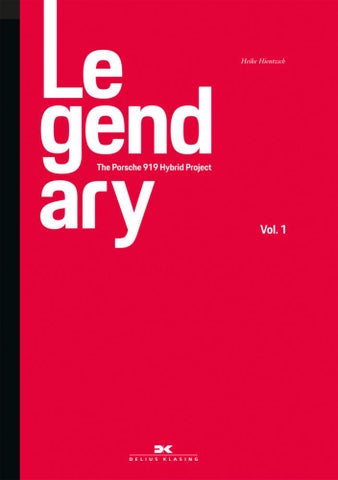
Prologue
Over and over again, the eyelids are losing the battle against gravity. For 14 hours, the race cars have been roaring past outside. Another hour until sunrise, before the first rays of light mercifully emerge over the Dunlop bridge. The mechanics’ overalls are drenched in sweat. The fireproof balaclavas are itching, the radio inserts in the ears are hurting. The night has carved an older version of one self into everyone’s face. The pitch in radio traffic is changing: »Two laps to go, two laps to go.« The next pit stop is due. The tyre man rushes into the garage from behind with his trolley and the pre-heated slicks. Wide awake, the crew is lining up for the service. Their Porsche 919 Hybrid is well down the ranks at Le Mans in 2017. Over one hour of repairs was necessary on Saturday evening. But still: nobody is giving up. The 24-hour race isn’t over until the chequered flag drops. The comeback is in full swing. Ten hours later, Porsche has achieved the almost incomprehensible: the third consecutive victory at Le Mans. The third World Endurance Championship title in a row is to follow almost five months later. And in the drivers’ world championship, 2017 also brings the hat-trick in the fourth and final year of running for the Porsche 919 Hybrid. It couldn’t have been any better. The foundation for this streak of success was laid six years earlier: in the summer of 2011, Porsche’s management board decides to return to
4
DK_Porsche_919_Lesebuch_Innen_Englisch.indd 4
15.11.18 10:40
the top category of the World Endurance Championship for the 2014 season. The main goal: another overall win in the Le Mans 24 Hours. Between 1970 and 1998, Porsche had scored 16 overall wins at the Sarthe. Porsche and Le Mans – a perfect match, closely intertwined in countless stories, impressive records, a world-famous film with Steve McQueen and major technical innovations. In all those years, Porsche had remained loyal to Le Mans with successful campaigns in the GT category. But class victories can never step out of the shadow of the top league. The brilliance of the overall wins threatened to fade. It was time to write a new chapter.
5
DK_Porsche_919_Lesebuch_Innen_Englisch.indd 5
15.11.18 10:40
A clean sheet of paper
»Fritz didn’t even have an excavation pit.« Matthias Müller Chairman of the board at Porsche AG, 2010-2015
6
DK_Porsche_919_Lesebuch_Innen_Englisch.indd 6
15.11.18 10:40
We’ll get it done. That much is certain on 29 June, 2011, as Porsche announces its return to the top category of the Le Mans Prototypes (LMP1) for the 2014 season. The decisive factor for the time of the return is a revolution that is on its way: new regulations will come into force for the World Endurance Championship to include the participation of highly-efficient hybrid-powered race cars. The ideas that are being discussed are promising exactly the kind of engineering challenge the innovative power of which Ferry Porsche already firmly believed in.
In 2011, the board is investigating thoroughly and comes to a wellthought conclusion. Matthias Müller is the chairman, Wolfgang Hatz is the board member for research and development, the father of the project. But: nobody can guess where this journey will lead them. The consequences of the revolution can by no means be envisaged, the dimensions of the programme cannot be estimated exactly and success isn’t guaranteed. But whatever happens and despite board changes: together with the Porsche family, the Porsche management has always backed the involvement and is very often present in the pit box. The reward for the courage and the confidence will be an unparalleled range of achievements and innovations. Surely, Ferry Porsche would have been happy. But when the project started back in 2011, there was still a colossal amount of uncertainties. Staff: A handful of employees. Location: Not yet available. Regulations: Will only be ready in June, 2012.
7
DK_Porsche_919_Lesebuch_Innen_Englisch.indd 7
15.11.18 10:40
Fritz Enzinger
The new head of Porsche’s LMP1 programme has spent his entire
professional life to date at BMW. Having come on board as a young mechanical engineer, Fritz Enzinger is soon attracted by motorsport. Strategic planning, sponsoring, staff structure, team management, driver hiring – his duties have become varied in the course of his career. They are taking the Styrian, always in a good mood and born in Oberwölz in Austria in 1956, through the racing world: touring cars, FIA GT Championship, the overall win at Le Mans in 1999, then Formula 1 until the end of 2009, followed by structural preparations for the DTM entry. Enzinger knows his way throughout the company, is always close to the board. But after BMW’s withdrawal from Formula 1, he is lacking the challenge in Munich. At the Nürburgring, in the summer of 2011, he has a conversation with Matthias Müller. While Timo Bernhard, Romain Dumas, Marc Lieb and Lucas Luhr are on their way to victory in the 24-hour race with their Porsche 911 GT3 RSR, the Porsche chairman is offering Enzinger nothing and everything: nothing is available, but all the opportunities to create are there. Enzinger is immediately excited. »That was the undertaking I have always been dreaming of. I knew
8
DK_Porsche_919_Lesebuch_Innen_Englisch.indd 8
15.11.18 10:40
that I had the experience and the network for it. To top BMW, it just had to be Porsche.« His eyes are sparkling when he looks back, but he also admits: »The first months were difficult. In 2011, I arrived as a stranger into the company in a grey month of November in which the rain never seemed to stop. I was working 14 hours every day and was fighting every battle. There was never so much as a first step in this project. Everything had to happen simultaneously: construction meetings, regulation meetings, recruitment, finances, technology – one meeting followed the next and time went by quickly. Of course, there also were days on which I had my doubts. We had to create a Formula 1 race car with a roof and a highly complex drivetrain. And we had to get the infrastructure in place and had to put the operational team together. Building something that huge from scratch wasn’t just a first for Porsche. Anywhere else in the automotive industry, I also only know of examples in which existing structures were expanded.« Almost at the same time as Enzinger and even before the presentation of the new regulations by Le Mans organisers, the ACO (Automobile Club de l’Ouest) and the FIA (Fédération Internationale de l’Automobile) in June, 2012, Alexander Hitzinger is coming on board as the technical director at the end of 2011. His impressive references: the successful development at British engine manufacturer Cosworth of the first Formula 1 engine to reach 20,000 rpm, then the implementation of the Advanced Technologies department of Red Bull Racing, the Formula 1 World Champions at the time. The German, born in 1971, is the right man for radically new approaches and solutions without compromises. In the development of the car, he is following an extremely aggressive philosophy from the outset. Maximum use is to be made of the potential of the new regulations. First the performance, then reliability, that is his creed. When the car has reached the point where it can make it to the finish of a six-hour endurance race, it has to be capable to win. Enzinger has courage. He turns down the initial idea to outsource the
new project to an external existing race team. Enzinger intends to establish top-level racing at Weissach for the long term and create everything there what is needed. He is fighting and gets the green
9
DK_Porsche_919_Lesebuch_Innen_Englisch.indd 9
15.11.18 10:40
Bigger, faster, further
In 2015, the Porsche LMP1 team is reaching its full size with 260 em-
ployees and meanwhile is acting at a different level. In the early stages, an excursion, a failure or a power cut in the morning could still upset the planning for the day, but now, the operational level is much more stable. In 2015, the people know each other and feel safer in their duties. The fact that the ship is not side-tracked that easily anymore, is the result of many intense private discussions. That is relevant team work in the background, perhaps work that doesn’t win races, but makes it very easy to lose some if left out. Working conditions at Weissach have improved too: development of the 918 Spyder now having been concluded, there is considerably more storage space for the LMP1 programme. The annexation of another adjacent building allows for the installation of five vehicle bays, workshop areas with U-shaped work benches. But space is still insufficient so an additional building is being planned. Time for the next big step: Porsche will now be running three Class 1 prototypes at Le Mans. The development team has learned and implemented at an impressive speed. The drivetrain concept of the 919 Hybrid remains in place, but otherwise, no stone is left unturned. Every single part is being improved: the two-litre, four-cylinder turbo petrol engine is lighter, more rigid and has a more efficient combustion than before. With a fuel consumption limited to 89 kilogram per hour by the regulations and a maximum
82
DK_Porsche_919_Lesebuch_Innen_Englisch.indd 82
15.11.18 10:40
admitted energy yield of 138 Megajoule for every lap at Le Mans, the power output ranges between 520 and 535hp, depending on the outside temperature. Compared to 2014, this is particularly the result of a higher compression rate, a longer stroke and a dualboost charger. Unlike a conventional turbo, it has a double-sided compressor wheel, supplied by separate inlets, and an axial turbine. This combination leads to a significantly reduced inertia moment and, as a result, a considerably better build-up of the boost pressure. The combustion air ratio has increased from lambda 1.0 to lambda 1.3. Meanwhile, 30 development engineers and twelve mechanics are involved with the combustion engine and the exhaust gas energy recuperation alone. Additional staff is coming from procurement, quality management and test bed operation, only for this faculty. Also for enhanced performance, but equally for more efficient aerodynamics, a twin-pipe exhaust system with asymmetric manifolds replaces the centralised exhaust system previously used. Without considering the exhaust gas energy recuperation, the degree of efficiency now reaches an impressive 40 percent. Only with the ERS in the exhaust system, up to four Megajoule can be recovered per lap at Le Mans. Both energy recovery systems, KERS and ERS, were weight-optimised. The accumulated output from both systems has increased by around a third. Accordingly, the system output from the combustion engine and the e-machine is now reaching the level of 1,000hp. The battery has been made no less than 15 kilogram lighter. Test results with a new type of cell were so positive that the decision in favour of the so-called three-quarter battery was already taken at Le Mans in 2014. 75 percent of the more powerful cells are sufficient to still increase the power output. Modifications on the geometry enhance the structural function of the 90-degree V-engine in the chassis, which leads to a better overall rigidity. The gearbox department has shaved off five kilograms in detailed work and further reduced gearshift times. The accumulation of the progress allows for the graduation into the highest energy efficiency class as defined by the regulations. Four levels
83
DK_Porsche_919_Lesebuch_Innen_Englisch.indd 83
15.11.18 10:40
from two to eight Megajoule (MJ) of electric power per lap at Le Mans are available. These 13.629 kilometres are the benchmark. For the other seven race tracks, calculations are adjusted accordingly. In 2014, the Porsche 919 Hybrid raced in the six Megajoule class. Anyone with a petrol engine wanting to recuperate eight Megajoule per lap is only allowed to consume 4.76 litres of fuel. In comparison, 5.07 litres of fuel per lap are allowed in the two Megajoule class. Meticulous calculations are required when opting for the highest energy class, because the more powerful the recuperation and storage systems are, the bigger and the heavier they tend to be as well. In 2015, the Porsche 919 Hybrid has reached the level at which it can be homologated as the first, and in this year, the only prototype to compete in the top class of eight Megajoule. Calculation example for one lap at Le Mans in 2015:
2 Megajoule recuperation = 5.07 l petrol = 3.94 l Diesel 4 Megajoule recuperation = 4.94 l petrol = 3.84 l Diesel 6 Megajoule recuperation = 4.81 l petrol = 3.74 l Diesel 8 Megajoule recuperation = 4.76 l petrol = 3.65 l Diesel For 2015, the monocoque is given an entirely new design. It has now been made in one piece rather than from two parts and considerably lighter and more rigid. The focus is on the sheer performance of the structure. Among the things learned in 2014 is the fact that there isn’t much room left to play with the aerodynamics anyway when it is made as small as the regulations and the space needed to accommodate certain components allow. In order to make any use of the experience from the dÊbut season at all, the entire development and production process is reduced to less than nine months. Even insights from Mark Webber’s accident can still be taken into account. This is done in co-operation with the FIA. The survival cell having performed so well in Brazil and the entire high-voltage technology also having responded as planned, the authorities come to inspect the wreck and include solutions from Porsche into the regulations. The chassis department led by Achim Schulz at the time is presenting a further development of the stroke roll chassis. This ensures a considerably improved handling. The trick of this
84
DK_Porsche_919_Lesebuch_Innen_Englisch.indd 84
15.11.18 10:40
technology: spring and damper forces can be individually defined for straight-line driving and cornering and therefore provide a compromise between opposing requirements: high spring rigidity and damping on the straights for a stabile aero platform, but low spring rigidity and damping in case of lateral forces for a better handling in corners and while running over kerbs. »Downforce, aerodynamics and aero handling,« Timo Bernhard answers right away when asked what, from a driver’s perspective, has brought the biggest progress for 2015. Indeed, the 2014 and 2015-spec cars are worlds apart in terms of aerodynamics. »The 2015-spec car effectively was the first car from our new aerodynamics department,« Damien Favre comments. Flashback: at the time the Frenchman came to join the Porsche LMP Team in July 2013, no such department existed. Alexander Hitzinger instructs him to set it up and to implement the processes required to interconnect Computational Fluid Dynamics (CFD), wind tunnel and track testing. Favre has a wealth of experience. He had been working in Formula 1 for eleven years and also worked in the World Rally Championship. »For Le Mans 2015, you can have a car that is capable of winning. Sooner is impossible,« he explains to Hitzinger in 2013 and starts his work. Starting from scratch, he establishes structures and an organisation, recruits the staff, acquires equipment and looks out for a state-of-the-art wind tunnel. While a handful of Porsche aerodynamicists is working on the 2014-spec Porsche 919 Hybrid with Dallara, structures for the future are being implemented already. The bodywork for the 2015 car is designed at Weissach and tested with a 60-percent scale model in the wind tunnel of the Williams Formula 1 team at Grove in the UK. Meanwhile, the aerodynamics department at Weissach includes 15 employees, with an equal number of experts working on the Porsche at Williams. Instead of 1,000 hours, 2,500 hours are now spent testing in the wind tunnel. The efficiency of surface and CFD calculations increases fivefold. Another important step: Porsche has built its own 1:1 scale wind tunnel at Weissach in the meantime, suited for tests with actual cars
85
DK_Porsche_919_Lesebuch_Innen_Englisch.indd 85
15.11.18 10:40
and primarily meant for future production cars. Favre is making an effort. Indeed, the 919 is the very first car to be tested in the new wind tunnel in December 2014. »The people there had been working incredibly hard for us to facilitate testing at this early date,« Favre says. »That was a great achievement and extremely valuable to compare the insights from track tests and from the 60-percent wind tunnel.« The car, more compact and more delicate in every area, is getting a considerably slimmer and more efficient body. The most visible changes are the new look of the front section and the much more finely designed engine cover with the twin-pipe exhaust system that allows for an aerodynamic use of the exhaust gas. Much debate was involved in the design of the area between the engine cover and the rear end of the car. Here, Favre and his team came up with a particularly clever interpretation of the regulations. In many details, on the other hand, regulations are more restrictive. For instance, 50 percent of the wheel rim surface now has to be open in order to limit the aerodynamic use. Those who determine the regulations and the engineers are living a symbiosis: just as consequently as the ones try to slow down the fast prototypes for safety reasons over and over again, the others are finding ways to enhance the performance. In total, four aerodynamic configurations arise for the 919 in the 2015 season: a first work status of the bodywork for the roll-out in December, a slightly modified version of the Le Mans package for the first two races at Silverstone and Spa, the extreme configuration with minimised drag for the long straights at Le Mans and, above all, for the first time, a dedicated variety with significantly more downforce for the following races. In spite of some adjustments, the Le Mans package means a sacrifice in terms of performance for the seasonopening races that has to be accepted. Favre: »Le Mans simply is the most important race. By making compromises for the two preceding races, we gain in two ways: first of all, valuable time in working with the Le Mans kit and second, months for the development of the high-downforce package for the races after Le Mans.« After all, it is in these six six-hour races in the second half of the season where the majority of the world championship points is at stake. In both
86
DK_Porsche_919_Lesebuch_Innen_Englisch.indd 86
15.11.18 10:40
Spa: strong qualifying, difficult race
Satisfaction after qualifying: the two 919s are on the front row again.
Bernhard/Hartley are happy with their average time of 1m55.793s, the seventh pole position in total for their crew and the first world championship point of 2016. Jani/Lieb set a time of 1m56.590s. On race day, 7 May, asphalt temperatures at Spa exceed 50 degrees. And things are going less smoothly. Hartley is leading until the first stop. Then Bernhard stages a breath-taking duel for the lead with SĂŠbastien Buemi in the number 5 Toyota, the Cologne-based team having built a robust new car. Bernhard gets past at La Source, Buemi counters at Eau Rouge. For Bernhard/Hartley/Webber, however, Spa seems to be cursed: going into lap 37, Bernhard reports a puncture and has to complete almost 7 kilometres before making his stop. On the way, the tyre disintegrates and gets stuck in the bodywork. A wheel is locked, the other one is rotating at vehicle speed. Too much for the differential. A tiny safety ring comes loose, the flange opens, oil is leaking out. The extent of the damage initially goes unnoticed, the mechanics only replace the front section of the car, Webber gets in. On lap 45, however, there is another failure of the left front tyre, chafed on a flic. Webber heads into the pits. At speeds of 300 km/h through Eau Rouge, such significant damage is a highly unpleasant
152
DK_Porsche_919_Lesebuch_Innen_Englisch.indd 152
15.11.18 10:40
affair. Seidl has eye contact with Webber as the car is up on its jack stands in the pit box. He doesn’t like what he believes to recognise in the Australian’s eyes. Fear is a dangerous passenger. He suggests a driver change, Webber willingly gets out. Thorough checks are carried out, the bodywork is repaired. Hartley rejoins the race with the car after a long stop. The front runners have completed 56 laps, the number 1 car is four laps down in 14th place as the next stop is on: the front transmission is affected by the high differential speeds of the two front wheels. At 4.38pm, repair starts and at 6.17pm, number 1 is going back out again in penultimate position, 51 laps down, with Webber behind the wheel. For the future, this experience leads to a new rule: in case of a puncture, drivers are to travel only at 80 km/h until the engineers allow them to speed up. At Spa, Hartley brings the car home in 27th place overall, fifth in the hybrid class. His fastest race lap of 1m58.431s shows what the 919 could have achieved. The sister car can’t unfold its potential either. Lieb has a strong opening stint and is chasing Hartley, but he is reporting an issue with the hybrid system barely six laps into the race. The battery has massive cell malfunctions. In the Porsche pit box, engineers find a solution to control the power in- and output in such a way that the car can be operated with permanently reduced hybrid power and that no further cells will fail. Jens Maurer explains: »The system allowed for the power from the exhaust gas energy to be guided to the e-machine directly, without having to go through the battery.« Once again, mastering this emergency is possible thanks to having the best people on site. In spite of their reduced power, Dumas/Jani/Lieb are in third position because Audi and Toyota are also having difficulties with one of their cars. When the leading number 5 Toyota hits trouble as well, Jani moves up into second place and Dumas brings this position home. Victory goes to Lucas di Grassi, Loïc Duval and Oliver Jarvis with their Audi. The new car from Ingolstadt is a good one too. At the end of this troublesome Saturday, Dumas/Jani/Lieb have extended their lead in the drivers’ standings while Porsche (54 points) has taken over first place in the manufacturers’ standings from Toyota (45) and Audi (41). That is the situation prior to Le Mans.
153
DK_Porsche_919_Lesebuch_Innen_Englisch.indd 153
15.11.18 10:40
The marathon 2016
Marathon is a community with a little over 33,000 inhabitants to the
northeast of Athens. In its vicinity, a battle between Persians and Athenians took place in 490 BC. Allegedly – and highly controversial from a historic-scientific perspective – the messenger Pheidippides had delivered the news of the Athenians’ victory 40 kilometres down the road and died of exhaustion after his run. The marathon as a synonym for a killing distance that has to be completed at any cost is based on this myth. Le Mans is its motorsport equivalent: a marathon for man and machine. And more brutally than ever, it would become apparent in 2016 that there, the journey isn’t the reward. There is a new routine within the team during its third participation at Le Mans, the squad is better prepared than ever before. The success from 2015 is a moral boost and, just like at Audi and Toyota, there are only two cars to manage this time. The new fuel limitation has reduced the engine power, but cornering speeds have increased. The competition has considerably upped the ante, Audi sets the fastest time of the day during the pre-event test.
154
DK_Porsche_919_Lesebuch_Innen_Englisch.indd 154
15.11.18 10:40
In race week, conditions on Wednesday and Thursday are changeable. There are frequent rain showers and interruptions due to accidents. In the only free practice session on Wednesday, both Porsches come out on top and they also end up first and second in the subsequent first qualifying in the dark. As a result of the weather, neither of the two qualifying sessions on Thursday produce any lap time improvements. Therefore, Porsche is on pole position at Le Mans for the 18th time and locks out the front row of the grid for the 15th time. Neel Jani’s fastest time of 3m19.733s is almost three seconds slower than his record lap from the previous year, the effect of the reduced performance and the not entirely ideal conditions. With a 3m20.203s, Timo Bernhard secures second place on the grid for the number 1 car. For the third consecutive year, Jani and Bernhard will be the starting drivers. Weather already having prevented a thrilling qualifying on Thursday, fans are now also deprived at the start which is normally so full of emotion, again due to the weather. From 3pm until 3.52pm, the safety car is ahead of the field for seven laps in the decreasing rain. At least, the rain is then gone for the remainder. On lap nine, Mike Conway is taking the lead in the number 6 Toyota ahead of the two Porsches. After eleven laps, Bernhard hands over to Brendon Hartley who continues with slicks. Jani is called in only one lap later. Dumas takes over, also with dry-weather tyres. »In hindsight,« as Marc Lieb knows, »our change came one lap too late. The minute that was lost in the process, we then had to try to make up for again.« Toyota is changing too late as well, Hartley is in the lead, Dumas in fifth place. The first Audi, Fässler/Lotterer/Tréluyer with the number 7 car, already drops out of the front-running group due to a turbo charger issue in the second hour. The second car from Ingolstadt, the number 8 with Di Grassi/Duval/Jarvis, isn’t fully capable of keeping up with the speed shown by Toyota and Porsche. In the evening, the number 6 Toyota with Conway, Kamui Kobayashi and Stéphane Sarrazin is the fastest car on track and is leading the race. The second Toyota with starting number 5, driven by Davidson/Buemi/ Nakajima, has lost some time in an additional stop due to a puncture. Without any problems, the two Porsches are completing their first triple stints with Mark Webber and Marc Lieb behind the respective
155
DK_Porsche_919_Lesebuch_Innen_Englisch.indd 155
15.11.18 10:40
wheels. In the final daylight, starting drivers Bernhard and Jani take over again. The gaps and positions at the front of the field change permanently. Good or bad luck during the numerous neutralisations have their effect and the tyre performance is changeable as well. At 10.42pm, the two Porsches are swapping positions behind the leading number 6 Toyota. Jani is doing really well and now in second place. Bernhard, on the other hand, aborts his quadruple stint early due to tyre degradation and hands over to Hartley. After only one lap, the Kiwi is back in the pits: the water pump doesn’t work. »That part had never caused any problems,« engineer Stefan Moser sighs, shaking his head. »It turned out to be a quality issue, unknown to the supplier.« At 11.12pm, the number 1 car is pushed into the garage. While the mechanics are working frenetically for over one hour, one driver becomes silent: Mark Webber knows that his last chance of winning the Le Mans 24 Hours has just gone sour. His decision to retire as a race driver at the end of the season had already been taken. He has already informed Fritz Enzinger and Andreas Seidl, nobody else in the team knows it yet. At 0.27am, Hartley makes the first attempt with the repaired car, but already has to stop again one lap later due to excess temperatures: the failing water pump has contaminated the coolant with particles that are now blocking the radiators. These had not been replaced before to save time, a mistake in hindsight. Work continues until 1.56am, Hartley is 40 laps down on the leaders as he leaves the pit box once more. The three show a brave performance to make it to the finish. World championship points are the only thing they can score but in order to reach the required minimum distance to be classified, they have to push hard. Timo Bernhard: »We all dealt with this situation in a very professional way and we soldiered on as if nothing had happened. Kyle, our race engineer, sounded on the radio just like we would still have been fighting for victory. We wanted to show a good performance. That was what we owed to the team and the brand.« Their comeback ends in 13th place overall and fifth position in the LMP1 class. It is the race of the sister cars: shortly before midnight, Jani overtakes the Toyota for the lead and at 0.12am, Dumas is starting his night stint. The duel between the number 2 Porsche and the number 6 Toyota is
156
DK_Porsche_919_Lesebuch_Innen_Englisch.indd 156
15.11.18 10:40
the main talking point of these hours: they alternate in the lead over and over again. For most of the time, it is a duel at a distance, because Porsche and Toyota are on different refuelling patterns. The two 919 Hybrids regularly refuel after 13 laps, Toyota after 14 laps, but needs some more time during every stop and is also slightly slower on track. Fuel management is a science in itself at Le Mans: regulations
stipulate the maximum fuel tank capacity for an LMP1 car in litres. Furthermore, only a specified quantity of fuel may be used during each lap. This is regulated by the energetic value of the fuel. However, the fuel weight varies depending on the temperature while the amount of energy remains unchanged. How many kilograms of fuel fit into the tank therefore changes from the day to the cooler night. During the night, Porsche is also able to complete 14 laps but only just. As this is impossible during the warmer parts of the race, refuelling is only done for 13 laps which speeds up the pit stops. That Toyota is able to drive one lap longer in identical conditions, also in daytime, is probably the result of a different electric drive strategy, so switching off the combustion engine before corners at an early stage. This allows fuel saving. Is it worth it? Christian Eifrig is handling the complicated calculations for the Dumas/Jani/Lieb car. His colleague Jürg Fürst is calculating for the sister car. The sensitive arithmetic is calculated in grams: if, in optimal conditions, the fuel tank with a maximum capacity of 62.5 litres, as specified in the regulations for 2016, can accommodate 44.1 kilograms of fuel, the fuel consumption has to be calculated exactly to one per thousand – this equals a quantity of only 44.1 gram. These minimal units decide if a car makes it for 14 laps without too many compromises in terms of electric drive or not. Both at Porsche and at Toyota, small setbacks occur over and over again during the race. Once, Dumas is losing valuable time as he has to come in for fuel just before a safety car phase and then has to wait for the light at the pit lane exit to go green. At 3.38am, Lieb takes over in the lead. During his second tank interval, he has to come into the pits due to a slow puncture and loses the lead to Toyota again. The two TS050s don’t make it through the night
157
DK_Porsche_919_Lesebuch_Innen_Englisch.indd 157
15.11.18 10:40
totally without problems either. Kamui Kobayashi tangles with a GT car resulting in an aerodynamic inadequacy. Still, the number 6 keeps up with the front-running group until a spin on Sunday morning. Just after sunrise, at 6.15am, Lieb gets out of the car. Dumas continues for ten laps with the same set of tyres, the brief stint is the result of the calculation of stint times per driver and a suitable yellow flag phase. At 6.50am, Jani is taking over. Again, the safety car is deployed. Yellow flags are out over and over again, there is no lack of incidents in this race while the battle with Toyota is an intellectual challenge for the race strategists. To enhance the tyre performance, the next stop with driver change already takes place at 8.41am. Marc Lieb is driving his strong final quadruple stint of the day. »I have done everything for this one race,« he says later. »It probably was the best of my career. I was excellently prepared, the track suits me. Simply everything fitted in this weekend. When I got out after my final stint, I was happy with my performance. That is the level you always dream of, being happy with yourself just once.« Jani is behind the wheel from lap 332 for the remaining three hours of the race. Meanwhile, the number 5 Toyota is the car to beat. Depending on pit stop timing and yellow flag phases, the simulation programme once has the Toyota, the next time the Porsche, as the predicted winner of the race. It is neck-and-neck. With eleven minutes remaining, after 381 of the eventual 384 race laps, the duel seems to have been decided in favour of Toyota driver Kazuki Nakajima: a tyre of the Porsche is losing pressure, Jani has to make an unscheduled pit stop. That’s it then. Mentally, Fritz Enzinger is already working on his statement about second place. But then, the inconceivable happens: »I have no power!« is the desperate radio message from Nakajima to the Toyota pit box. Jani is immediately brought up to date. »Push, push! There are still possibilities,« race engineer Jeremy Moore spurs him on. »First of all, I thought that he was going crazy, with the gap being so big...,« Jani recalls. Toyota manages to get the car going again with electric power, but the Japanese has to let Jani overtake him without a battle and doesn’t even make it into the classification due to his insufficient speed on this lap. Later, a faulty
158
DK_Porsche_919_Lesebuch_Innen_Englisch.indd 158
15.11.18 10:40
The author would like to thank all contributors and supporters, in particular the LMP1 team, who provided unfailing help in documenting the special story of the 919 Hybrid in these books. Bibliographic information of the German National Library: The German National Library (Deutsche Nationalbibliothek) has added this publication to the German National Bibliography (Deutsche Nationalbibliografie); detailed bibliographic information is available on the Internet at http://dnb.dnb.de.
1st edition ISBN 978-3-667-11442-6 © Delius Klasing & Co. KG, Bielefeld Author: Heike Hientzsch Concept: Edwin Baaske, Heike Hientzsch, Anja Wassertheurer Project management: Marco Brinkmann Photography: Porsche AG Sources: Mark Webber, Aussie Grit: My Formula One Journey 2015. Formula1.com, Introducing Brendon Hartley – The Rookie, 2018 Art Direction: Jörg Weusthoff Layout: Weusthoff Noël kommunikation.design, Hamburg Production: Axel Gerber, Jörn Heese Lithography: k2 Konzept, Hamburg Translation: René de Boer, proof reading Martyn Pass Printing: Kunst- und Werbedruck, Bad Oeynhausen Printed in Germany 2018 All rights reserved! Without the express permission of the publisher, the work may not be reproduced, transmitted or copied in whole or in part, such as by manual or electronic means and mechanical systems including photocopying, tape recording and data storage. Delius Klasing Verlag Siekerwall 21 D-33602 Bielefeld Tel.: 0521/559-0, Fax: 0521/559-115 E-Mail: info@delius-klasing.de www.delius-klasing.de
MAP09092018
DK_Porsche_919_Lesebuch_Innen_Englisch.indd 272
15.11.18 10:40