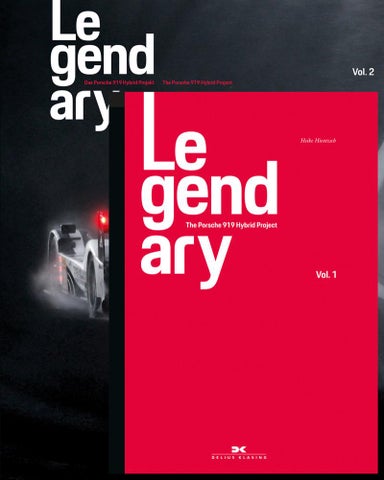
Prologue
the top category of the World Endurance Championship for the 2014 season. The main goal: another overall win in the Le Mans 24 Hours. Between 1970 and 1998, Porsche had scored 16 overall wins at the Sarthe. Porsche and Le Mans – a perfect match, closely intertwined in countless stories, impressive records, a world-famous film with Steve McQueen and major technical innovations. In all those years, Porsche had remained loyal to Le Mans with successful campaigns in the GT category. But class victories can never step out of the shadow of the top league. The brilliance of the overall wins threatened to fade. It was time to write a new chapter.
Over and over again, the eyelids are losing the battle against gravity. For 14 hours, the race cars have been roaring past outside. Another hour until sunrise, before the first rays of light mercifully emerge over the Dunlop bridge. The mechanics’ overalls are drenched in sweat. The fireproof balaclavas are itching, the radio inserts in the ears are hurting. The night has carved an older version of one self into everyone’s face. The pitch in radio traffic is changing: »Two laps to go, two laps to go.« The next pit stop is due. The tyre man rushes into the garage from behind with his trolley and the pre-heated slicks. Wide awake, the crew is lining up for the service. Their Porsche 919 Hybrid is well down the ranks at Le Mans in 2017. Over one hour of repairs was necessary on Saturday evening. But still: nobody is giving up. The 24-hour race isn’t over until the chequered flag drops. The comeback is in full swing. Ten hours later, Porsche has achieved the almost incomprehensible: the third consecutive victory at Le Mans. The third World Endurance Championship title in a row is to follow almost five months later. And in the drivers’ world championship, 2017 also brings the hat-trick in the fourth and final year of running for the Porsche 919 Hybrid. It couldn’t have been any better. The foundation for this streak of success was laid six years earlier: in the summer of 2011, Porsche’s management board decides to return to
4
5
Fritz Enzinger
The new head of Porsche’s LMP1 programme has spent his entire
professional life to date at BMW. Having come on board as a young mechanical engineer, Fritz Enzinger is soon attracted by motorsport. Strategic planning, sponsoring, staff structure, team management, driver hiring – his duties have become varied in the course of his career. They are taking the Styrian, always in a good mood and born in Oberwölz in Austria in 1956, through the racing world: touring cars, FIA GT Championship, the overall win at Le Mans in 1999, then Formula 1 until the end of 2009, followed by structural preparations for the DTM entry. Enzinger knows his way throughout the company, is always close to the board. But after BMW’s withdrawal from Formula 1, he is lacking the challenge in Munich. At the Nürburgring, in the summer of 2011, he has a conversation with Matthias Müller. While Timo Bernhard, Romain Dumas, Marc Lieb and Lucas Luhr are on their way to victory in the 24-hour race with their Porsche 911 GT3 RSR, the Porsche chairman is offering Enzinger nothing and everything: nothing is available, but all the opportunities to create are there. Enzinger is immediately excited. »That was the undertaking I have always been dreaming of. I knew
8
that I had the experience and the network for it. To top BMW, it just had to be Porsche.« His eyes are sparkling when he looks back, but he also admits: »The first months were difficult. In 2011, I arrived as a stranger into the company in a grey month of November in which the rain never seemed to stop. I was working 14 hours every day and was fighting every battle. There was never so much as a first step in this project. Everything had to happen simultaneously: construction meetings, regulation meetings, recruitment, finances, technology – one meeting followed the next and time went by quickly. Of course, there also were days on which I had my doubts. We had to create a Formula 1 race car with a roof and a highly complex drivetrain. And we had to get the infrastructure in place and had to put the operational team together. Building something that huge from scratch wasn’t just a first for Porsche. Anywhere else in the automotive industry, I also only know of examples in which existing structures were expanded.« Almost at the same time as Enzinger and even before the presentation of the new regulations by Le Mans organisers, the ACO (Automobile Club de l’Ouest) and the FIA (Fédération Internationale de l’Automobile) in June, 2012, Alexander Hitzinger is coming on board as the technical director at the end of 2011. His impressive references: the successful development at British engine manufacturer Cosworth of the first Formula 1 engine to reach 20,000 rpm, then the implementation of the Advanced Technologies department of Red Bull Racing, the Formula 1 World Champions at the time. The German, born in 1971, is the right man for radically new approaches and solutions without compromises. In the development of the car, he is following an extremely aggressive philosophy from the outset. Maximum use is to be made of the potential of the new regulations. First the performance, then reliability, that is his creed. When the car has reached the point where it can make it to the finish of a six-hour endurance race, it has to be capable to win. Enzinger has courage. He turns down the initial idea to outsource the
new project to an external existing race team. Enzinger intends to establish top-level racing at Weissach for the long term and create everything there what is needed. He is fighting and gets the green
9
cells. To secure the competitive advantage, they sign an exclusive contract with the manufacturer for the WEC. The high-performance cell is a derivative of the cells that are also used in Formula 1. Porsche is consequently developing them further, together with A123. Once again, the sports car manufacturer is taking a high risk as it is heading into uncharted territory. The courage pays off: until the end of its career in the WEC, the 919 Hybrid will have a battery that is lighter and smaller than those of the competition that will also switch to lithium-ion storage at a later stage. Another advantage of the battery compared to the capacitor is the consistency of voltage under load. This allows for the electro motor and the inverter to be made lighter. The battery of the Porsche 919 Hybrid consists of several hundreds of cells, every single one enclosed in its own cylindrical metal capsule. The battery package is equipped with a new fluid cooling and is more or less located where the passenger seat would be in a production car.
24
Ignition times
Stefan Moser reflects on the development of the combustion engine and the exhaust gas energy recuperation. He has been working for Porsche Motorsport since 2002 and from 2008, he has been project leader drive train for the RS Spyder with which Porsche wins races in the US. At the end of 2008, the works programme with the opentop prototype runs out, but customer teams keep running the LMP2 until the end of 2010. ÂťUnder Wolfgang DĂźrheimer, our board member for development at the time, the RS Spyder always had the character of a learning programme. With a small team, we used this project to get up to speed again in terms of prototype development,ÂŤ Moser recalls. In 2009, the green light is given for a pre-development project referred to as turbo-downsizing. The aim is to compare atmospheric and turbocharged engines with the prospect of potential future involvements in motorsport. Porsche stays on the ball. The LMP1 regulations that are valid from 2011 until 2014 allow for either an atmospheric V8 engine with a displacement between three and four litres or a two-litre four-cylinder turbo. Regulations from 2014 onwards are still unknown. However, indications are that the focus will be on optimising efficiency. That was hardly an issue with the previous turbo engines with restrictors: here, it was the air intake restrictor that regulated the output, minimising fuel consumption was rather unattractive in comparison. It was much more important to use the limited amount of air as efficiently as possible and therefore bring a huge amount of fuel into the combustion chamber to even ignite the smallest part of air. Now, the FIA is developing so-called fuel-flow metres. These are restricting the amount of fuel rather than the amount of air. Consequently, the foundation has been laid for an innovative
25
The record lap Timo Bernhard Porsche 919 Hybrid Evo 29 June 2018
Lateral acceleration in g Gear engaged ➊
Metzgesfeld 251 km/h 2.6 g
Aremberg 142 km/h 2.9 g ➍
Fuchsröhre 329 km/h
Ex-Mühle 156 km/h 2.1 g ➍
Hohe Acht 169 km/h 2.9 g ➍ Klostertal 1 257 km/h 2.6 g ➏
Schwedenkreuz 339 km/h
average speed 233.8 km/h
Schwalbenschwanz 121 km/h 2.6 g ➌
>>>
Flugplatz 273 km/h 3.2 g ➐
Bergwerk 143 km/h 2.9 g ➍
Döttinger Höhe 369 km/h Hatzenbachbogen 242 km/h 2.9 g ➏
Pflanzgarten 278 km/h
Brünnchen 149 km/h 2.4 g ➍
Earl Bamber
Timo Bernhard
Born: 9 July 1990, Wanganui (New Zealand)
Born: 24 February 1981, Homburg/Saar (Germany)
258
259
Earl Bamber
Timo Bernhard
Born: 9 July 1990, Wanganui (New Zealand)
Born: 24 February 1981, Homburg/Saar (Germany)
258
259
Nick Tandy
Mark Webber
Born: 5 November 1984, Bedford (Great Britain)
Born: 27 August 1976, Queanbeyan (NSW), Australia
266
267
Nick Tandy
Mark Webber
Born: 5 November 1984, Bedford (Great Britain)
Born: 27 August 1976, Queanbeyan (NSW), Australia
266
267
The author would like to thank all contributors and supporters, in particular the LMP1 team, who provided unfailing help in documenting the special story of the 919 Hybrid in these books. Bibliographic information of the German National Library: The German National Library (Deutsche Nationalbibliothek) has added this publication to the German National Bibliography (Deutsche Nationalbibliografie); detailed bibliographic information is available on the Internet at http://dnb.dnb.de. 1st edition ISBN 978-3-667-11442-6 © Delius Klasing & Co. KG, Bielefeld Author: Heike Hientzsch Concept: Edwin Baaske, Heike Hientzsch, Anja Wassertheurer Photography: Porsche AG Sources: Mark Webber, Aussie Grit: My Formula One Journey 2015. Formula1.com, Introducing Brendon Hartley – The Rookie, 2018 Art Direction: Jörg Weusthoff Project management: Marco Brinkmann Layout: Weusthoff Noël kommunikation.design, Hamburg Production: Jörn Heese Lithography: k2 Konzept, Hamburg Translation: René de Boer, proof reading Martyn Pass Printing: Kunst- und Werbedruck, Bad Oeynhausen Printed in Germany 2018 All rights reserved! Without the express permission of the publisher, the work may not be reproduced, transmitted or copied in whole or in part, such as by manual or electronic means and mechanical systems including photocopying, tape recording and data storage. Delius Klasing Verlag Siekerwall 21 D-33602 Bielefeld Tel.: 0521/559-0, Fax: 0521/559-115 E-Mail: info@delius-klasing.de www.delius-klasing.de
MAP09092018