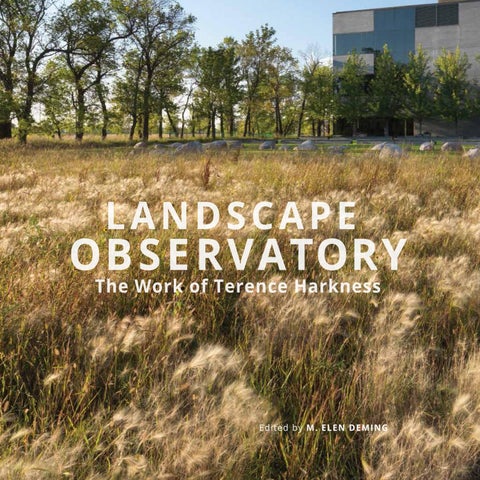
Publisher: AR+D an imprint of ORO Editions
CONTENTS Foreword Gary Hilderbrand 4
Novato, CA www.oroeditions.com info@oroeditions.com Publishers of Architecture, Art, and Design Printed in China
Acknowledgments
6
I. Introduction
Landscape Observatory: An Introduction
M. Elen Deming and Molly Catherine Briggs 10
Formative Landscapes: Biographical Notes on Terry Harkness
Frank Clements with M. Elen Deming 18
A Landscape in Evolution
Brenda J. Brown 30
Library of Congress Catalog Card Number
II. Portfolio
ISBN: 978-1-939621-92-4
The Thinness of Things: Illinois Gardens
10 9 8 7 6 5 4 3 2 First Edition
Douglas Johnston 36
Foothill Mountain Observatory
Copyright Š 2017 M. Elen Deming All rights reserved No part of this book may be reproduced or utilized in any form or by any means, electronic or mechanical, including photocopying, recording, or by any information storage and retrieval system, without permission in writing from the publisher. Inquiries should be addressed to:
Ken McCown 46
Taj Mahal Cultural Heritage District
Amita Sinha 56
Design without Judgement: Emiquon Nature Preserve
Douglas Johnston 64
International Software Campus
Brenda J. Brown 72 III. Reflections
ORO Editions
Place-Based Pedagogy
Gordon Goff: Publisher
M. Elen Deming 82
info@oroeditions.com
A Design Educator
(415) 883.3300
Brenda J. Brown 84
Prairie Plantsman
James Wescoat 92
Borrowed Landscapes: Transforming the University
M. Elen Deming with Kathleen Harleman 94
Afterword Robert B. Riley 100  
Appendices Contributors
104
108
Curriculum Vitae and Project List
Publications List
110
Landscape Observatory par excellence Gary Hilderbrand
We all know the reward that comes with discovery of a designed landscape project that, whether subtly or radically transformative, seems to have risen out of its place—and makes you see the place more acutely, more profoundly. To achieve this, designers must dig into the dynamic characteristics of the territories in which we work, conceptualize their parts, and reorder them with exacting material specificity to make something beautifully fit. Terry Harkness has shown us how to do this and this book is a welcome reflection on his body of thought and work. Whether you have known him as a teacher or colleague, or if you have had only brief encounters, you come to revere the power of his example. Ten years ago, I spent a long weekend with Terry and a handful of other colleagues reviewing professional awards submissions, debating the worthiness of diverse projects whose authors sought the competitive holy grail of peer recognition. We had little time for banter, but over the course of our days together I learned that Terry had driven his trusty station wagon from Illinois to Washington so he could revisit places and passages he hadn’t seen in some years. His itinerary included the familiar agricultural plains of eastern Illinois and central Ohio; the corrugated ridge-and-valley formations along the Allegheny Plateau and Appalachian Mountains of West Virginia, Pennsylvania, and eastern Maryland; and the rolling Piedmont plain that runs to the fall line, where the Potomac meets the coastal plain and bathes Washington’s political landscape in thick, humid air. It’s fitting that landscape architects convene in the nation’s capital annually to judge works from across the US and beyond. For Terry, it matters how you get there. The trip is 700 miles from Champaign to the coast and takes 11 hours on the road to complete. Perhaps longer if you like to explore. My flight from Boston to Washington had taken just over an hour; I’d commandeered an aisle seat where I could squeeze in some correspondence and review details about our assignment for the weekend deliberations. I wasn’t on the plane to observe. But Terry made that trip by car so he could see where he was going—his way of preparing for the jury. Upon learning this, I felt he was rather better equipped than I was to scour the awards submissions for what was really behind them.
his work in the 1986 exhibition, Transforming the American Garden. However, all the participants came away from the jury weekend knowing that Terry’s interrogative practice had made him an agile design critic, a rigorous cross-examiner and persuasive advocate, a consequential teacher, and, above all, a generous humanist. What the authors have captured in this book is a heartfelt, wonderfully rich tribute to the real McCoy. There’s no hiding the admiration on these pages for Terry’s deeply rooted passions, nor the authors’ collective appreciation—we might say envy—of his teachings. Stories like those told here can emerge only from close knowledge of the man himself from prolonged shared times, and described through well-considered scholarly frameworks and close reading of practice. The authors remind us that Terry’s pedagogy in particular gains from the profound influence of Stanley White and the probing ruminations of Bob Riley—two other giants who have enriched and distilled the DNA of the Illinois landscape tradition. How else, and where else, could this happen? It explains so much about Terry Harkness as a teacher. But the authors push us well beyond that, to the core of his personal practice. Through these essays, we arrive at a palpably complete picture of a rare hybrid creature. He is the beloved academic who really works with land. The mid-western diviner whose reading of a landscape in Mughal India prospers with the same astute foretelling as his critical appraisal of an Illinois farmstead. An artisan who possesses a farmer’s straightforward pragmatism but can deliver a gripping sermon on the poetics of the Midwestern horizon or the emblematic role of the hedgerow in a world history of cultivation practices. The gift of this book is that the pedagogy and designed works of this teacher-maker-philosopher are cast in a bright light through the reflections of those who have had either long association or a brief close encounter with him. Within these chapters, you will come to understand Terry Harkness as one who makes us see, with sharper eyes and greater powers, par excellence.
Terry was an influential voice for all of us on the jury. He was skeptical of polished photographs and catchy narratives. He argued for deeply felt, conceptualized landscape thinking over well-honed conventions or scratchy innovations. I’d already known Terry’s penetrating ways since first seeing 4
FOREWORD
|
5
Landscape Observatory: An Introduction M. Elen Deming and Molly Catherine Briggs
In the ebb and flow of landscape design theory, currents of regionalism remain insistent. Since the late 19th century, in the work of Charles Eliot Jr., Warren Manning, Jens Jensen, Richard Haag, A.E. Bye and Lawrence Halprin, among many others, histories of the American designed landscape are marbled with regionalist values. Similar sensibilities are manifested in the work of master designer Terence G. Harkness (1939–). In his thought process, design work, and teaching, Harkness slips around and beyond his own time, simultaneously of his milieu yet also transcending it. Harkness’s work responds to a moment in landscape architecture when cultural geographers, critics, and historians such as J.B. Jackson, Robert Riley, and William Cronon advanced strong intellectual influences on the field, even as postmodern designers explored the limits of formal and allusive processes. Yet Harkness’s practice grows out of very particular intimacies—with a land grant university in East Central Illinois, the epic landscapes of the northern American plains, the fluid pulses of northern California’s mountain topographies. While remaining uniquely synthetic, his method offers clear parallels to the work of other place-based designers, for example Warren Byrd or Christophe Girot. In his keen powers of observation, analysis of regional patterns, and best transformation of landscape cues into new representations of place, Harkness’s body of work may be characterized as a landscape observatory.
A Pedagogy of Seeing. The notion of the observatory speaks to Harkness’s penchant for design
Opposite: Prairie Slope Garden
as a form of teaching—to compel us to “come to attention” and really see the landscape we inhabit. The objective of such precise perception is not limited to ecological process but, rather, leads to holistic comprehension of landscape genesis, cultural co-evolution, and social formation. Not quite an ecologist, yet far more than a formalist, Harkness’s design forms invoke the interdependence of regional cultural history taking place within the biophysical landscape.
at Temple Hoyne Buell Hall, University of Illinois, Champaign-Urbana (photo by L. Brian Stauffer, courtesy of University of Illinois Public Affairs)
Interview with Molly Briggs and M. Elen Deming, August 15, 2011: MCB: Both disciplinary and yet also transcending that, this idea of observation and observatory seems to be a beautiful way to get beyond the moorings of a single site. TGH: Right. It is. It’s behind all my statements … or the questions I’m asking myself – can a garden do that? Well, it’s really asking: Now can we come to attention? Can we observe and can there be instruments made that assist us 10
INTRODUCTION
|
11
A Landscape in Evolution Brenda J. Brown
In his 1970 MLA thesis, A Landscape in Evolution: The Graphic History of Champaign and Piatt Counties from 70,000 BC to AD 1860, after citing J.B. Jackson, May Watts, John Muir, and Henry David Thoreau as exemplary readers of landscape, Terry Harkness stated his hypothesis: [A] pictorial-image format of ”reading a regional landscape” can be a more efficient, more meaningful and more powerful way to understanding than an equivalent written exposition on the same subject. (3) I first became aware of this document in a seminar with Bob Riley who admiringly used some of its pictures while lecturing on the evolution of Illinois’s vernacular landscape. Later, cozy in the old Mumford Hall Library, I pored through its pages, awestruck by the thesis’s scope. Looking at it now I am of two minds. Perhaps the dominant perspective is that of a former student, who encountered Terry twenty-some years after the thesis was finished and who watched his work continue to develop. Yet now I myself advise and evaluate graduate students on theses and practicums so I have a teacher’s perspective as well. I still cannot help but be struck by the project’s ambition, the somewhat foolhardy intention to tell
Above: Delicate Hold (photo courtesy
a largely pictorial 70,000-year history of two Illinois counties. Actually, the original intention was to
of Ken McCown, December 2010)
encompass 110 years more, to extend past the 1860 endpoint to the time of the writing. The many, many drawings are clear, if (as with some of the people and animals) occasionally clumsy. I am also
Opposite: Sycamore with Red
impressed by what a very good student this is, at how he musters and displays so many of the tools
Winged Blackbird. Portrait of regional
and skills gained in his studies to analyze and interpret this Midwestern chunk of earth. And what a
landscape character (photo courtesy
strong will this document’s creator must have had! Indeed, in his support for Terry’s 2007 Jot Carpenter nomination, Bob Riley recalled: “His enthusiasm and innovation made waves here when he was still
of Ken McCown, March 2012)
a student. The Graduate College had to change its Masters thesis format requirements to handle his running text with sketch sidebars.” And he added, “This is still the best introduction to the Central Illinois landscape around.” EVOLUTION
|
31
Terry Harkness, a keen and careful observer of the landscape, sees much more in the apparent plainness of the Illinois landscape. He sees the landscape not as a recipient of imported design forms but as a source of unique form, literally grounded in its place. Harkness’s designs for eastcentral Illinois are not based on conventions of what the landscape should be, but a celebration of what the landscape is. Abstracted and magnified, fields and groves become geometric planes. Where roads and hedgerows border the fields, insertions of edges mark the planes on the ground while hedges and fences frame them. Channels and roads are the figurative and literal expressions of drainage and movement with the horizon separating or joining the earth and sky.
Above: Terry Harkness, n.d. Analysis of landscape elements, patterns, abstraction, and transformation for An East Central Illinois Garden
Opposite: Strays and Shadows, the agrarian patterns of the central Illinois landscape (photo courtesy of Ken McCown, August 2009)
38
ILLINOIS GARDENS
|
39
The orthogonal grid of the Land Ordinance forms the two main spines of the design. The visitor may move along the north-south line up into the mountains on a stair to see and learn the complexities of the plant communities. This trip up the mountains also lets the visitor learn about ecological disturbances of fire and flood, and reveals the management of these disturbances through firebreaks and water retention. An emergency storage drum anchors the north end of this axis in the foothills. The other spine aligns itself with the mountain range, allowing people to see the rising sides of the range tapering into the distance of the Los Angeles basin. Cultural landscapes from different eras and land use types surround this spine. This area tells a story of how water use dictates landscape design style throughout the basin. A walk through this area reveals xeric landscapes of contemporary residential land uses, lush plantings in higher irrigation zones, and agricultural landscapes consisting of crops as well as vineyards. At the east end of this east-west circulation spine is an overlook to a retention module, which enables the visitor to see the managed landscape. A dam bounding a colossal basin collects mud and rock debris from annual floods. This is an engineered landscape but just as dynamic as a natural one. This area is similar to basins all along the foothills that protect Los Angeles from debris destruction during flooding. These basins fill to the top with rock during major storms and then must be emptied of debris afterwards. What a dramatic change in the Observatory, from a fiftyfoot-deep basin when empty, to being flush with the surrounding grade by captured rocks, sand, and mud after rains. Above: Harkness, n.d. (ca. 1996-97). Plan detail of Foothill Mountain Observatory
Opposite: Harkness, n.d. (ca 1996-97). Foothill Mountain Observatory concept for development of landscape typology
To the south end of the site is the spillway and baustrocephinian water recharge system, commonly used in Southern California to replenish groundwater. Water moves down the alluvial fan into spreading fields. These shallow and broad ponds are a magnet for birds along the Pacific Flyway. Visitors would see this intercontinental avian ecological system. Mr. Harkness positions the viewer to stand north of the spreading fields. With the sun to the south, the water would appear golden and opaque from the sunlight, a distinctly different view than the other rugged and rocky parts of the Observatory.
Given the dynamics of this world of materials in motion, as Mr. Harkness suggests, “the design holds it still” at least long enough to perceive their patterns. The Observatory project embraces the complex conditions of landscape through design, not interpretation or metaphor. The observatory is not a representation of regionalism through design, it is a framework of circulation and program to integrate people with natural systems, agriculture, and infrastructure. The design helps recalibrate people to their landscapes, not as nature, or garden, or infrastructure, but as an integrated whole of elements and systems evolving over time to shape and reflect culture. Interview with Molly Briggs and M. Elen Deming, August 1, 2011: TGH: It took me forever to figure out what was going on! This is the world I grew up in, right here. … north of San Bernadino. Those are the alluvial outwash plains and these are eucalyptus and this area was all orchards, down below. … And this whole agricultural type changed in ten years! Before that they tried to do it with dried fruits because they couldn’t do it with fresh fruits [but] when they finally could put ice in cars, refrigerated cars, this worked. This is a story about climate and water. You can grow anything if you can get water to it. That was true then and that’s true today! And here are the suburbs creeping up that hill. [Foothill Mountain Observatory] tells that whole story, about mountain building and wasting… John McPhee wrote about this, he wrote the story of all this mountain building and erosion and destruction and flooding. That is the story of this garden. Look at the axis. It goes right up the mountain, on a crossaxis, and then there are all of these terraces that come off. There you see going up to the two canyons on either side. One is unchanged; the other
A trip along the two spines in the design reveals Southern California agriculture, geology, engineering, culture, ecology, and other factors integrated into the observatory site. The compositional qualities of how the design fits into the local and regional landscape show the potential capacities of the landscape architect to integrate people with their place by letting them see their culture through the Earth’s systems and responses to them. The circulation systems provide the viewers with the maximum "combined total impact" by integrating distant views into the 52
Observatory site to tell the complex stories of the landscape.
has been harnessed. So this brown teardrop shape on the right hand corner collects the boulder and debris from these flash floods. The green trapezoids are actually recharging all the water that comes off and you distribute it through these basins ... The left stays as it is, the right is managed. You don’t see the water in the wet season. You get all these braided streams coming out. FOOTHILL MOUNTAIN
|
53
Design Without Judgment: The Emiquon Preserve Douglas Johnston
In buying a 7000-acre farm near Havana, Illinois, The Nature Conservancy (TNC) did something unprecedented. There had been keen interest by natural resource advocates in the restoration of large floodplain river systems such as the Illinois River, which had been dammed, channeled, and drained over the past century. By acquiring an entire levee district in 2000, TNC could embark on a large-scale restoration experiment to reconnect the river to its floodplain and recreate a landscape that was already lost by the end of the 19th century. This was the genesis of the Emiquon Preserve. TNC planned to reconstruct a stretch of the Illinois River’s historic hydrologic cycle and floodplain lakes in order to increase fish and waterfowl habitat and restore historic floodplain vegetation, including wetlands, prairie, and bottomland and upland forests. However, restoration wasn’t as easy as simply removing the levees that separated the bottomlands from the river. This part of the Illinois River floodplain is as flat as a pancake; small changes in water level result in very large changes in surface area. The irony was that “restoration” would require control mechanisms for very deliberate water management. TNC’s plan for restoration was challenged by other cultural factors as well. From the start, removal of productive farmland in the region challenged public understanding. To the laypersons’ eyes, the crisp order of cultivated row crops would be replaced with unknown mixes of long-dormant seeds, or worse, extensive areas of mud. The Nature Conservancy would need to explain the restoration efforts in a way that could teach, interpret, and reveal the long history of human use and settlement of this landscape.
Above: Emiquon Preserve, Havana, IL. Before—floodplain with agricultural lands beside the levee, showing a controlled burn (photo courtesy of D. Johnston)
Opposite: Austin Tao Associates/ Terry Harkness/ Doug Johnston. January 2006. Emiquon Visitor Use Plan Technical Report, Historic Landscape Types (22)
Our involvement (Terry Harkness and myself) began with an invitation from Austin Tao, a St. Louis landscape architect and Terry’s former classmate, to collaborate in preparing a proposal for a visitor use plan. Recognizing that we were potentially dealing with multiple types of visitors in a very subtle and expansive site (larger than the entire Chicago Loop), the design team sought to reveal EMIQUON
|
65
A Design Educator Brenda J. Brown
Interview with Molly Briggs and M. Elen Deming, August 1, 2011: TGH: The first semester I taught, I was assigned to teach the history of landscape architecture! What are you doing? You’ve never taught before, so why don’t you teach History of Landscape Architecture?!
When I think of Terry Harkness during my student years at the University of Illinois I think first of the slightly impish character that presided in his office on Nevada Street. He sits on one side of a large wooden table facing out a large window to the north, trace paper and color markers near at hand. Nearby too is the stuff of Terry’s ongoing investigations—pop-up books, postcards, and design books, his own photographs, analyses, drawings and plans as well as students’ work. There is also a sort of doll bearing an uncanny resemblance to the man (I always imagined it had been a gift from someone in his family). Over time, I naturally developed a more informed and nuanced picture of him as a thoughtful, diplomatic, and often clever strategist, determinedly positive, yet at the same time not one to suffer fools gladly. Although to my knowledge he always kept his commitments, and generously gave his time to students, somewhat paradoxically he would never be found when he did not want to be. Of course he was, as he continues to be, a committed designer and educator with strong convictions in both arenas. Terry frequently observes that his role as a professor and a practitioner are not so different; both are about educating. Matt Torgerson, who worked with Terry in both roles, finds it difficult to distinguish between the two. Nevertheless, Matt notes Terry’s attentive responsiveness, adaptability, and respect in dealing with clients and points out: “He can make things seem so simple, so distilled, that people do not realize how deeply and carefully he has considered them.” Interview with Molly Briggs and M. Elen Deming, August 1, 2011: MCB: I’ve heard you say, both in print and in person, that all of your work is both didactic and experiential. How do those things happen together and how do you deal with the fact that people have to pay attention on different levels at the same time in order to get it?
Above: Sophomore studio design jury with Terry Harkness, Robert Riley, D. Fairchild Ruggles and David Hays (photo courtesy of Misa Inoue, Spring 2011)
Opposite: Harkness, n.d. ca. 197073. sketch explaining processional route at Saihoji Moss Garden, Kyoto, Japan; course lecture from History of World Landscapes
TGH: Here’s what I learned from Stan White. Stan White would go out on these trips, wonderful, experiential. He’d blindfold people in the studio, and he’d give them things. He’d give them a lemon (remember when lemon juice used 84
EDUCAT0R
|
85
Contributors Molly Catherine Briggs is Instructor in Art & Design as well as a doctoral candidate in landscape architecture history and theory at the University of Illinois at Urbana-Champaign. She holds an MFA in studio art from Northwestern University and has been the recipient of numerous creative and research awards, including the Douglas Dockery Thomas Fellowship in Garden History and Design and a Summer Fellowship at Dumbarton Oaks Research Library. She has also been recognized for outstanding contributions to teaching. Her dissertation, Immersive Media and the Large Parks Movement, identifies representational affinities between panoramas—painted virtual reality environments—and the large urban landscape parks that emerged simultaneously in the nineteenth century. Brenda J. Brown teaches in the University of Manitoba’s Department of Landscape Architecture. Her MLA degree (University of Illinois at Urbana Champaign, 1996) followed MA and MFA degrees from the University of Iowa. Together with Terry Harkness and Doug Johnston, she organized the Eco-Revelatory Design exhibition that opened at the University of Illinois at Urbana-Champaign in 1998 and closed at the National Building Museum in Washington, DC in 2000 and was editor of its catalogue. As designer, artist, writer, and educator, she continues to be concerned with the revelation of landscape ecosystem phenomena, processes, and relationships—particularly with reciprocal revelations of landscapes and sounds—in projects ranging from Florida to Manitoba to Michoacán. Frank C. Clements, FASLA, received his MLA from the University of Illinois at Champaign-Urbana (1971) and his BS in Landscape Architecture from Michigan State University (1965). His working experience in landscape architecture, planning, and urban design spans 45 years at notable Midwestern firms such as HOK Architects (St. Louis) where he worked with Terry Harkness. He also worked at Johnson, Johnson and & Roy, Hitchcock Design Group, and Wolff Clements and Associates (Chicago). Clements has been involved in a wide variety of national and international projects, including national and community parks, office parks, office buildings, corporate headquarters and campuses, industrial facilities, housing complexes, urban and suburban streetscapes, and large mixed-use developments. M. Elen Deming, ASLA, is Professor of Landscape Architecture at the University of Illinois, UrbanaChampaign, where she teaches design studio, history and theory, and research design. From 1993 to 2008, she taught at the State University of New York (SUNY) College of Environmental Science and Forestry, where she also co-edited Landscape Journal. A licensed landscape architect and cultural historian, Elen recently edited the book Values in Landscape Architecture: Finding Center in Theory and Practice (LSU 2015) and has published essays in several scholarly journals. Her co-authored book, Landscape Architecture Research: Inquiry/ Strategy/ Design (Wiley 2011), describes the breadth of research strategies advancing the field of practice. 104
Opposite: University of Illinois at Urbana-Champaign (photo courtesy of Ken McCown, June 2016)
CONTRIBUTORS
|
105