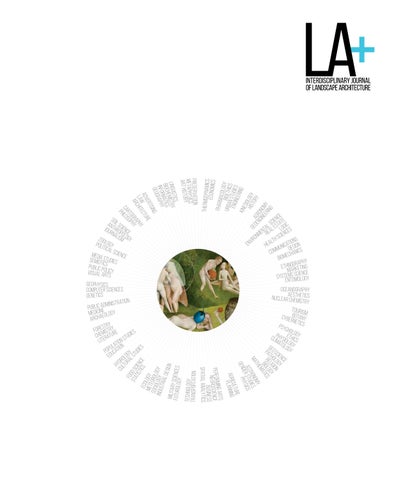
vitality |vīˈtalədē| noun • the state of being strong and active; energy: changes that will give renewed vitality to our democracy. • the power giving continuance of life, present in all living things: the vitality of seeds. Oxford English Dictionary, 3rd Ed.
In This Issue
4
Editorial tatum l. hands + richard weller
68
DISGUSTINGLY VITAL COLIN CURLEY
6
corporeal ecologies sara jensen carr
76
ON HUMAN PLASTICITY JAKE BOSWELL
12
doctor's orders: health and the renaissance garden mirka beneŠ
82
VITAL CONNECTIONS: DESIGNING ECOLOGICAL NETWORKS ANDREW GONZALEZ
20
HABITS OF VITALITY CHUAN HAO CHEN
88
IN CONVERSATION WITH ROB MCDONALD richard weller + BILLY FLEMING
26
DRAWN TO LIFE: DESIRE AND THE CITY COLIN ELLARD
92
TOKYO'S LANDSCAPE FUTURE CHRISTOPHER MARCINCOSKI
34
SHEIKH-DOWN: PLACEMAKING IN DUBAI JULIAN BOLLETER
95
HUMAN, ALL TOO HUMAN MARK KINGWELL
40
DESIGNING HEALTHY, LIVABLE CITIES BILLIE GILES-CORTI, JONATHAN ARUNDEL + LUCY GUNN
100
IN CONVERSATION WITH SIERRA BAINBRIDGE ELLEN NEISES
46
A RURAL UNDERTAKING CLAY GRUBER
56
WHAT HAPPENS NEXT MINDY THOMPSON FULLILOVE
62
IN CONVERSATION WITH JANE BENNETT RICHARD WELLER
Image Credits Upcoming Issues
sara jensen carr
corporeal ecologies Sara Jensen Carr is an assistant professor of architecture, urbanism, and landscape at Northeastern University, and formerly held a joint appointment in the School of Architecture and Office of Public Health Studies at University of Hawaii at Manoa. She was a 2017 Mellon Fellow in Urban Landscape Studies at Dumbarton Oaks, and is currently working on a book for UVA Press titled The Topography of Wellness: Health and the American Urban Landscape.
Environmental Studies, Public Health, Urban Design
N
ature and cities are often conceptualized as opposing forces, the urban condition the cause of illness both actual and existential, and nature as its antidote. Jefferson’s Notes on the State of Virginia warned the social and political ill effect of cities on American culture “as sores do to the strength of the human body.”1 Others have hypothesized cities as bodies writ large, with landscape as the conduit to its vitality: we can easily envision parks as lungs, walkable streets as circulatory systems, water as lifeblood. That place, and specifically the presence of landscape, shapes wellbeing seems intrinsic knowledge. Few would dispute the restorative power of contact with nature, but writings from Hippocrates’s Airs, Waters, Places to Thoreau’s Walden to Wilson’s Biophilia have tried to articulate landscape’s healing powers. From the Industrial Revolution to the early 1900s, the transformation of the urban landscape was a key factor in eradicating infectious disease. But for the better part of the 20th century, advances in medical practice led to treating internal rather than external causes of ill health. However, as we understand more about the myriad causes of chronic illness, the role of place has once again come under examination as direct and indirect cause. Expanded empirical methods mean that we understand more than ever the effects of our environment on our minds and bodies, but the larger and unanswered question is what we do with this knowledge. In the age of Fitbits, wellness metrics, and smart cities, it is increasingly tempting to quantify “green” as a unit that can be dosed and distributed for maximum efficiency. This data-driven approach may indeed be an effective platform to help people understand the power of urban landscape, but to employ it in this manner is unlikely to improve public health. To understand why, we must look to history and carefully consider the implications of this most recent research. Arterial Urbanism
Burgeoning factory development and the influx of people to cities during the American and European Industrial Revolutions made sickness palpable in the air and water. An 1858 issue of Punch magazine depicts the Grim Reaper rowing a boat on the heavily polluted River Thames, the London skyline behind him, making clear the association between urban development and disease. Industrial waste and rapid development blocked out the sun and clogged rivers and streams. Dirt roads and cobblestone crevices were thought to hold filth that also infected the air above them. Many paths abruptly ended in pools of wastewater and polluted marshland. An 1865 report on the sanitary conditions of New York City contains vivid tactile descriptions of reclaimed ground made of “bricks, mortar, slate, gravel, ashes, coal-dust, street-sweepings, oyster, clam, lobster, and egg shells, pig’s hair, shavings, straw, glass, carpets, brooms, refuse materials from tanneries, crockery, bones, dead animals – as cats, rats, and dogs; shoes, boots, feathers, oyster cans, old tin roofs, tin clippings, etc.”2 In most major Western cities, the epidemics of cholera and yellow fever necessitated a partnership between departments of planning and public health, who had little choice but to pave over streams and the ground plane, creating a hardscape that could be washed down and drained.3
Doctor’s Orders: Health and the Renaissance Garden 14
M i r ka Beneš Mirka Beneš is an historian of landscape architecture and an associate professor at the University of Texas at Austin, with a PhD in art and architectural history from Yale University. Prior to her appointment at University of Texas, Beneš taught at Harvard University’s Graduate School of Design for 17 years. Her research and publications focus on early modern society, villa gardens, and vernacular and agrarian landscapes in Rome, and the painter Claude Lorrain.
Garden History, Medicine
B
oth contemporary and historical studies in medicine and design speak repeatedly of “vitality,” the moderns citing the visual-mental effect of greenery on “vital organs” and on lowering elevated “vital signs,” as well as “creating vital landscapes,” and the ancients noting the same effect in ameliorating the flux of “vital spirits” or “vital heat.” Both then and now, vitality was a key index of health and also a key result of the often healing experience of nature and gardens.1 As a historian of landscape architecture, who studies Renaissance Rome and the social and mental experiences of its landscapes and villa gardens, I am inspired by this contemporary research, which has much to teach the historian. And in turn, medical researchers and landscape architects are learning from history; a key player in the field, the landscape architect Catharine Ward Thompson, finds at times “a surprisingly close resonance” between ancient theories and those of today’s researchers, concluding that modern psychology usefully confirms historical ideas on mental engagement with landscape.2 In this essay, I will pair discussion of contemporary concerns with a case study of health and landscape from mid-17thcentury Rome. I will track, using samples from unpublished archival records, the experiences of a Roman noblewoman whose medical reports over 20 years, 1648 to 1668, detail her pathological conditions and the prescriptions by her doctors, which included taking rest in garden settings and taking specific medicines while walking in villas and gardens. This particular female case is seen through the lens of the broader historical picture of health landscapes and that of the medical literature in Renaissance Rome, in which the healthful experience of greenery and gardens was noted by doctors in their treatises. I will begin with, first, a brief historiographical mention of the kind of literature emerging today on health and landscape, and, second, a very brief historical review of landscapes of health and how landscapes over the centuries have been associated with physical and spiritual health. These will provide context for reading the specifics of the historical Roman situation. In the conclusion, I will comment on the “surprisingly close resonance” between past and present perceptions of landscape and health. While concerned with broad issues of demography, social equity, and sustainability, the current research literature has for some time been structured by a sub-category, namely the healing or therapeutic garden. This now constitutes an entire field of study built on foundational research since the 1990s by the architect and planner Clare Cooper Marcus in the US and the architect Roger S. Ulrich in the US and Sweden. Both have global interests in architecture, landscape architecture, planning, and healthcare, and both have bridged disciplinary boundaries between design and medicine.3 Much of their research has focused on evidence-based healthcare design in the settings of hospitals, hospices, and convalescent centers, with an emphasis on healing gardens. What statistical and medical evidence, they ask, supports the self-reported or apparent benefits of gardens to health, both physical and mental?
LA+ vitality/spring 2020 15
Starting in the late 1970s, Ulrich had pioneered in studying the effects of green scenery and vegetation on human health and vitality, and coined the expression “evidence-based healthcare design,” but he was a loner in a field that did not yet exist. This work had a broader context, a generalized return to nature by humans confronting an increasingly urbanizing and industrializing modern world, conceptualized for example in the work of Edward O. Wilson.4 Foundational works were published by Ulrich, Cooper Marcus, and Wilson from the mid1990s, and by 2000 the field of therapeutic gardens had taken off. It includes not only gardens in design and experience, but also measuring the salutary experience of gardening and cultivating plants, for example in horticultural therapy.5 Now, the field is broadening again. Today, landscape architects are increasingly major contributors to the field, and their contributions often center on just how the detailed designs of urban green spaces, gardens, and parks work in equilibrating health and vital signs, including through outdoor activity and exercise to combat obesity. For example, Ward Thompson wishes to widen the approach, “to explore engagement with the natural environment in garden, park, and wider landscape as a means to support healthy behaviors and responses.”6 Health and landscape, natural and designed, have been associated for millennia, whether in the practices of physicians and religious communities or in vernacular culture and folklore. A few key points from ancient, medieval, and modern history of health landscapes can help to situate our Roman Renaissance example.7 In Roman antiquity, the dialectical notion of the city as unhealthful, crowded, and evil versus the countryside as healthful, restorative, and morally good was expressed in the creation of countless suburban and country villas, replete with gardens for medicinal herbs and for exercise, including pools for swimming and cooling. That dialectic has endured for centuries, even in Central Park, New York, and its progeny. Evoking the authority of Greek doctors, Vitruvius, the Roman architect writing around 15 BCE, proclaimed in his Ten Books on Architecture that green surroundings and exercise had beneficial effects on the human body and mind. Many architects should study medicine, he advocated. And he noted a direct causal relationship between exercise, viewing greenery, the air that (he thought) emanated from plants, and ophthalmological health: “Walking in the open air is very healthy, particularly for the eyes, since the refined and rarefied air that comes from green things, finding its way in because of physical exercise… leaves the sight keen.”8 Much of Hippocrates’s thought bequeathed to the Byzantine, Islamic, and medieval European worlds, including his tract on Airs, Waters, and Places, stressed climate, water quality, and a beautiful landscape environment for good health.9 In Medieval Europe and the Islamic East, medicine, food, plants, and gardens went hand in hand, fed by Greek medical tracts translated into Arabic and then into Latin. These pointed to the many roles that flowering plants and their perfumes had in the health of body
1 Magdalena van den Berg, et al., “Visiting Green Spaces is Associated with Mental Health and Vitality: A Cross-Sectional study in Four European Cities,” Health & Place 38 (2016): 8–15. 2 Catharine Ward Thompson, “Linking Landscape and Health: The Recurring Theme,” Landscape and Urban Planning 99, no. 3 (2011): 187–95, at 187. 3 See, e.g., Roger S. Ulrich, “Evidence-Based Health-Care Architecture,” The Lancet 368 (2006): 538–39. 4 Edward O. Wilson, Biophilia (Cambridge, MA: Harvard University Press, 1984). 5 Key studies include Roger S. Ulrich, “Visual Landscapes and Psychological Well-Being,” Landscape Research 4, no. 1 (1979): 17–23; Roger S. Ulrich, “View Through a Window May Influence Recovery from Surgery,” Science 224, no. 4647 (1984): 420–21; Ulrich, et al., “A Review of the Research Literature on Evidence-Based Healthcare Design,” HERD 1, no. 3 (2008): 61–125; Clare Cooper Marcus & Marni Barnes (eds), Healing Gardens: Therapeutic Benefits and Design Recommendations (New York, NY: John Wiley, 1999). Of equal importance in the development of this research field, focused on case studies, is the collaborative work of a landscape architect, a physician, and an urban historian: Nancy Gerlach-Spriggs, Richard Enoch Kaufman & Sam Bass Warner Jr, Restorative Gardens: The Healing Landscape (New Haven: Yale University Press, 1998). For research by psychologists on therapeutic gardening, with a large bibliography, see Jane Clatworthy, Joe Hinds & Paul M. Camic, “Gardening as a Mental Health Intervention: A Review,” Mental Health Review Journal 18, no. 4 (2013), 214–25. This aspect is also related to the large current field of urban agricultural studies. 6 Ward Thompson, “Linking Landscape and Health,” 187–88; also see Catherine Ward Thompson, Peter Aspinall & Simon Bell (eds), Innovative Approaches to Researching Landscape and Health. Open Space: People Space 2 (London: Routledge, 2010). 7 A comprehensive documentary history of health and landscape, including healing gardens, is yet to be written. For the earlier periods, see the excellent account in Carole Rawcliffe, “‘Delectable Sightes and Fragrant Smelles’: Gardens and Health in Late Medieval and Early Modern England,” Garden History 36, no. 1 (2008): 3–21. Fine overviews, mostly on the modern period, are in Gerlach-Spriggs, et al., Restorative Gardens, 7–32; Karen R. Jones, “‘The Lungs of the City’: Green Space, Public Health and Bodily Metaphor in the Landscape of Urban Park History,” Environment and History 24 (2018), 39–58. Also see Cooper Marcus & Barnes, Healing Gardens, 1–26 and Ward Thompson, “Linking Landscape and Health,” 188–93. 8 Several of the new studies published today on health and landscape cite or begin with Vitruvius. The quotation from Vitruvius, The Ten Books on Architecture, Bk 5.9.5, is from Jones, “The Lungs of the City,” 43–44. 9 Ward Thompson, “Linking Landscape and Health,” 188–89; Rawcliffe, “Delectable Sightes and Fragrant Smelles,” 3–21.
clay gruber
A rural undertaking 54
estimated that around 3,800 workers will enter the region within the next decade only to leave within a 20-year timeframe when minerals are exhausted and related employment wanes.16 The question I have asked in my research is whether the energy of the boom can be used in preparation for bust; that is, whether Tonopah can become a better place for both its temporary and, more importantly, its permanent residents. Put another way, I ask whether the 19th-century idea of the company town can be applied productively to the 21st century and if so, how? To begin, I argue that the first role of the designer in the 21stcentury boomtown is to act as an intermediary between incoming private companies and the public sector. This is a form of masterplanning in which design decisions capitalize on a temporary influx of financing, access to innovative technology, and jobs training that companies like SolarReserve will bring to the region. This requires decisions that determine what elements of the boomtown development stay after industry leaves and what goes. In Tonopah, collaborative investment by both lithium and solar interests in a community center and jobs training facility in the middle of the town services both private and public interests during the boom, while transitioning to a community hub run by the city once industry leaves town. As well, medical facilities and other general amenities need to be established at the onset of the boom, given that the closest medical center to Tonopah is over 200 miles away. Once community and industrial amenities are accounted for, an inventory of vacant land, housing stock, and existing landscape conditions (such as, topography and hydrologic features) needs to be established to account for the expansion and contraction of a doubling or tripling of the town’s current size. This process takes ingenuity, as designers need to determine where to locate permanent housing, as well as plan and design
for flexible housing typologies and infrastructure. Moreover, these decisions need to consider how new development can leave or be repurposed after the bust with the most minimal impact on the land and community. The boom also brings with it tools and technology expertise that would have previously cost an exorbitant amount of money to ship to the region. The temporary proximity of these assets to Tonopah along with an increased tax base, allow for the city to invest in infrastructural updates that will make the town resilient in the 21st century. In practical terms, the high desert environment of central Nevada requires investment in water capture and harvesting, as well as turning the grid over to being supported by solar energy. Perhaps one of the most important elements of bringing 21st-century technology into rural landscapes is how access and proximity to these technologies demystifies our current moment of industrial mutation. As members of a given household return home with training in solar technology or computer programming, families begin to see themselves in the evolution of 21st-century society. The built environment needs do the same; not through the futuristic curved polycarbonate forms of its urban counterparts, but through subtle pragmatic gestures that enhance the population’s quality of life. Solarpowered street lamps, technologically advanced urban agriculture practices, and inexpensive infrastructural upgrades prove the process and value of technological upgrades to a skeptical public, rather than its vanity and unfamiliarity. This design work becomes extremely important for both private and public parties. For private companies, particularly ones who deal in extraction and energy, the public has increasingly demanded accountability for the environmental
LA+ vitality/spring 2020 55
and social impact their work has on the land and communities they affect. So much so, that our digitally connected world has taken accountability global, requiring the Ayn Randian industrialists to soften their approach and adopt a benevolent ethos. This creates an opportunity for local governments to work with companies to bring much-needed financing into rural communities that have been struggling to create healthy, livable environments. As Rem Koolhaas argues, “If you look carefully, the countryside is changing much more rapidly and radically than the ‘city.’”17 Yet, this radical change has gone unnoticed by the design community. By looking into how the 21st century is changing our rural environments, we will find opportunities for designers to breathe vitality back into the neglected corners of our world. The consequence of which will only enhance the vitality of our own professions. Entering nearly unexplored territories for the first time, designers have real opportunities to strengthen communities, create new forms of collaborating, and expand our existing toolkits. Opening our eyes to the lost corners of the country by redefining the 21st-century boomtown will be a good place to start.
14 Fred Lambert, “Tesla Gigafactory Now Employs Over 850 Workers, 1,000 More to Come in First Half of 2017 with Production Ramp Up,” https://electrek.co/2016/12/08/ tesla-gigafactory-workers-2017-productionramp-up/ (December 9, 2016). 15 Joe Ryan, “SolarReserve Planning World’s Largest Solar Farm for $5 Billion,” Bloomberg (October 13, 2016) https://www.bloomberg. com/news/articles/2016-10-13/solarreserveplans-world-s-largest-solar-farm-for-5-billion. 16 SolarReserve, “Sandstone” https://www. solarreserve.com/en/global-projects/csp/ sandstone; Rockstone Research, “Prima Diamond Acquires the Green Energy Project in Utah with Historic Lithium Grades of 1700 Mg per Liter,” http://rockstone-research. com/index.php/en/research-reports/667Prima-Diamond-Acquires-the-Green-EnergyProject-in-Utah-with-Historic-Lithium-Gradesof-1700-mg-per-liter. 17 Rem Koolhaas, “Rem Koolhaas Sees the Future in the Countryside,” The Economist (2018), http://www.theworldin.com/ edition/2018/article/14595/rem-koolhaassees-future-countryside.
Below: Cemetery at Goldfield, Nevada.
IN conversation with
Jane Bennett While architecture takes flight, landscape architecture is of the ground. Traditionally, this ground has anchored both the peasant and poet against the centrifuge of modernity, but now the ground itself is full of toxins and detritus “made by man.” So, if it is no longer possible to innocently love this ground, it is incumbent upon us to continue to breathe vitality into it. For this we need first to find new words for old ground. Someone who designers have turned to for these words is the North American political philosopher, and author of Vibrant Matter: The Political Ecology of Things, Jane Bennett. Richard Weller interviewed Bennett on behalf of LA+ Journal.
+ Your 2010 book Vibrant Matter begins with an epiphany as you stare into a puddle of urban detritus in Baltimore. From this unlikely wellspring, you construct an aesthetics and a politics of ecology that challenges the modern (Cartesian) scientific and economic worldview of nature as an inert resource. Can you briefly retrace that arc for us?
It’s less an arc than a wavy line with switchbacks, but the trajectory was, as you say, toward the revival of a (not so) minor tradition of Euro-American thought, according to which materials were really felt to be lively, (quasi) independent forces. These forces were experienced as being operative in nature and also in (though not wholly “of”) human beings. The propelling insight of Vibrant Matter was nothing special: it was simply that even today (in a modern world defined as “disenchanted”), ordinary experience includes moments where so-called inanimate stuff tugs at our sleeves, calls out, enables us to act, and trips us up in flows not wholly of our making or wholly susceptible to rational or technical control. Acknowledging limits to human mastery is a necessary first step toward crafting more effective collaborations with stuff that has its own persistent tendencies and activities. It turns out that human efforts aiming to vanquish rival forces are often less effective than those seeking to form productive if uneasy assemblages with them. (Do not wage a war of annihilation with the HIV virus but keep its viral load below the point where it overwhelms the well-being of the virus-flesh assemblage. Thanks to Jairus Grove for that example. Or, as Deleuze and Guattari said in A Thousand Plateaus “form a rhizome with our viruses, or rather our viruses cause us to form a rhizome with other animals.”)
+ In Vibrant Matter you ask, “What would happen to our thinking about nature if we experienced materialities as actants, and how would the direction of public policy shift if it attended more carefully to their trajectories and powers?” What are the trajectories and powers you refer to, and how might we attend to them more carefully?
Walt Whitman’s Leaves of Grass (currently my favorite book) helps me to name one of those “powers” – specifically, a kind of gravitational or connective power (one could call it a radically apersonal “sympathy”) by which bodies become drawn into each other’s orbit. The example comes from these two lines of his “Song of Myself.” The press of my foot springs a hundred affections. They scorn the best I can do to relate them.
Here, Whitman refigures the act of taking a step as an encounter between foot and ground, where ground too presents itself as a player – as a site and a prompt for “affections.” These affections are irreducible to the sentiment of the human walker. They are apersonal, atmospheric currents springing up between a sensitive foot and a gravity-saturated, moist, and vibratory geo-surface of Earth. These affections are more “affects” than emotions. They “go beyond the strength of those who undergo them,” say Deleuze and Guattari in What is Philosophy? This swarm of affections “scorns” rational comprehension. Human attempts to identify a stable system of relations between the “hundred affections” get bounced back. Also confounded is any attempt to distinguish sharply between cause and effect: the “press of my foot” is, well, mine – or is it the pulling down of gravity? Likewise, the “spring” is a function of foot lifted by walker and the (spring-back) resistance offered by the ground. The odd syntax of the line—“the press of my foot springs” rather than “from the press of my foot springs”—shows human foot, earthly gravity, and affections to be sprung together, quickened into life by virtue of their encounter. Messages I take from this example: human and nonhuman “powers” are always entangled; humans are Earthlings. The example is both poetic and prosaic, for it illustrates something very basic about life, more basic than what the language of “public policy” is able to articulate. How did Whitman even notice the existence of these apersonal trajectories and atmospheric powers? By practicing a technique that he calls “doting.” Doting is a cultivated style of perceiving and describing; it is a highly sensitive “loafing” that luxuriates in the encounter without judging it. It inhabits an interval, which delays judgment. Doting relies upon what Deleuze and Guattari call (in A Thousand Plateaus) the power of the “little detail that starts to swell and carries you off.” The poems model this doting in the hope that the practice will mimetically infect the reader’s own style of encounter. The object of Whitman’s doting includes himself (“I dote on myself, there is that lot of me and all so luscious”), but doting is an appropriate posture toward all kinds of things, including:
+ The story of how MASS got its start is inspiring in terms of how design can make roads beyond the market. Can you tell us how MASS came to be?
We are all aware of the reality that architects design only a small percentage of what gets built in the United States, and across the world. We all experience this fact in our day-to-day lives, and even in some of the important turning points in our lives, such as birth, illness, or death. We also know that how we design or don’t design space inevitably impacts everyone who interfaces with the built world, which is where we land in the idea that design is never neutral, it either helps or harms. MASS’s beginnings really reflect where we are today: we are a group of people coalescing around the idea that design—specifically architecture and landscape architecture, but inclusive of all the allied fields—can do more across the board. It’s not just about the ability or capacity of designers today to be able to provide “design that heals,” it’s about addressing a market that has devalued the importance and significance of a well-designed built environment, and the processes necessary to make that happen.
+ Could you talk more about the focus that you and your partners place on the frontend work – on identifying the places where designers are not going and the design research work that should be done?
Because the challenges are systemic and structural, we have to work beyond what the market currently supports. We go where we think we can achieve maximum effect through design, whether or not there is a fee available there. Instead of only starting with a project that already has a set fee and scope, we’re looking for the partners, organizations, thought leaders, and projects where we think design can amplify the impact of those entities, and helping to define the scope itself. We have found that in most cases, initial design thinking is happening, but designers just aren’t being invited to the conversation. And sometimes, initial design thinking isn’t allowed to happen—or the potential impact of a project is taken off the discussion table entirely—because there isn’t capital to support it. In many cases our upfront work can help partners unlock access to funding for the completion of the design and implementation of their visions.
Previous: In order to build the Butaro District Hospital, MASS hired and trained people from across the community, 50% of whom were women. Above: Calling on the ubedehe “community works for the community” process, hundreds of people from the area came to help excavate the Butaro Hospital site.
We also want to be working within markets, so we’ll go after RFPs or do work where there is already funding. In those cases, we look for opportunities to innovate in a way that can affect positive systemic change in society, in policy, or in a market, and make sure we’re aligned with a partner who is invested in working to that end. An example of this might be working on an RFP for a park, because we know that the municipal entity is dedicated to creating a new model of equity and seeking ways of diffusing the gentrification that inevitably comes with upgrading urban public space, and is willing to do the hard work of shifting policy, zoning, development planning, and procurement procedure to try to find new solutions that don’t ensure displacement of middle- and lower-income communities.
Beyond this, every year we go through that process of thinking about what’s the next thing we want to be tackling. On our MASS staff retreats, we crowdsource areas of work and places of interest and hear what people are most passionate about and where they already have connections. We ask everyone in the office to speak about where they come from, the communities that they grew up in. Or just by being active citizens of the world, can we identify places where our approach to design and architecture and landscape could bring benefit and address certain issues. + Your long-term investigation of health and healing has ranged across many scales. How did you make the progression from your initial health project—the Butaro District Hospital— to thinking about health and vitality at many other scales?
In part because of how Butaro District Hospital came to be, and in part because of how it was received by both the community and the Ministry of Health in Rwanda, we became aware of the potential of health and healing as a really productive frame. In terms of understanding how design can shift policy, at the other end of the scale, it became apparent with Butaro that when the result of a hyper-engaged design process resulted in a campus that was beautiful and unexpected, but geared toward the comfort of the clinicians and patients without adding cost, the improvement on the typical or bare-minimum approach was undeniable. This made it easier for ministry officials who had the power and ability to scale innovation within the country (and at this point across the region, as Rwanda has become a model healthcare system internationally) to argue for replication of this design methodology. At the smaller scale, we learned that if we design the process, we can design for impact and for healing. We learned from working with the contractors, furniture builders, masons, day laborers, and how they came to contribute to and own the project, that the process of building itself offers many layers of impact. After the hospital opened, we learned about the different ways that each person who worked on the project felt ownership and pride. Many shared that the new skills they gained helped them to better provide for their families, and you could see the ripple effects this was having even a few years out. They were telling us about living in better housing, having increased access to education and healthcare, increased economic opportunity – each of which underpins improved health. Our data on this is at this point qualitative and anecdotal but, to me, undeniable. And there are other moments that I think also hint at potentials for healing we’ve yet to cultivate. One of my early Rwandan colleagues was our first choice on an amazing project to build a conservation school in the Congo with the African Wildlife Foundation, but he wasn’t able to go because of political tensions between the two