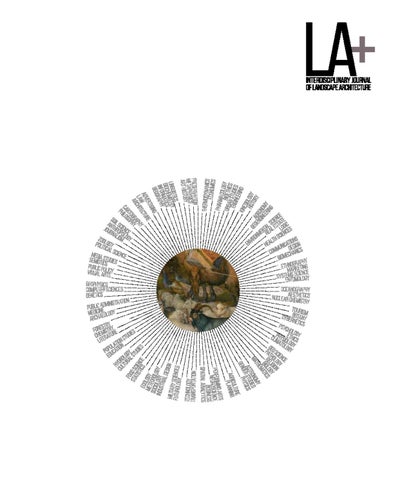
creature |the brief| the LA+ CREATURE design ideas competition asked designers to: • choose a nonhuman creature as a client (any species, any size, anywhere) and identify its needs (energy, shelter, procreation, movement, interaction, environment, etc). • design (or redesign) a place, structure, thing, system, or process that improves the creature’s life. • contribute, through the design, to increasing human awareness of and empathy for the creature’s existence. Results within
In This Issue
4
Editorial RICHARD WELLER + tatum l. hands
6
creaturely entanglements lori gruen
12
jury q+a chris reed, kate orff, timothy morton, jennifer wolch, andrew grant, farre nixon
68
aroussiak gabrielian
72
dan parker + stanislav roudavski
76
aashti miller, aitor frÍas-sÁnchez + joaquÍn perailes-santiago
80
conor o'shea
84
huong dinh
22
winning entries
24
niko dellic + ambika pharma
88
sadie imae + natalya dikhanov
30
catherine valverde, youzi xu + elizabeth servito
92
yiru wang + yun wang
36
feras abdallah + calla rose ostrander
96
salon des refusÉS
42
bingjian liu, heejung shin + esther jung
48
arthur lam
54
honorable mentions
56
marzia micali
60
zhou wang
64
hillary dewildt
Upcoming Issues
Endpapers: "The Entry of the Animals into Noah's Ark" (1613) by Jan Breughel the Elder, public domain via Wikimedia Commons. Editorial: Image by Ian Dillon.
LA+ cREATURE/FALL 2021 5
CREATURE editorial Throughout history landscape architecture has typically prioritized humans and plants over animals. It may be, however, that the animal, long neglected by the field, is becoming an increasingly important way into understanding and reenvisaging the landscapes of the Anthropocene. Animals provide key ecosystem services, they serve as mascots for larger environmental issues, and efforts to preserve them can galvanize communities. More than this, recent scholarship and advocacy points to the bigger idea that quite apart from what they can do or mean for us, animals have their own lives. And just as we value our own, theirs also warrant our respect and moral consideration. Now, for the first time in the history of design a movement of actively cocreating with animals is emerging and it was this movement that the LA+ CREATURE design competition sought to consolidate. Judged by landscape architects Kate Orff, Andrew Grant, Chris Reed, and Farre Nixon, along with the former Dean of Environmental Design at University of California, Berkeley, Jennifer Wolch, and ecological philosopher Timothy Morton, the LA+ CREATURE competition attracted 258 entries from 31 countries. Specifically, the competition asked “whether we can live with animals in new ways, whether we can transcend the dualism of decimation on the one hand and ‘fortress conservation’ on the other, and how we can use design to open our cities, our landscapes, and our minds to a more symbiotic existence with other creatures.” Entrants were then required to do three things: choose a nonhuman creature (any species, any size, anywhere) and identify its needs (energy, shelter, procreation, movement, interaction, environment, etc.); design (or redesign) a place, structure, thing, system, and/or process that improves the creature’s life; and contribute, through the design, to increasing human awareness of and empathy for the creature’s existence. The jury chose five equal winning entries and awarded 10 honorable mentions. In 2017, Marcus Owens and Jennifer Wolch scoured design websites and blogs for projects concerning animals to see if they could draw some general conclusions. Of 86 mainly hypothetical projects produced during the period 2000–2014, they found that 72 were for vertebrates (including 12 bats or birds), 12 were for arthropods (including seven bees), and two for other invertebrates. In addition to the fact that birds, bats, and bees seemed to be popular among designers, their conclusion was that most designs were more a form of “architectural practice as brand-building in the contemporary moment…rather than designing for animals per se. By comparison, of the 258
designs proposed in the LA+ CREATURE competition, 69 were for invertebrates (including 53 arthropods), 171 for vertebrates, and 18 for miscellaneous other creatures (including microbes and fungi). While there certainly were a considerable number of birds, bats, and bees among them (48, 12, and 12 respectively), submissions ranged across an impressively broad spectrum of creatures from large to small, wild to domestic, familiar to unknown, and friendly to deadly. And the designs were largely focused on the welfare of creatures, including interventions to address human exploitation of animals, to rethink the way in which we live and work with animals, and to restore habitats and food sources devastated through human action or inaction. Furthermore, many entrants sought to meet animals on their own terms and challenged the complicated problem of distanciation between us and them. This issue of LA+ documents all the awarded entries, as well as a Salon des Refuses of entries that, for both conceptual and graphic reasons, caught the judges’ eyes. To help make sense of this fascinating collection of work, each member of the jury responds to the same set of interview questions. And to close, we feature an essay by Lori Gruen, a leading scholar in critical animal studies, where she discusses the work and helps us understand it in its broader philosophical context. LA+ sincerely thanks all those who participated.
Tatum L. Hands + Richard Weller Issue Editors
Creaturely Entanglements
Lori Gruen
The more coherent one becomes within oneself as a creature, the more fully one enters into the communion of all creatures.1 Wendell Berry
Lori Gruen is the William Griffin Professor of Philosophy and coordinator of Animal Studies at Wesleyan University in Connecticut. She is the author and editor of 11 books, including Entangled Empathy (2015), Critical Terms for Animal Studies (2018), Ethics and Animals (2011), and Ethics of Captivity (2014). Gruen documented the history of the first 100 chimpanzees used in biomedical and behavioral research in the US and maintains the evolving website The Last 1,000 (http://last1000chimps. com), which follows the journey to retirement of the last 1,000 chimpanzees to serve in this capacity in the US.
ANIMAL STUDIES, ETHICS
Above: The Rhinoceros by Albrecht Dürer.
R
ecently, the New York Times Magazine published an indepth story about the death of Sudan, the last male northern white rhinoceros on Earth.2 Sudan died a few years before the story ran, on March 19, 2018, after living a long, transcontinental life. His death was movingly described in Sam Armstrong’s stunning piece that explores a particularly elaborate, and in all likelihood, doomed, conservation effort to save this subspecies from extinction. Though Sudan was the last male, two females remain, his daughter Najin, and his grand-daughter Fatu. Neither have been able to reproduce, but there is a scientific hope, perhaps better described as sci-fi or fantasy, that their eggs may be used to eventually produce offspring. The Institute for Conservation Research at the San Diego Zoo has created a Frozen Zoo® that contains over 10,000 cells, eggs, sperm, and embryos from 1,000 species, including the northern white rhino.3 They have 12 cell lines developed from Sudan’s kind, and their goal is to develop stem cells to create sperm, and perhaps use Najin and Fatu’s eggs, to create an embryo that will be implanted into a reproductively successful southern white rhinoceros in an attempt to re-establish a sustainable population. Armstrong describes this as “a reproductive hail Mary” as the odds are stacked against a successful birth, and even if baby northern white rhinos are born, the problems with keeping them alive in the wild are daunting. Without armed guards, even in protected territory, the remaining two females would surely be dead already. As Armstrong notes, “Some billionaire would no doubt pay a fortune to own the horns of the last two northern whites.”4
Creaturely Entanglements 8
Whether rich or poor, Homo sapiens have wreaked havoc on the planet and the other creatures who live on it. In May 2019, the United Nations reported that around one million animal and plant species are threatened with extinction.5 In addition to the northern white rhino, the Javan, Sumatran, and western black rhinos are effectively extinct. Orangutans in Borneo and Sumatra are expected to be extinct in roughly a decade. Various tortoises, bats, and many different toads, frogs, lizards, and other amphibians have been classified as extinct. Insects are going extinct at alarming rates, although it is hard to determine actual numbers. The population of monarch butterflies has been consistently tracked and is now down 90% from 20 years ago; that is approximately 900 million butterflies gone.6 Bumblebee and many spider populations have drastically declined. Polar bears, giant pandas, Cross River gorillas, and other megafauna are at great risk, as are hundreds of less charismatic creatures like eels, clams, and birds. Size, lifeways, and years on this Earth (it is estimated that rhinoceros have roamed the planet for 50 million years, a long run that is close to its end) don’t stop the catastrophe unfolding around us. No place is safe. We are heating the seas and leaving them strewn with plastic detritus degrading the ecosystems of the world’s oceans. We’ve had a similar impact on land-based ecosystems. It is estimated, for instance, that a billion animals were killed by the fires that scorched Australian landscapes during the first few weeks of the hot season 2019–2020. These human-generated cataclysms haven’t spared the animals who soar through the skies. Billions of birds have vanished in nearly all areas of North America since the 1970s. LA+ CREATURE could not be more timely and illuminating in the shadow of this anthropogenic mass extinction. The brief and designs help us to imagine different, more empathetic and symbiotic, ways of living with other creatures, ways that may sustain us all.
In one of the winning designs, Catherine Valverde, Youzi Xu, and Elizabeth Servito focus on the deleterious impact of human encroachment on the watershed that was home to the California tiger salamander. They propose repurposing golf courses to restore wetland habitats for the salamanders using three strategies, “vegetate, separate, and celebrate.” The plan calls for restoring vegetation to support vernal pools, separating salamanders from humans to avoid damage from foot and car traffic, and celebrating the beauty of the shift from golf course greens to a Californian botanical garden. I’d like to broaden our thinking with these strategies, in the hope of revealing tensions and opportunities for reimagining our vexed relations with the more than human world. While vegetating in the context of landscape design has a distinctive meaning, in a more colloquial and metaphorical sense, the term is often applied derogatorily to humans to liken them to plants. As young environmentalists like Greta Thunberg chastise policy makers for their inaction in the face of climate catastrophe, we might say that most humans are indeed vegetating as the planet burns. But that is unfair to plants that are sometimes more active than commonly thought. Interesting, although controversial, scientific research has suggested that humans may be “more plant-like than we would like to think, just as plants are more animal-like than we usually assume.”7 Our general passivity has allowed destructive human consumption and the extractive industries that support it to go largely unnoticed and unchecked, essentially condoning the status quo. This sort of inertia is just one side of vegetation, however. The other, of course, is growing and thriving in all sorts of conditions, hospitable or not. Perhaps we can reimagine vegetating as a process that quiets the mind so that new ideas can sprout – a helpful strategy in the face of the growing crises.
LA+ cREATURE/FALL 2021 9
Many of the designs for LA+ CREATURE adopt the second strategy of separating humans from the animal “clients” in order to protect the creatures while at the same time highlighting their unique life worlds. Separation can provide animals space to attend to their social and material needs and desires without worrying about ever-present human encroachment. This opportunity is particularly important for social animals, allowing them to deepen relations with others of their kind, to develop specific cultures, to communicate, to play, and to create. Individual flourishing, in humans as well as other animals, crucially depends on a sustaining and sustainable space to be more than separate individuals and relish experiences with conspecifics and kin. Conscientiously separating them from us by creating protective, sometimes prosthetic, habitats provides new opportunities for them to thrive. It also provides humans with the opportunity to both rectify prior destruction and to see anew the ways other beings live, love, move, and ultimately die. Yet separation is arguably the most powerful force that has led us to the planetary, as well as the political, crises we now face. Separation is a necessary part of the process of othering that grounds the oppression of those picked out as different. Racial and gender binaries are central categories of othering, as is the separation of humans from nonhumans. That humans are variously thought to be “at the top of the food chain” or “closer to God” or “outside of nature,” and other animals (as well as Homo sapiens deemed not quite human) are considered less valuable, has served as a justification not just of exclusion, but instrumentalization, exploitation, and indifference. Separation can also obscure the ways in which we are variously entangled. There is a common illusion that we can escape the relationships we are in, separate ourselves, whoever those selves are, from others. Of course, we can separate some
animals from others for everyone’s good, and we can separate ourselves in many instances from harmful and troubling others. But we are all, deeply, inseparably, entangled with others. We can’t always, perhaps ever, fully transcend the relationships we are in but we can work to understand and improve them, in part, by improving our own self-conceptions. As Wendell Berry observes in the epigraph above, making one’s self coherent and intelligible will allow us to more fully engage with others. Our relationships with human and animal others co-constitute who we are and how we configure our identities and agency, our thoughts and desires. We can’t make coherent sense of living without others, and that includes other animals. We are entangled in complex relationships and we can’t separate from all of them. Rather than imagining that separation is always a viable strategy we may do better to think about how to be more perceptive and more responsive in our entangled relationships. That we are already in relations should ground our desires to more conscientiously reflect and engage with others. Since we exist in relation with other organisms, and our perceptions, attitudes, even our identities, are entangled with them and our actions make their experiences better or worse, which in turn affects our own experiences, we have good reasons for focusing our attention on these social/natural entanglements. That attention can lead us to want to improve on these relationships as we don’t want to be in “bad” or “abusive” ones. Since we are already, inevitably in relationships, it makes sense to work to make them better, more meaningful, and more mutually satisfying. But recognizing that we are inevitably in relationships, replete with vulnerability and dependency, doesn’t mean that we should accept those relationships as they are. Not all relationships are equally defensible. Relationships of exploitation or instrumentalization are precisely the sorts of relationships that we should work to imagine changing.
Creaturely Entanglements 10
Importantly, we are not just in relationships as selves with others, but the self is comprised of what Karen Barad calls “intra-actions.” Barad argues that the idea of “intra-action queers the familiar sense of causality (where one or more causal agents precede and produce an effect) and more generally unsettles the metaphysics of individualism (the belief that there are individually constituted agents or entities, as well as times and places).”8 What this means is that there is not an individual that exists prior to and separate from the entangled intraactions that constitute them. But, importantly, the individual that emerges from her entanglements is distinctly constituted by particular intra-actions. Understanding and reflecting on our entanglements is part of what it takes to constitute our selves.9 There is no self or other prior to our intra-actions. While everyone is entangled with others and to some extent with various forms and forces of life, there also are separate embodied beings who organize their perceptions and attitudes as a self, however porous, vulnerable, or shifting her boundaries may be. Most discussions of how to think about our relationships with other animals fail to attend to the particularity of individual animals. The category “creature” itself obscures important differences and relationships. Beavers, birds, and bats are animals, but we are in different relationships with each. Particular relationships with some birds, like owls, gives us virtually no context for understanding and empathizing with other birds, like pelicans, and the same holds true for bats. And within each group, there are individuals who have distinct personalities and likes and dislikes that get overlooked when we fail to separate them out. We are in a continuous dance between othering and sameness, separation and entanglement. In response to othering, there is often a cry for inclusion, but these are awkward pleas as
inclusion has tended to lean toward sameness rather than difference – “we too are human,” “we too are valuable,” “we too matter.” Inclusion often is based on likenesses with those at the center; chimpanzees are more like human children than chinchilla or coral are. This process of “saming” then leaves those who are too different beyond our grasp. Importantly, those within the valued category themselves, who may also be different, will have their differences ignored or overlooked by saming forms of inclusion. When what we are focused on is similarities—how general types of intelligence or cognitive skills are shared, or some sensitivities and vulnerabilities are shared, or the same emotional responses are shared—distinctively valuable aspects of the lives of others become obscured. In failing to attend to separate ways of being, we ignore valuable aspects of different lives. There may be occasions when pointing out similarities has a strategic function, perhaps to call attention to those who have been denied recognition. But in doing that, the obfuscating impulses of saming and the too quick retreat to separation need to be regularly kept in check. Dancing between recognition of our robust entanglements and appreciation of our distinctness is one way to celebrate the magnificence of the more than human world. But in this celebration, as in perhaps most celebrations, we inevitably encounter loss. Huong Dinh’s honorable mention design presents a clever way of moving from loss to celebration, death to life, passivity to engagement. She proposes an alternative curriculum, the “Life of L” for young people who are ordinarily introduced to the northern leopard frog drenched in formaldehyde, taking students out of the biology lab and into the world to see frogs anew and alive, in a holistic, immersive encounter. It is a terrific celebration of the complexities of the failures and possibilities in our relationships with others. L is, as Dinh notes, no longer an abstraction, but “a protagonist in their
LA+ cREATURE/FALL 2021 11
own story with their unique worldview.” Frogs, birds, beavers, octopus, walruses, spiders, cicada, crab, eels, and many other creatures make their own distinct meanings in the world, but though they may have individual worldviews, our world and theirs are inextricably entangled. Our encounters can be harsh and extractive, we can kill or sicken them, and they can pass along deadly pathogens to us. Alternatively, as Donna Haraway suggests, we can make kin with other creatures.10 In so doing we will take on responsibilities that require that we not only learn about the worldviews of others, but empathetically work to try to understand what would make their lives better and bring about the conditions that make that possible. Imagine if we all had a brief encouraging us to redesign the world to improve all of our creaturely lives. That would really be something to celebrate.
1 Wendell Berry, What are People For? (Counterpoint, 2010), 11. 2 Sam Anderson, “The Last Two Northern White Rhinos on Earth,” The New York Times Magazine (January 6, 2021) https://www. nytimes.com/2021/01/06/magazine/the-lasttwo-northern-white-rhinos-on-earth.html. 3 Institute for Conservation Research, “White Rhino,”_https://institute.sandiegozoo.org/ species/white-rhino.(accessed January 30, 2021). 4 Anderson, “The Last Two Northern White Rhinos on Earth.” 5 United Nations, “UN Report: Nature’s Dangerous Decline ‘Unprecedented’; Species Extinction Rates ‘Accelerating,” https:// www.un.org/sustainabledevelopment/ blog/2019/05/nature-decline-unprecedentedreport/ (accessed January 30, 2021). 6 Brook Jarvis, “The Insect Apocalypse is Here,” The New York Times Magazine (November 27, 2018) https://www. nytimes.com/2018/11/27/magazine/insectapocalypse.html. 7 Josh Gabbatiss, “Plants can See, Hear, Smell – and Respond,” BBC Earth (January 10, 2017) http://www.bbc.com/earth/story/20170109plants-can-see-hear-and-smell-and-respond. 8 Karen Barad, Meeting the Universe Half-way (Duke, 2007); Karen Barad, “Intraactions,” Mousse Magazine 34 (2012). 9 For a fuller discussion of entanglement see Lori Gruen, Entangled Empathy (Lantern, 2014). 10 Donna Haraway, Staying with the Trouble: Making Kin in the Chthulucene (Duke, 2016).
The Jury Nixeedorff morantolch
HONORABLE MENTIONS 88
SADIE IMAE NATALYA DIKHANOV Desert Rain Frog
Breviceps macrops
T
he desert rain frog went viral when a 30-second clip of the small, soft, globular, sand-encrusted being appeared on YouTube, squeaking loudly. But this brief stint in the public eye didn’t bring attention to its precarious living situation in the delicate coastal ecosystem of South Africa and Namibia, damaged by diamond-mining operations that destroy dunes and displace the endemic flora and fauna that have adapted to live there. As the frog doesn’t travel far on its stubby limbs, it can’t easily relocate to another suitable habitat. Today, the mining operations have mostly moved on, but not without leaving deep tracks. Additional threats now include transportation, tourism, housing developments, and crop farming. We propose a transportable pavilion system that plugs into abandoned mining sites to heal the landscape. Mining operations produce acid that leaches into water and soil. Sulfate-reducing bacteria, by feeding on algae, are able to break down harsh metals in the water and return it to normal pH-levels. The
polluted water circulates until purified. Once treated, the algae pavilions and bioreactors are moved to the next mining site, and the now-treated water goes to neighboring human communities. We want to inspire awe of algae, fog, dunes, and the desert rain frog. These phenomena are often considered nuisances, or simply go unnoticed. Here they are openly displayed and celebrated. Nonhumans are the artists of the pavilions’ facades – the rising and falling algae levels and condensation generate the texture and decoration of both interior and exterior. Humans, limited to an elevated walkway, can traverse the landscape or walk along the polluted/purifying body of water inside the pavilions. Wooden posts create a field: easy to navigate for frogs, hard for humans. This matrix makes clear that humans are visitors, allowing the dunes to regenerate undisturbed, and restoring home and habitat for the desert rain frog.
5º E
10º E
15º E
20º E
25º E
30º E
35º E
40º E
45º E
20º S 25º S 30º S 35º S
25º S
30º S JAN FEB MAR APR MAY JUN JUL AUG SEP OCT NOV DEC
0
DESERT RAIN FROG
10 mm
FOG / LOW CLOUD (FLC) OCCURRENCE FREQUENCY ON THE WEST COAST
SCIENTIFIC NAME
Breviceps macrops CLASSIFICATION
Brevicipitidae TYPE
Fossorial (burrowing / underground living) COASTAL VEGETATION
BABY NAME
Tadpole, polliwog, froglet
Namib Namaqualand Cape Subtropical
COLLECTIVE NOUN
Army, colony AVERAGE LENGTH
40-60 mm LIFE EXPECTANCY
4 to 15 years
RESOURCES
Diamond Copper Iron Coal Gold
BREEDING SEASON
Late summer to early fall FAMILY UNIT
During breeding season, male makes call to attract females GEOGRAPHICAL DISTRIBUTION
ABANDONED MINES
South Africa and Namibia
Mines Major towns
NATURAL HABITAT
White coastal sands, areas with >75 fog-days/yr DIET
Beetles, insects, and their larvae WORLD POPULATION
PH LEVELS
Decreasing
< 8.0 8.0 - 8.4 8.4 - 8.5 > 8.5
CONSERVATION STATUS
Near Threatened (proposed: Endangered) PROTECTION STATUS
None PREDATORS
0
200
400 km
Humans and their endeavors
RELATIVE FREQUENCY OF FLC OCCURRENCE (%) 0
4
8
12
16
20
24
28
salon des refusÉs 128
1
LA+ cREATURE/FALL 2021 129
2
1 Jingyi Zhou, Shuzhen Gao + Xiao Tan: A transnational network of communities and landscapes devoted to supporting the monarch butterfly to make its epic annual migration from Mexico to Canada. 2 Madeleine Ghillany-Lehar + Rohan Lewis: Textured shade structures encourage lichen growth for woodland caribou in logged old-growth forests.