FOREWORD The Kunstmuseum Basel (Basel Art Museum) is among the most internationally renowned museums of its kind. Its world-famous collection, the Öffentliche Kunstsammlung Basel (Public Collection Basel), comprises over 300,000 works spanning eight centuries, from the late Middle Ages to the present day. The core collection, the ‘Amerbach-Kabinett’ contains fifteenth- and sixteenth-century art treasures (panels, drawings, prints and the private library of the humanist and lawyer Bonifacius Amerbach) and was purchased by the city in 1661, transferred to the University and made available to the public. As a result, the city of Basel has the oldest public art collection in the world. We owe this unique corpus to the friendship between Amerbach and his considerably more famous contemporaries Hans Holbein the Younger and Erasmus of Rotterdam, both of whom lived in Basel for a considerable period at the beginning of the sixteenth century. Auguste Rodin (1840–1917) Les bourgeois de Calais The Burghers of Calais, 1884–1889 Bronze (Ex. 7/12, Cast Alexis Rudier: 1942/43). 216.8 x 255.6 x 196.6 cm Purchased with funds from the bequest of Prof. Rudolf Handmann-Horner, the Lottery Fund, private contributions and grants from the MeisterwerkFund, 1948
Dan Flavin’s installation in the large inner courtyard of the Kunstmuseum Basel, Untitled. In Memory of Urs Graf, 1972 Concept / 1975 Installation Gift of the Dia Art Foundation, New York, 1980
4
|
KUNSTMUSEUM BASEL
The good fortune of being able to grow over a number of centuries while largely escaping wars and other catastrophes has given the Öffentlichen Kunstsammlung Basel an unusual degree of historical continuity, although it does not contain works from certain periods that are available in museums of comparable art-historical breadth, for instance the Italian Renaissance or baroque art. Another striking feature is the absence of the kind of monumental works that are typical of royal and noble collections. However, the Basel collection came into being in a small commercial city state that largely escaped geopolitical catastrophes. Basel was thus able to retain its wealth while also having the advantage of a continual supply of new ideas from immigrants seeking refuge from religious or political persecution.
FOREWORD
|
5
The way the collection continued to develop after 1900, and in particular its quality, are unquestionably unique. Unlike famous art museums in Munich, Paris, London, Vienna and Madrid, the striking feature of Kunstmuseum Basel is the impressive collection of twentiethcentury art – an expression of the broadening of this city’s horizons and of visions of collecting that, unlike those of other European cities, were not interrupted or even destroyed by political events. Since the early sixteenth century, there has also been a distinctive tradition in Basel of philanthropic commitment to the common good, combined with a great affinity for culture and research, which have regularly been of crucial benefit to the Öffentliche Kunstsammlung. The period after the First World War saw the start of a phase of intensive growth in the collection of international modern art of the nineteenth and twentieth centuries. After the Second World War this was supplemented by donations and bequests, in some cases sizeable, from private benefactors such as Raoul LaRoche, Maja Sacher-Stehlin, Marguerite Arp-Hagenbach, Richard Doetsch-Benziger, Max Geldner and Martha and Robert von Hirsch. In addition, considerable financial donations made it possible to extend the museum, such as those of Maja Sacher-Stehlin 1980 (opening of the Museum für Gegnwartskunst / Museum of Contemporary Art) and her niece, Dr. h.c. Maja Oeri, whose farsightedness and generosity enabled the museum to purchase the Laurenzbau in 1999 and pay for the new building in 2016. Another contributory reason for this generous patronage was probably the fact that,
6
|
KUNSTMUSEUM BASEL
Barnett Newman (1905–1970) Day Before One, 1951 Oil on cotton, 334.7 x 127.3 cm Donated by the Swiss National Insurance Company on the occasion of its seventy-fifth anniversary (1958), 1959
despite the modest purchasing opportunities, my predecessors further expanded the collection at a consistently high level, both retrospectively (how can we fill more of the gaps?) and with an eye to the future. Last, but not least, a number of artists have made important donations to the museum during their lifetime – including Samuel Birmann in the nineteenth century and, more recently, Hans/Jean Arp, Pablo Picasso, Jasper Johns, Frank Stella and many others. The variety and quality of our collection up to the present day mean that exhibitions can be created from our own collections, something that many larger museums can only dream of. With this in mind, in this book we wish to present a selection of our most significant and popular works: Der tote Christus im Grab / The Body of the Dead Christ in the Tomb by Hans Holbein the Younger, the first version of Arnold Böcklin’s Die Toteninsel / The Isle of the Dead, Pablo Picasso’s Les deux frères / The Two Brothers and Andy Warhol’s Black and White Disaster #4 – just a fraction of what you can discover in the Kunstmuseum Basel. Josef Helfenstein Director Kunstmuseum Basel
FOREWORD
|
7
Hans Baldung Grien 1484/85–1545
Jugendliches Selbstbildnis Youthful Self-Portrait, ca. 1502 Pen and brush in black, heightened with pink and white, on blue-green primed paper: 22 x 16 cm Kunstmuseum Basel, Kupferstichkabinett, Amerbach-Kabinett
This drawing of the artist, when aged about 18, ranks among the most remarkable works in the museum’s Kupferstichkabinett (department of prints and drawings). It is unusual in a number of respects. It is one of the earliest self-portrait drawings to have survived north of the Alps. Hans Baldung Grien probably drew it in around 1502 at the start of his time as an assistant in the Nuremberg workshop of Albrecht Dürer. He may therefore have created this image of himself at the instigation of Dürer, who was intensely preoccupied with the depiction of his own person. In this portrait, with its almost fully frontal close-up view, narrowly defined image and its subject gazing directly out of the picture, Baldung displayed a new independence in both the conception of the picture and the drawing technique. His chosen technique of chiaroscuro drawing – unusual in a self-portrait – together with the rare combination of blue-green primer with pink heightening displays evidence of an exceptional creative passion. This economical and effective use of hatching shapes the individual features of the face and brings it to life. The realistic representation of the shaggy hat adds a special accent: this is a Zottelhut – a felt hat with wool, linen or silk pile attached, thus imitating more costly fur hoods prescribed in sumptuary laws relating to dress. In combining this elegant Zottelhut with the mesh hood that holds his hair in place, Baldung created an extravagant outfit that he hoped would stake his claim as a person of high status. The concept of artistic precocity may have played a part in this self-portrait, which links youthful appearance with great skill. It is possible that Baldung used this drawing to recommend himself to the master.
8
|
KUNSTMUSEUM BASEL
YOUTHFUL SELF-PORTRAIT
|
9
Matthias Grünewald 1480/83–1528
Die Kreuzigung Christi The Crucifixion, ca. 1515 (?) Mixed technique on lime wood, 74.9 x 54.4 cm Kunstmuseum Basel, acquired before 1775
Depictions of the crucifixion at the end of the late Middle Ages occasionally combine symbolism and realism, functioning alternately as historical reporting and visual devotional aids. The expressive Matthias Grünewald, creator of the Isenheim Altarpiece now preserved in Colmar, was destined to master this complex creative task like no other artist. The Basel panel was long considered to be one of Grünewald’s early works; however, the similarities to the crucifixion panel of his magnum opus, the Isenheim Altarpiece, which was not produced until somewhere between 1512 and 1516, cannot be overlooked. The scene in this panel is depicted in the same way as in the altarpiece, with the darkness that is mentioned in the Synoptic Gospels (Mt. 27:45; Mk. 15:33; Lk. 23:44), but rarely illustrated, miraculously descending at midday over Golgatha. In the distance we see the outlines of Jerusalem. Christ’s maltreated body stands out brightly, bearing bloodstained stigmata. With sovereign disregard for human anatomy, the painter has given him terribly extended arms, with which he is brutally stretched on the cross. The intention was to make the faithful vividly aware of the magnitude of the act of redemption and move them to pity. The Virgin Mary on the left, the woman standing behind her – one of the women whom the Bible reported to have been present at the foot of the cross – and Mary Magdalene embracing the stem of the cross, express their grief in various ways. On the right the favourite disciple John and the Roman centurion represent the male gender. The centurion is given particular importance as, according to the three Synoptic gospels, he summarised the event in one conclusive sentence: ‘Truly, this man was the Son of God’. Immediately behind the centurion’s head Grünewald used gold paint to inscribe these words in Latin.
10
|
KUNSTMUSEUM BASEL
Hans Baldung Grien 1484/85–1545
Der Tod und die Frau Death and the Woman, c.1520/25 Mixed technique on lime wood, 29.8 x 17.1 cm Kunstmuseum Basel, Museum Faesch, 1823
Death claims everyone, even beautiful young women. This was already the theme of the late medieval Danse Macabre, an artistic allegory that showed all classes of society caught up in a dance with death. After 1500 the variety of their themes was often reduced to a strikingly erotic duo, celebrating feminine beauty while also emphasising its transience. The theme of the confrontation between a terrifying figure of death and a radiant beauty offered the artist a welcome opportunity to get to grips with depicting a naked female body. Hans Baldung, who was active mainly in Strasbourg and was constantly preoccupied with motifs of death and the erotic, developed a predilection for this subject: in this painting, Baldung has interpreted this subject in an extremely original fashion. Death holds the woman’s head very gently and tries to steal a kiss from her, which of course appears grotesque in view of his bony skull. Taken by surprise, the young woman is still unaware of what any viewer admiring her alabaster body can clearly perceive – the fact that she is standing on a slab covering a tomb and that the oversized cloth she wishes to wrap around herself is a shroud. In this way Baldung actively involves the viewer in his pictorial strategy and brings psychology into play – two approaches that point far into the future of European painting.
12
|
KUNSTMUSEUM BASEL
13
Franz Marc 1880–1916
Tierschicksale (Die Bäume zeigten ihre Ringe, die Tiere ihre Adern), Animal Destinies (The Trees showed their Rings, the Animals their Veins), 1913 Oil on canvas, 194.7 x 263.5 cm 1793 Kunstmuseum Basel, purchased with a special loan form the Cantonal Government of Basel, 1939
A catastrophe overtakes the animal world. Strong fiery-red diagonals that split and cross one another are the visual manifestation of an apocalyptic power extending over the entire surface of the painting and seizing hold of the animals. The victims react in very different ways: startled horses alongside apparently indifferent wild boar and deer nervously sniffing the air. At the centre is a lone blue deer. It stretches its long neck towards the rays and accepts its fate with dignity. In 1915, while serving at the front during the First World War, Franz Marc received a postcard reproduction of this picture and was hugely moved by the sight of his own work, recognising in it a ‘premonition of this war’, which would claim his life in 1916. The large-format painting was publicly exhibited for the first time in 1913 at the Autumn Salon in Berlin. In 1916 it was shown in Berlin and Munich as part of a memorial exhibition in honour of Marc. This was organised by the avant-garde magazine Der Sturm, which promoted expressionism and had intended to mount the exhibition in February 1917 at the Kunstverein Wiesbaden. However, a devastating fire broke out in the art courier’s storage depot and almost one third of the painting fell victim to the flames. In 1919 it was at last cautiously restored by Marc’s artist friend Paul Klee. Klee worked with the aid of colour studies and photographs of its original state. He carried out his reconstruction in brownish tempera paints, leaving the burnt edge visible as a reminder of the destruction. Klee is said to have suggested to Franz Marc that he should call the painting Animal Destinies. It originally bore the title The Trees showed their Rings, the Animals their Veins.
52
|
KUNSTMUSEUM BASEL
ANIMAL DESTINIES (THE TREES SHOWED THEIR RINGS, THE ANIMALS THEIR VEINS)
|
53
Robert Delaunay 1885–1941
Hommage à Blériot Homage to Blériot, 1914 Leimtempera auf Leinwand, 250 x 251 cm G 1962.6 Kunstmuseum Basel, purchase, 1962
Hommage à Blériot is a major work by Robert Delaunay and a key work of the branch of abstraction formed by colour. On 25 July 1909 the pioneer of aviation, Louis Blériot, made the first crossing of the English Channel in an aircraft he had built himself. Robert Delaunay was fascinated by technological progress and expressed his admiration of the brilliant inventor in this painting, where one can make out a motionless propeller, a flying biplane and a second emblematic aircraft. The motif of the painting was partly inspired by the countless visits made by the technology enthusiast artist to the Buc aerodrome, which was located in the Ile de France, not far from Paris. The Eiffel Tower in the background locates the scene close to the city. Delaunay pays his own homage to modern technology by applying the laws of simultaneous and complementary contrast formulated by Michel Eugène Chevreul in his nineteenth-century theories of colour. Simultaneous contrast affects the way we see colour – a correction process of the eyes, in which the perception of a colour is strengthened by the adjacent complementary hues. Delaunay discovered the effect of these laws through painting socalled ‘sun discs’ and realised that the sensation of movement can be produced by simultaneous contrasts arranged in circles. The sun discs in the right foreground of Homage to Blériot evoke the rotations of a starting propeller. Their motive power is given free rein and they extend across the entire picture, thus determining the inner cohesion of the composition. The dedication to Blériot is not so much a souvenir of the magic moment of the first cross-channel flight as a tribute to the great aircraft constructor, with whom Delaunay felt a sympathetic connection through his own avant-garde artistic inventions.
54
|
KUNSTMUSEUM BASEL
Wassily Kandinsky 1866–1944
Improvisation 35, 1914 (May) Oil on canvas, 110.3 x 120.3 cm G 1966.11 Kunstmuseum Basel, gift of Hans Arp, 1966
I mprovisation 35 comes at the end of the first phase of Wassily Kandinsky’s pioneering development from realism to abstraction. From 1908, when he began to develop his abstract pictorial language, he often used musical terms for the titles of his works. Improvisation 35 is the last of a series of consecutively numbered ‘improvisations’, which he had begun in 1909. In his theoretical writings from this period Kandinsky distinguishes three categories: ‘impressions’ give an impression of external nature; ‘improvisations’ are involuntary, largely spontaneous, articulations of inner, mental processes; ‘compositions’ are large-format works created more slowly and deliberately, but that nevertheless combine elements drawn from preliminary studies and improvisations. Kandinsky sought a pictorial language for the spiritual dimension – far from the material or externally visible world. Although in many places Improvisation 35 triggers associations with real objects, the shapes avoid any more precise determination and the connections are lost in the juxtaposition of clearly defined and blurred zones, the contrast between pale, pastel shades and bright or dark colours, and the dynamic rhythm of rapid movement next to calmer areas. The picture was painted in Germany in 1914. Shortly afterwards, Kandinsky, who was Russian by birth, was forced to leave Germany at the outbreak of the First World War and return to his native Moscow, leaving his paintings behind. The artist Hans Arp bought Improvisation 35 after 1920 and refused to sell it, even in times of financial deprivation. After Arp’s death in 1966 the painting passed into the collection of the Kunstmuseum Basel.
56
|
KUNSTMUSEUM BASEL
IMPROVISATION 35
|
57
Piet Mondrian 1872–1944
Composition aux couleurs claires avec contours gris (Composition avec grille 7) Composition: Light Colour Planes with Grey Lines (Composition with Grid 7), 1919 Oil on canvas, 49.1 x 49.2 cm G 1968.87 Kunstmuseum Basel, donation Marguerite Arp-Hagenbach, 1968
Taking the analytical division of the pictorial space used in cubism as his starting point, from 1912 onwards Piet Mondrian’s compositions became increasingly abstract. In 1917 he finally expunged all memories of the phenomenal world from his paintings. Whereas the titles of his previous pictures had related the abstract forms to landscape or architecture and the composition had been adapted to the physical space of the viewer’s experience, from this point on, for the rest of his career, the forms in his works withdrew into themselves. He reduced sculptural devices to geometric abstraction: he endowed line, colour, form and surface with their own qualities – they represent nothing but themselves. He began to structure the entire canvas with vertical and horizontal lines. He inserted rectangular fields of colour in the resulting grid, thus producing a flat two-dimensionality with no illusion of depth. Composition: Light Colour Planes with Grey Lines comes from the beginning of this change. In this picture, Mondrian has used many grey lines to create a grid with very small fields filled with various light shades of grey. The muted colours, which gradually come closer to one another, with nuances that seem like mutations of a single tone, become meaningful as variations relating to an integrated whole of tone and format. The grid is finite, and as if to indicate the specific finality of the structure of the painting, Mondrian closes off the grid at each of the four corners of the canvas with strips of equal size. In this way, he prevents the picture from becoming no more than an example of a structure that would bring abstract painting dangerously close to decorative art.
58
|
KUNSTMUSEUM BASEL
Ernst Ludwig Kirchner 1880-1938
Stafelalp, Rückkehr der Tiere Stafelalp, Return of the Animals, 1919 Oil on canvas, 120.5 x 168 cm G 2017.10 Kunstmuseum Basel, gift of Eberhard W. Kornfeld 2017
Kirchner moved to Davos in 1918 seeking a place in the mountains to recover from a war-related emotional breakdown. Using the expressionist techniques he had developed before the war, he concentrated on portraying the surrounding mountains and the rhythm of the simpler farming life of Frauenkirch. This painting can be seen as a companion piece to Alpaufzug (‘Ascent to the Mountains’), which he had completed earlier in 1919. Both works were painted in a studio space in the so-called Lärchenhaus that Kirchner rented from a farming family. These are among the most important paintings that Kirchner created in Davos, contrasting the momentum of the herds being driven up to higher pastures in the morning with their return to lower slopes in the evening at the end of summer. Kirchner shows 11 of the 16 huts on the Stafelalp where the cows were milked near a stone-built dairy, in which the milk would be stored and cooled with spring water. In front of the dairy is the young goatherd with six goats, somewhat larger compared with the small figures of the farmers, who are waiting outside the huts for the cows, scattered across the middle of the picture. The well, shown in the centre of the picture, still exists, and is a place where farmers can still draw their water. In the background are the dominant mountains the Rinerhorn in red and, to the right, the rocky Leidnachhörner. The picture is still in the original frame designed by Kirchner. One of the sons of the Müller family from whom he rented the Lärchenhaus was a carpenter and made it for him according to his wishes.
60
|
KUNSTMUSEUM BASEL
STAFELALP, RETURN OF THE ANIMALS
|
61
We are indebted to our colleagues, past and present, for their careful research on the collection of the Kunstmuseum Basel. This edition © 2020, Scala Arts & Heritage Publishers Ltd in association with Kunstmuseum Basel Text and photography copyright © Kunstmuseum Basel, 2020, except as follows: pp. 37, 39, 41, 47, 49, 50–5, 67, 71, 75, 77, 79, 81, 85, 87, 89, 91 © ProLitteris, Zürich; p. 73 © estate of the artist; p. 83 © the artist; p. 93 © the artist; p. 95 © the artist. Every effort has been made to acknowledge correct copyright of images where applicable. Any errors or omissions are unintentional and should be notified to the Publisher, who will arrange for corrections to appear in any reprints. First published in 2020 by Scala Arts & Heritage Publishers Ltd 27 Old Gloucester Street London, WC1N 3AX 10 9 8 7 6 5 4 3 2 1 ISBN: 978-1-78551-308-4 All rights reserved. No part of this book may be reproduced, stored in a retrieval system, or transmitted in any form or by any means,
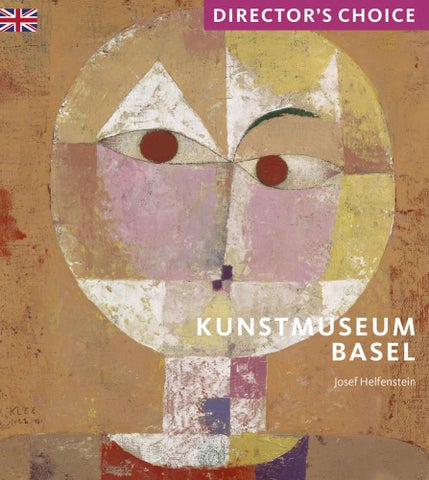
Front cover:
electronic, mechanical, photocopying, recording, or otherwise,
Paul Klee
without the written permission of Kunstmuseum Basel and Scala
Senecio (Baldgreis), 1922
Arts & Heritage Publishers Ltd. Back cover: Director’s Choice® is a registered trademark of
Hans Holbein the Younger
Scala Arts & Heritage Publishers Ltd
Portrait of Erasmus of Rotterdam
Project manager: Claire Young
Writing, 1523
Translation: Rae Walter in association with
96
First Edition Translations Ltd, Cambridge, UK
Frontispiece:
Graphic design: Heather Bowen
Caspar Wolf
Printed and bound in China
Glacier Lauteraar, 1776
|
KUNSTMUSEUM BASEL