T
iny dots surrounded by blue at the edges of world maps. A remote place that hides stories on their way to extinction. That’s Kiribati, a country situated in the middle of the Pacific Ocean, which has ended up in the news because of the tragic fate that would seem to await it. Many scholars say it will be the first country in the world to disappear, literally, owing to climate change, in twenty, thirty, fifty, one hundred years’ time depending on the projections. An ocean that continues to grow and is so threatening that Anote Tong, President of
iribati until 2015, devised a plan B K aimed at surviving the greenhouse effect: mass migration to a piece of land 1,864 miles away, in Fiji, purchased in 2014 from the Anglican Church. We found the story to be so intriguing and fascinating that we decided to travel the 9,176 miles that divide us from it. A journey laden with questions, expectations, uncertainties, an experience filled with meanings—all of which different—for us and for all the people we met along the way. We left Italy expecting to find a nation in a state of emergency, frightened families with their
170° E
175° E
180° E
175° W
170° W
165° W
160° W
155° W
10° N
H
International date line
MARSHALL ISLANDS
150° W 10° N
aw
ai
i
Kingman Reef (US) Palmyra (US)
5° N
5° N
Teraina Washington Tabuaeran Fanning
Makin Butaritari
Howland (US)
Abemama
Nikunau
Phoenix Islands
Tamana
Arorae
Kanton
McKean
Enderb ury
le
Birnie
Malden
ip e
r
te
Rawaki Phoenix Manra Nikumaroro Orona Sydney Hull Gardner
om
ar
in
5° S
Starbuck
C
av
is o
tt
5° S
0° N
Line Islands
io
Onotoa
ni
Tabiteuea
az
Banaba
Equator Jarvis (US)
PIPA
ic
Nonouti Beru
KIRIBATI
Baker (US)
un
Kuria Aranuka
0° N
Kiritimati Christmas
Gilbert Islands
m
Maiana
Marakei Tarawa
co
Abaiang
TUVALU
TOKELAU Caroline Millennium
10° S
10° S
Vostok Flint
SAMOA WALLIS AND FUTUNA 15° S
AMER ICAN SAMOA
FIJI
COOK ISLANDS
VANUATU
Republic of KIRIBATI
and the Central Pacific
NIUE
60 FRENCH 125 250 375 POLYNESIA
TONGA
MILES
20° S 170° E
175° E
180° E
175° W
170° W
15° S
165° W
160° W
155° W
500 20° S
150° W
TM OM U ST O CS CU SS
r r
E VIIR RONMEN N NTT E NV E
lant s P ant u e recio us Pl ur o as ureA P reci e Tr eas58. A P thing f Clo Tr 58. ce o f Clothing e i h a P ce o ugh in Pie ug orld in a W orld W r e de i er r de ri ONM
HA H B I A B IT S TS
46. A 46. A Guest Is G u e st I Com s C in 70. I om g 22. In t t’ h s f e i n 22. In th M7o0o.nIt’s Alw g for D 72.eAMo lighAl ay or in no t w s D 10702. .TAn Enndligaht ays Sun inne End nd ne Su da 100. he T e n y a a a T h e Teachenrd a Beg day che ’s MBe in n r ’ 78. A s Margrin i Que 52 a ia ni 78 s . A r Q 52. T ria uestion tio of .T n W o f Wo o
S S
TY ETEY CICI OO
76 30. A7 . The 6 30. A P.leTahe First s P lea anFtirst Tim 80. I s san Hi T e 80. I olated t H tchime sola a itc ted nd h an Co d C nn on ec ne te ct e 6 98 6 98. W .W
CL CU UL TUTU
4 4
REE R
56 56 62.6W 2. W . W. eWea h h o evoeerveravinvging oa’shA ah 1021.02. NoN ’srA FinFin s s k rk ds ds a o tOonO AraTdraede TieTdietd Cal Cla 2. T e’nseW ’s W 32.3A am m ristrist 86.86. F I F I m m i a ndind giangin a t sasa ioantion Is Is NN o t Eot E no no 34 34 20.2A 0. A .T.T L L he he 38.3T8. Thuckuycky he Fe F N N a a u u i t hfithfumbmb ul l B B
yay aD herheDr notnot berbeOrnOene mum Is AuN Is A ng nges es rorwrowuleuN le g g r o . R. R o 4 4 omom 8 8 s s rd rd
CITVIIV IT ITEISE S AT AC
L RA L U A T R TU NA A N
92.9L 2.aL uagu hghi LeL ftjaArjar ingnHgeHe fteA lpslps YoYo u Du D ig ige es s tYtY MiM 9 9 sfoisrftourtu ne nTe T 90.9C 0.aC reare hy hNy N 2 2 amam 74.7D 4.aDan nce ce e e ,a,a La La ng ng
S EF LI FS B EE L I E B
r or oo AoD 2. D 82.8A ok ook BoB eikae a d d k i L L an an ism ky kyn’snL’s Lepteipcitsicm d d a Sk Sk e She SMaM h ft of 48.48. o T o T o t 4. 4. . N6. NHinHin 6 2 2h a h a it it
ing Sing g the ngin by e lSyi es ed y thite tiz befin elyLeav no izendd initof aves yp ot . I efgic Le me H n 96 nda c of I p erfu 2. Hy 96h. e M agi f P ume .T eM od ll o erf 2. 18 . TrhFo odSpe ll of P mber Nu ber 18 u Fohe pe o T r e S ucky Num ou 4. Th L ky 4. A uc 0. A L man o n 0. W ma Is Wo Is ge uage ua
AN A NT H T HR O R OP I P IC C
t at Is JIesaJleoaulosyusy Wah 8. h 68.6W ? ?
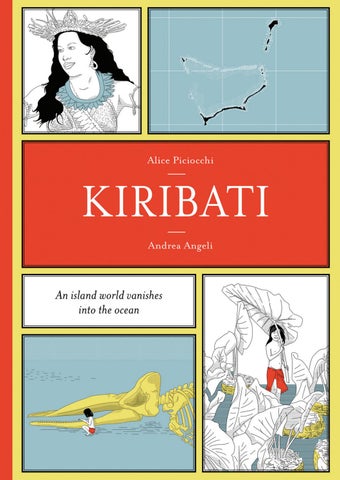
This is a book to be read from start to finish, in a circular way. Each chapter depicts an essential aspect of Kiribati’s cultural, environmental, and social identity. Like the small pieces of a puzzle that can be assembled, taken apart, and carried away.
PROPERTY
THE LAND
Plate V
Plate VI
Ocean side
Typical hereditary succession
parents
1st son
1st daughter
2nd son taro plantation
Absence of direct heirs
house
couple without children
closest relatives
Gift in exchange for favors or assistance
house
elderly person with no one
nurse
relative or acquaintance
parents
son
daughter and nun
Atypical hereditary succession
Lagoon side Lato laguna
BWABWAI
GROW ING BWABWAI
Plate XXII
Plate XXIII
Fig. 1 13 ft.
A
B C
10
aquifer line
D
Fig. 2
Cyrtosperma chamissonis
Fig. 1
Fig. 3
A
3 B C
Fig. 2
A
B
0 ft. C
Fig. 1 Nutritional composition of rhizomes: A. 26.2 % carbohydrates – B. 5.5 % proteins, fat, fiber and other – C. 68.3 % water Fig. 2 Nutritional composition of leaves: A. 2.6 % carbohydrates – B. 11.7 % protein, fat, fiber and other – C. 85.7 % water Fig. 3 Detail of tuberous rhizome
Fig. 1 Cross-section of a cultivated cyrtosperma chamissonis: A. Mulch of pandan and coconut leaves – B. Humus – C. Mixture of humus or sand, dry leaves, and mud – D. Composite of dry green leaves of the Guettarda speciosa, Messerchmidia argentea Fig. 2 Semi-hypogeal plantation of cyrtosperma chamissonis
94| Culture
SPELLS To find a long-lasting lover
To get your wife to come back after arguing
Plate XL
To separate a couple
The Spell of Perfume South Tarawa, November 27, 5:30 p.m.
2 km
Beru 1°19' 00" S; 175°58' 00" E There’s something about Beru that makes it different from the other atolls: at its southernmost part it has a central lake rich in edible seaweed, and, during the rainy season, it is also full of fish (milkfish).
We’re seated inside a delivery van that’s used as public transportation, packed like sardines. To our right a mother stares out the window holding her son in her arms as he sucks a pink lollipop and looks at us in a daze. Five kids hop on wearing their school uniforms, while behind them a plump woman in her sixties sips on a Coke. Many students can’t get on and who knows how long they’re going to have to wait, seeing that those under the age of sixteen don’t pay and the drivers hardly ever stop to pick them up. The woman plops down to our left and starts babbling; in the background you can hear the students tittering, amused by the woman’s impetuousness. After a while we start asking her questions, like whether she’s married and has any children. She starts telling us her story. At the age of eighteen she married a man who came from her island, Beru, and they had seven children together, two of whom died before the age of ten: one fell down from a coconut tree, the other died of dysentery. She talks about it calmly, as if these tragedies were just a natural part of the life cycle. She immediately changes the subject and tells us how her relationship with her husband began, and that it has lasted for over forty years. She says that when they were no more than kids, while walking past her with a bunch of schoolmates, he had looked at her, making fun of her, saying that she was ugly. She was very upset about it, so the following day she went to see her great-grandmother, famous on the island for her magical powers. The elderly woman cast a spell on her great-granddaughter, making her fragrance irresistible to the boy’s sense of smell. From that moment on, her smell was like opium for him and he couldn’t do without her. She smiles at the thought. Now he’ll think twice before offending a woman.
bla bla bla
bla bla bla
bla bla bla
days
moments
times
To find a long-lasting lover: At dawn, on the fourth day after menstruation has ended, tie a coconut leaf to your ankle after rubbing it between your thighs and biting on it. Say the spell. To get your wife to come back after arguing: At dawn, noon, and dusk, use a coconut shell to pour water over your head, then throw the container in front of you, as you look at the sun and say the spell. The last two times the coconut has to be turned so that it faces you. To separate a couple: At dusk, go down to the beach and look for human feces; jump over them with your left foot three times while you say the spell. Repeat three days in a row.
Comings and Goings
Comings and Goings
1000 BC
1200 AD
1500 AD
1765 AD
1788 AD
1777 AD
Thomas Gilbert and Pacific population
Migration of Samoans, Fijians, and Tongans
Spanish sailors
discover the existence of the islands
John Marshall cross the sixteen atolls in the archipelago, later named after Gilbert
Arrival of European
sperm whale hunters
James Cook discovers Christmas Island
O
nce upon a time, about 3,000 years ago, there was a handful of tiny dots in the middle of the ocean inhabited by a tranquil and peaceful population that lived a simple life, traveled short distances to fish, and had
guage family that is known of today as the Austronesian languages. One day, about 800 years ago, on the horizon they sighted huge canoes sailed by expert rowers who were determined to expand further afield. They were Samoans, followed by the inhabitants of Tonga and no intention of complicating its existence. The peo- the Fijis, who in the space of a few ple’s great- and great-great-grandhundred years settled and became fathers had arrived there from the integrated to the point that some of West, typically from Indonesia, the Polynesian (Tonga and Samoa) and Melanesian (Fijis) cultural after a long journey. They weren’t the only ones to push traits were indistinctly assimilated out into the open sea: other friends by the inhabitants of the atolls. of theirs had traveled even farther, Then came the years of the explodisseminating far and wide the lan- rations and the era of the sailing
ships. For the first time ever, the natives saw pale faces speaking in unintelligible tongues and wearing bizarre attire. The archipelagos had become a crossroads: people would stop there for a few months and then head out again. Spaniards,
Russians, Englishmen, and Americans passed through. In the second half of
the eighteenth century other Europeans arrived on board whalers to hunt the sperm whales that filled the waters. Others instead arrived after voyages that had lasted many years, and once they set foot on the
islands they used the word “discovery.” They were the ones who meticulously annotated on special papers every single morphological and geological aspect of the territory. One of them was James Cook who, on December 24, 1777, during his third voyage across the Pacific, landed on what is still today the world’s largest atoll, which he called Christmas Island, or Kiritimati in the local language. A few years later, in 1788, the British explorer Thomas Gilbert, together with John Marshall, during a journey from the Australian Botany Bay to the
Based on an Idea by Alice Piciocchi and Andrea Angeli First published in Italy 2016 by 24 ORE Cultura srl, Milano Italian title: KIRIBATI – Cronache illustrate da una terra (s)perduta © 2016 24 ORE Cultura srl, Milano Text © 2016 Alice Piciocchi Illustrations © 2016 Andrea Angeli © 2017 for the English edition: Sieveking Verlag, Munich www.sieveking-verlag.de English Translation: Sylvia Adrian Notini Copyeditor: Barclay Gail Swerling Typesetting and Production: Sieveking Verlag, Munich ISBN 978-3-944874-77-7 Printed in Germany
Andrea Angeli Born in Brescia in 1984 he graduated in architecture from Milan Polytechnic. He developed his professional activity as he went along, and this led him from the construction site to publishing, by way of archives and design studies. As a child his head was always looking skywards so that he could reproduce in his school notebooks the patterns made by the airplanes in the sky. Nowadays, he takes those airplanes to go to faraway places. It is thanks to all his travels that he has discovered drawing to be an intriguing way to build things—stories more than actual buildings. The illustrations in this book are the result of his most recent, unusual journey. Alice Piciocchi Born in Milan in 1985, Alice holds a degree in Industrial Design from Milan Polytechnic, and is the author of research, articles, and publications on the topics of architecture and design. As a child she didn’t particularly enjoy studying geography, but her passion for maps and an extraordinary trip to Kiribati changed all that, and encouraged her to enroll at the Faculty of Human Sciences for the Environment, the Territory, and the Landscape. The stories in this book are an account of her trip to Kiribati.