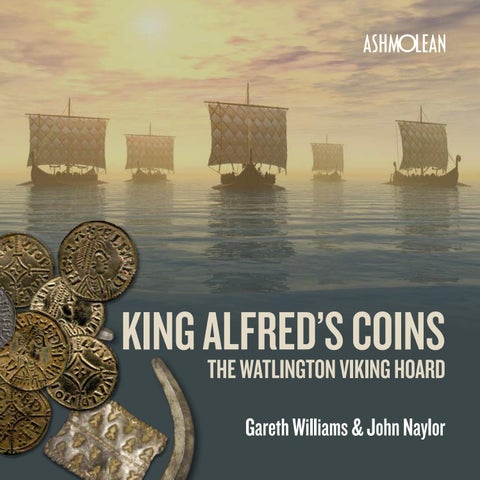
KING ALFRED’S COINS THE WATLINGTON VIKING HOARD
Gareth Williams & John Naylor
DISCOVERY AND CONSERVATION
Fig 2. James Mather, finder of the Watlington hoard.
On 7 October 2015, James Mather was metal-detecting on a field near Watlington, Oxfordshire with the permission of the landowner. He had been working for several hours but had found little more than ring pulls and shotgun cartridges. Thinking he would give up for the day he picked up a strong signal and, digging into
the soil, discovered a thin cigar-shaped object about six centimetres in length made from silver. James had seen similar objects on a visit to the British Museum and immediately recognised that it was a Viking-Age ingot (bar). Carefully detecting in the surrounding area, James picked up another signal a few metres away. Digging down he started to find silver pennies and realising that he had discovered a hoard he called archaeologist David Williams and the landowner. David works for the Portable Antiquities Scheme (PAS), a project funded via the British Museum to encourage the recording of archaeological finds made by members of the public. As the Finds Liaison Officer for Surrey and East Berkshire he is responsible for recording many local finds, and James regularly reports discoveries to him. After discussion with David, James carefully removed the coins which had been uncovered, as David was unable to visit the site that day. Once he’d done this, James found that he was still getting a strong signal from the small hole and so he and David agreed to return to the site to excavate the find archaeologically. As well as reporting finds to David, James often attends the Ashmolean Museum’s Identification Service. Knowing that he had to report his find as potential Treasure (under the Treasure Act 1996) and that the Ashmolean is home to the PAS’s National Finds Advisor for Medieval Coinage, James contacted the Museum and was able to deposit the objects that he had already found the following day. A few days later, James met David and one of his colleagues at the findspot along with the landowner
2 . king alfred’s coins: the watlington viking hoard
and together they excavated the rest of the hoard. James had backfilled his initial excavation and David decided to excavate a 1.5 metre square trench around this. Once he had removed the ploughsoil, the hoard could be seen as a dark stain within a flinty clay subsoil. David carefully cleaned around the hoard in order to uncover its full extent, a compact thirty centimetres by ten centimetres. From here, he started to define the objects and he could see that it consisted of coins, arm-rings and ingots. A couple of ingots were found to the side of the main group where they had been moved by ploughing, but the bulk of the hoard was in a small, intact group. Realising that the coins were very brittle or already broken into fragments, David decided to lift the hoard as a block and have it excavated under laboratory conditions. To do this, he removed the soil surrounding the hoard to leave it standing as an island, wrapped it in cling film, and moved it onto a metal tray before placing it into a plastic box. The hoard was taken to London to be excavated by Pippa Pearce, Senior Conservator in the British Museum’s Department of Conservation and Scientific Research.
l Fig 3. David Williams and Emma Corke excavating the small trench around the hoard. j Fig 4. The soil block wrapped in clingfilm just after delivery to the British Museum. Some of the armrings, an ingot and coins are visible on the top of the block.
Pippa’s first task before starting to excavate the block was to assess what it contained. This was achieved using x-ray which revealed the internal structure of the block. A concentration of objects was visible – coins, arm-rings and ingots – at one end of the block, with more coins and ingots spread out within the remaining space, indicating that over time it had become quite mixed in with the surrounding soil, no doubt having been affected by both natural processes after burial
L Fig 5. X-ray of the soil block before its excavation at the British Museum. A tightly packed cluster of armrings, ingots and coins is clearly visible at the right-hand end. The spread of objects towards the left-hand end, including an ingot is one of the ways that the team could tell that the hoard was becoming dispersed in the ground.
king alfred’s coins: the watlington viking hoard . 3
THE HOARD In total the hoard contained around 200 complete silver coins plus fragments, seven items of jewellery – consisting of complete silver arm-rings, a number of deliberately cut fragments, known as hack-silver (see p. 11), and fifteen silver ingots. How does this compare to other Viking hoards which have been found in England? The mixture of coins, intact jewellery, hack-silver and ingots is typical of the mixed hoards of the Vikings, who continued to value silver by weight long after they settled in England (see p. 16) and started to mint coins of their own. It is certainly nowhere near as large as some, for instance, the Vale of York hoard (617 coins, 68 other silver and gold objects) or the Cuerdale hoard, the largest Viking hoard from England, which contained around 7,500 coins and 1,000 other objects. It is, however, comparable with medium-sized hoards such as Silverdale (27 coins, 174 other objects) or Croydon (a nineteenth-century find of around 250 coins together with a number of ingots and hacksilver). The importance of the Watlington hoard, then, lies not so much in its size but in its content, its date and its findspot. The latter two are discussed later in this book. Here we will focus on the finds themselves.
K Fig 7. A mixture of objects from the hoard, including armrings, ingots, coins and cut-up pieces of silver and gold.
L Fig 8. Part of a Viking hoard from Croydon, Surrey, buried c. 871–2. The hoard may be linked with the Viking army that invaded Wessex at that time.
COINAGE The coins found in the hoard date to a very narrow period of time during the later 870s during the reigns of Alfred the Great, king of Wessex from 871–99, and his contemporary Ceolwulf II, king of Mercia from 874–c.879. The coins are a combination of issues by both Alfred and Ceolwulf, along with two of Æthelred, king alfred’s coins: the watlington viking hoard . 5
Fig 9. Selection of coins showing the mixture of coin types within the hoard.
6 . king alfred’s coins: the watlington viking hoard
THE VIKINGS IN ENGLAND The term Viking is often used as a general term to describe the Scandinavian peoples from c.750–1100. The term is convenient because the modern kingdoms of Denmark, Norway, and Sweden only took shape in the course of the Viking Age. For much of this period these areas were divided into many smaller kingdoms, and contemporary sources are seldom specific about exactly where particular groups or individuals originated. Terms such as ‘Danes’ and ‘Northmen’ were used very imprecisely, together with other terms such as ‘heathens’, ‘pagans’, and ‘pirates’. Recent scholarship has emphasised the many peaceful achievements of the ‘Vikings’ in this broad sense, including their craftsmanship, their skills in shipbuilding and seamanship, and their important role in the development of towns and long-distance trade. However, víkingr in Old Norse and wicing in Old English meant ‘pirate’ or ‘raider’, and it was their raiding activity that primarily attracted the attention of contemporary Anglo-Saxon chroniclers, not least because most of the early attacks focused on churches and monasteries, which were regarded as untouchable within a Christian society, but which provided easily accessible and poorly defended concentrations of wealth for coastal raiders. I Fig 24. Excavation of the Viking settlement at Coppergate, York. The Vikings developed towns in northern England, Ireland and Russia as well as in their Scandinavian homelands. k i n g a l f r e d ’ s c o i n s : t h e w a t l i n g t o n v i k i n g h o a r d . 13
I Fig 25. Tenth-century carving of a warrior from St Andrew’s Church, Middleton, North Yorkshire. This is one of the best surviving contemporary representations of a Viking warrior, and shows him equipped with sword, spear, axe, knife, helmet and shield.
The earliest account of a Viking raid in England, recorded in the Anglo-Saxon Chronicle for 789, may have been a trading expedition which became violent, but an attack on the Northumbrian monastery of Lindisfarne in 793 was clearly a planned raid, and was followed by a series of assaults on monasteries around the coasts of Britain and Ireland. Not all of these are recorded in detail, but Kentish charters from the 790s onwards also record military service against ‘seaborne pagans’, indicating otherwise unrecorded raids. Most early attacks seem to have been on a fairly small scale, and relied in part on the Vikings’ abilities to strike suddenly and effectively from the sea and disappear again before defensive forces could be mustered. Some early assaults were probably more prolonged, and both Kentish and Irish sources suggest the use of temporary fortified camps. Even so, raiding in this period was limited to the sailing season from spring through to early autumn. The early to mid-ninth century saw Viking fleets increase in size from a handful of ships to tens and then hundreds of ships, carrying thousands of men. These were large enough to face the armies of whole kingdoms on equal terms, although they typically preferred looting and extortion to the risks of battle. They also adopted a new strategy of overwintering in hostile territory, establishing winter camps from which they could continue to raid to re-supply themselves, or in some cases agree truces with native rulers which allowed them to stay peacefully over the winter, even in areas in which they had just been raiding. Another increase in Viking raids occurred in 865. In that year a force described as a micel here landed in the kingdom of East Anglia, and ‘made peace’ over the winter. Micel here is normally translated as ‘Great Army’,
14 . k i n g a l f r e d ’ s c o i n s : t h e w a t l i n g t o n v i k i n g h o a r d
KING ALFRED AND THE VIKINGS I Fig 31. Statue of Alfred the Great by Hamo Thorneycroft, RA, erected in Winchester in 1899 for the millennium of Alfred’s death. Alfred is shown as a warrior, but his sword doubles as a cross, emphasising Alfred’s role as a patron of the Church.
King Alfred of Wessex (871–99) is the only monarch in British history widely known as ‘the Great’. His reputation derives to an extent from his success in defending Wessex from Viking attack, and from his integration of Wessex and the kingdom of Mercia into what was to become the kingdom of England. Alfred was the youngest of the five sons of Æthelwulf of Wessex (839–58). It was only because his older brothers died young that he became king at all, and his first wars against the Vikings took place during the reign of his brother Æthelred (865–71). In 868, they led a West Saxon army to support their brother-in-law Burgred of Mercia against the Viking micel here at Nottingham, but were unable to dislodge the Vikings. In 870–71 Viking attentions turned to Wessex itself, and the brothers fought nine battles against them. As the Anglo-Saxon Chronicle puts it, ‘sometimes one side had the victory, sometimes the other’. One of these battles, Ashdown, was a major victory; Æthelred and Alfred defeated the Vikings, killing two kings and five earls, as well as many of their followers. Ashdown was not decisive however, and the Vikings continued to raid Wessex for several months before withdrawing to Mercia. Æthelred died in 871, probably of wounds received on the battlefield, and Alfred became king rather than Æthelred’s son Æthelwold, who was still a child. Alfred then enjoyed a few years of respite while
18 . k i n g a l f r e d ’ s c o i n s : t h e w a t l i n g t o n v i k i n g h o a r d
the micel here campaigned in Mercia (see p. 25). The micel here divided in 874, with part going north to Northumbria, and the other part to East Anglia, but the East Anglian army turned to Wessex again in 875, led by a king named Guthrum. A Viking force marched overland to Wareham in Dorset, where they were joined by a fleet sailing round the coast. A truce was
established with Alfred, enabling them to stay there peacefully. This almost certainly involved a payment from Alfred, as well as the exchange of hostages. However, the Vikings broke the truce, and moved on to Exeter, but their accompanying fleet was destroyed in a storm off the coast near Swanage. Without the support of these ships and the supplies they carried,
L Fig 32. Finds from a Viking
camp in Yorkshire, dating from around the time of the Viking settlement of Northumbria in 876. The finds include objects relating to production and exchange as well as warfare, while the size of the camp suggests the presence of thousands of men.
k i n g a l f r e d ’ s c o i n s : t h e w a t l i n g t o n v i k i n g h o a r d . 19
In October 2015, metal detectorist James Mather discovered an important Viking hoard near Watlington in South Oxfordshire. The hoard dates from the end of the 870s, a key moment in the struggle between Anglo-Saxons and Vikings for control of southern England. The Watlington hoard is a significant new source of information on that struggle, throwing new light not only on the conflict between Anglo-Saxon and Viking, but also on the changing relationship between the two great AngloSaxon kingdoms of Mercia and Wessex. This was to lead to the formation of a single united kingdom of England only a few years later.