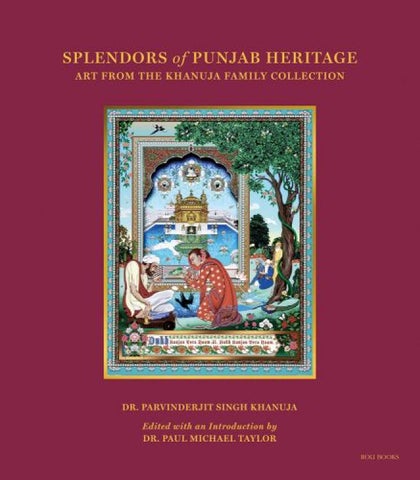
Splendors of Punjab Heritage art from the khanuja family collection
With Essays by dr. Parvinderjit Singh Khanuja
Edited with an Introduction by Dr. Paul Michael Taylor
Sikhmuseum.org in association with
Asian Cultural History Program, Smithsonian Institution
Splendors of Punjab Heritage art from the khanuja family collection
With Essays by dr. Parvinderjit Singh Khanuja
Edited with an Introduction by Dr. Paul Michael Taylor
Sikhmuseum.org in association with
Asian Cultural History Program, Smithsonian Institution
1
On e a n d t he Sa me L igh t: Gu rus i n Sik hism “The Benefactor Giver heard the cries (of humanity) and Guru Nanak was sent to this world.” 1 Bhai Gurdas (Sikh Theologian)
C
1. The ten gurus Artist unknown | c. Late 19th century | 26 x 21 in | Panel painting on wooden plank The ten gurus are portrayed in a typical Thanjavur style painting, a popular art form from southern India made up of rich and vibrant colors with glittering gold overlaid on delicate but extensive gesso work. The paintings are also embedded with glass beads and pieces or precious gemstones.
urrently the fifth largest religion in the world with over 25 million followers, Sikhism’s birth, history, and tenets are closely tied to the lives of its early spiritual leaders. The gurus were important institution builders who founded religious centers which expanded into townships and became experiments in egalitarian community life. Sikhism’s much-celebrated founder is Guru Nanak (1469–1539), born at Rai Talwandi, now known as Nankana Sahib, and situated in the Punjab province of Pakistan. An insight into the life and teachings of Guru Nanak can be acquired by delving into his writings and his janamsakhis (biographies). The compilers of these biographies strove to lend authenticity and historical credibility to the anecdotes pertaining to the life of the first guru by inserting quotations from the hymns of Guru Nanak and of his successors as found in the Sri Guru Granth Sahib, the holy scripture of Sikhism (henceforth SGGS). Many of these anecdotes attest to Guru Nanak’s wise words along with miraculous happenings. A notable instance of the latter is an event that took place at Sultanpur Lodhi, where the first guru went for a morning bath in the Bein river. Guru Nanak reappeared three days later, after having an experience with the Divine, which has been aptly described by William Cole. He writes, “Guru Nanak’s experience is regarded as one of commissioning rather than enlightenment; Sikhs consider him to have been born in a state of spiritual liberation.”2 During his lifetime, Guru Nanak covered an extraordinary 20,000 miles, mostly on foot. He traveled to many parts of Asia and the Middle East. In the words of Janet Baker, “Guru Nanak Ji’s life can be viewed as a testament to interfaith tolerance and spiritual oneness. His principles were revolutionary in the world of Hindu and Muslim India 500 years ago. In defiance of the caste system and social practices of his day, he declared that all people are equal; Hindu and Muslim, man and woman, rich or poor.”3 Wherever Guru Nanak went, he established a community of devotees of the Divine. Believers gathered in communal hubs traditionally known as dharamsals, where they sang divine hymns and where food was prepared in the communal kitchens (langar). Guru Nanak created the ideal community of Kartarpur (in present-day Pakistan), where he spent the last eighteen years of his life. As Nikky G.K. Singh has noted, Guru Nanak also “set up the institutions of sangat (congregation), seva (selfless labor) and langar (community meal, kitchen) to foster the spirit of communitas.”4 He upheld the principle of equality of all persons, regardless of their background and caste. He instilled the ethics of sharing and inclusiveness. Guru Nanak also established the important tradition of Gurmat Kirtan (Sikh devotional hymns). His singing of revelations in certain melodies was based on classical musical traditions that enhanced the message and the feelings therein. Guru Nanak’s respect for the glory of the natural world and the beauty of the cosmos reflected his reverence for the all-pervasive spirit of the Divine and nature. This is well expressed in the verse, “Air is the Guru, Water is the Father, and Earth is the Great Mother of all….” (SGGS p. 1021). On the aspect of equality, “the idealistic approach to Sikhism is to recognize the existence of the same heavenly Light in every human being.”5 As an activist, Guru Nanak spread the message of equality, especially when it came to women:
25
34
35
10
11
12
10. Guru Nanak in Mecca Artist unknown | c. Late 18th century | 9 x 6 in | Gouache on paper Baba Nanak is seen lying down to rest with his feet pointed towards the Kaaba, considered by Muslims to be the house of God. As per stories from Nanak’s life and travels mentioned in janamsakhis, when he is asked to move his feet he suggests politely to turn them in the direction where God does not dwell.
11. Guru Nanak takes charge at modikhana, a granary store at Sultanpur Artist unknown | c. Late 19th century | 9 x 7 in | Gouache on paper
12. Guru Nanak in Tibet, in discussion with an ascetic Datti Kaur | 2019 | 30 x 22 in | Color pencil on paper Guru Nanak is said to have visited Tibet more than once. His visit to Mount Kailash is described in the janamsakhis.
13. Guru Nanak with Raja Shivnabh of Sri Lanka Artist unknown | c. 1895 | 10 x 6.5 in | Gouache on paper The raja of Sri Lanka had waited patiently to see the guru for many years. Bhai Mardana can be seen playing his rabab.
13
Painting the gurus Indian artists often turned to epics and religious texts and created miniatures to transform words into a visual reality.
38
19
17
17. Guru Nanak with his companions Bhai Bala and Bhai Mardana Artist unknown | 19th century | 21.5 x 15 in | Gouache on paper
18. Guru Angad Dev (second guru) Artist unknown | 19th century | 18 x 13.5 in | Gouache on paper
20
18
19. Guru Amardas (third guru)
21. Guru Arjan Dev (fifth guru)
Artist unknown | 19th century | 17 x 13 in | Gouache on paper
Artist unknown | 19th century | 17.5 x 13.5 in | Gouache on paper
20. Guru Ram Das (fourth guru)
22. Guru Hargobind (sixth guru)
Artist unknown | 19th century | 19 x 13.75 in | Gouache on paper
Artist unknown | 19th century | 16 x 12 in | Gouache on paper
21
22
39
46
47
35
36
35. Guru Arjan Dev Artist unknown | 19th century | 8.6 x 6.25 in | Gouache on paper
36. Guru Arjan Dev Artist unknown | c. Early 19th century | 4.5 x 3.75 in | Gouache on paper
37. Guru Hargobind standing armed with sword, shield, bow and a quiver of arrows Artist unknown | c. Mid-18th century | 9.25 x 6.25 in | Gouache and gold dust on paper
37
Painting episodes from the gurus’ lives Devender Singh, a contemporary artist based in India, transforms episodes from Sikh religious history into delightful compositions.
52
53
45
47
46
45. Guru Nanak and the sacred thread
46. Guru Nanak and Bhai Lalo the carpenter
Devender Singh | 2018 | 35.5 x 45.5 in | Oil on canvas
Devender Singh | 2018 | 35.5 x 45.5 in | Oil on canvas
Guru Nanak at the age of nine refused to wear the sacred thread, or janeu, which according to Hindu tradition would define his high social status. As the Hindu priest presented the thread, young Nanak caught the thread with his hand in protest and reasoned that it is only by adoring and praising the Divine’s name that honor and a true thread are obtained. He rejected using rituals and objects to worship the Divine.
Guru Nanak, upon his visit to Saidpur in Punjab chose to stay at the house of a lowly and honest carpenter, Bhai Lalo, over the rich and wealthy, Malik Bhago. When the latter approached for explanations, Guru Nanak squeezed the bread he had received from both men. Milk, a symbol of honest labor, came out of Bhai Lalo’s bread. Malik Bhago’s bread instead oozed blood, a symbol of ill-gotten wealth.
47. Babur asking for Guru Nanak’s forgiveness Devender Singh | 2018 | 35.5 x 45.5 in | Oil on canvas The Mughal troops under Babur sacked Saidpur in Punjab, and Guru Nanak and his companions were imprisoned. When the guru was forced to grind corn, the grinding stone moved on its own, while he meditated and sang hymns. Babur, on hearing of this miracle, asked for forgiveness. Guru Nanak’s advice was to be just to all. He also urged the emperor to be merciful and forgive others.
sikh Gurus in Contemporary art These artworks by the Singh Twins draw inspiration from Sikh tradition, Western medieval illuminated manuscripts, and contemporary Western culture.
60
61
59
59. Enlightenment of Guru Nanak
60. Guru Amardas destroys the five vices
Rabindra K.D. Kaur Singh | 1992 | 14 x 11 in | Gouache on paper | © The Singh Twins
The Singh Twins | 1989 | 16.4 x 11.6 in | Gouache and gold dust | © The Singh Twins
Guru Nanak is shown in a narrative sequence, first bathing, then being taken up to the Divine abode in the upper register of the composition, and finally receiving the naam or spiritual message, thereby attaining complete enlightenment. Following the janamsakhi convention, these paintings too integrate text and images, but are more imaginative and complex in their presentation and treatment.
This allegorical portrait of Guru Amardas illustrates verses from the Sri Guru Granth Sahib which pay tribute to him as a warrior striking victory over his enemies – the five vices. In Sikh symbolism, the vices (lust, anger, greed, pride, and attachment) are likened to five animals. Other details in the artwork, such as the entwined trees (symbolizing the human soul clinging on to the Divine) represent how destruction of the vices through Divine’s grace leads to spiritual enlightenment and union.
60
61. Ascension of Guru Ram Das The Singh Twins | 1990 | 16 x 11.5 in | Gouache and gold dust | © The Singh Twins This painting depicts the passing of the guruship from Guru Ram Das to Guru Arjan. The occasion is witnessed by the entire creation, blessed by the previous gurus and glorified by deities representing the Divine presence. The artists reveal how the guruship was ultimately vested in the Sikh scriptures, which are given due respect – depicted enthroned, garlanded, and shaded by the umbrella of royal authority. The umbrella, emblazoned with a map of the world, symbolizes the universality of Sikh teachings.
61
64
65
65
64. Guru Nanak M.F. Hussain | 1972 | 50 x 40.25 in (with frame) | Digital, limited edition
64
A modern rendition of Guru Nanak’s portrait by one of the most celebrated and internationally recognized Indian artists of the twentieth century. Presented on the day of Gurpurab, this is the only painting of Guru Nanak that Hussain ever made.
66
65. Sodar (a musical composition of the Divine) by Guru Nanak Sumeet Aurora | 2020 | 53 x 40 in | Acrylic on canvas The painting celebrates the joyous yearning of the seeker in pursuit of the exquisite throne of the Divine as disclosed in the pauree or stanza 27 of Guru Nanak’s Japji.
66. Aarti (musical depiction in praise of the Divine), composed by Guru Nanak Sumeet Aurora | 2020 | 54 x 40 in | Acrylic on canvas A depiction of the sacred prayer called Aarti that Guru Nanak recited at Jagannath Temple in Puri.
64
65
65
64. Guru Nanak M.F. Hussain | 1972 | 50 x 40.25 in (with frame) | Digital, limited edition
64
A modern rendition of Guru Nanak’s portrait by one of the most celebrated and internationally recognized Indian artists of the twentieth century. Presented on the day of Gurpurab, this is the only painting of Guru Nanak that Hussain ever made.
66
65. Sodar (a musical composition of the Divine) by Guru Nanak Sumeet Aurora | 2020 | 53 x 40 in | Acrylic on canvas The painting celebrates the joyous yearning of the seeker in pursuit of the exquisite throne of the Divine as disclosed in the pauree or stanza 27 of Guru Nanak’s Japji.
66. Aarti (musical depiction in praise of the Divine), composed by Guru Nanak Sumeet Aurora | 2020 | 54 x 40 in | Acrylic on canvas A depiction of the sacred prayer called Aarti that Guru Nanak recited at Jagannath Temple in Puri.
Guru Tegh Bahadur These paintings were sketched by Arpana Caur to celebrate the 400th birth anniversary of Guru Tegh Bahadur.*
67
71
72
71. Martyrdom of Bhai Mati Das, Bhai Sati Das and Bhai Dyala (companions of Guru Tegh Bahadur) in Chandni Chowk
66
67
Arpana Caur | 2021 | 13.8 x 10.6 in | Gouache on paper
72. Guru Tegh Bahadur’s martyrdom Arpana Caur | 2021 | 10.6 x 13.8 in | Gouache on paper
73. Guru Tegh Bahadur (secret cremation of the headless body by Lakhi Shah Vanjara) Arpana Caur | 2021 | 13.8 x 10.6 in | Gouache on paper
74. Guru Tegh Bahadur (journey of the sacred head, Bhai Jaita to Guru Gobind Rai) 68
69
67. Guru Tegh Bahadur rescuing Makhan Shah’s drowning boat
68. Guru Tegh Bahadur and Mata Gujri in meditation
Arpana Caur | 2021 | 10.6 x 13.8 in | Gouache on paper
Arpana Caur | 2021 | 13.8 x 10.6 in | Gouache on paper
70
69. Guru Tegh Bahadur in a cage, incarcerated by Mughal Emperor Auragzeb Arpana Caur | 2021 | 13.8 x 10.6 in | Gouache on paper
Arpana Caur | 2021 | 13.8 x 10.6 in | Gouache on paper
73
74
70. Guru Tegh Bahadur (transcendence) Arpana Caur | 2021 | 13.8 x 10.6 in | Gouache on paper
*Paintings 67 to 70 and 72 to 74 were first published in Celebrating the Life and Spirit of Guru Tegh Bahadur by Harminder Kaur.
sri Guru Granth Sahib A compilation of hymns written by six Sikh gurus, fifteen saints – including Bhagat Kabir, Bhagat Ravidas, Sheikh Farid and Bhagat Namdev – eleven bhatts (balladeers) and four Sikhs. The verses are composed in thirty-one ragas.
70
71
79
79. A Sikh prince and his entourage leaving an ashram carrying packages, perhaps a copy of the Sri Guru Granth Sahib Artist unknown | c. 1830–50s | 10.25 x 15.25 in | Gouache on paper This fine painting with pink floral borders is most probably from the Sikh-Pahari school and bears inscriptions on the reverse in the Nagari and Gurmukhi scripts.
80. Sri Guru Granth Sahib (miniature) c. 1914 | 1.25 x 1.25 in This miniature Sri Guru Granth Sahib contains 1,430 pages, and can be read with a magnifying glass. Printed in Germany, it was used by Sikh soldiers during the First World War. It was carried in the turbans of the Sikh soldiers, thus giving them comfort that the guru was with them.
80
74
75
89
89. Mira Bai surrounded by devotees
90. Bhagat Kabir with attendants and devotees
Artist unknown | c. 17th–18th century | 7.5 x 11 in | Watercolor on paper
Artist unknown | c. Late 17th/early 18th century | 8.7 x 6.7 in | Gouache and gold on paper
Mira Bai was a bhagat saint of the sixteenth century. Born into a Rajput royal family, she was a devotee of Krishna. Some of the earlier copies of Adi Granth do have a few of her writings. However, the final Sri Guru Granth Sahib does not have any incorporated in it. Here we see her surrounded by devotees listening to her soulful bhajans (songs).
One of the most revered saints of the Bhakti and Sufi movement, Bhagat Kabir’s compositions are also part of the Sri Guru Granth Sahib. Out of the fifteen bhagats whose bani is part of the Sikh scriptures, Kabir’s contribution is the largest. 90