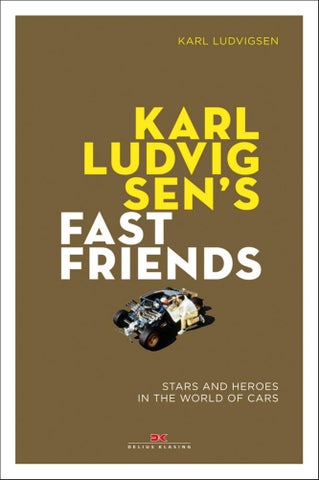
CONTENTS Introduction....................................................................................... 6 Executives............................................................................................. 9 Elliot Ludvigsen................................................................................... 10 Ferry Porsche....................................................................................... 17 Louise PiÍch......................................................................................... 26 Werner Breitschwerdt........................................................................... 37 Robert Lutz.......................................................................................... 50 Agnelli brothers.................................................................................... 57 Carlo Abarth........................................................................................ 62 Designers............................................................................................. 71 Giorgetto Giugiaro............................................................................... 72 Albrecht Goertz.................................................................................... 82 Larry Shinoda...................................................................................... 88 Peter Pfeiffer......................................................................................... 97 Tony Lapine....................................................................................... 104 Stefan Habsburg................................................................................. 114 Engineers........................................................................................... 123 Alexander von Falkenhausen.............................................................. 124 Rudolf Uhlenhaut............................................................................... 135 John DeLorean................................................................................... 140 Racers................................................................................................. 145 Juan Manuel Fangio........................................................................... 146 Phil Hill.............................................................................................. 155 Emerson Fittipaldi.............................................................................. 162 Mario Andretti................................................................................... 168 Car Guys............................................................................................. 175 Bernard Cahier................................................................................... 176 Rodolfo Mailander............................................................................. 181 Paul Frère........................................................................................... 187
Even my 300SL was struggling at the high altitude at which this picture was taken – not in the Alps but in the Rocky Mountains. It was during an epic drive in the summer of 1959 with the Mercedes I bought in Germany and brought back to the USA.
6
Introduction
INTRODUCTION
I
like to say that I’ve never had a job interview. I suppose there have been some exceptions. One might be when I was invited to meet Daimler-Benz export chief Heinz C. Hoppe in Manhattan when he was looking for a press manager for his American sales company. I was attracted but felt that my future still lay with General Motors. Another might be my dinner with Bob Lutz in Detroit when he was chairman of Ford of Europe. We discussed a possible position there that eventuated as a vice presidency. But Bob and I had been friends for more than a decade so that doesn’t really count. Otherwise I was invited – sometimes out of the blue – to take up various positions in the world of cars. That included my magazine editorships and my jobs at GM, Fiat and Ford. The only common denominator was my passionate interest in automobiles, which I spiced up with my proven writing and research skills plus training in mechanical engineering and industrial design. I took a big step into the unknown when I left GM in 1967, turning down several internal job offers. Could I support my family as a freelance writer? The same was true when I left Ford in 1983. Could I make the grade as the head of my own management consultancy specialising in the motor industry? Happily the answer in both cases was ‘yes’. The common factor for my employment choices was my deep curiosity about the whys and wherefores of automobiles, their users and their makers. High on my agenda was to gain knowledge of motor racing around the world, its history and its evolution. I tried to use my understanding of engineering and design to explain to an interested audience what was happening, why it was happening and who was making it happen. The latter turned out to be the most challenging to uncover! I’ve had the pleasure and honour of meeting and working with many men and women in the course of my career, innovators to legends in their lifetime. As the biographer of such people as Juan Fangio, Giorgetto Giugiaro, Introduction 7
ENGINEERS
Silver-haired Alex von Falkenhausen showed one of his BMW engines to a visiting group of American journalists including Bob Fendell, left, and the author behind him.
124
Engineers
ALEX VON FALKENHAUSEN
H
ow much influence can one man have on the character of an automobile company? If it’s a small one, like Lotus, a Colin Chapman can make a difference. Or a Ferrari at Ferrari. But a big car producer like BMW? In this case the answer is that one man could and did have a profound effect on the company and the cars that it still produces. BMW’s ‘Engine Pope’ Alex von Falkenhausen had the genius and foresight to give BMW’s managers the engines they didn’t know they wanted and needed. Von Falkenhausen faced his first big test as a creator of engines for BMW at the end of the 1950s. The company’s most popular cars were small rear-engined models, descendants of the Isetta bubble car, with two-cylinder air-cooled engines derived from the company’s motorcycles. BMW’s directors wanted to upgrade them with water-cooled fours but they were wary of going too large because they feared that would put them in conflict with other German car makers. ‘The directors wanted a 1,300 cc,’ von Falkenhausen recalled. ‘Others like Borgward and Opel had 1,500s so it took much work and persuasion to get them to accept a 1,500.’ The size of the new engine was one thing but its design was another. ‘Then many cars had pushrods and three-bearing crankshafts,’ the engineer recalled, ‘but I knew we must have something more. Alfa Romeo had already made many five-bearing engines with two overhead camshafts, so I fought for a BMW 1500 that had an overhead camshaft and five bearings for the crankshaft. We made the block very, very stiff.’ When BMW decided to build an all-new front-engined sedan at the beginning of the 1960s, its executives were still thinking small. As far as they were concerned 1,500 cc was the upper limit for their new sedan. Von Falkenhausen could see into the future, however. ‘I thought we needed to have a good two-litre to ensure a good market for the car,’ he reasoned. Alex von Falkenhausen 125
The tables were turned on Mailander at Reims in 1954 when the Cunningham team’s documentary photographer Derek Waller pictured Rudy chatting with his wife Mary. 182
Car Guys
Theirs was the brainchild of engineer Hans Gassmann, who conceived and patented the Mercedes system from scratch. Mailander and I enjoyed a genial dinner in downtown Stuttgart, opposite the Bahnhof, and he drove me back to Böblingen. During that dinner it must have dawned on me that my host was the Rodolfo Mailander, the photo journalist whose illustrated reports from Europe I had enjoyed in Auto Speed & Sport. In this magazine, a worthy effort by Robert Petersen in 1952 and 1953 to barge into Road & Track territory with a monthly for the sporty set, Mailander’s material was among its strongest offerings. I had also seen the Mailander photo credit in Automobile Year among other publications. Great images resulted from Rudy’s initiative. His technical proficiency combined with an unerring eye achieved wonderfully consistent and imagerich negatives on Agfa, Ilford and Kodak film. With his German, French, Italian and English, he was quickly at home with all the drivers and car builders, who appreciated his knowledge and enthusiasm. Their acceptance of Mailander as part of the racing ‘circus’ is obvious from the warmth that many of his images display. When I asked Rudy how he came to the profession that he pursued from 1950 to 1955 he explained: ‘I was in Germany after the war but I very much wanted to get back to Italy, so I started to write for the famous editor Canestrini, whom I had come to know by chance before the war. He was interested in getting some articles about the situation in Germany and so on, so I started writing for Canestrini. No photographs yet; that came later. ‘Then I decided that this was fun,’ Rudy continued. ‘In Stuttgart I knew a gentleman who was a German sports reporter, writing for auto motor und sport. So when he was to go to Italy or to Monte Carlo he said, “Right, we could do something together. You make the photographs and I write and you help me with the language and so forth.” And so I started. ‘Then one day at the Geneva Grand Prix, Robert Braunschweig, editor of the Swiss Automobil Revue, took me aside and said, “I’ve seen some articles of yours, some photographs. Would you like to help us? We could start with a story about the Via Emilia, which is home to Ferrari, Maserati and the other Italian sports-car and motorcycle makers.” So I wrote an article and then I didn’t hear anything for two months or so – or three months it was. ‘In the meantime,’ Mailander continued, ‘I stopped every week to buy Automobil Revue, which was very difficult to find. Then one day when I was Rodolfo Mailander 183
in Milan, Ing. Satta from Alfa Romeo phoned and said, “Congratulations!” And I said, “For what?” And he said, “For your article, of course!” I thought that because he was a high-ranking Alfa Romeo engineer, he had seen Braunschweig who had told him that I was sending an article. But he said, “No, no. It’s two pages and in the next issue there is another page.” So I looked and looked and couldn’t find it immediately so I went to Lugano to buy one. I finally saw it. I was very happy about that. ‘Then Braunschweig phoned and said he had had some very good comments on it and he wanted me to work for them. I became their travelling correspondent. The first car I had was a Mercedes 170 diesel that my father bought me and then I changed the 170 to a Porsche. I liked the Porsche very much. When I visited a girl I could take her with me – but not her mother as well!’ Rudy took wonderful pictures of Enzo Ferrari and his cars, both at the factory and on the track. I asked him how he accomplished this. ‘Ferrari was a very difficult character,’ he replied. ‘He always gave you an appointment when he wasn’t there. You had to wait and somebody took you out for lunch, waiting until he arrived. Maybe he was there, but they told you, “No, he’s not here because he has other things on” and so on. Ferrari said, “Oh, let him wait, he’s...not so important...” And I did this twice. The third time, after two hours I went away and left him. At that time he needed publicity for a new Ferrari automobile and Braunschweig always kept him very much involved, so Ferrari said he was very upset that I went away. ‘The next morning I decided to take a chance,’ Rudy added. ‘I went to the barber shop where he went every morning and waited there for him. I said, “I’m awfully sorry but the last time I waited one day and then they told me, ‘No, you had no time and to come the next day.’” It amused him that somebody would do that, so from then on he was always there when he asked me to call on him.’ Since 1955 the cosmopolitan and polished Mailander had been working for Daimler-Benz. Though he had sold his Leica – to his later regret – he still had his photographic archives. During my spare time from radio repair I was still writing for SCI, so I went through his contact prints and asked for a number of images that I needed for my own journalism. Our relationship became more than professional. Rudy and his wife Helga visited in Munich, where I was assigned, and I saw them in Stuttgart 184
Car Guys
Bibliographic information of the German National Library The German National Library lists this publication in the Deutsche Nationalbibliografie; more detailed bibliographic information can be found online at http://dnb.dnb.de.
1st edition ISBN 978-3-667-11457-0 © Delius Klasing & Co. KG, Bielefeld (Germany) Proofreading: Kaye Müller, Hanno Vienken Picture credits: Ludvigsen Partners except for Stefan Habsburg from GM Media Archives, and Phil Hill from Motoring Picture Library/Alamy Stock Photo Cover design: Felix Kempf, www.fx68.de Typesetting: Axel Gerber Lithography: Mohn Media, Gütersloh Printer: Pustet, Regensburg Printed in Germany 2019 While all reasonable care has been taken in the publication of the book, neither the author nor the publisher takes any responsibility for the accuracy, completeness or timeliness of the information given in this book. All rights reserved. This work may not be reproduced, transferred or copied in full or in part, manually or with the aid of electronic or mechanical systems, including photocopying, recording or storing as data, without the express consent of the publishing house. Delius Klasing Verlag Siekerwall 21, 33602 Bielefeld, Germany Phone: +49-521-559-0, Fax: +49-521-559-115 Email: info@delius-klasing.de www.delius-klasing.de