roya l acade my pub lic ation s Florence Dassonville Alison Hissey Rosie Hore Carola Krueger Peter Sawbridge Nick Tite Picture research: Sara Ayad Design: Maggi Smith Colour origination: Gomer Press Printed in Wales by Gomer Press Copyright © 2018 Royal Academy of Arts, London Any copy of this book issued by the publisher as a paperback is sold subject to the condition that it shall not by way of trade or otherwise be lent, re-sold, hired out or otherwise circulated without the publisher’s prior consent in any form of binding or cover other than that in which it is published and without a similar condition including these words being imposed on a subsequent purchaser. All Rights Reserved. No part of this publication may be reproduced or transmitted in any form or by any means, electronic or mechanical, including photocopy, recording or any other information storage and retrieval system, without prior permission in writing from the publisher. British Library Cataloguing-in-Publication Data A catalogue record for this book is available from the British Library i sb n 978-1-910350-81-2 (paperback) Distributed outside the United States and Canada by ACC Publishing Group, Sandy Lane, Old Martlesham, Woodbridge, Suffolk ip12 4sd Distributed in the United States and Canada by ARTBOOK | D.A.P., 155 Sixth Avenue, New York NY 10013
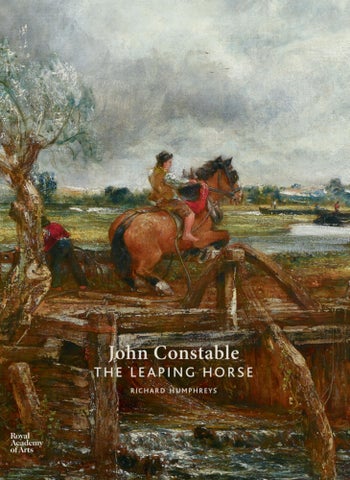
editorial note All works of art illustrated are by John Constable unless otherwise stated. Dimensions of works of art are given in centimetres, height before width. Frontispiece: detail of fig. 34, John Constable, The Leaping Horse, 1825.
FINAL_CONSTABLE Leaping Horse.indd 4
au t hor ’ s ac k n owl e d g e me n ts I should like to thank a number of Royal Academy staff: Tim Marlow and Nick Tite for inviting me to write this book; Peter Sawbridge for being such a supportive and shrewd general editor; and Alison Hissey for her expert copy-editing. Sara Ayad’s inspirational picture research made a huge difference; and Maggi Smith’s design is both intelligent and beautiful. I owe a great debt to a number of former Tate colleagues: David Blayney Brown, Anne Lyles, Leslie Parris and Ian Warrell. Their scholarship and enthusiasm over many years helped me appreciate the extraordinary power of Constable’s art. Sarah Cove’s pioneering work on the artist’s materials and techniques made me realise the limitations of art history in forming that appreciation. Recently I have benefited greatly from the expertise of Mark Evans of the Victoria and Albert Museum. Stephen Calloway and Susan Owens have also given me much useful advice. Finally, my wife, Joanna Banham, gave me great encouragement and one priceless art-historical tip.
photo g r a phi c ac k n owl e d g e me n ts
All works of art are reproduced by kind permission of the owners. Every attempt has been made to trace the photographers of works reproduced. Specific acknowledgements are as follows:
photo g r a phi c c re di ts
Florence, © 2018 Photo Scala/The Fitzwilliam Museum, Cambridge: fig. 3. London, © Bridgeman Images: figs 12 (Museo ThyssenBornemisza, Madrid); 15 (Ashmolean Museum, University of Oxford); 23 (The Huntington Library, Art Collections & Botanical Gardens); 25 (Christie’s Images). London, © The British Library Board: fig. 20. London, © London Metropolitan Archives (City of London): figs 16, 43. London, © Museum of London: fig. 13. London, © The National Gallery: figs 4 (Presented by Sir George Beaumont, 1828); 19 (Presented by Henry Vaughan, 1886); 22 (Presented to the National Gallery under the acceptance-in-lieu procedure, 1987). London, © National Portrait Gallery: fig. 1. London, © Royal Academy of Arts, London: fig. 7; figs 30, 34, 35–39, 42, 46, 49, 52, 54–56, 62, 63 (Photo: Prudence Cuming Associates Ltd); 44, 45, 57 (Photo: John Hammond). London, © The Samuel Courtauld Trust, The Courtauld Gallery: fig. 27. London, courtesy of Sotheby’s, 2018: figs 2, 26. London, © Tate, 2018: figs 8, 11, 18, 24, 47, 59, 60. London, © The Trustees of the British Museum: figs 28, 29, 64. London, © Victoria and Albert Museum: figs 5, 6, 31, 32, 33, 41, 48, 53, 58. Nayland (Suffolk), Reproduced by kind permission of the Churchwardens of St James Church: fig. 9. New Haven, Yale University Art Gallery (open access license): fig. 50. New York, © Copyright The Frick Collection: fig. 21. New York, Metropolitan Museum of Art, under CC0 1.0 Universal (CC0 1.0) license: figs 14, 51. © Private collection: fig. 10. © Private collection: fig. 65. Richmond, © Virginia Museum of Fine Arts. Photo: Katherine Wetzel: 61. Sudbury (Suffolk), Courtesy of Gainsborough’s House: fig. 40
c op yri g ht
Eleanor M. Gribble © by permission of the artist’s family Claude Rogers © Crispin Rogers/Estate
20/02/2018 08:05
Contents
FINAL_CONSTABLE Leaping Horse.indd 5
‘Honest John’
6
‘My master the publick is hard, cruel, & unrelenting’
14
‘How I long to get back to my large landscape’
22
‘The large subject now on my easil’
28
‘One brief moment caught from fleeting time’
40
‘The greatest painting in the world’
56
Endnotes Further Reading Index
61 63 64
20/02/2018 08:05
religious and moral duty; his teacher, the Revd Dr Thomas Grimwood, called him ‘Honest John’. Constable’s life and art were profoundly informed by the institution and the traditions of the Church of England. John Fisher, rector of nearby Langham, and later Bishop of Salisbury, and his nephew Archdeacon John Fisher (fig. 3), were important figures in Constable’s spiritual and intellectual development. The younger Fisher introduced him to a range of theological literature, including the writings of William Paley, whose ideas on ‘natural theology’ made a deep impression on Constable. Fisher told him that Paley’s sermons were ‘fit companions for your sketches, being exactly like them: full of vigour, & nature, fresh, original, warm from observation of nature, hasty, unpolished, untouched afterwards’.2 ‘Hasty’, ‘unpolished’, ‘untouched’ – ironically, these were precisely the kinds of words used to criticise Constable’s paintings throughout his career. Constable joined the family business, but this didn’t suit him either. He spent most of his spare time sketching the Dedham Vale landscape (as seen in one of his earliest exhibited landscapes, fig. 6), and conceived the ambition to become a professional artist. His sketching companion was a plumber and glazier, John Dunthorne, with whom he spent hours drawing and painting in the local fields. Plumbers traditionally worked as painters on inn signs, portraits and other local commissions. Like William Hogarth before him, Constable would have appreciated the practical and unpretentious qualities of such work, far removed from the corrupt refinements of the London art world.3 Constable’s mother Ann, apparently concerned by the reputedly atheist Dunthorne’s effect on her son’s character, introduced him to the wealthy collector and amateur artist Sir George Beaumont when the latter visited Dedham in 1795. Beaumont, who often travelled with his beloved small Landscape with Hagar and the Angel by Claude Lorrain (fig. 4), introduced Constable to the Old Masters and gave him helpful advice about becoming an artist.
Fig. 2 (above left) East Bergholt Church with the Tomb of the Artist’s Parents, 1818. Pencil on paper, 20 × 32 cm. Private collection Fig. 3 (above) Reverend [later Archdeacon] John Fisher, 1816. Oil on canvas, 35.9 × 30.3 cm. Fitzwilliam Museum, Cambridge, PD.44-1972
Fig. 4 Claude Lorrain, Landscape with Hagar and the Angel, 1646. Oil on canvas mounted on wood, 52.2 × 42.3 cm. National Gallery, London, inv. NG61
8
FINAL_CONSTABLE Leaping Horse.indd 8
20/02/2018 08:05
Fig. 5 Barges on the Stour, with Dedham Church in the Distance, c. 1811. Oil on paper laid on canvas, 26 × 31.1 cm. Victoria and Albert Museum, London, 325-1888
Fig. 6 Dedham Vale, 1802. Oil on canvas, 43.5 × 34.3 cm. Victoria and Albert Museum, London, 124-1888
9
FINAL_CONSTABLE Leaping Horse.indd 9
20/02/2018 08:05
of the Committee of Arrangement, who decided in which rooms and where on the wall accepted paintings would be hung. Of the six River Stour ‘six-footers’ Constable exhibited between 1819 and 1826, only three were placed in the Great Room. One reason for this bias against landscapes was the numerical dominance of tall upright portraits, which made large horizontal landscapes awkward to fit in. It may be significant that Constable’s one vertical work in the series, The Lock (fig. 12), was hung in the Great Room, probably in the centre of a wall and at a favourable height. It was sold for 150 guineas on the first day of the 1824 exhibition.13 Constable, as a landscape painter, had another disadvantage. Despite the high regard accorded to paintings by Claude Lorrain and Nicolas Poussin, and to the English pioneers Richard Wilson and Thomas Gainsborough, landscape was still regarded as a less elevated undertaking than history painting and portraiture. One critic in 1822 objected to the pretension of classifying landscape as history painting: ‘The delineation of landscape is sometimes elevated to this distinction, – but this is certainly irrational, – for how can this, a lower species of portraiture, the portraiture of trees, and ruins, and mountains, and rivers, bind a superior tye upon our intellect to that which links us to the embodying by art of the human form divine.’ 14 Sir Thomas Lawrence, President of the Royal Academy from 1820 to 1830, told Constable on his eventual election to the status of Royal Academician in 1829, that he was lucky, as a mere landscape painter, to have triumphed over more deserving history painters. The British Institution for Promoting the Fine Arts in the United Kingdom (fig. 14) had been founded in 1805 by a group of aristocratic and wealthy collectors. Its founders included three men whose private collections of Old Masters later formed the collection of the National Gallery, which opened in 1824: Fig. 14 Thomas Rowlandson, Auguste Charles Pugin and John Bluck (aquatint), The British Institution (Pall Mall), 1808. London: Rudolph Ackermann, 1808. Hand-coloured etching and aquatint, 24.5 × 28.7 cm. The Elisha Whittelsey Collection, The Elisha Whittelsey Fund, 1959. Metropolitan Museum of Art, New York, 59.533.570
16
FINAL_CONSTABLE Leaping Horse.indd 16
20/02/2018 08:05
Sir George Beaumont; the eccentric Marquess of Stafford; and the financier John Julius Angerstein. Constable, perhaps inconsistently, was unenthusiastic about the new institution, predicting that it would encourage artists to study historic art over nature. Unlike the Academy’s exhibitions, which attracted around 80,000 visitors, the British Institution’s attendance was much lower, usually in the region of 10,000. It was more socially exclusive and its audience was described in 1816 as ‘of a more refined cast, and seem in some degree to partake of the superiority of the pictures they behold’. 15 Although smaller than the Academy, its three large rooms on the ground floor were well proportioned and top-lit. Around 500 works by living British artists were displayed each year at its summer exhibition. The man employed to run the British Institution was William Seguier, a successful and well-connected art dealer and restorer, who became Surveyor of the King’s Pictures in 1820, and the first Keeper of the National Gallery in 1824. His autocratic role in the choice and positioning of works at the exhibitions, and his extensive influence in the art world, provoked much discontent and suspicion. In 1833 Constable quipped that he had received at his studio in Charlotte Street, ‘a much greater man than the King … “mr seg ui er ”’. 16 The British Institution offered artists the opportunity to display their work, to sell it and, through its policy of allowing artists to copy works during winter Old Master loan exhibitions, to study the great art of the past. Constable exhibited 36 works there, including The White Horse and The Hay Wain. ‘Monsieur John Constable, Peintre Paysagiste, 35 Charlotte Street’ Most successful artists had a gallery space open to prospective customers. Benjamin West, President of the Royal Academy from 1792 to 1805 and again from 1806 to 1820, had a large gallery hung with expensive draperies at his house in Newman Street, near Constable. His successor as PRA, Sir Thomas Lawrence, had an elegant ‘showroom’ at his house in Russell Square, in which Fig. 15 George Jones, Interior of Turner’s Gallery: The Artist Showing His Works, c. 1851. Oil on millboard, 14 × 23 cm. Ashmolean Museum, Oxford
17
FINAL_CONSTABLE Leaping Horse.indd 17
20/02/2018 08:05
‘How I long to get back to my large landscape’
It cannot surely be saying too much when I assert that his landscape is full of religious & moral feeling, & shows how much of his own nature God has implanted in the mind of man. 26 By 1825 Constable had achieved an international reputation, establishing himself as one of the leading landscape painters in Europe. In 1819, after years of submitting modestly sized paintings to the Academy, he had embarked on a series of large canvases – the famous ‘six-footers’ – depicting scenes on a short stretch of the River Stour. The first in the series, The White Horse (fig. 21), was well received and led to Constable being elected an Associate Royal Academician, after more than a decade of failed attempts. Much to his disgust, he had hitherto been overlooked in favour of artists largely forgotten today, such as Alfred Chalon, Abraham Cooper and an erstwhile friend, Ramsay Richard Reinagle, who, Constable had remarked darkly, was ‘no inward man’. 27 The White Horse was bought for 100 guineas by Archdeacon John Fisher. The Leaping Horse was the final work in the River Stour series, which also included Stratford Mill (fig. 22), The Hay Wain (fig. 19), View on the Stour Near Dedham (fig. 23) and The Lock (1824). In his letterpress for the ‘English Landscape’ mezzotints (1830–32) Constable quotes from the second book of Virgil’s Georgics: Rura mihi et rigui placeant in vallibus amnes, Flumina amem sylvasque, inglorius.28 John Dryden’s translation reads: My next desire is, void of care and strife, To lead a soft, secure, inglorious life: A country cottage near a crystal flood, A winding valley, and a lofty wood. 29 Although these lines convey nostalgia for a rural life, their source also reminds us that Constable’s Stour scenes express a georgic rather than a merely pastoral vision; that is, they are concerned with agricultural realities and the hard work that makes the landscape a source of sustenance as well as pleasure and retreat. Constable’s brave Suffolk horse leaps for a purpose, and as part of God’s providential natural order. 22
FINAL_CONSTABLE Leaping Horse.indd 22
20/02/2018 08:05
Fig. 21 The White Horse, 1819. Oil on canvas, 131.4 × 188.3 cm. The Frick Collection, New York, 1943.1.147
23
FINAL_CONSTABLE Leaping Horse.indd 23
20/02/2018 08:05
FINAL_CONSTABLE Leaping Horse.indd 32
20/02/2018 08:05
FINAL_CONSTABLE Leaping Horse.indd 33
20/02/2018 08:05
evaded … it is worse … It will be difficult to name a class of Landscape, in which the sky is not the ‘key note’, the standard of ‘Scale’, and the chief ‘Organ of sentiment’. 56 There is little evidence that Constable’s sky studies were directly used in painting his large canvases; rather, they deepened his understanding and allowed him to invent skies that suited particular compositions and states of feeling (fig. 45). The sky in The Leaping Horse is cloudy, though far lighter than that in the sketch, the cumulus clouds filtering a soft light over the landscape, patches of blue sky visible across the canvas. The painting’s climate seems as ambiguous as its topography. The foliage of the canopy of large trees in The Leaping Horse might suggest that, instead of the high summer season of The Hay Wain, it is late summer. It isn’t clear, either, what time of day it is, but the white paint dragged and dabbed over the greens and blues of the water possibly evokes a mid-morning atmosphere. Yet the light on the horizon, knifed on as streaks of white, hints both at early morning and at dusk. Clearly we are no longer in the even noon-day light of a number of the earlier six-footers. It is not inconceivable that Constable presents us, instead, with a temporal manifold. The river ‘Oft on thy rising banks, delightful ST OUR , My evening steps have past the silent hour, When, fir’d by Meditation’s rapture’s lays, I wish’d thy lovely, rural sweets to praise: Oft have I said, O hail, neglected name; Tho’ least invoked, not least thy rural fame!’ 57 Fig. 45 Rainstorm over the Sea, c. 1824–28. Oil on paper laid on canvas, 23.5 × 32.6 cm. Royal Academy of Arts, London, 03/1390
44
FINAL_CONSTABLE Leaping Horse.indd 44
20/02/2018 08:06
Fig. 46 Detail of The Leaping Horse (fig. 34), showing white paint dragged over the river’s surface
Nearly fifty miles long from its source in Cambridgeshire to the sea at Harwich, the Stour had been made navigable over the 23 miles from Sudbury to the opening of its tidal estuary at Mistley by a Navigation Act in 1705. The original navigation had thirteen flash-locks, or staunches, and a further thirteen pound locks, but it was expensive and difficult to run and its commissioners often spent more on repairs than they received in tolls. In 1781 a further Act of Parliament was passed to improve the navigation’s efficiency and to nominate new commissioners. These included Golding Constable and two of Thomas Gainsborough’s brothers. The Act gave greater powers to the Commissioners, and new towpaths and deep dredging improved the river’s efficiency. As with the original Act, however, little thought was given to the problem of the towpath, or in Suffolk dialect the ‘haling’ path, changing banks so frequently. Local farmers and other riparian landowners placed fences across the paths to keep in their sheep and cattle, requiring 20 places for horses to be ferried across the river, and 123 fences over which they had to jump (fig. 47). The traffic along the Stour was at its busiest during Constable’s lifetime. By 1800 there were about 40 lighters, or barges, working the river. These were built at the dry dock at Flatford, which Constable had painted out of doors in 1815 (fig. 48). They operated in pairs, or gangs, shackled bow to stern, the rear lighter functioning as a rudder for the pair. The stern vessel had a single hold with a small cabin at the back, a cauldron bubbling nearby. Each lighter measured about ten feet wide and 46 feet long, with a depth of three feet, and could carry a load of thirteen tonnes. The crew consisted of a captain and a horseman, and the 26 tonnes of cargo was towed by one horse. A sail assisted the lighter’s passage when the wind allowed. 45
FINAL_CONSTABLE Leaping Horse.indd 45
20/02/2018 08:06
Fig. 49 Detail of The Leaping Horse (fig. 34), showing the horse and its rider
horse painters as George Stubbs, Sawrey Gilpin and James Ward, he drew and painted racing horses, war-horses, legendary horses and even London working horses. In 1823 Géricault made a series of lithographs for a French translation of Lord Byron’s poem Mazeppa (1819; fig. 51). One shows the hero tied to the back of a horse that is leaping out of a river onto the bank. Another, more significant image by Géricault, from which a lithograph was published in the same year (fig. 50), shows an unmounted horse leaping a wooden barrier in a similar manner and direction to its Byronic counterpart. It also looks remarkably like Constable’s horse, the barrier at a similar height to that on the Float Jump between Flatford and Dedham. C. R. Leslie said of Constable that he ‘died as he lived, surrounded by art, for the walls of the little attic were covered with engravings’ and other works of art. 60 He was an obsessive collector of prints and drawings, mainly by landscape artists of the seventeenth and eighteenth centuries. He bought and sold art throughout his life, and was a regular customer at the major London print dealers of the day, such as Dominic Colnaghi and Henry Farrer. The sale of Constable’s possessions in 1838 included over 5,000 individual prints and nearly 40 books of prints, along with 250 drawings, 59 ‘Pictures by Old and Modern Masters’, and his own copies after them. There is no evidence from the sale catalogues that Constable owned any works by Géricault – many of his prints were bundled up in unidentified lots – but it seems entirely likely that he would have seen the lithograph of the Frenchman’s leaping horse in the course of his almost daily rounds of the dealers. Another possibility is that his great admirer Géricault had sent him a portfolio by way of artistic homage. 48
FINAL_CONSTABLE Leaping Horse.indd 48
20/02/2018 08:06
Fig. 50 (above) Louis-Pierre-Marie Courtin after Théodore Géricault, Horse Jumping a Fence, 1823. Lithograph, 16.6 × 21.7 cm. Yale University Art Gallery, 1956.3.51. Gift of Charles Y. Lazarus, B.A. 1936. Fig. 51 (above right) Théodore Géricault, Mazeppa, 1823. Lithograph, 27.1 × 34.6 cm. Metropolitan Museum of Art, New York, 17.41.8. Rogers Fund, 1917.
Finally, the horse’s mount has no obvious model. The lightermen and their young riders, a tough and often insubordinate workforce, no doubt appealed to Constable’s sense of the unpretentious heroism of the ‘free-born’ English labourer. The riders, often with gipsy connections, were also credited with various magical powers as ‘whisperers’, using obscure commands and talismans to control their steeds. Constable had been a keen and talented student at the Academy life class and, as The Lock shows, he was capable of making powerful images of the human figure. He may have made a study of the boy from the life in London, or possibly he called upon an engraved image. Whatever the case, the alert focus of the boy’s head and body, the wind in his neckerchief and billowing sleeves and jerkin, and his stocky, tanned calf are all captured with the brilliance of a painter who was now undoubtedly a master of his art. The trees By the rivers of Babylon, there we sat down, yea, we wept, when we remembered Zion. We hanged our harps upon the willows in the midst thereof. (Book of Ezekiel 1:1–3) The white willow was a familiar presence along the Stour, a traditional material for wicker basketry, barge poles, fencing and firewood. During Constable’s lifetime willows were planted along river banks to prevent erosion. The tree was used to cure many ailments and had ancient magical attributes of fertility, connected with its proximity to water and its ability to re-grow rapidly after pollarding. Its flexible movement in the wind was associated with poetic inspiration and with the origins of music. Constable’s pollarded tree (fig. 52) perhaps has something of the quality of a naturally formed ancient musical instrument. We saw earlier that one critic scoffed at the ‘portraiture of trees’. As if in response to such opinions, Leslie records that Constable admired ‘a fine tree with an ecstasy of delight like that with which he would catch up a beautiful child in his arms’. 61 In his last lecture, at Hampstead in 1836, Constable reminded 49
FINAL_CONSTABLE Leaping Horse.indd 49
20/02/2018 08:06
‘The greatest painting in the world’
I have worked very hard – and my large picture went last week to the Academy … It is a lovely subject, of the canal kind, lively – & soothing – calm and exhilarating, fresh – & blowing, but it should have been on my easil a few weeks longer. Nevertheless, as my most numerous admirers are for my mind in these things – I thought I would send it. 71 Constable sent The Leaping Horse for display at the Royal Academy’s annual exhibition in the first week of April 1825 as Landscape, along with two other paintings similarly titled. It was exhibited in the School of Painting. This was off the prestigious Great Room on the third and top floor of the Academy’s rooms in the north wing of William Chambers’s Somerset House, the institution’s home from 1780 until 1837, the year of Constable’s death. James Ward’s Moon Rising, Scene at Bristol, William Collins’s ‘coast scene with fish as usual, and a landscape like a large cow-turd’ 72 and Turner’s Harbour of Dieppe were among his few serious landscape rivals, all fighting for notice in the crowd of portraits. The Leaping Horse drew favourable notice from the mostly anonymous critics. The New Monthly Magazine praised its ‘fresh, forcible, original style’. More interestingly, the Morning Chronicle wrote: ‘The composition has all the pleasing peculiarities of this artist’s style, 73 who describes aquatic scenery with the minute and picturesque fidelity of Crabbe.’ 74 The reference was to the priest and poet George Crabbe, Constable’s fellow East Anglian, the author of The Village (1783) and The Borough (1810). Crabbe would have been very familiar to Constable, who quoted him throughout the letterpress to his ‘English Landscape’ mezzotints. Like Constable, Crabbe combined his veneration for aesthetic tradition with a passionate concern for the study of nature. The Literary Gazette’s review remarked on the placement of The Leaping Horse in the School of Painting, which was half the size of the Great Room: ‘It is grand as a composition, with an effect derived from the study of nature; but the situation in which it is placed is by no means favourable to the style of its execution, the detail which requires a distance not to be obtained where it hangs.’ 75
Fig. 61 Branch Hill Pond, Hampstead Heath, 1825. Oil on canvas, 62.2 × 78.1 cm. Adolph D. and Wilkins C. Williams Collection, Virginia Museum of Fine Arts, Richmond, Virginia, 49.18.4
56
FINAL_CONSTABLE Leaping Horse.indd 56
20/02/2018 08:06
Fig. 62 Detail of The Leaping Horse (fig. 34), showing the area in the sky to the right of the horse, where the willow tree was
Although Constable would have been heartened by the reviewer’s response to the painting, he would have strongly disagreed with the idea that his work needed only to be seen from a distance. The painting didn’t sell at the Academy exhibition. In August 1825 Constable sent a description of it to a prospective buyer unknown to him, the iron manufacturer Francis Darby. Darby instead purchased the two Hampstead paintings in the exhibition (fig. 61). Back in his studio, Constable made significant changes to The Leaping Horse early in September. He wrote in his journal to Maria: ‘Got up early – set to work on my large picture. Took out the old willow stump by my horse, which has improved it much – almost finished – made one or two other alterations…’ 76 The willow was to the right of the horse when the painting was exhibited (fig. 62); by moving it to the centre Constable gave greater emphasis to the animal. The new, more vertical willow was painted over part of the lighterman handling the rope on the Float Jump. The outline of the willow on the right is clearly visible to the naked eye under the paint; Constable left a short stump in its place. 57
FINAL_CONSTABLE Leaping Horse.indd 57
20/02/2018 08:06