Contents
7
Stephen Bann John Carter’s Drawings 19
John Carter Between Dimensions 29
Plates 154
Biography 158
Index
Study for ‘Quadrants’ 1966 Pencil on graph paper, 41.5 × 59.5 cm
Contents
7
Stephen Bann John Carter’s Drawings 19
John Carter Between Dimensions 29
Plates 154
Biography 158
Index
Study for ‘Quadrants’ 1966 Pencil on graph paper, 41.5 × 59.5 cm
Stephen Bann
John Carter’s Drawings
The drawings by John Carter that feature in this collection are predominantly drawings for what he has called ‘wall objects’ (after the German Wandobjekte). The wider significance that might be attached to this term requires a little preliminary consideration. Carter is not willing to think of his ‘wall objects’ as approximating to the status of paintings, or indeed of sculpture. He is quite right to be hesitant in making this equation. Indeed, one of the reasons for not doing so lies in the relationship of these works, and the drawings associated with them, to a tradition of understanding the plastic arts in their totality that is firmly anchored in the history of the West. The nineteenth-century French theorist of the arts, Charles Blanc, summed up this tradition in a monumental treatise that influenced his contemporaries greatly, and still has relevance today. In his Grammaire des arts du dessin (1867), the category of ‘drawing’ (dessin) is not simply a term that is applied to preliminary studies for future objects, but an overarching process of ordering that is common to all of the plastic arts, encompassing the wider aspect that we might describe as ‘design’. Moreover, the hierarchy of the arts that can be derived from the centrality of this concept is not the one that is commonly applied today. Our attention at present is monopolised by the fabulous prices raised at auction by detached works of art – more frequently than not, easel paintings and free-standing sculptures. But Blanc holds fast to the principle that architecture is at the vital origin of the arts, at least in their Western manifestation: Of the three arts of ‘drawing’, architecture is the first, the one that engendered the two others; Sculpture and painting, primitively incorporated in the walls of the temple, have become detached one after the other to create for themselves a separate existence; but this freedom, if it extended their domain and augmented their resources, has made them lose in part the authority that architecture lent them in sheltering them; That sculpture and painting only raise themselves to the dignity of monumental art when they consent to submit themselves to their elder sister; firstly, in restricting themselves to the main lines, in abstaining from the play of picturesque shadows and from violence in movements; secondly, in decorating surfaces without turning them inside out, that is to say, in not faking emptiness where the architect would have wanted fullness; In word, the arts of the makers of statuary and of paintings, if they are now, in their emancipated state, more animated, more lively and more free, are never greater and more noble than in their austere obedience to the laws of architecture.1
Drawing III (Place) 1974 Conté crayon on paper, 59.5 × 59.5 cm
6
7
It may perhaps appear at first sight that Blanc is defending a point of view that is hopelessly anachronistic. No one now would continue to defend the system of artistic training that depended on this focus on the Greek temple as the matrix of the plastic arts. Indeed Carter himself has noted with humour that he is probably the only artist of his generation to have begun his education with a course in ‘antique drawing’: that is to say, the discipline of drawing from the plaster casts of Ancient Greek sculptures, which was (up to the nineteenth century) the necessary prelude to drawing from the live model.2 Yet we only have to shift our point of view a little to realise that the central argument so tenaciously defended by Blanc was not so much defeated by the rise of Modernism as impelled to migrate to a new institutional context. Did not the manifesto of the Bauhaus, published by Walter Gropius in 1919, conclude with the ringing statement: ‘Das Endziel ist der Bau’? (The final aim is the building.) The Bauhaus manifesto is illustrated not by an image of a Greek temple, but by Feininger’s modernistic interpretation of a Gothic cathedral. The paradigm of ‘building’ work thus lies in the future, and not in the remote classical past. Yet the basic argument persists that the arts of ‘drawing’ find their justification, and display their interconnection, only when related to the ‘laws of architecture’. I believe that we can see in this briefly sketched account of the continuity between neoclassical doctrine and modernism a good reason for Carter’s apparent equivocation in respect of his ‘wall objects’. It would be quite wrong to envisage them, in some way, as suspended in a no man’s land between painting and that of sculpture, or more crudely, as equivocating between the goal of representation in two dimensions and in three. Yet it is true that the tendency of modernist art in general has been towards subscribing to an ideal of ‘medium purity’ that seems to be at variance with the programme announced by the Bauhaus. Only rarely do we catch a strong sense, in the present conditions of museum display, of the integral relationship between painting and architecture that was taken for granted in the work of some of its most prominent exponents. Rarely indeed do we see a Mondrian presented outside its protective Perspex box; no longer can such a valuable work be exposed in the carefully designed frame that the artist used to adjust his canvases to the surface of the white wall. Only in certain museum collections (and mainly in accord with his instructions for the display of his ‘Diamond’ compositions) are we encouraged to experience the placing of a work by Mondrian high up on the wall, as an index of the architectural role for which it was intended.
One of the most eloquent British critics of the twentieth century, Adrian Stokes, adopted this approach consistently, and gave particular attention to the significance of the ‘wall’ as a feature that embodied the crossover between architecture and the plastic arts. As Alex Potts explains: The most striking peculiarity of Stokes’s conception of sculptural and architectural form was the way he sought to assimilate the experience of both to the aesthetics of the wall. For him the ultimate material basis of any visual art was ‘the enlivenment of surface’ achieved in the wall. Thus the essence of carving in sculpture was epitomised for him, not by the shaping of stone in the round, as in the freestanding marble work of Greek and Roman antiquity and of the Italian High Renaissance, but by the relatively low-relief sculpture of the Romanesque and the Italian Quattrocento – by work such as the twelfth-century Romanesque portal at Charlieu that he singled out in his essay ‘The Impact of Architecture’ as achieving ‘a flowering from within the surface of the plain wall above’.3 To this comment, two further points could be added. As with Blanc’s genealogy, the ‘freestanding marble work of Greek and Roman antiquity’ is ‘freestanding’ only because it has, over the ages, lost its connection to temple architecture. What is more, the ‘aesthetics of the wall’ was not only an aspect to be taken into account, in Stokes’s view, in explaining ‘the essence of carving in sculpture’. It was also an explanation for the significance of the distinctive new process of working that Stokes had observed, early in the course of their making, in the reliefs of Ben Nicholson. It was Nicholson’s work of the early 1930s, in particular, that Stokes saw as vindicating his preference for a ‘carving’ as opposed to a ‘modelling’ approach. Although his study Stones of Rimini (1935) was principally concerned with the low-relief carving of the fifteenth-century artist Agostino di Duccio at Rimini, it was also well adjusted to his shrewd perception of a change that was taking place before his eyes: I, at any rate, put in a word for carving. And, indeed, there are signs that the original carving conception is today rediscovered. Already there are painters who disdain the moulding properties of oil paint, who, so to speak, prefer to polish and scratch their canvases like the carver his stone. An attitude of such kind – rather than the often concomitant abstraction in design – is the basis of the painting we feel to be contemporary.4
It is true, moreover, that the recognition of architecture as the paradigm for the plastic arts in general has not lacked its defenders in the twentieth century.
Nicholson evidently concurred with Stokes’s view that he had made a decisive shift in his practice when he began to work on his surfaces in this way, often adding a layer of plaster which would support the ‘polishing’ and ‘scratching’ processes.5 And I wonder whether Carter may not have recognised a similar shift in practice when he began to work on a piece such as Drawing III (Place) of 1974. A predominant feature of his work in the 1960s was the use of collage, in which by definition the surfaces of the different elements are pre-existent, and brought together to form the kind of fluctuating surface tension that harks back to the synthetic Cubism of Picasso and Braque. But in the case of Drawing III (Place), as Carter himself has noted, the use of the medium of Conté crayon recalled the studies on paper of the French Post-Impressionist painter, Georges
8
9
All the same, this abandonment of context does not invalidate the point that an artist may choose to follow a practice that assumes the existence of an architectural dimension. Carter’s ‘wall objects’ are a tribute to this persuasion. The special interest of his drawings in this context is attested by the fact that they are not simply ‘studies’ whose purpose is to contribute to the realisation of a detached painting or sculpture. They are careful exercises in defining the forms, and planning the surfaces, that will match the architectural location.
Seurat: ‘These were famous for their velvety blacks, but [a successful result] is immensely laborious to achieve on this scale’.6 One might add that a drawing of this kind, involving a difficult medium, was not undertaken just in the spirit of accepting a gratuitous challenge to the artist. It was precisely this difficulty of winning over the surface – what Stokes chose to identify with a process of carving on stone – that made the drawing so congruent with the ‘wall objects’ that formed its subsequent expression. Carter noted in the case of another drawing from the mid-1970s, Squares Study (Light Orange), that, once again, the medium was difficult to control, and required pencil additions to define the forms. ‘The medium of oil pastel is very imprecise, but with the boundaries in pencil line, or by stencilling the edges, some degree of accuracy can be achieved.’ But in this specific case, the experience of making the drawing resulted in a change of medium whose dividends became apparent much later in his construction of the ‘wall objects’: ‘I think that it was the surface texture of oil pastel that led me eventually to the use of marble powder on my wall sculptures, and their paler colours introduced a new lightness to my work that might not otherwise have suggested itself.’ I invoked Nicholson’s experience in the early 1930s to explain the change of direction that Carter’s work was about to take in the mid-1970s. Of course, the analogy cannot be taken much further, and it goes without saying that there was no special connection with the type of work that Nicholson himself was producing in the 1970s. Perhaps more surprisingly, it is difficult to think of any close connection between Carter’s work in this period, and the development of other, broadly likeminded British artists of the post-war generation. This is hardly the place to review the history of the Constructivist or ‘Constructionist’ movement as it developed from the 1950s onwards in Britain. Victor Pasmore’s transition from oil painting to works of abstract relief set down one marker. Kenneth and Mary Martin’s influence as artists and teachers gave an impetus, on the one hand, to the use of ‘Chance and Order’ to determine pictorial structures, and on the other, to the development of geometrical relief work in architectural settings. In 1972, the exhibition of the Systems group at the Whitechapel Art Gallery had signalled a desire to test the adaptability of constructive work to more ambitious spatial conditions, while at the same time exploring the linguistic and mathematical bases of picture-making.7 It is enough to say, at this point in my argument, that Carter stood apart from these developments. But this is not to say that he had no significant links with the various historical precedents that might be traced to the Constructivist tradition of the Modern Movement. I have already invoked the case of the Bauhaus in respect of the primacy of architecture and its relevance to the concept of a ‘wall object’. There seems to me to be a special kinship between Carter’s work and the development of an artist like Joseph Albers, who was admitted, as a student, to Gropius’s programme of ‘wall painting’ and experimented particularly with the surface treatment of sandblasted glass, which he used to deploy simple configurations of geometry. In this example, however, the important role reserved to drawing in Carter’s case would be
Squares Study (Light Orange) 1976 Oil pastel and pencil on paper, 59.5 × 84 cm
10
11
paralleled by the central position occupied in Albers’s career by the print series, Graphic Tectonics (1942).8 The latter series perfectly illustrates a kind of implicit congruence between graphic form and what might be described as architectural building – a concern that also seems to impel the formal development of Carter’s drawings throughout the 1980s. A strangely compelling example of the architectural element in Carter’s preparatory work can be found in his two Pierced Square Studies of 1989. He has spoken about the limitation of the use of watercolour in his early drawings, since the medium made the work appear like ‘a study for a print’, rather than a model for a surface involving deep shadows. The use of acrylic gouache as medium enabled him to overcome this limitation, since it replaced the ‘atmospheric’ effects of watercolour with a forceful impression of solidity. In effect, the ‘Pierced Square’ series immediately conjures up a recollection of the façade of Le Corbusier’s iconic building, the Church of Notre Dame du Haut at Ronchamp. Le Corbusier inserted an irregular pattern of dissimilar small deep windows into the solid concrete wall. The forms in Carter’s gouache studies are in fact based on a regular pattern of overlaid bands, with the holes being the spaces left between the bands. They do however achieve a parallel effect of ‘piercing’ the surface, rather than simply lying upon it, and to that extent foreshadow the impact of Carter’s wall object finished with marble powder on board: Untitled Theme: Pierced Blue Square (1986). Yet these two comparisons – with Albers and with Le Corbusier – suggest only in a very general way the kinship of Carter’s drawings with the tradition of the pioneers of the Modern Movement. I have already suggested that he stands somewhat apart from his British contemporaries. But it is certain that his work achieves a different resonance if it is placed in the broader European context. After the brutal intervention of the Second World War, it inevitably took time to revive the internationalist and utopian strain of Constructive art that derived originally from the Bauhaus and the De Stijl movement. Yet by 1975, such organisations as the ‘international workgroup for constructive art’ were publicising the activities of kindred artists in Belgium, France, Austria, Hungary, Germany, Italy and Britain.9 The British representatives featured in their bulletin of February that year included Peter Lowe and Colin Jones (both students of the Martins) who were working with the permutation and serial development of square units. But one older artist who stood out in this context was the Belgian Guy Vandenbranden (born 1926), described as being a member of the ‘third generation of abstract artists’. His work from the 1950s (as illustrated in the bulletin) involved slightly tilting the rectangular units, and exploring the consequent mismatch between the framing boundary and the forms set within it. Although I would hesitate to imply any direct contact, this is precisely the kind of tension that Carter began to explore in drawings such as Two Frames and Blue Frame Study (both 1979). From the 1980s onwards, Carter has himself been a frequent participant in some of the major European groupings for the propagation of constructive art.10 It would be appropriate to claim (as was once remarked by the German
Pierced Square Study 1990 Gouache on paper, 50 × 50 cm
12
13
White Angle, Black Angle II 1994 Acrylic on paper, 46.8 × 28 cm
96
paralleled by the central position occupied in Albers’s career by the print series, Graphic Tectonics (1942).8 The latter series perfectly illustrates a kind of implicit congruence between graphic form and what might be described as architectural building – a concern that also seems to impel the formal development of Carter’s drawings throughout the 1980s. A strangely compelling example of the architectural element in Carter’s preparatory work can be found in his two Pierced Square Studies of 1989. He has spoken about the limitation of the use of watercolour in his early drawings, since the medium made the work appear like ‘a study for a print’, rather than a model for a surface involving deep shadows. The use of acrylic gouache as medium enabled him to overcome this limitation, since it replaced the ‘atmospheric’ effects of watercolour with a forceful impression of solidity. In effect, the ‘Pierced Square’ series immediately conjures up a recollection of the façade of Le Corbusier’s iconic building, the Church of Notre Dame du Haut at Ronchamp. Le Corbusier inserted an irregular pattern of dissimilar small deep windows into the solid concrete wall. The forms in Carter’s gouache studies are in fact based on a regular pattern of overlaid bands, with the holes being the spaces left between the bands. They do however achieve a parallel effect of ‘piercing’ the surface, rather than simply lying upon it, and to that extent foreshadow the impact of Carter’s wall object finished with marble powder on board: Untitled Theme: Pierced Blue Square (1986). Yet these two comparisons – with Albers and with Le Corbusier – suggest only in a very general way the kinship of Carter’s drawings with the tradition of the pioneers of the Modern Movement. I have already suggested that he stands somewhat apart from his British contemporaries. But it is certain that his work achieves a different resonance if it is placed in the broader European context. After the brutal intervention of the Second World War, it inevitably took time to revive the internationalist and utopian strain of Constructive art that derived originally from the Bauhaus and the De Stijl movement. Yet by 1975, such organisations as the ‘international workgroup for constructive art’ were publicising the activities of kindred artists in Belgium, France, Austria, Hungary, Germany, Italy and Britain.9 The British representatives featured in their bulletin of February that year included Peter Lowe and Colin Jones (both students of the Martins) who were working with the permutation and serial development of square units. But one older artist who stood out in this context was the Belgian Guy Vandenbranden (born 1926), described as being a member of the ‘third generation of abstract artists’. His work from the 1950s (as illustrated in the bulletin) involved slightly tilting the rectangular units, and exploring the consequent mismatch between the framing boundary and the forms set within it. Although I would hesitate to imply any direct contact, this is precisely the kind of tension that Carter began to explore in drawings such as Two Frames and Blue Frame Study (both 1979). From the 1980s onwards, Carter has himself been a frequent participant in some of the major European groupings for the propagation of constructive art.10 It would be appropriate to claim (as was once remarked by the German
Pierced Square Study 1990 Gouache on paper, 50 × 50 cm
12
13
Cross and Square 1994 Pigment with ink on paper, 38.5 × 64 cm
Arena – Exact Version 1994 Watercolour on paper, 34.6 × 34.6 cm
98
99
White Angle, Black Angle II 1994 Acrylic on paper, 46.8 × 28 cm
96
Intrusion 1997 Acrylic and pencil on paper, 66.5 Ă— 47.6 cm
100
Cross and Square 1994 Pigment with ink on paper, 38.5 × 64 cm
Arena – Exact Version 1994 Watercolour on paper, 34.6 × 34.6 cm
98
99
Triangle Theme 1997 Ink and gouache on paper, 32 Ă— 25.5 cm
Untitled Theme: Vertical Bands Study 1998 Indian ink, gouache and pencil on paper, 38.4 Ă— 61 cm
104
105
Intrusion 1997 Acrylic and pencil on paper, 66.5 Ă— 47.6 cm
100
White Angle, Black Angle: Complex Version 1999 Acrylic on paper, 70 × 50 cm
106
Triangle Theme 1997 Ink and gouache on paper, 32 Ă— 25.5 cm
Untitled Theme: Vertical Bands Study 1998 Indian ink, gouache and pencil on paper, 38.4 Ă— 61 cm
104
105
White Angle, Black Angle: Complex Version 1999 Acrylic on paper, 70 × 50 cm
106
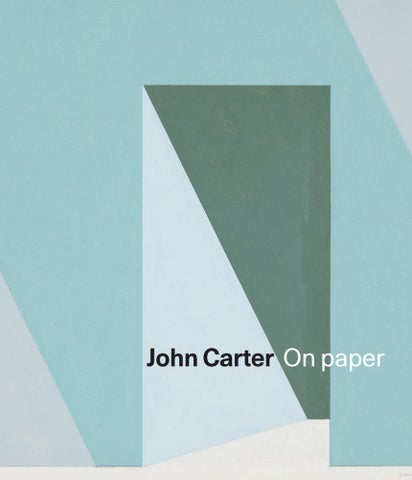
First published in 2019 by Royal Academy of Arts Burlington House Piccadilly London W1J 0BD Copyright © Royal Academy of Arts, 2019 All images and text by John Carter RA © John Carter RA, 2019 Text by Stephen Bann © Stephen Bann, 2019 Copy-editing: Dorothy Feaver Designed by Mark Thomson Set in Unica77 Printed in Belgium by die Keure in an edition of 1,200 copies Cover: Corner Opening III, 2005/9
Any copy of this book issued by the publisher is sold subject to the condition that it shall not by way of trade or otherwise be lent, re-sold, hired out or otherwise circulated without the publisher’s prior consent in any form of binding or cover other than that in which it is published and without a similar condition including these words being imposed on a subsequent purchaser. All Rights Reserved. No part of this publication may be reproduced or transmitted in any form or by any means, electronic or mechanical, including photocopy, recording, or any other information storage and retrieval system, without prior permission in writing from the publisher. British Library Cataloguing-in-Publication Data A catalogue record for this book is available from the British Library ISBN 978–1–912520–20–6 Distributed outside the United States and Canada by ACC Art Books Ltd, Sandy Lane, Old Martlesham, Woodbridge, Suffolk IP12 4SD Distributed in the United States and Canada by ARTBOOK | D.A.P., 155 Sixth Avenue, New York NY 10013
Editorial note All dimensions of works of art are given in centimetres, height before width. Artist’s acknowledgements The artist wishes to thank Peter Abrahams, Stephen Bann, Belinda Cadbury, John Gray, the Directors of the Redfern Gallery, Mark Thomson and Nick Tite. Photographic acknowledgements All photography is by Peter Abrahams with the exception of the image on page 30, which comes from the Arts Council Collection, Southbank Centre, London.