MAD
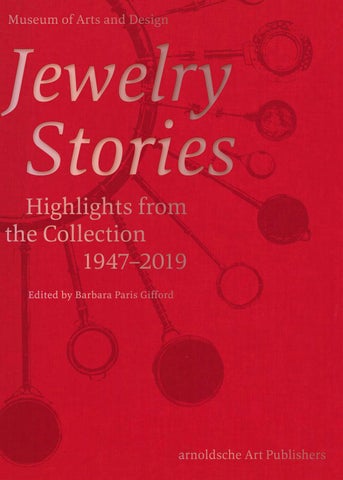
Museum of Arts and Design
Jewelry Stories
Jewelry Stories Highlights from the Collection 1947–2019 Edited by Barbara Paris Gifford
arnoldsche
arnoldsche Art Publishers
6 6
((page numbers will be adjusted in final step))
Foreword There has never been a time when humans lived without adornment. Museum collections around the world attest that people throughout history have crafted and worn jewelry, an enduring form of personal ornamentation that carries within it a multitude of stories. Jewelry gives us insight into the context in which it was made: the materials available, the political environment, the discovery of new techniques. It showcases the possibilities of design, craftsmanship, and imagination. It is treasured and passed down through generations, chronicling the lives of those who have worn it. It was therefore natural for Aileen Osborn Webb, the founder of the Museum of Arts and Design (MAD), to include jewelry in her collecting vision. A philanthropist and craft patron, Webb believed in the promotion of craft as a means to educate society and elevate its tastes, and jewelry was an important part of that exercise, featuring in the Museum’s exhibitions from the outset. The Museum’s founding, in 1956, dovetailed with the American studio jewelry movement, which burgeoned in the years after World War II. The war made available materials such as aluminum and plastic, mass-manufactured to compensate for metal shortages and now awaiting new uses. It also spurred émigrés from the Bauhaus in Germany to come to the United States, where they established institutions that aimed to equalize the arts, no matter the medium. Armed with new pedagogies and materials, young artists during this period embarked on a journey of fertile experimentation that resulted in new artistic forms. Since its founding, MAD has continuously collected one-of-a-kind pieces of studio and contemporary art jewelry, keeping pace with the development of the field. Over the years, the jewelry collection has grown to represent one-third of the Museum’s entire holdings; it encompasses over 950 objects, many of which have
been included in on-site exhibitions and loaned to other institutions. In 2008, with the move to its new home on Columbus Circle, MAD formalized its commitment to the medium through the dedication of the Tiffany & Co. Foundation Jewelry Gallery, a space solely devoted to the display of jewelry. And in 2020, the Museum presented its twentieth iteration of MAD About Jewelry, a highly anticipated annual sale in support of works by studio and contemporary art jewelers. The Tiffany Jewelry Gallery includes visible storage in the form of forty-five study drawers, enabling visitors to explore a larger portion of the collection than was previously possible. In 2020, twelve years after their initial presentation, the time came for a refresh of the drawers. This provided the impetus for the exhibition 45 Stories in Jewelry: 1947 to Now, which sought to enliven studio and contemporary jewelry so that the stories imbued in it could be heard. The exhibition opened February 13, 2020, to rave reviews, only to be closed down a short time later due to the worldwide Covid-19 pandemic. Thanks to the quick reaction of the MAD staff, led by Associate Curator Barbara Paris Gifford, 45 Stories in Jewelry went viral. Every week for seven months, the folios of 45 Stories formed the backdrop for a new virtual program, “In the MAD Loupe,” which brought together jewelry collectors, designers, curators, and writers to explore the exhibition and its treasures. The program continues to unite the jewelry community, spotlighting the artists who may offer the next forty-five stories in jewelry. A project of this historical and technical magnitude came to life in the very capable hands of Gifford, along with an advisory committee of contemporary jewelry experts and historians, comprising Erin Daily, Toni Greenbaum, Bella Neyman, Sasha Nixon, Timothy Veske-McMahon, and Brian Weissman, with support
from MAD Assistant Curator Angelik Vizcarrondo-Laboy. They chose the pieces to highlight and, along with a host of other jewelry experts, wrote the stories. On behalf of the MAD leadership team, I thank them all for their dedication to this project. This catalogue, published on the occasion of 45 Stories in Jewelry, presents images of the pieces on view, accompanied by expanded versions of their contextual narratives. As in the exhibition, the stories are arranged
according to theme or relationship, to illuminate connections among the works. Together, the photos and stories in these pages invite discovery of MAD’s collection of studio and contemporary art jewelry, offering intimate insights into the works and the personal, societal, and environmental forces that influenced their creation. Michele Cohen MAD Board Chair
6 6
((page numbers will be adjusted in final step))
Foreword There has never been a time when humans lived without adornment. Museum collections around the world attest that people throughout history have crafted and worn jewelry, an enduring form of personal ornamentation that carries within it a multitude of stories. Jewelry gives us insight into the context in which it was made: the materials available, the political environment, the discovery of new techniques. It showcases the possibilities of design, craftsmanship, and imagination. It is treasured and passed down through generations, chronicling the lives of those who have worn it. It was therefore natural for Aileen Osborn Webb, the founder of the Museum of Arts and Design (MAD), to include jewelry in her collecting vision. A philanthropist and craft patron, Webb believed in the promotion of craft as a means to educate society and elevate its tastes, and jewelry was an important part of that exercise, featuring in the Museum’s exhibitions from the outset. The Museum’s founding, in 1956, dovetailed with the American studio jewelry movement, which burgeoned in the years after World War II. The war made available materials such as aluminum and plastic, mass-manufactured to compensate for metal shortages and now awaiting new uses. It also spurred émigrés from the Bauhaus in Germany to come to the United States, where they established institutions that aimed to equalize the arts, no matter the medium. Armed with new pedagogies and materials, young artists during this period embarked on a journey of fertile experimentation that resulted in new artistic forms. Since its founding, MAD has continuously collected one-of-a-kind pieces of studio and contemporary art jewelry, keeping pace with the development of the field. Over the years, the jewelry collection has grown to represent one-third of the Museum’s entire holdings; it encompasses over 950 objects, many of which have
been included in on-site exhibitions and loaned to other institutions. In 2008, with the move to its new home on Columbus Circle, MAD formalized its commitment to the medium through the dedication of the Tiffany & Co. Foundation Jewelry Gallery, a space solely devoted to the display of jewelry. And in 2020, the Museum presented its twentieth iteration of MAD About Jewelry, a highly anticipated annual sale in support of works by studio and contemporary art jewelers. The Tiffany Jewelry Gallery includes visible storage in the form of forty-five study drawers, enabling visitors to explore a larger portion of the collection than was previously possible. In 2020, twelve years after their initial presentation, the time came for a refresh of the drawers. This provided the impetus for the exhibition 45 Stories in Jewelry: 1947 to Now, which sought to enliven studio and contemporary jewelry so that the stories imbued in it could be heard. The exhibition opened February 13, 2020, to rave reviews, only to be closed down a short time later due to the worldwide Covid-19 pandemic. Thanks to the quick reaction of the MAD staff, led by Associate Curator Barbara Paris Gifford, 45 Stories in Jewelry went viral. Every week for seven months, the folios of 45 Stories formed the backdrop for a new virtual program, “In the MAD Loupe,” which brought together jewelry collectors, designers, curators, and writers to explore the exhibition and its treasures. The program continues to unite the jewelry community, spotlighting the artists who may offer the next forty-five stories in jewelry. A project of this historical and technical magnitude came to life in the very capable hands of Gifford, along with an advisory committee of contemporary jewelry experts and historians, comprising Erin Daily, Toni Greenbaum, Bella Neyman, Sasha Nixon, Timothy Veske-McMahon, and Brian Weissman, with support
from MAD Assistant Curator Angelik Vizcarrondo-Laboy. They chose the pieces to highlight and, along with a host of other jewelry experts, wrote the stories. On behalf of the MAD leadership team, I thank them all for their dedication to this project. This catalogue, published on the occasion of 45 Stories in Jewelry, presents images of the pieces on view, accompanied by expanded versions of their contextual narratives. As in the exhibition, the stories are arranged
according to theme or relationship, to illuminate connections among the works. Together, the photos and stories in these pages invite discovery of MAD’s collection of studio and contemporary art jewelry, offering intimate insights into the works and the personal, societal, and environmental forces that influenced their creation. Michele Cohen MAD Board Chair
8 8
Acknowledgments
Committee Statement
This catalogue and the exhibition it accompanies represent the collaborative effort of a multitude of individuals, and I am deeply grateful for their dedication and insight. I must begin by acknowledging the artists in the exhibition, who have courageously challenged ingrained notions of what jewelry can be. Their vision and craftsmanship have resulted in engaging, thought-provoking works. Many thanks go to the donors behind the exhibition: your generosity has enriched our collection and made this project possible. And to the authors whose stories illuminate the jewelry on view: by sharing your expertise and recollections, you broaden our understanding of the works and the meaning behind them. In realizing the exhibition and catalogue, I worked closely with the 45 Stories in Jewelry Committee: Erin Daily, Toni Greenbaum, Bella Neyman, Timothy Veske-McMahon, Brian Weissman, and MAD Exhibitions Manager Sasha Nixon. My unending gratitude goes to them, as well as to my curatorial partner, colleague, and friend, MAD Assistant Curator Angelik Vizcarrondo-Laboy. They were instrumental in selecting the works to be exhibited and the authors to write about them, and in bringing the project to fruition. Karen Davidov, Helen W. Drutt English, Jeannine Falino, Thomas Gentille, LaVon Kellner, Ursula Ilse-Neuman, Kellie Riggs, Paul J. Smith, and Shannon R. Stratton, served as mentors and confidants, providing indispensable guidance. Elissa Auther, MAD William and Mildred Lasdon Chief Curator, a trusted advisor and steadfast supporter, ensured the project would achieve its highest standard. Numerous colleagues at MAD have been critical to the success of the project: Thuto Durkac-Somo, Audio-
As an artist, I am intensely drawn to the stories jewelry tells, and how these stories shift over time. These intimate, portable, and potent objects fascinate me. The history of the world exists in jewelry and its stories; these are human stories, and they connect us all. Jewelry is always in a profound relationship with the maker, the material, and the wearer, within a specific history. Each relationship adds to jewelry’s ever-evolving tale, enriching it and connecting it to the next generation. It is an honor and a privilege to be in the position to make these selections for 45 Stories In Jewelry: 1947 to Now and Jewelry Stories, to have power to rearrange and create new narratives, to look over the Museum of Arts and Design’s vast holdings and consider which voices have been represented and which lineages are missing entirely. Our committee was made up of historians, curators, educators, and practicing artists, people deeply interested in the history of the field of jewelry. It was exciting to work together to reimagine which viewpoints could be brought out and highlighted in the collection. From the beginning of our committee conversations, we understood that one of the goals of our time together was to identify important omissions. By illuminating gaps, we could tell a compelling story with the collection as it stands while advocating for new acquisitions to include more stories, more people, and more perspectives. The effort to reach a new understanding of the Museum’s collection was a collaborative one. The selection process valued differences in approaches, materials, concepts, and the views the artists brought to their work. The differences within the exhibition committee were also valued. For works made in the last hundred
visual Coordinator; Hendrik Gerrits, Deputy Director of Exhibitions and Operations; Willow Holdorf, Director of Exhibitions; Josh Graver, former Creative Director; Nathan Bennett, former Head of Exhibition Design and Production; Derya Kovey, former Associate Registrar of Exhibitions; Ellen Holdorf, Director of Collections Management; Terry Skoda, Barbara Tober Deputy Director of Institutional Advancement; Samantha Conlan, Associate Deputy Director for Institutional Giving; and Lydia Brawner, Associate Curator of Public Programs. My thanks extend to the Museum’s Education, Communications, and Development Departments, and to the MAD Collections Committee and Board of Trustees. The exhibition bore richer fruit thanks to Trisha Cheeney, John Coast, Laila Lott, and Tony Rogers, who expertly mounted the jewelry, resulting in a striking visual display. Thanks to Dirk Allgaier, Matthias Becher, and Karina Moschke at Arnoldsche Art Publishers for creating this beautiful volume, and to our talented and patient editor, Kristin Kearns, for editing every word. My appreciation also goes to those who provided the dazzling images for the exhibition and catalogue. Special thanks to Cindi Strauss and the Museum of Fine Arts, Houston, for allowing us to draw from the timeline in Ornament as Art: Avant-Garde Jewelry from the Helen Williams Drutt Collection, The Museum of Fine Arts, Houston. And most of all, thank you to Michele and Marty Cohen, who supported this exhibition and catalogue and have been crucial to the continued vitality of the Museum of Arts and Design. Barbara Paris Gifford MAD Associate Curator
years, it takes multiple perspectives to fully consider the dynamic conversation of studio and contemporary art jewelry. Each committee member brings their own neural web of connections to help expand the jewelry cosmos. The pieces presented already exist in a community and a trajectory of art history reference points, dotted with technological innovations. The committee’s various perspectives created the new lens necessary to understand these contexts. I appreciate that artists give themselves the opportunity to build the world anew with each piece of work, to stitch a version of the world as they see it, or want it seen. They translate thoughts that otherwise go unsaid or, importantly, underscore the actions that should be taken. My hope is that the stories we have told here honor the artists who have dedicated themselves to engaging in the ongoing conversation that is jewelry. I also hope that these stories captivate and resonate with viewers, to bring them into the dialogue. My final hope is for the future: that when the next opportunity arises to revisit and reimagine the jewelry collection at MAD, there will be more stories to include—ones that fill the gaps that are present, that expand the current boundaries, shake the foundations, and bring new contours to a vision that truly reflects the full expression of jewelry. Erin S. Daily on behalf of the 45 Stories in Jewelry: 1947 to Now and Jewelry Stories Committee: Toni Greenbaum Bella Neyman Sasha Nixon Timothy Veske-McMahon Brian Weissman
8 8
Acknowledgments
Committee Statement
This catalogue and the exhibition it accompanies represent the collaborative effort of a multitude of individuals, and I am deeply grateful for their dedication and insight. I must begin by acknowledging the artists in the exhibition, who have courageously challenged ingrained notions of what jewelry can be. Their vision and craftsmanship have resulted in engaging, thought-provoking works. Many thanks go to the donors behind the exhibition: your generosity has enriched our collection and made this project possible. And to the authors whose stories illuminate the jewelry on view: by sharing your expertise and recollections, you broaden our understanding of the works and the meaning behind them. In realizing the exhibition and catalogue, I worked closely with the 45 Stories in Jewelry Committee: Erin Daily, Toni Greenbaum, Bella Neyman, Timothy Veske-McMahon, Brian Weissman, and MAD Exhibitions Manager Sasha Nixon. My unending gratitude goes to them, as well as to my curatorial partner, colleague, and friend, MAD Assistant Curator Angelik Vizcarrondo-Laboy. They were instrumental in selecting the works to be exhibited and the authors to write about them, and in bringing the project to fruition. Karen Davidov, Helen W. Drutt English, Jeannine Falino, Thomas Gentille, LaVon Kellner, Ursula Ilse-Neuman, Kellie Riggs, Paul J. Smith, and Shannon R. Stratton, served as mentors and confidants, providing indispensable guidance. Elissa Auther, MAD William and Mildred Lasdon Chief Curator, a trusted advisor and steadfast supporter, ensured the project would achieve its highest standard. Numerous colleagues at MAD have been critical to the success of the project: Thuto Durkac-Somo, Audio-
As an artist, I am intensely drawn to the stories jewelry tells, and how these stories shift over time. These intimate, portable, and potent objects fascinate me. The history of the world exists in jewelry and its stories; these are human stories, and they connect us all. Jewelry is always in a profound relationship with the maker, the material, and the wearer, within a specific history. Each relationship adds to jewelry’s ever-evolving tale, enriching it and connecting it to the next generation. It is an honor and a privilege to be in the position to make these selections for 45 Stories In Jewelry: 1947 to Now and Jewelry Stories, to have power to rearrange and create new narratives, to look over the Museum of Arts and Design’s vast holdings and consider which voices have been represented and which lineages are missing entirely. Our committee was made up of historians, curators, educators, and practicing artists, people deeply interested in the history of the field of jewelry. It was exciting to work together to reimagine which viewpoints could be brought out and highlighted in the collection. From the beginning of our committee conversations, we understood that one of the goals of our time together was to identify important omissions. By illuminating gaps, we could tell a compelling story with the collection as it stands while advocating for new acquisitions to include more stories, more people, and more perspectives. The effort to reach a new understanding of the Museum’s collection was a collaborative one. The selection process valued differences in approaches, materials, concepts, and the views the artists brought to their work. The differences within the exhibition committee were also valued. For works made in the last hundred
visual Coordinator; Hendrik Gerrits, Deputy Director of Exhibitions and Operations; Willow Holdorf, Director of Exhibitions; Josh Graver, former Creative Director; Nathan Bennett, former Head of Exhibition Design and Production; Derya Kovey, former Associate Registrar of Exhibitions; Ellen Holdorf, Director of Collections Management; Terry Skoda, Barbara Tober Deputy Director of Institutional Advancement; Samantha Conlan, Associate Deputy Director for Institutional Giving; and Lydia Brawner, Associate Curator of Public Programs. My thanks extend to the Museum’s Education, Communications, and Development Departments, and to the MAD Collections Committee and Board of Trustees. The exhibition bore richer fruit thanks to Trisha Cheeney, John Coast, Laila Lott, and Tony Rogers, who expertly mounted the jewelry, resulting in a striking visual display. Thanks to Dirk Allgaier, Matthias Becher, and Karina Moschke at Arnoldsche Art Publishers for creating this beautiful volume, and to our talented and patient editor, Kristin Kearns, for editing every word. My appreciation also goes to those who provided the dazzling images for the exhibition and catalogue. Special thanks to Cindi Strauss and the Museum of Fine Arts, Houston, for allowing us to draw from the timeline in Ornament as Art: Avant-Garde Jewelry from the Helen Williams Drutt Collection, The Museum of Fine Arts, Houston. And most of all, thank you to Michele and Marty Cohen, who supported this exhibition and catalogue and have been crucial to the continued vitality of the Museum of Arts and Design. Barbara Paris Gifford MAD Associate Curator
years, it takes multiple perspectives to fully consider the dynamic conversation of studio and contemporary art jewelry. Each committee member brings their own neural web of connections to help expand the jewelry cosmos. The pieces presented already exist in a community and a trajectory of art history reference points, dotted with technological innovations. The committee’s various perspectives created the new lens necessary to understand these contexts. I appreciate that artists give themselves the opportunity to build the world anew with each piece of work, to stitch a version of the world as they see it, or want it seen. They translate thoughts that otherwise go unsaid or, importantly, underscore the actions that should be taken. My hope is that the stories we have told here honor the artists who have dedicated themselves to engaging in the ongoing conversation that is jewelry. I also hope that these stories captivate and resonate with viewers, to bring them into the dialogue. My final hope is for the future: that when the next opportunity arises to revisit and reimagine the jewelry collection at MAD, there will be more stories to include—ones that fill the gaps that are present, that expand the current boundaries, shake the foundations, and bring new contours to a vision that truly reflects the full expression of jewelry. Erin S. Daily on behalf of the 45 Stories in Jewelry: 1947 to Now and Jewelry Stories Committee: Toni Greenbaum Bella Neyman Sasha Nixon Timothy Veske-McMahon Brian Weissman
10 10
Artists, Authors, and Donors Artists Gijs Bakker Aline Berdichevsky Harriete Estel Berman David Bielander Melanie Bilenker Manfred Bischoff Helen Britton Caroline Broadhead Sigurd Bronger Lola Brooks Irena Brynner Kim Buck Cécile et Jeanne Peter Chang Eunmi Chun Sharon Church William Clark Giovanni Corvaja Margret Craver Margaret De Patta Arline Fisch Karl Fritsch Thomas Gentille Lisa Gralnick Adam Grinovich Gésine Hackenberg William Harper Hanna Hedman Mari Ishikawa Sergey Jivetin Lauren Kalman Esther Knobel Henning Koppel Sam Kramer Julia Maria Künnap Otto Künzli Zachery Lechtenberg Stanley Lechtzin Charles Loloma Julia Manheim Stefano Marchetti Bruno Martinazzi Märta Mattsson John Paul Miller Myra Mimlitsch-Gray
Eleanor Moty Iris Nieuwenburg Ronald Hayes Pearson Wendy Ramshaw Gerd Rothmann Mary Ann Scherr Joyce J. Scott Sondra Sherman Sakurako Shimizu Vivian Shimoyama Kiff Slemmons Arthur Smith Ramona Solberg Bettina Speckner Donald Paul Tompkins Julia Turner MJ Tyson Emmy van Leersum Tone Vigeland David Watkins Mallory Weston Heather White van Stolk Ed Wiener J. Fred Woell
Authors
Donors
Glenn Adamson Elissa Auther Donna Bilak Helen Britton Susan Cummins Erin S. Daily Liesbeth den Besten Andrea DiNoto Helen W. Drutt English Marina Elenskaya Elizabeth Essner Jeannine Falino Thomas Gentille Barbara Paris Gifford Toni Greenbaum Mike Holmes Petra Hölscher Ursula Ilse-Neuman Bernard N. Jazzar Yevgeniya Kaganovich Pat Kirkham Ronald T. Labaco Keith A. Lewis Urmas Lüüs Ellen Maurer Zilioli David McFadden America Meredith Jennifer-Navva Milliken Myra Mimlitsch-Gray Sara Morris Harold B. “Hal” Nelson Bella Neyman Sasha Nixon Anni Nørskov Mørch Kayleigh Perkov Patricia C. Phillips Suzanne Ramljak Kellie Riggs Joyce J. Scott Robert Shetterly Lowery Stokes Sims Shannon R. Stratton Timothy Veske-McMahon Angelik Vizcarrondo-Laboy Brian Weissman
Private Donors Madeleine Albright Anonymous Dr. Neil H. Bander Susan C. Beech Gail M. Brown Hope Byer Michele Caplan Garth Clark and Mark Del Vecchio Michele Cohen Michele and Marty Cohen Marcia Docter Helen W. Drutt English Lisa Gralnick Vicki Halper Amy Hanan Ann Kaplan Jane Korman Diane Kuhn Nanette L. Laitman Mimi Livingston Sonia and Isaac Luski Virginia S. Lyon Bruno Martinazzi Laura Selwyn Oskowitz Ronald Hayes Pearson Wendy Ramshaw and David Watkins Aviva and Jack Robinson Joanna Roos Donna Schneier Sakurako Shimizu Barbara Tober Inger Wästberg Lawrence and Stephan Zucker
Collaborative Giving American Craft Council, Norman Anderson, Knoll North America, Suzi Pleyte, Daniel Rhodes, and Aileen Osborn Webb Eugene Bielawski, The Margaret De Patta Bequest, through the American Craft Council Mary Lee Hu, through the American Craft Council Johnson Wax Company, through the American Craft Council Ann Kaplan and the MAD Collections Committee Edith Lechtzin, through the American Craft Council Jeffrey Manocherian and the MAD Collections Committee Rotasa Art Jewelry Grant and the MAD Collections Committee
Institutional Donors MAD Collections Committee MAD LOOT! Purchase Committee
Organizational Donors American Craft Council
Collection Donors Helen Williams Drutt Family Collection Porter-Price Collection Susan Grant Lewin Collection
Foundation Donors Annie & Otto Johs. Detlefs’ Charitable Foundation Barbara Rockefeller Foundation Barbro Osher Pro Suecia Foundation Horace W. Goldsmith Foundation Rotasa Fund
Gallery Donors Mobilia Gallery
10 10
Artists, Authors, and Donors Artists Gijs Bakker Aline Berdichevsky Harriete Estel Berman David Bielander Melanie Bilenker Manfred Bischoff Helen Britton Caroline Broadhead Sigurd Bronger Lola Brooks Irena Brynner Kim Buck Cécile et Jeanne Peter Chang Eunmi Chun Sharon Church William Clark Giovanni Corvaja Margret Craver Margaret De Patta Arline Fisch Karl Fritsch Thomas Gentille Lisa Gralnick Adam Grinovich Gésine Hackenberg William Harper Hanna Hedman Mari Ishikawa Sergey Jivetin Lauren Kalman Esther Knobel Henning Koppel Sam Kramer Julia Maria Künnap Otto Künzli Zachery Lechtenberg Stanley Lechtzin Charles Loloma Julia Manheim Stefano Marchetti Bruno Martinazzi Märta Mattsson John Paul Miller Myra Mimlitsch-Gray
Eleanor Moty Iris Nieuwenburg Ronald Hayes Pearson Wendy Ramshaw Gerd Rothmann Mary Ann Scherr Joyce J. Scott Sondra Sherman Sakurako Shimizu Vivian Shimoyama Kiff Slemmons Arthur Smith Ramona Solberg Bettina Speckner Donald Paul Tompkins Julia Turner MJ Tyson Emmy van Leersum Tone Vigeland David Watkins Mallory Weston Heather White van Stolk Ed Wiener J. Fred Woell
Authors
Donors
Glenn Adamson Elissa Auther Donna Bilak Helen Britton Susan Cummins Erin S. Daily Liesbeth den Besten Andrea DiNoto Helen W. Drutt English Marina Elenskaya Elizabeth Essner Jeannine Falino Thomas Gentille Barbara Paris Gifford Toni Greenbaum Mike Holmes Petra Hölscher Ursula Ilse-Neuman Bernard N. Jazzar Yevgeniya Kaganovich Pat Kirkham Ronald T. Labaco Keith A. Lewis Urmas Lüüs Ellen Maurer Zilioli David McFadden America Meredith Jennifer-Navva Milliken Myra Mimlitsch-Gray Sara Morris Harold B. “Hal” Nelson Bella Neyman Sasha Nixon Anni Nørskov Mørch Kayleigh Perkov Patricia C. Phillips Suzanne Ramljak Kellie Riggs Joyce J. Scott Robert Shetterly Lowery Stokes Sims Shannon R. Stratton Timothy Veske-McMahon Angelik Vizcarrondo-Laboy Brian Weissman
Private Donors Madeleine Albright Anonymous Dr. Neil H. Bander Susan C. Beech Gail M. Brown Hope Byer Michele Caplan Garth Clark and Mark Del Vecchio Michele Cohen Michele and Marty Cohen Marcia Docter Helen W. Drutt English Lisa Gralnick Vicki Halper Amy Hanan Ann Kaplan Jane Korman Diane Kuhn Nanette L. Laitman Mimi Livingston Sonia and Isaac Luski Virginia S. Lyon Bruno Martinazzi Laura Selwyn Oskowitz Ronald Hayes Pearson Wendy Ramshaw and David Watkins Aviva and Jack Robinson Joanna Roos Donna Schneier Sakurako Shimizu Barbara Tober Inger Wästberg Lawrence and Stephan Zucker
Collaborative Giving American Craft Council, Norman Anderson, Knoll North America, Suzi Pleyte, Daniel Rhodes, and Aileen Osborn Webb Eugene Bielawski, The Margaret De Patta Bequest, through the American Craft Council Mary Lee Hu, through the American Craft Council Johnson Wax Company, through the American Craft Council Ann Kaplan and the MAD Collections Committee Edith Lechtzin, through the American Craft Council Jeffrey Manocherian and the MAD Collections Committee Rotasa Art Jewelry Grant and the MAD Collections Committee
Institutional Donors MAD Collections Committee MAD LOOT! Purchase Committee
Organizational Donors American Craft Council
Collection Donors Helen Williams Drutt Family Collection Porter-Price Collection Susan Grant Lewin Collection
Foundation Donors Annie & Otto Johs. Detlefs’ Charitable Foundation Barbara Rockefeller Foundation Barbro Osher Pro Suecia Foundation Horace W. Goldsmith Foundation Rotasa Fund
Gallery Donors Mobilia Gallery
12 12
A MAD Jewelry Tale Several years ago, when I first pulled open the visible-storage drawers in MAD’s Tiffany & Co. Foundation Jewelry Gallery, it was obvious the studio and contemporary art jewelry inside had stories to tell.1 This was not the jewelry I was used to seeing, made of gold or platinum, with expensive faceted stones. By contrast, most of these pieces were fabricated with non-precious materials, and seemed to share more with contemporary sculpture than with the historical gems often shown in museum collections. Yet their placement in display drawers, as opposed to on the body, stripped these unusual works of their frame of reference. When jewelry is worn, it has the wearer to speak for it; but in a museum, key aspects of its power fade. The body does not animate it, and the wearer cannot tell you about it. Housed in drawers, as these were, the pieces risked dissociation from context and intention. Like many art forms, jewelry is a social medium that reflects our changing world. Uniquely, through its intimacy with the body, it is also an extension of the wearer. Jewelry facilitates connections and serves as a badge of affiliation. It has the ability to begin a conversation, to communicate a point of view, and to signal
and create relationships. And herein lies the challenge for a jewelry curator: How do you make it come to life off the body? How can you convey the intentions of the artists? And how do you simultaneously contextualize art jewelry’s autonomous past and its points of intersection with the larger world of visual and material culture, history, and politics? These questions are at the root of the exhibition 45 Stories in Jewelry: 1947 to Now and its accompanying publication, Jewelry Stories. Studio and contemporary jewelry, collectively defined as jewelry made by craftspeople and artists focused on experimentation and the concept of art as a wearable medium, developed in earnest after World War II. MAD began collecting studio jewelry upon its opening in 19562 and included examples in its inaugural exhibition, Craftsmanship in a Changing World (fig.2); it showed its first exhibition dedicated to the medium, American Jewelry and Related Objects, sponsored by the Hickok Company of Rochester, New York (fig. 1), the following year. Since then, the Museum has mounted over 150 exhibitions with jewelry as its subject.3 Thus, unlike most institutions with studio and contemporary art jewelry holdings, MAD has jewelry embedded in its DNA.
1 Installation view of MAD’s first jewelry exhibition,
American Jewelry and Related Objects, Museum of Contemporary Crafts (now MAD), May 17 – June 23, 1957. 2 Installation view of jewelry in Craftsmanship in a
Changing World, Museum of Contemporary Crafts (now MAD), September 20 – November 4, 1956.
12 12
A MAD Jewelry Tale Several years ago, when I first pulled open the visible-storage drawers in MAD’s Tiffany & Co. Foundation Jewelry Gallery, it was obvious the studio and contemporary art jewelry inside had stories to tell.1 This was not the jewelry I was used to seeing, made of gold or platinum, with expensive faceted stones. By contrast, most of these pieces were fabricated with non-precious materials, and seemed to share more with contemporary sculpture than with the historical gems often shown in museum collections. Yet their placement in display drawers, as opposed to on the body, stripped these unusual works of their frame of reference. When jewelry is worn, it has the wearer to speak for it; but in a museum, key aspects of its power fade. The body does not animate it, and the wearer cannot tell you about it. Housed in drawers, as these were, the pieces risked dissociation from context and intention. Like many art forms, jewelry is a social medium that reflects our changing world. Uniquely, through its intimacy with the body, it is also an extension of the wearer. Jewelry facilitates connections and serves as a badge of affiliation. It has the ability to begin a conversation, to communicate a point of view, and to signal
and create relationships. And herein lies the challenge for a jewelry curator: How do you make it come to life off the body? How can you convey the intentions of the artists? And how do you simultaneously contextualize art jewelry’s autonomous past and its points of intersection with the larger world of visual and material culture, history, and politics? These questions are at the root of the exhibition 45 Stories in Jewelry: 1947 to Now and its accompanying publication, Jewelry Stories. Studio and contemporary jewelry, collectively defined as jewelry made by craftspeople and artists focused on experimentation and the concept of art as a wearable medium, developed in earnest after World War II. MAD began collecting studio jewelry upon its opening in 19562 and included examples in its inaugural exhibition, Craftsmanship in a Changing World (fig.2); it showed its first exhibition dedicated to the medium, American Jewelry and Related Objects, sponsored by the Hickok Company of Rochester, New York (fig. 1), the following year. Since then, the Museum has mounted over 150 exhibitions with jewelry as its subject.3 Thus, unlike most institutions with studio and contemporary art jewelry holdings, MAD has jewelry embedded in its DNA.
1 Installation view of MAD’s first jewelry exhibition,
American Jewelry and Related Objects, Museum of Contemporary Crafts (now MAD), May 17 – June 23, 1957. 2 Installation view of jewelry in Craftsmanship in a
Changing World, Museum of Contemporary Crafts (now MAD), September 20 – November 4, 1956.
14 14 The exhibition 45 Stories in Jewelry is the latest addition to this exceptional history. Its title refers to the number of visible-storage drawers in the Tiffany Jewelry Gallery. The drawers underwent a complete redesign prior to the exhibition, with each displaying a piece of jewelry on a panel, accompanied by a written vignette. The pairing of works with their contextual images and narratives mimics an Instagram-style post, presenting information consistent with the post-digital era (fig. 3). Taken together, the panels illustrate the evolution of studio and contemporary art jewelry through the lens of MAD’s collection: from pieces that directly echo the design values and social ethos of the postwar era to those that illustrate experimentation with a wide variety of materials, technologies, and forms; and from works that subvert and deepen traditional jewelry meanings to those that express the social, political, and environmental preoccupations of the twenty-first century.4 While the story these objects collectively tell is US-centric due to the nature of MAD’s collecting history, the exhibition reveals the predominant global developments that have shaped art jewelry since 1947. To create the exhibition, I assembled a committee to help select the jewelry and identify experts in the field to compose the stories. The curatorial process was intentionally collaborative, to make space for contribu-
tions from the art jewelry community. The authors selected come from a wide array of backgrounds: they are artists, historians, gallerists, curators, and educators, who shared their perspectives on and often their firsthand accounts of the artists represented. In addition to providing insightful contexts for the works on view, their narratives reveal the relationships, networks, and affiliations that have driven the vitality of the field. The exhibition design took the form of two large oval structures, echoing not only the built-in elliptical jewelry case located in the Tiffany Jewelry Gallery, but also the shape of a communal dining table—underscoring, once more, the personal and professional relationships shaping the jewelry field (figs. 4, 5). After the exhibition closes, the drawers will be fitted back into their permanent display cabinet, permitting future visitors to discover the collection on their own, drawer by drawer. While the stories that make up the exhibition and the greater portion of this catalogue are arranged thematically or relationally, this essay charts them chronologically. It is my hope that the new installation of display drawers, together with this accompanying publication, responds to the questions I had as a firsttime viewer of these remarkable works, connecting them to art jewelry’s place in the history of craft and design; the various aesthetic, social, and political environments
3 Drawer panel for Wendy Ramshaw
and David Watkins’ “Something Special” paper jewelry (c. 1968) as installed in 45 Stories in Jewelry: 1947 to Now.
4+5 Installation views of 45 Stories in Jewelry:
1947 to Now.
14 14 The exhibition 45 Stories in Jewelry is the latest addition to this exceptional history. Its title refers to the number of visible-storage drawers in the Tiffany Jewelry Gallery. The drawers underwent a complete redesign prior to the exhibition, with each displaying a piece of jewelry on a panel, accompanied by a written vignette. The pairing of works with their contextual images and narratives mimics an Instagram-style post, presenting information consistent with the post-digital era (fig. 3). Taken together, the panels illustrate the evolution of studio and contemporary art jewelry through the lens of MAD’s collection: from pieces that directly echo the design values and social ethos of the postwar era to those that illustrate experimentation with a wide variety of materials, technologies, and forms; and from works that subvert and deepen traditional jewelry meanings to those that express the social, political, and environmental preoccupations of the twenty-first century.4 While the story these objects collectively tell is US-centric due to the nature of MAD’s collecting history, the exhibition reveals the predominant global developments that have shaped art jewelry since 1947. To create the exhibition, I assembled a committee to help select the jewelry and identify experts in the field to compose the stories. The curatorial process was intentionally collaborative, to make space for contribu-
tions from the art jewelry community. The authors selected come from a wide array of backgrounds: they are artists, historians, gallerists, curators, and educators, who shared their perspectives on and often their firsthand accounts of the artists represented. In addition to providing insightful contexts for the works on view, their narratives reveal the relationships, networks, and affiliations that have driven the vitality of the field. The exhibition design took the form of two large oval structures, echoing not only the built-in elliptical jewelry case located in the Tiffany Jewelry Gallery, but also the shape of a communal dining table—underscoring, once more, the personal and professional relationships shaping the jewelry field (figs. 4, 5). After the exhibition closes, the drawers will be fitted back into their permanent display cabinet, permitting future visitors to discover the collection on their own, drawer by drawer. While the stories that make up the exhibition and the greater portion of this catalogue are arranged thematically or relationally, this essay charts them chronologically. It is my hope that the new installation of display drawers, together with this accompanying publication, responds to the questions I had as a firsttime viewer of these remarkable works, connecting them to art jewelry’s place in the history of craft and design; the various aesthetic, social, and political environments
3 Drawer panel for Wendy Ramshaw
and David Watkins’ “Something Special” paper jewelry (c. 1968) as installed in 45 Stories in Jewelry: 1947 to Now.
4+5 Installation views of 45 Stories in Jewelry:
1947 to Now.
84 84
Crossed Paths The United States (US) has been built on indigenous land by continuous waves of voluntary and involuntary immigration from around the globe. Many come in pursuit of the romanticized “American Dream,” a coinage that reflects the long-standing perception of this country as a place of refuge, a paradise of opportunity, holding the promise of a better life. But not all are afforded the privilege of dreaming, as the US has historically been unkind to Brown and Black people. Furthermore, antithetical to the foundation of this country, the Trump administration flaunts a heavily anti-migratory agenda that is most poignant along the border with Mexico. Faced with detention centers, the separation of children from their families, tear gassing, ICE raids, deportations, and persistent cries to build “the wall” that will “make America great again,” this community is being specifically targeted and attacked for the sake of racist ideals. Almost two thousand miles long, the US-Mexico border spans four American and six Mexican states. Unbeknownst to most of the population in the US, members of towns on both sides of the border engage in a symbiotic exchange of culture, ideas, and wealth. Although the media often portrays immigrants in a negative light, the majority come to this country to work or are escaping violence in their home countries; in fact, this group alone makes up almost half of the country’s agricultural labor force.19 Many immigrants make the difficult decision to brave the perilous journey across
the border, often leaving their families behind, knowing they might never see them again, not least because they might not survive. Mexican artist Aline Berdichevsky and American artist Julia Turner harness the intimate storytelling potential of jewelry to give insight into the aforementioned journey, a tale of both hope and loss. Their practices complement each other like two sides of a coin—or rather, two sides of a border. The former focuses on the immigrant’s experience en route, while the latter speaks to one of the most devastating outcomes at the end of the road. In Lightvessels 1 (2013), Berdichevsky renders in porcelain the care packages prepared by women in the Mexican town of La Patrona, who throw them to people riding on the roofs of trains headed for the US. The intended function of this piece as a hand jewel creates empathy with these travelers, whose ability to catch one of these parcels can make the difference between life or death. Turner’s Three Days Walking (2013) reveals the harsh reality that awaits many who cross the border. The poignant brooch is based on Victorian mourning jewelry. Turner memorializes the unidentified immigrants who die while traversing the desert by transforming the red dots used to mark their locations on maps into a resilient desert flower. Angelik Vizcarrondo-Laboy MAD Assistant Curator
FROM TOP
Aline Berdichevsky Mexico, b. 1977 Julia Turner United States, b. 1970
Aline Berdichevsky 49 Lightvessels 1 (Hand Jewel), 2013 Julia Turner 50 Three Days Walking (Mourning Brooch), 2013
84 84
Crossed Paths The United States (US) has been built on indigenous land by continuous waves of voluntary and involuntary immigration from around the globe. Many come in pursuit of the romanticized “American Dream,” a coinage that reflects the long-standing perception of this country as a place of refuge, a paradise of opportunity, holding the promise of a better life. But not all are afforded the privilege of dreaming, as the US has historically been unkind to Brown and Black people. Furthermore, antithetical to the foundation of this country, the Trump administration flaunts a heavily anti-migratory agenda that is most poignant along the border with Mexico. Faced with detention centers, the separation of children from their families, tear gassing, ICE raids, deportations, and persistent cries to build “the wall” that will “make America great again,” this community is being specifically targeted and attacked for the sake of racist ideals. Almost two thousand miles long, the US-Mexico border spans four American and six Mexican states. Unbeknownst to most of the population in the US, members of towns on both sides of the border engage in a symbiotic exchange of culture, ideas, and wealth. Although the media often portrays immigrants in a negative light, the majority come to this country to work or are escaping violence in their home countries; in fact, this group alone makes up almost half of the country’s agricultural labor force.19 Many immigrants make the difficult decision to brave the perilous journey across
the border, often leaving their families behind, knowing they might never see them again, not least because they might not survive. Mexican artist Aline Berdichevsky and American artist Julia Turner harness the intimate storytelling potential of jewelry to give insight into the aforementioned journey, a tale of both hope and loss. Their practices complement each other like two sides of a coin—or rather, two sides of a border. The former focuses on the immigrant’s experience en route, while the latter speaks to one of the most devastating outcomes at the end of the road. In Lightvessels 1 (2013), Berdichevsky renders in porcelain the care packages prepared by women in the Mexican town of La Patrona, who throw them to people riding on the roofs of trains headed for the US. The intended function of this piece as a hand jewel creates empathy with these travelers, whose ability to catch one of these parcels can make the difference between life or death. Turner’s Three Days Walking (2013) reveals the harsh reality that awaits many who cross the border. The poignant brooch is based on Victorian mourning jewelry. Turner memorializes the unidentified immigrants who die while traversing the desert by transforming the red dots used to mark their locations on maps into a resilient desert flower. Angelik Vizcarrondo-Laboy MAD Assistant Curator
FROM TOP
Aline Berdichevsky Mexico, b. 1977 Julia Turner United States, b. 1970
Aline Berdichevsky 49 Lightvessels 1 (Hand Jewel), 2013 Julia Turner 50 Three Days Walking (Mourning Brooch), 2013
86 86
Protest & Power Political jewelry comprises a small but passionate subset of the contemporary jewelry world. William Clark’s Police State Badge (1969) and Donald Tompkins’ Jack Zucker Commemorative Medal (1972) exemplify jewelry’s subversive potential as a form of protest and provocation. On first glance, Police State Badge looks like the star worn by the Sheriff in a movie western—but then you realize that this is not the emblem of civic authority but a public questioning of that authority. Clark made the piece in response to the Vietnam War, as part of the larger West Coast protest movement of the 1960s and 1970s. Smart and powerful, the badge displays a combination of humor and passion typical of Clark’s work during that time. Clark wants to remind us, as he frequently did in life, to be wary of institutionalized power and prepared to stand up to it. In the 1970s, he wore his Police State Badge during a protest and was threatened with arrest for impersonating a police officer: in his telling, the longhaired Clark laughed and, after pointing out that the officer’s sergeant wouldn’t be happy with that particular arrest, was let go. In 2003, he remade a small edition of the badge, this time in response to the Iraq War; today, those badges are out in the world, doing their necessary work when the times require it. Whereas Clark’s piece brings focus to a controversial issue, Tompkins’ Jack Zucker Commemorative Medal honors a life of activism. Jack Zucker was a longtime union organizer unafraid to speak truth to power; his
most famous act was to stand up to the state-sponsored bullying by US Senator Joseph McCarthy and his House Un-American Activities Committee. Zucker’s son, Lawrence, remembers his father’s testimony under oath: “My father, who was not shy, stood up, raised his hand to show his pinky finger, and said in his booming voice, ‘Senator McCarthy, I have more patriotism in my little finger than you have in your entire body.’” The Zucker Medal contains a photoetching of Zucker, a found American Federation of Labor badge, a cast charm of a dancing girl, and a handstamped quote of Zucker’s words to McCarthy. Beginning in 1965, Tompkins combined Pop art and Funk sensibilities. His early use of found materials, text, experimental jewelry techniques, and personal narrative would change the course of American studio jewelry. The Jack Zucker Commemorative Medal is one of twenty- five “Commemorative Medals” he created between 1968 and 1974. The medals celebrated artists, writers Tompkins admired, and political figures like President Richard Nixon, whom he ridiculed. Tompkins was a family friend of Zucker’s, and made the medal as a gift to celebrate his accomplishments. We are lucky to have it in the MAD collection, to remind us not only of Tompkins’ pioneering work but also how important engaged, principled citizens like Zucker are for our country. Mike Holmes Curator, author, and owner of Velvet da Vinci
FROM TOP
Donald Paul Tompkins 51 Jack Zucker Commemorative Medal (from the
William Clark United States, 1942 –2008 Donald Paul Tompkins United States, 1933 –1982
“Commemorative Medals” series), c. 1972 William Clark 52 Police State Badge, 1969
86 86
Protest & Power Political jewelry comprises a small but passionate subset of the contemporary jewelry world. William Clark’s Police State Badge (1969) and Donald Tompkins’ Jack Zucker Commemorative Medal (1972) exemplify jewelry’s subversive potential as a form of protest and provocation. On first glance, Police State Badge looks like the star worn by the Sheriff in a movie western—but then you realize that this is not the emblem of civic authority but a public questioning of that authority. Clark made the piece in response to the Vietnam War, as part of the larger West Coast protest movement of the 1960s and 1970s. Smart and powerful, the badge displays a combination of humor and passion typical of Clark’s work during that time. Clark wants to remind us, as he frequently did in life, to be wary of institutionalized power and prepared to stand up to it. In the 1970s, he wore his Police State Badge during a protest and was threatened with arrest for impersonating a police officer: in his telling, the longhaired Clark laughed and, after pointing out that the officer’s sergeant wouldn’t be happy with that particular arrest, was let go. In 2003, he remade a small edition of the badge, this time in response to the Iraq War; today, those badges are out in the world, doing their necessary work when the times require it. Whereas Clark’s piece brings focus to a controversial issue, Tompkins’ Jack Zucker Commemorative Medal honors a life of activism. Jack Zucker was a longtime union organizer unafraid to speak truth to power; his
most famous act was to stand up to the state-sponsored bullying by US Senator Joseph McCarthy and his House Un-American Activities Committee. Zucker’s son, Lawrence, remembers his father’s testimony under oath: “My father, who was not shy, stood up, raised his hand to show his pinky finger, and said in his booming voice, ‘Senator McCarthy, I have more patriotism in my little finger than you have in your entire body.’” The Zucker Medal contains a photoetching of Zucker, a found American Federation of Labor badge, a cast charm of a dancing girl, and a handstamped quote of Zucker’s words to McCarthy. Beginning in 1965, Tompkins combined Pop art and Funk sensibilities. His early use of found materials, text, experimental jewelry techniques, and personal narrative would change the course of American studio jewelry. The Jack Zucker Commemorative Medal is one of twenty- five “Commemorative Medals” he created between 1968 and 1974. The medals celebrated artists, writers Tompkins admired, and political figures like President Richard Nixon, whom he ridiculed. Tompkins was a family friend of Zucker’s, and made the medal as a gift to celebrate his accomplishments. We are lucky to have it in the MAD collection, to remind us not only of Tompkins’ pioneering work but also how important engaged, principled citizens like Zucker are for our country. Mike Holmes Curator, author, and owner of Velvet da Vinci
FROM TOP
Donald Paul Tompkins 51 Jack Zucker Commemorative Medal (from the
William Clark United States, 1942 –2008 Donald Paul Tompkins United States, 1933 –1982
“Commemorative Medals” series), c. 1972 William Clark 52 Police State Badge, 1969
88 88
Nevertheless, She Persisted Lauren Kalman’s practice blurs lines between body and architecture, adornment and ornament, in an exploration of the feminine as a place and gender as a construction. For Kalman, gender is at once spacious and restrictive, and she works this out over a range of media—from the jewelry object, the field in which she was trained, to sculpture, performance, photography, and video. Kalman represents and performs the body in conversation with the human-engineered world, or the built environment. The “feminine” inserts itself, assertively and powerfully, into the picture, as opposed to fragmented ornament or objects of adornment standing in for an absent, imagined form. But Kalman also positions the female body as engineered, in a way analogous to urban planning and architecture. In her objects, the two concepts merge, both materially and physically, such that Kalman’s bodies become inseparable from the notion of space. The body, concepts of gender and femininity—these are all “sites” in her work, places that can be materially poked and prodded, featured and obscured. Although she concentrates the audience’s focus on the body, the constraints Kalman applies to her process—ranging from material choice to color—make room for an attention to surface and shape. Through her self-imposed limitations and reference to Modernist theorists like Adolf Loos (1870-1933), whose critique of ornament framed decoration as puerile and criminal, she sets up an uneasy position. Desire and the erotic guides much of Kalman’s exploration of the aforementioned sites: she blends Modernist tropes like minimalist form and palette with gilding, allusions to BDSM, and an emphasis on the orifice. The resulting layering of minimalism and ornamentation leaves a disrupted beauty, wherein heteronormativity and whiteness exist along
Lauren Kalman
United States, b. 1980
FROM TOP
Lauren Kalman 53 But if the Crime is Beautiful … Monstrance, 2015 54 Embodier (1) Collar (from the “Icons of the Flesh”
series), 2016
a spectrum from fascist to erotic to puritanical, pointing to the complexity and contradictory nature of desire. Kalman’s work often leaves the viewer wanting for relief or resolution. It creates disorientation around the body and its modification, and asks which is the true modifier: the actual, material decoration with which one might enhance oneself? Or the gaze, desire, and culture that define, moderate, and shape our form and thus our sense of embodiment? The collar featured in Jewelry Stories is from Kalman’s series “Icons of the Flesh” (2016). Meant for public wear rather than exhibition display, this series of “embodiers,” taking the form of badges, buttons, and collars, can be added to the body as a kind of analog augmentation. Bumps, protrusions, indentations, and crevices recall nipples and genitalia as much as they do the buttons of uniforms and other regalia, performing as something between medal and simple armor. They are body modifiers in the starkest way possible, as they simultaneously speak to survival and triumph. The very fact of persisting as woman, female, femme, feminine is explored in these interchangeable insignia, which invite the wearer to combine and present the symbols that speak most powerfully to their sense of embodiment. In Monstrance, Kalman gilds female genitalia, a simple and direct bodily modification that alludes to value and preciousness: accentuated and transformed, the vulva becomes a source of both power and exploitation. This potent ambiguity reflects the scope of beliefs surrounding femininity and the interpretation of the vulgar versus the erotic. Shannon R. Stratton Executive Director of Ox-Bow School of Art and Artists’ Residency and former MAD Chief Curator (2015–2019)
88 88
Nevertheless, She Persisted Lauren Kalman’s practice blurs lines between body and architecture, adornment and ornament, in an exploration of the feminine as a place and gender as a construction. For Kalman, gender is at once spacious and restrictive, and she works this out over a range of media—from the jewelry object, the field in which she was trained, to sculpture, performance, photography, and video. Kalman represents and performs the body in conversation with the human-engineered world, or the built environment. The “feminine” inserts itself, assertively and powerfully, into the picture, as opposed to fragmented ornament or objects of adornment standing in for an absent, imagined form. But Kalman also positions the female body as engineered, in a way analogous to urban planning and architecture. In her objects, the two concepts merge, both materially and physically, such that Kalman’s bodies become inseparable from the notion of space. The body, concepts of gender and femininity—these are all “sites” in her work, places that can be materially poked and prodded, featured and obscured. Although she concentrates the audience’s focus on the body, the constraints Kalman applies to her process—ranging from material choice to color—make room for an attention to surface and shape. Through her self-imposed limitations and reference to Modernist theorists like Adolf Loos (1870-1933), whose critique of ornament framed decoration as puerile and criminal, she sets up an uneasy position. Desire and the erotic guides much of Kalman’s exploration of the aforementioned sites: she blends Modernist tropes like minimalist form and palette with gilding, allusions to BDSM, and an emphasis on the orifice. The resulting layering of minimalism and ornamentation leaves a disrupted beauty, wherein heteronormativity and whiteness exist along
Lauren Kalman
United States, b. 1980
FROM TOP
Lauren Kalman 53 But if the Crime is Beautiful … Monstrance, 2015 54 Embodier (1) Collar (from the “Icons of the Flesh”
series), 2016
a spectrum from fascist to erotic to puritanical, pointing to the complexity and contradictory nature of desire. Kalman’s work often leaves the viewer wanting for relief or resolution. It creates disorientation around the body and its modification, and asks which is the true modifier: the actual, material decoration with which one might enhance oneself? Or the gaze, desire, and culture that define, moderate, and shape our form and thus our sense of embodiment? The collar featured in Jewelry Stories is from Kalman’s series “Icons of the Flesh” (2016). Meant for public wear rather than exhibition display, this series of “embodiers,” taking the form of badges, buttons, and collars, can be added to the body as a kind of analog augmentation. Bumps, protrusions, indentations, and crevices recall nipples and genitalia as much as they do the buttons of uniforms and other regalia, performing as something between medal and simple armor. They are body modifiers in the starkest way possible, as they simultaneously speak to survival and triumph. The very fact of persisting as woman, female, femme, feminine is explored in these interchangeable insignia, which invite the wearer to combine and present the symbols that speak most powerfully to their sense of embodiment. In Monstrance, Kalman gilds female genitalia, a simple and direct bodily modification that alludes to value and preciousness: accentuated and transformed, the vulva becomes a source of both power and exploitation. This potent ambiguity reflects the scope of beliefs surrounding femininity and the interpretation of the vulgar versus the erotic. Shannon R. Stratton Executive Director of Ox-Bow School of Art and Artists’ Residency and former MAD Chief Curator (2015–2019)
90 90
Pioneering Female Jewelers Women jewelers at mid-century were an adventurous group, willing to experiment with materials and techniques to create a new grammar of ornament. Margret Craver was among the first female jewelers and metalsmiths in the United States to work in a modern idiom. Born in Kansas in 1907, Craver was trained in her home state and continued her education with brief apprenticeships in the United States and abroad. She worked for master craftsmen including arts and crafts metalsmith Arthur Stone, Tiffany & Co. jeweler Wilson Weir, and Baron Erik Fleming, silversmith to the King of Sweden. She was active during and after the war, designing therapeutic jewelry programs for returning veterans, directing summer metalsmithing programs for art teachers, and mounting an exhibition featuring her students’ work at the Metropolitan Museum of Art (1949). These endeavors were supported by the precious metals refiner Handy & Harman. In the mid-1950s, Craver became intrigued with a seventeenth-century technique called émail en résille sur verre, or en résille, a French term describing elements suspended within an enamel body. She rediscovered the method and gave it a modern interpretation. In Hair Ornament (1959), her completed enamel is set like a jewel; colored enamel and slivers of gold leaf float within the disc. The hair ornament was among the first successful examples to emerge from her experiments, and was included in the 1959 exhibition Enamels at the MAD. A Russian-born sculptor, Irena Brynner was trained in Switzerland and moved to San Francisco in 1946. Upon seeing a choker with suspended elements by Claire Falkenstein, Brynner realized that her sculptural forms could be
scaled for the human figure. Soon her designs were sold at local craft galleries, including Fraser’s in Berkeley and Nanny’s jewelry shop in San Francisco. She became a founding member of the Metal Arts Guild in the Bay Area, where she counted among her colleagues Margaret De Patta, merry renk, and casting expert Bob Winston. In 1956 Brynner’s jewelry was favorably reviewed in Craft Horizons (today’s American Craft magazine), and soon afterward she moved to New York City to advance her career. Three years later, she had a one-woman show at MAD. The Museum’s Director at the time, architect David Campbell, had designed the Museum’s early galleries, and he did the same for Brynner’s own tiny studio nearby at 46 West Fifty-Fifth Street. Brynner sometimes worked in the lost-wax casting technique, which she probably learned in San Francisco from Winston. Her Earrings (1967) are are notable for the delicate cast-openwork design that frames the ear. No less ingenious is the method of attachment, which utilizes the ear’s inner and outer contours for a secure fit. The earrings expanded areas for ornamentation and were shown in the groundbreaking traveling exhibition Objects: USA (1969). An earlier work, a gold collar forged into a gestural curve, was made for architect Virginia Lyon, who recognized a kindred spirit in the independent and talented Brynner. Both women advanced their careers at a time when women struggled for recognition; Lyon became the artist’s friend and patron. Jeannine Falino Curator, historian, author, and editor of Crafting Modernism: Midcentury American Art and Design
CLOCKWISE FROM LEFT
Irena Brynner 55 Earrings, 1967
Irena Brynner Russia, 1917–2003 Margret Craver United States, 1907–2010
Margret Craver 56 Hair Ornament, 1959 Irena Brynner 57 Collar, c. 1965 IMAGE EDITING WILL CHECK SILVER WHEN WE GET THERE
90 90
Pioneering Female Jewelers Women jewelers at mid-century were an adventurous group, willing to experiment with materials and techniques to create a new grammar of ornament. Margret Craver was among the first female jewelers and metalsmiths in the United States to work in a modern idiom. Born in Kansas in 1907, Craver was trained in her home state and continued her education with brief apprenticeships in the United States and abroad. She worked for master craftsmen including arts and crafts metalsmith Arthur Stone, Tiffany & Co. jeweler Wilson Weir, and Baron Erik Fleming, silversmith to the King of Sweden. She was active during and after the war, designing therapeutic jewelry programs for returning veterans, directing summer metalsmithing programs for art teachers, and mounting an exhibition featuring her students’ work at the Metropolitan Museum of Art (1949). These endeavors were supported by the precious metals refiner Handy & Harman. In the mid-1950s, Craver became intrigued with a seventeenth-century technique called émail en résille sur verre, or en résille, a French term describing elements suspended within an enamel body. She rediscovered the method and gave it a modern interpretation. In Hair Ornament (1959), her completed enamel is set like a jewel; colored enamel and slivers of gold leaf float within the disc. The hair ornament was among the first successful examples to emerge from her experiments, and was included in the 1959 exhibition Enamels at the MAD. A Russian-born sculptor, Irena Brynner was trained in Switzerland and moved to San Francisco in 1946. Upon seeing a choker with suspended elements by Claire Falkenstein, Brynner realized that her sculptural forms could be
scaled for the human figure. Soon her designs were sold at local craft galleries, including Fraser’s in Berkeley and Nanny’s jewelry shop in San Francisco. She became a founding member of the Metal Arts Guild in the Bay Area, where she counted among her colleagues Margaret De Patta, merry renk, and casting expert Bob Winston. In 1956 Brynner’s jewelry was favorably reviewed in Craft Horizons (today’s American Craft magazine), and soon afterward she moved to New York City to advance her career. Three years later, she had a one-woman show at MAD. The Museum’s Director at the time, architect David Campbell, had designed the Museum’s early galleries, and he did the same for Brynner’s own tiny studio nearby at 46 West Fifty-Fifth Street. Brynner sometimes worked in the lost-wax casting technique, which she probably learned in San Francisco from Winston. Her Earrings (1967) are are notable for the delicate cast-openwork design that frames the ear. No less ingenious is the method of attachment, which utilizes the ear’s inner and outer contours for a secure fit. The earrings expanded areas for ornamentation and were shown in the groundbreaking traveling exhibition Objects: USA (1969). An earlier work, a gold collar forged into a gestural curve, was made for architect Virginia Lyon, who recognized a kindred spirit in the independent and talented Brynner. Both women advanced their careers at a time when women struggled for recognition; Lyon became the artist’s friend and patron. Jeannine Falino Curator, historian, author, and editor of Crafting Modernism: Midcentury American Art and Design
CLOCKWISE FROM LEFT
Irena Brynner 55 Earrings, 1967
Irena Brynner Russia, 1917–2003 Margret Craver United States, 1907–2010
Margret Craver 56 Hair Ornament, 1959 Irena Brynner 57 Collar, c. 1965 IMAGE EDITING WILL CHECK SILVER WHEN WE GET THERE
92 92
A Northwest Treasure Ramona Solberg had an intense love of multicultural jewelry and a belief in the global fellowship of craft. Much like jazz, her jewelry reinterprets a mix of rhythms drawn from many cultures. Shaman’s Necklace (1968) was first shown in the famous Objects: USA exhibition and catalogue in 1969. It was an excellent example of what Solberg could do with her “treasures”—artifacts including a 1908 US penny with an Indian head on it; a talismanic Brazilian figa of a pointing ivory hand; a Guatemalan milagro, or figurative devotional offering; and an Alaskan bonefish. Solberg was a big woman with strong passions, who loved to travel. She did not put up with nonsense. She had served in the Women’s Army Corps during World War II, an experience that, combined with teaching middle school, made her fearless. She received her Bachelor’s and Master’s degrees at the University of Washington, where she studied with the reputedly intimidating Ruth Penington. Before and after her studies, she used the GI Bill to travel, first to Mexico and then to Norway. The Norwegian trip solidified her love of simple Scandinavian designs, to which Penington had introduced her. In 1956, after she had been teaching high school for two years, she was hired at Central Washington State College (now Central Washington University), where she stayed until 1967, followed by sixteen years at the University of Washington. She loved helping others to learn. During her travels to Mexico and Norway, she began her lifelong interest in collecting things: pre- Columbian objects, Viking relics, beads, and other small, inexpensive objects that intrigued her. Solberg
famously declared, “If I wanted to send a message, I would send a telegram,” implying that her work had no meaning; but in fact it bespeaks a love of the handmade and an interest in magic, superstition, and cultures from around the world. She participated in World Crafts Council conferences, exhibitions, and activities to promote fellowship among craftspeople in different countries. In 1972, the publisher Van Nostrand Reinhold asked Solberg to author a book called Inventive Jewelry-Making, a manual for people without elaborate technical skills, who could use materials available in everyday life. The book addresses a curious combination of hippie DIY jewelry techniques, studio jewelry’s experimentation with found objects, the intense fascination with jewelry from around the world, and a belief in the value of craft in the classroom. It includes plenty of examples of adornment from Africa, Mexico, and the Pacific, mixing studio craft jewelry with folk and traditional objects. In the untitled necklace from 2001, Solberg simply combined materials she loved: silver, ebony, bone, a bead, a pebble, and a lacquered chopstick. The chopstick might have come from eating Chinese food with Ron Ho, a good friend and fellow jeweler. Solberg’s generous spirit influenced and was in fluenced by a group of Pacific Northwest jewelers, including Ken Cory, Laurie Hall, Ron Ho, Kiff Slemmons, Lori Talcott, Don Tompkins, Merrily Tompkins, and Nancy Worden. She left her legacy with them. Susan Cummins Founder of Art Jewelry Forum
FROM LEFT
Ramona Solberg
United States, 1921–2005
Ramona Solberg 58 Shaman’s Necklace, 1968 59 Untitled (Necklace), 2001
92 92
A Northwest Treasure Ramona Solberg had an intense love of multicultural jewelry and a belief in the global fellowship of craft. Much like jazz, her jewelry reinterprets a mix of rhythms drawn from many cultures. Shaman’s Necklace (1968) was first shown in the famous Objects: USA exhibition and catalogue in 1969. It was an excellent example of what Solberg could do with her “treasures”—artifacts including a 1908 US penny with an Indian head on it; a talismanic Brazilian figa of a pointing ivory hand; a Guatemalan milagro, or figurative devotional offering; and an Alaskan bonefish. Solberg was a big woman with strong passions, who loved to travel. She did not put up with nonsense. She had served in the Women’s Army Corps during World War II, an experience that, combined with teaching middle school, made her fearless. She received her Bachelor’s and Master’s degrees at the University of Washington, where she studied with the reputedly intimidating Ruth Penington. Before and after her studies, she used the GI Bill to travel, first to Mexico and then to Norway. The Norwegian trip solidified her love of simple Scandinavian designs, to which Penington had introduced her. In 1956, after she had been teaching high school for two years, she was hired at Central Washington State College (now Central Washington University), where she stayed until 1967, followed by sixteen years at the University of Washington. She loved helping others to learn. During her travels to Mexico and Norway, she began her lifelong interest in collecting things: pre- Columbian objects, Viking relics, beads, and other small, inexpensive objects that intrigued her. Solberg
famously declared, “If I wanted to send a message, I would send a telegram,” implying that her work had no meaning; but in fact it bespeaks a love of the handmade and an interest in magic, superstition, and cultures from around the world. She participated in World Crafts Council conferences, exhibitions, and activities to promote fellowship among craftspeople in different countries. In 1972, the publisher Van Nostrand Reinhold asked Solberg to author a book called Inventive Jewelry-Making, a manual for people without elaborate technical skills, who could use materials available in everyday life. The book addresses a curious combination of hippie DIY jewelry techniques, studio jewelry’s experimentation with found objects, the intense fascination with jewelry from around the world, and a belief in the value of craft in the classroom. It includes plenty of examples of adornment from Africa, Mexico, and the Pacific, mixing studio craft jewelry with folk and traditional objects. In the untitled necklace from 2001, Solberg simply combined materials she loved: silver, ebony, bone, a bead, a pebble, and a lacquered chopstick. The chopstick might have come from eating Chinese food with Ron Ho, a good friend and fellow jeweler. Solberg’s generous spirit influenced and was in fluenced by a group of Pacific Northwest jewelers, including Ken Cory, Laurie Hall, Ron Ho, Kiff Slemmons, Lori Talcott, Don Tompkins, Merrily Tompkins, and Nancy Worden. She left her legacy with them. Susan Cummins Founder of Art Jewelry Forum
FROM LEFT
Ramona Solberg
United States, 1921–2005
Ramona Solberg 58 Shaman’s Necklace, 1968 59 Untitled (Necklace), 2001