Foreword
Sonny Rollins
These pictures are very emotional for me. They take me back to a time when everything was – you could say ‘copasetic’. Elvin Jones is smiling. And I don’t think I’ve ever seen a photo of Paul Chambers smiling, but there he is. Paul Chambers is smiling! All these guys: Ron Carter, Miles, Red Garland. I mean, these pictures take me back into a time which will never be like that again. Everybody was working. Everybody was contributing. Everybody was being appreciated. Jazz was appreciated. Of course, many of these guys aren’t here anymore, and that’s emotional for me, too. Here I am, the last guy standing. And I’m sure that the habits I established around that time – healthy habits – were responsible for my good fortune. It’s hard for me to look through these pictures with anything but great feeling: Coleman Hawkins, Philly Joe Jones, Jimmy Heath, Pete La Roca. All these guys represent a family that’s special to me. I was lucky, because I always had a great family life with my wife at home. But these guys, you could say that they were a family, too. The photos that Steve Schapiro took of me at the Apollo have special meaning for me. I spent my life going to the Apollo. As a youngster, I used to go there every week and catch the bands that came to town. I was born on 157th Street in Harlem, so I was right in the area. When I was getting older and going to the Apollo, we were living on Sugar Hill and we took the streetcar. We’d catch the streetcar at 155th Street and Amsterdam Avenue and that streetcar went all the way down Amsterdam Avenue, going through the neighbourhood, making stops. It would make a left turn at 125th Street and then we’d go across 125th Street to the Apollo. I saw everybody there: Count Basie, and I think I saw Duke Ellington there. All the stars of the day, all the great artists of the day, came through and they’d spend a week at the Apollo. I saw Coleman Hawkins with a small group; I went to see him twice, because Coleman was my man. Dinah Washington. Lionel Hampton and his band. Arnett Cobb, the saxophonist. Tiny Bradshaw and his band — I think Sonny Stitt was in that band. The Apollo was like my high school, or I should say my college. I was there every week. I went with guys from school; there were quite a few jazz fans in my group. Now, if you ask me if I remember my week at the Apollo, the week that’s in these pictures? Somewhat. I remember when I played there, people from my block where I’d lived – they were there, shouting, “Yeah! Go, Sonny! Go, Sonny!” And I remember my friend Bobby Hutcherson was there. Years later, I was talking to him about it, and he remembered that I’d been lifting weights in the dressing room. He recalled the heavy sound of my weights when I put them down on the floor: Boom! I was lifting weights as a change in life, and I used to walk around the city with my dumbbells, and people would say, “Wow, look at that guy. He’s got a five-pound dumbbell in one hand and his saxophone case in his other hand”. They’d say, “Wow, he’s a weird guy”. But I think it did contribute to my longevity, to my being here today. It’s hard for me to categorise my feelings when I look through these pictures. I have devoted my life to religion, the Eastern religions. I studied yoga in India in the ’60s. I’ve been involved with that world, and I’ve always been that way. And jazz itself – the whole thing is of a spiritual bent, so it all comes down to much the same thing, eventually. Thank God for us ordinary people who’ve had so many of these wonderful experiences in life. I’m very proud of that – very happy with that.
5
Sonny Rollins, Apollo Theater, New York, 1962.
15
Above: Nat Adderley, New York, 1961 or ’62. Opposite: Cannonball Adderley, New York, 1961 or ’62.
15
Above: Nat Adderley, New York, 1961 or ’62. Opposite: Cannonball Adderley, New York, 1961 or ’62.
Bobby Timmons, New York, 1961.
Bobby Timmons, New York, 1961.
41
Above: Louis Hayes, New York, 1962. Opposite: Kenny Dorham, New York, 1962.
41
Above: Louis Hayes, New York, 1962. Opposite: Kenny Dorham, New York, 1962.
61
Above: Bobby Timmons, Village Vanguard, New York, 1961. Opposite: Ron Carter, Village Vanguard, New York, 1961.
61
Above: Bobby Timmons, Village Vanguard, New York, 1961. Opposite: Ron Carter, Village Vanguard, New York, 1961.
89
Above: Freddie Hubbard’s hands, New York, 1961 or ’62. Opposite: Freddie Hubbard, New York, 1961 or ’62.
89
Above: Freddie Hubbard’s hands, New York, 1961 or ’62. Opposite: Freddie Hubbard, New York, 1961 or ’62.
Above: Wynton Kelly, New York, 1961. Opposite: Wes Montgomery, New York, 1961.
102
Above: Wynton Kelly, New York, 1961. Opposite: Wes Montgomery, New York, 1961.
102
Ida Cox, New York, 1961. (On left: album producer Chris Albertson).
Ida Cox, New York, 1961. (On left: album producer Chris Albertson).
Front row, left to right: Johnny Griffin, James Moody, Arthur ‘Babe’ Clarke. Back row, left to right: Clark Terry, Ernie Royal, Jimmy Cleveland, New York, 1962.
148
149
Johnny Griffin, New York, 1962.
Front row, left to right: Johnny Griffin, James Moody, Arthur ‘Babe’ Clarke. Back row, left to right: Clark Terry, Ernie Royal, Jimmy Cleveland, New York, 1962.
148
149
Johnny Griffin, New York, 1962.
Dizzy Gillespie, Apollo Theater, New York, 1962.
Dizzy Gillespie, Apollo Theater, New York, 1962.
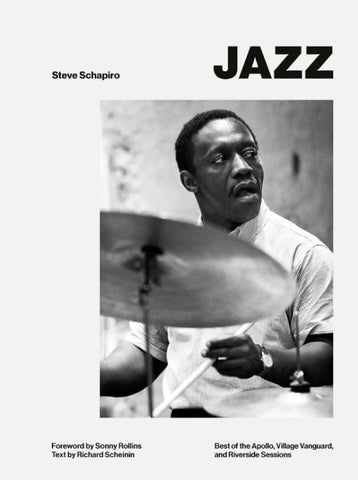
One of the leading social documentary photographers of the 1960s, Steve Schapiro’s images stand among the most important of the 20th century, covering Muhammad Ali, Martin Luther King Jr, James Baldwin and many others. These largely unknown jazz photos – shot just before his career breakthrough – showcase his early mastery and his empathy for his subjects, making Jazz: Best of the Apollo, Village Vanguard, and Riverside Sessions an essential archive. In the early ’60s, when Schapiro arrived on the scene, New York jazz was enjoying a golden age. A young freelance photographer who had grown up in the Bronx and somehow snagged a gig with Riverside Records, he began voraciously documenting shows, players, venues, recording sessions and gatherings, both in his native New York and later in Chicago. Whether it’s Sonny Rollins lifting weights backstage, or Bobby Timmons lost in an instant of discovery at the piano, Schapiro was on their wavelength. Written by US jazz journalist Richard Scheinin, Jazz: Best of the Apollo, Village Vanguard, and Riverside Sessions features scores of never-before-seen photos of jazz legends like Cannonball Adderley, Melba Liston, Bill Evans, Wayne Shorter, Freddie Hubbard, Sonny Rollins, Count Basie and more. ISBN: 978-1-78884-342-3
9 781788 843423 www.accartbooks.com
57500 £60.00/$75.00