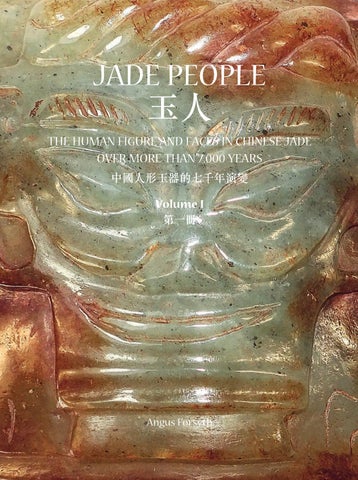
JADE PEOPLE 玉人 THE HUMAN FIGURE AND FACES IN CHINESE JADE OVER MORE THAN 7,000 YEARS 中國人形玉器的七千年演變
Volume I 第一冊
Angus Forsyth
RIGHT HAND SIDE
LEFT HAND SIDE
右面
左面
Both stone and mammoth ivory were the media of artistic creative effort and also related human sculptures of dancers with surprisingly elegant sensitivity in amphibolite which is a metamorphic rock formed under high pressure and high temperature in the amphibole group. This is mainly found in green, brown and black colour varieties and is exemplified in the famous Galgenberg Venus found at Galgenburg near Krems in Austria which has also been tentatively dated back to 20,000 BC. A significant message underlying the accent on buxom and bosomy realisation of the attraction of the physical attributes of the human female was the projection of recognition of a matriarchal significance in society accepting and acknowledging the essential and eternal role played by woman in giving birth and in weaning and protecting the offspring from harm. 石材和猛獁象牙不僅是藝術創作的媒介,也與雕塑本身息息相關。例如,舞者的雕塑在角閃岩中展現出令人驚訝的 優雅感。角閃岩是一種在高壓高溫環境下形成的變質岩,屬於角閃石類,主要呈現綠色、棕色和黑色。著名的《加 爾根貝格維納斯》(Galgenberg Venus)便是角閃岩雕刻的典範,於奧地利克雷姆斯附近的加爾根貝格出土,其年代 可追溯至約公元前20,000年。 雕塑中對女性豐滿胸部和身形的強調,傳遞了一個重要訊息:社會對女性在母系社會中的意義的認可與敬重,並承 認女性在繁衍後代、哺育嬰孩和保護孩子免受傷害方面的基本且永恆的角色。
12
JADE PEOPLE
From about 10,000 BC the development picture is of the male still hunting for meat but also now growing the crops in the revolution brought about by settled agriculture. The female was a hearth minder and children begetter nurtured by both the animal kills and agricultural fruits harvested and brought into the home by the male provider. Perhaps the most astounding picture of what at the present time appears to be by far the most accomplished stone sculpture working in the ancient world has been the major find at Gobekli Tepe (translateable to “Potbelly Hill” at Sanliurfa Province in South Eastern Turkey dating from c. 9,600 BC. Considerable energy has been applied to excavation and further research together with protection from weather erosion both of the site and of its amazing stone artefacts. These basically consist of huge rectangular tablets sculpted in high relief on each face with human and animal figures standing proud from the backing surface and of statuesque slim line human figures far removed from the fat belly ladies of Willendorf and of which the following is a striking example: 約在公元前10,000年,隨著定居農業的革命,社會的發展發生了變化。男性仍然以狩獵為主,提供肉類食物,但同 時也開始種植作物。女性則主要負責守護家園,養育孩子,並由男性提供狩獵和農業勞動的成果來支撐家庭生活。 或許現時最令人震撼的古代石雕藝術成就,來自土耳其東南部尚勒烏爾法省的哥貝克力石陣(Gobekli Tepe,意為 「大肚山」)。該遺址的年代可追溯至約公元前9,600年。大量的挖掘、研究以及對遺址和驚人石製文物的保護工作 已經展開,以免受天氣侵蝕。 這些石製文物主要由巨大矩形石碑組成,每一面均以高浮雕方式雕刻出突出於背景表面的動物和人類形象,還有纖 瘦的人體雕像,與威倫多夫的豐滿女性雕像形成鮮明對比。以下是一個引人注目的例子:
玉人
13
CLOSE UP showing the branching tines of the antlers with the central pair formed with an animal mask. 鹿角的分叉細部,中央一對形成獸面紋。
54
JADE PEOPLE
REAR VIEW 背面
玉人
55
From the tomb of Dayangzhou ( 大洋洲 ), Xin’gan, Jiangxi Province a now famous jade Shang Dynasty period figure was found of a part human and part bird form. It has a vertically elongated body and squats on its haunches with human arms and legs. Folded above the thigh onto each side are vestigial wings. The combination of these features more nearly approximates to Shamanism than any other Han Chinese belief. Here is a contemporary kindred example. Bird beaked human figure with chain link headdress – jade – mid Shang Dynasty c. 1,600 BC. 江西新干大洋洲墓葬中,出土一個著名的商代玉鳥人。此玉人軀幹直長,蹲坐在後腿上,有人類手腳,大腿上方有 折疊翅膀。這些特徵更接近薩滿形象,而非漢族傳統。 下圖是個同期相似的例子。鳥喙玉人,頭戴鍊環頭飾——玉——商代中期,約公元前1600年。
H. 高 10.0 cm LEFT HAND SIDE PROFILE VIEW
RIGHT HAND SIDE PROFILE VIEW 右側
左側
The head displays a bird beak and large feather crest. From the back of the crest a chain of separate jade links is suspended down the back of the figure and furthermore, given that one of the popular attributes of the Shaman is the power of flight it is tempting to associate this figure with Shamanistic practices. In this way the unique respect of the Han people for jade and jade working has been argued as showing for domestic audiences the inclusion of Shamanistic elements in jade worked into human form with major utilitarian limitations. 頭部有鳥喙和大羽冠。羽冠背面懸掛一串沿玉人背部延伸之玉環鏈。此外,考慮到相傳薩滿擁有的飛行法力,不免 令人把這玉人與薩滿信仰相連。 由此可見,傳統認為漢族對玉和玉雕的獨特尊重,以及玉器為本地所用的說法,在考慮到有具薩滿元素的例子時, 似難以成立。
60
JADE PEOPLE
However although the “bird beak” form features of these pieces are a strong temptation for association with Shamanic practices, it is necessary to set any such perception against the fact that in terms of the “kit” used in practice by Shamanistic priests throughout the ages there is no evidence shown of jade forming part of the necessary priestly practice paraphernalia of the Shaman. The rejection of this practical use of jade in Shamanistic tradition and practice was confirmed to me as the belief of Professor Chuneer Talisami and Dr. Larisa Pavlinskaya of the Siberian Department of the Peter the Great Museum of Anthropology and Ethnography in St. Petersburg that there was no Siberian tradition of Shamanistic use of jade artefacts. There is however a possibly tempting jade analogy to be found in a slightly later but distinctively ethnic Han Chinese culture in, say, the late Shang/Early Western Zhou period as shown by the working of the following figure : Seated male figure with raised line work, chin suspended links chain and headdress of reverse facing dragon – jade – late Shang to Early Western Zhou Dynasties c. 1,300 – 1,000 BC. This features a squatting human being adopting the same vertical sitting profile as the figure on page 60 with knees drawn up and folded but without the bird like attributes of beak and wings. His headdress is formed as a back facing dragon creature with partly open mouth while links of a separated chain hang down from beneath his chin rather than from the back of his headdress. To his rear, behind his buttocks, a distinct bird rears its head. 儘管這些例子的「鳥喙」特徵容易令人聯想到薩滿習俗,我們必須把這想法與歷代薩滿祭司的「工具包」相比照。 從這些「工具包」中,我們並沒證據顯示玉器是薩滿儀式中必需的一部分。彼得大帝人類學與民族學博物館西伯利 亞部門的Chuneer Talisami教授和Larisa Pavlinskaya博士曾確認,西伯利亞的薩滿傳統中並沒有使用玉器。 然而在稍晚,但具明顯漢族文化特色的文化中,特別是商代晚期/西周初期,可以找到一個可能相當有趣的玉器例 子,如下圖所示: 商代晚期至西周初期(公元前1300至1000年)的坐姿男性玉人,具有凸線刻工,下巴懸掛的環鏈,頭飾背面為龍形。 此玉人呈蹲坐姿,與第60頁的玉人垂直坐姿相同,膝部彎曲折疊,但沒有鳥喙和翅膀。他的頭飾背面形成一隻張口 龍形生物,鏈環從下巴下垂,而不是從頭飾的背面垂下。其臀部後方,設一仰頭鳥形。
H. 高 12.0 cm SIDE VIEW 側面圖
玉人
61
We move into a range of handsome exaggeration in the following forms of standing figures with a jutting chin, pert mouth and with long hair falling behind the head. Standing female human figure with the slender arms riding down on each side to support the enormous breasts – jade – pre-Hongshan Culture c. 4,000 BC. 我們進入以下形式的美麗誇張作品,描繪站立的人物,具有突出下巴、俏皮嘴巴以及長髮垂於頭後的形象。 站立女性人形,纖細的雙臂垂於身側支撐著巨大的胸部——玉器——前紅山文化,約公元前4000年。
H. 高 16.0 cm FRONT VIEW 正面
106
JADE PEOPLE
REAR VIEW 背面
玉人
107
A second figure holding huge breasts is now featured as below: Kneeling form female human figure with huge breasts each being supported by a hand of the figure which has large round and well formed eyes, a high bridge broad nose, full lips and dimpled cheeks and upstanding jug handle ears at each side of the head – jade – pre-Hongshan Culture c. 4,000 BC. 另一個持著巨大胸部的雕像,現在下圖展示: 跪姿女性人形,雙手支撐著每個巨大的胸部,雕像擁有圓大且形狀完美的眼睛、高挺的寬鼻、豐滿的嘴唇、凹陷的 雙頰,以及頭部兩側竪立的提梁耳——玉器——前紅山文化,約公元前4000年。
SIDE VIEW of the figure showing clearly the jutting out retrousse nose. 人物側視圖,明顯顯示出挺拔的鼻型。
H. 高 9.0 cm FRONT VIEW 正面
REAR VIEW 背面
112
JADE PEOPLE
Close up of the front view clearly showing the fingers of each hand supporting the huge breasts. 正面細部清晰顯示每隻手的手指支撐著巨大的胸部。
玉人
113
Interestingly enough and again attributable to the Hongshan Culture Period is a remarkable combination of human form and with a segmented insect form abdomen. Semi human figure with insect abdomen, high shoulders and hands clasped together across the stomach and drilled horizontally across behind the neck for suspension – jade – Hongshan Culture c. 3,000 BC. 有趣的是,同樣歸因於紅山文化時期的是,人類形態與分節的昆蟲腹部的一個顯著組合。 半人形態,帶有昆蟲腹部、高聳的肩膀,雙手在腹部交握,頸後水平鑽孔,以便懸掛——玉器——紅山文化,約公 元前 3000 年。
H. 高 8.0 cm FRONT VIEW 正面
186
JADE PEOPLE
REAR VIEW 背面
The representation of motherhood remained consistent as we see in the following figure. Kneeling naked female figure with breast swelling and distended stomach supported by her arms and pierced behind her neck for suspension – jade – Hongshan Culture c. 3,000 BC. 正如我們在下圖中看到的那樣,母性的表現保持一致。 跪姿裸體女性人像,乳房隆起,腹部膨脹,由她的手臂支撐,頸後穿孔,以便懸掛——玉器——紅山文化,約公元 前 3000 年。
H. 高 9.0 cm SIDE VIEW 側面
玉人
187
This pendant is included in this work in order to associate its form with the standing base or pediment of the following two very thin jade slices of human form figures standing upon a much narrowed version of the toothed comb pendant. Human figure thin plaque with human face and standing on a toothed comb pendant extension – jade – Hongshan Culture c. 3,000 BC And on the right side, human figure thin plaque with human face and standing on a toothed comb pendant extension – jade – Hongshan Culture c. 3,000 BC 吊墜包含在這項工作中,以將其形式與以下兩個非常薄的玉片人像的站立底座或基座聯繫起來,人像站在一個大大 縮窄的齒梳吊墜上。 人像薄片,帶有人臉,站在齒梳吊墜延伸部分上——玉器——紅山文化,約公元前 3000 年。 以及在右圖中,人像薄片,帶有人臉,站在齒梳吊墜延伸部分上——玉器——紅山文化,約公元前 3000 年。
192
JADE PEOPLE
H. 高 19.5 cm FRONT VIEW
H. 高 19..5 cm FRONT VIEW
正面
正面
An alternative form of the thin slice jade human form is the following figure appearing to stand upon an inverted relief buffalo head and with its own head surmounted by a curved around double headed dragon feature with each dragon head touching the two shoulders. Human figure thin plaque with human face and standing on a toothed comb pendant extension – jade – Hongshan Culture c. 3,000 BC 另一種形式的薄片玉人像是以下人像,它似乎站在一個倒置的浮雕水牛頭上,它自己的頭部則被一個彎曲的雙龍特 徵所覆蓋,每條龍的頭都接觸到兩個肩膀。 人像薄片,帶有人臉,站在齒梳吊墜延伸部分上——玉器——紅山文化,約公元前 3000 年。
H. 高 20.0 cm FRONT VIEW 正面
玉人
193
H. 高 12.0 cm FRONT VIEW 正面
326
JADE PEOPLE
In addition to a marvellous appreciation of and skolled proficiency of detail in the working of jade, the Shu jade workers were also innovative masters in the working and application of pure refined gold to both bronze and jade pieces. This would seem to have been perhaps the earliest use in China of applied gold leaf often on not only life size bronze forms of human heads as a fitted wrap around gold foil mask but also on similar smaller works. This likely reflects an important contemporary significance of gold as a major gesture to a wealthy function and prosperity of a top recognition of the value of pure gold in a community which was also highly respectful of the jade material. The following example replicates the by now familiar face with sunken cheeks and shorter form stalk eyed extended pupils which is entirely covered with carefully and skilfully applied gold leaf to all features except for the protruding stalk pupils from each eye and the heavy laterally grooved relief brows arching above each eye – jade – Shu Culture c. 1,200 BC. 除了對玉石加工展現出卓越不凡的審美與精湛技藝外,古蜀工匠亦是將純金應用於青銅與玉器的革新大師。此舉極 可能是神州境內將金箔裝飾於器物之始,其做法不限於在等身青銅頭像上覆蓋金面具,亦見於同類之微型器物。此 風尚反映了黃金在當時社會具有舉足輕重的地位,象徵著財富與繁榮,更體現了該社群在崇尚美玉之餘,對純金價 值的極度尊崇。下述實例重現了眾人所熟知的面相:雙頰深陷,配以較短的柱狀縱目;除凸出的瞳孔與上方具橫向 溝槽的重型浮雕弓眉外,全器面貌皆精巧地覆以細膩金箔——此為玉製,約公元前一千二百年之古蜀文化遺存。
REAR VIEW 背面
玉人
327
FRONT VIEW, a pair features 正面,一對造像
388
JADE PEOPLE
A SIDE VIEW 側面
REAR VIEW 背面
玉人
389
ISBN 978-1-78884-387-4