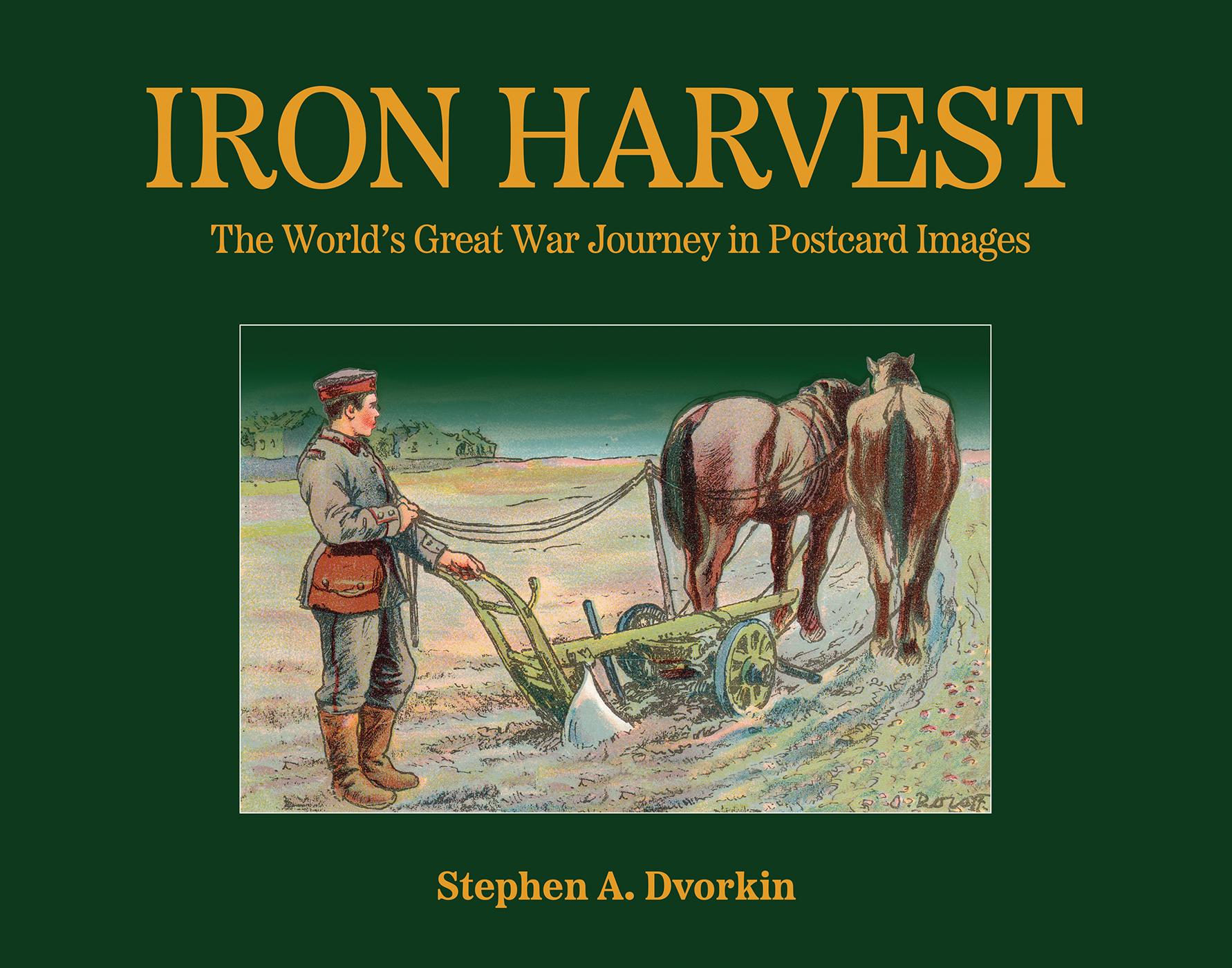
This volume’s cover image, picturing a uniformed soldier behind a plough, is taken from a German postcard published during World War I—the “Great War.” The postcard is captioned, in translation, “Springtime in Enemy Land.”
An estimated one ton of ordnance was fired for every square meter of territory on the Western Front during the Great War. In the Ypres Salient, on the north of that front, an estimated three hundred million British and German projectiles were duds, and most have not been recovered to this day. Unexploded artillery shells were quickly swallowed by the battleground mud.
Life being for the living, the former battlefields of Flanders and Picardy were returned to farming soon after the guns fell silent. As time passes, plowing and natural processes bring the old munitions to the surface— rusted, but still with the potential to kill.
The greater part of the “iron harvest” occurs during the spring planting and autumn harvest. Farmers gather the surfaced munitions and place them at established collection points. Mine clearance departments in Belgium and France recover thousands of pounds of unexploded munitions every year.
In the area around Ypres, hundreds of people have been killed by unearthed ordnance, and hundreds more injured, decades after the war ended.
That the Great War left artifacts to imperil the lives of French and Belgian farmers is a reality, but it may also be seen as broadly metaphorical. The war left artifacts other than those tons of unexploded ordnance: the failed idea that was “Yugoslavia”; the parceling-out of the Mid-East provinces of the former Ottoman Empire to a new set of colonial occupiers, without regard to their tribal or religious past; the stubbornly resurgent isolationism of the United States; the dispirited passivity of the liberal democracies of Western Europe; and the rise of fascism in a revanchist Germany.
The fruit of the Great War would be harvested on many fields; and the crop, wherever gathered, was poison.
What was it like to live through the cataclysm that left such legacies?
Picture postcards produced and sent by members of the combatant societies recorded their experiences and feelings in real time, affording us the opportunity to ponder them now. Some five hundred of those cards are reproduced in the following pages. If we are attentive, they have a tale to tell.
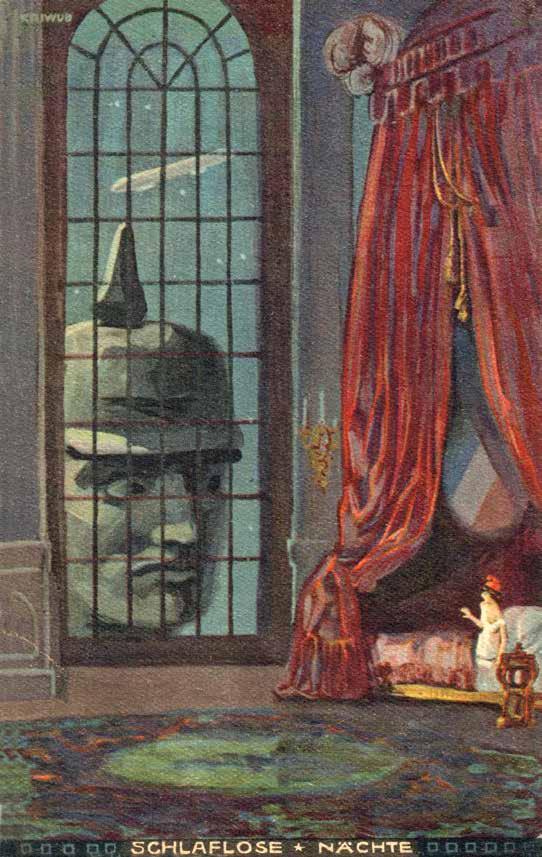
Germany was fully aware of the superior forces the Reich could bring to bear against France. Germans viewed with condescension the leaked plans of the French Conseil Supérieur de la Guerre that purportedly would carry French troops to Berlin and dismissed the French as a nation of strutting popinjays. On German postcard 18, a diminutive Marianne sees the gigantic helmeted head of a German soldier outside her bedroom window. Sleepless Nights is the card’s dry caption.
At a later point in this volume, postcard images will show vigilant German soldiers maintaining a watch on the Rhine— standing guard, thus, against an attack from the west. The paradox is that Germans could appreciate the Reich’s manpower superiority and at the same time harbor the paranoid fear of a French invasion. As will be seen, the latter view was encouraged by a propaganda campaign managed during pre-war years by the German government . . . for reasons of its own.
France’s recognized vulnerability to an increasingly belligerent Germany prompted the French to court Russia as a prospective ally. But Russia lay far from France’s border with Germany, and not even the eventual military alliance with Russia afforded the French the degree of international support deemed necessary in an atmosphere of growing tensions with Berlin.
Even as France appreciated that the country was not Germany’s military equal, it remained reluctant to relinquish its role as a power on the world stage. National self-esteem required projection of France’s rights as a colonial power to influence, occupy, and govern territories beyond the coasts of Europe. France’s colonial ambitions frequently led to confrontations with Great Britain, a rival of even longer standing than Germany.
The climax of France’s imperial disputes with Great Britain occurred with the Fashoda Crisis of 1898, which found both countries contending for control of the Upper Nile River basin. For a time it appeared that the Fashoda contretemps would result in war between France and Britain. However, the dispute prompted the French to take a broader view of its situation and conclude that enmity among France, Germany, and Britain put the French in the position of (in the words of one historian) “having one enemy too many.” Accordingly, France directed the evacuation of troops from Fashoda.
Unaware of the broader strategic thinking of France’s government, the French citizenry viewed Fashoda as “a public humiliation.” As another historian recorded, “Fashoda was long remembered in France as an example of British brutality and injustice.”
Even as the Fashoda Crisis was being diplomatically resolved, government leaders in London began to feel that Britain was unacceptably isolated. During the later years of the Nineteenth Century, Britain, placing confidence in the Royal Navy for its security, pursued a foreign policy characterized
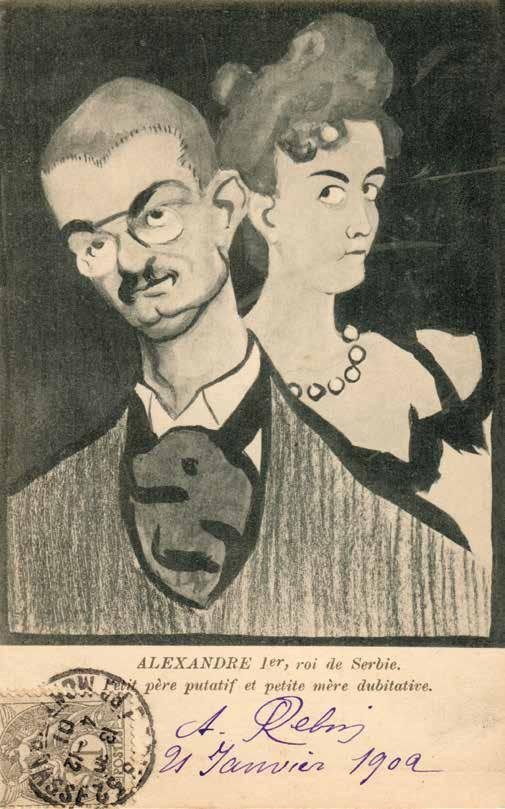
French postcard 54, presenting caricatured likenesses of Serbia’s King Alexander I and his wife, Queen Draga, is postmarked 1901. Two years later, the king and queen were both dead, and Serbia had a new ruling dynasty.
Alexander, whose reign commenced in 1889, was held in low regard by his subjects even before he announced his intention to marry Draga Masin, who had been a lady-in-waiting to his mother, Queen Natalija. Draga’s humble origins made her an inappropriate royal consort in the view of most Serbians. She was also twelve years older than Alexander, which raised questions about her ability to produce an heir to the throne. Influential Serbians, including the king’s mother, attempted to persuade Alexander to abandon his plan to marry Draga, and a campaign was conducted to besmirch her reputation. Alexander ignored the opposition and married Draga.
The royal couple was indeed childless. The French text of postcard 73 in fact appears to be a wry comment on Draga’s publicized, but false, pregnancy—a fiasco that was an international embarrassment for Serbia.
In May 1903, Alexander and Draga were shot by a band of conspirators, all Serbian army officers. Their bodies were then mutilated, and thrown from a second-story window of the royal palace. Serbia’s prime minister was murdered in his home, and—to put an end to speculation regarding Alexander’s succession plans—Draga’s two brothers were also shot.
The savagery of the murders shocked Europe. Some European countries—including, notably, Great Britain—suspended diplomatic relations with Serbia for several years.
Postcard 54 was mailed in France to an addressee in Holland. The world was a smaller place in 1901 and the royalty of even lesser countries were celebrities.
to the annexation, it was forced to climb down from that position once it became clear that the Great Powers accepted the new arrangement, and that not even Russia would back Serbia’s objections militarily.
In 1911, the Serbian conspirators responsible for the murder of King Alexander created a pan-Serbian and anti-Austrian terrorist organization, formally named Unification or Death (Ujedinjenje ili Smrt), but popularly known as the “Black Hand.” King Peter understood to whom he owed his position, and functioned largely as a figurehead, watching without complaint as those who took the Black Hand oath received appointments in Serbia’s military hierarchy and civil government. In a real sense, there was by 1914 little distinction between the Black Hand and the Serbian government. Thus, Apis was both the leader of the Black Hand and chief of intelligence of the Serbian Army.
The Black Hand established cells in Bosnia, and conducted an opportunistic campaign of terrorism and sabotage within its borders. In 1910, a Herzegovinian Serb—who had made frequent trips to Belgrade—unsuccessfully attempted to assassinate the imperial governor of Bosnia and Herzegovina.
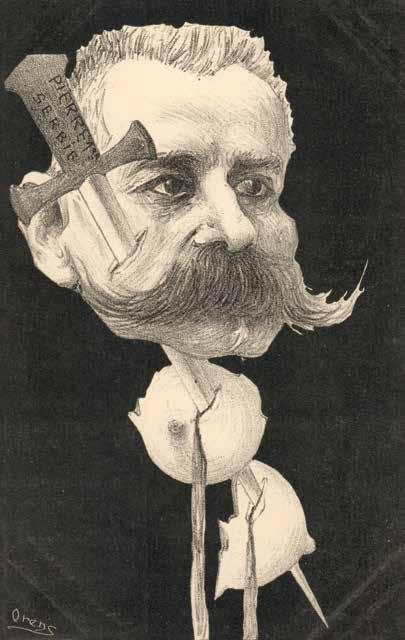
A number of postcard images from the pre-war period must have been, even then, arcane in their references. This was particularly true of images created by French postcard artist Orens Bonaventure Charles Denizard (1879-1965), a number of which appear in this book. The Orens postcard reproduced as image 55 portrays the head of Serbia’s King Peter I impaled by a sword, which also skewers two female breasts.
In some accounts, one of the assassins of King Alexander and Queen Draga carried Draga’s severed breast in a suitcase, producing it, when moved to do so, as a conversation piece. Was that grisly detail widely known in Orens’s France? And would there have been a market for postcards making reference to it?
Orens’s strange postcard may be viewed as an observation touching on the incivility of Serbian society of that time—a suggestion that in that “nest of violent barbarians” (as one historian characterized it) King Peter could at any moment be undone by the same penchant for murder that brought him to the throne . . . as he must certainly have realized.
210.
This section, examining the delusions brought into the war by the societies destined to fight it, closes with what is perhaps the most well-known of those delusions: the conviction that the war was certain to be short, and that the soldiers mustering for service in August of 1914 would be “home by Christmas.”
The “short war” delusion arose from a set of beliefs that so captivated pre-war Europe as to have been characterized by historians as a “cult.”
In his 1910 book, The Great Illusion, British-born lecturer, Ralph Norman Angell, acknowledged the tensions among European powers, but argued that economic interdependence made a European war economically senseless, and hence unlikely. “By impressive examples and incontrovertible argument Angell showed that in the present financial and economic interdependence of nations, the victor would suffer equally with the vanquished; therefore war had become unprofitable; therefore no nation would be so foolish as to start one.”
Angell’s book was translated into eleven languages. He was quoted frequently by persons of power and influence. Societies were formed to discuss the precepts advanced in his lectures and in his book.
A corollary of Angell’s belief in the irrationality of a European war was the conviction that if such a war did erupt, the interdependencies he highlighted would ensure that it would be short—that reason would quickly prevail to bring an end to hostilities.
In 1914 a generation that had never known a major war was confident
that the coming conflict would be glorious—and brief. In a conversation between a French reservist scheduled to report on the first day of mobilization and another whose mobilization was scheduled for day nine, the former expressed sympathy for the latter: “Bad luck! You’ll miss all the fun, it’ll be over by then.”
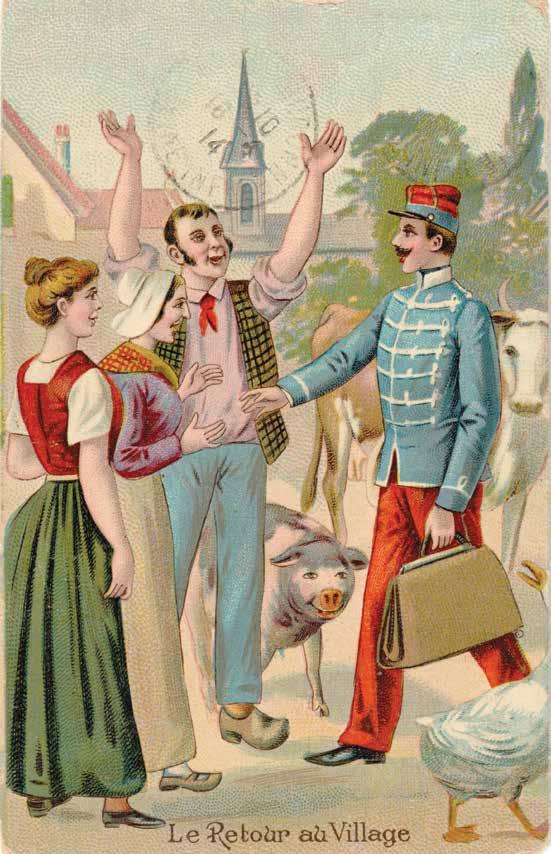
French postcard 210, posted less than a week after the outbreak of the war, already pictures a young French hussar returning home.
The Great War would last more than four years; and at least four million of the men who left to fight on its Western Front would never again see the trees of home in leaf. Of all the beliefs that were revealed by time to have been mistaken, the “short war” delusion is perhaps the most enduring in the memory of history—and the most poignant.
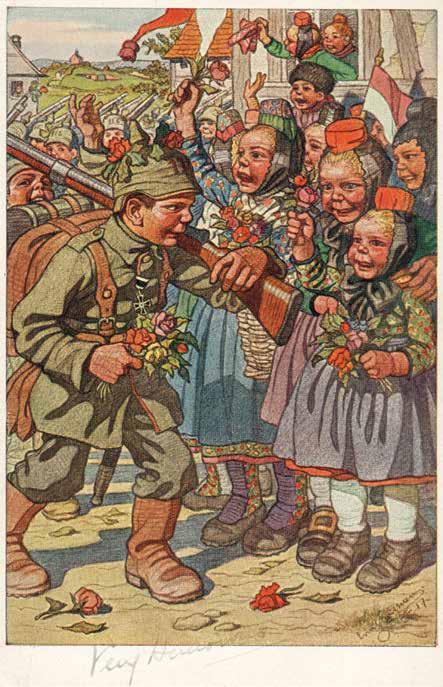
On German pre-war postcard 211, soldiers, adorned with flowers showered on them by the adoring population of their town, sally forth to war. This card could be a stand-in for any of those illustrating the Fantasy War. The subtext is that the delirious civilians seeing their sons, brothers, and sweethearts off to combat took it for granted that the war would be glorious, successfully-prosecuted, and short
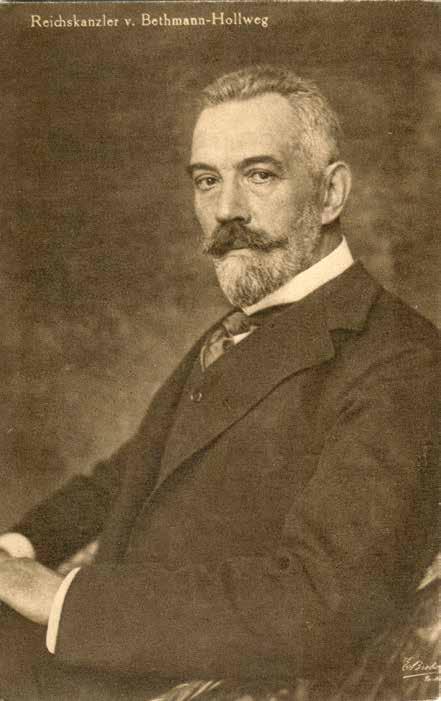
As Bethmann knew, the majority of German nationalists in positions of influence—including, more often than not, the mercurial kaiser—already viewed Great Britain as Germany’s ultimate enemy, the most ponderable obstacle to the Reich’s achievement of its rightful place among the nations. To Germans holding that view, Britain’s invocation of treaties, precedents, and international law was arrant hypocrisy, and Britain’s every diplomatic move was designed only to preserve a world order that redounded to Britain’s benefit, and Germany’s detriment.
The contest for colonies was Exhibit A to those Germans with a jaundiced view of Britain and the Pax Britannica. If territory outside the borders of the island nation was coveted, Britain simply seized it, as it had seized Egypt and the Transvaal. More galling, still, were actions taken by Britain to assure that lands it had no desire to possess would be disposed of in a manner that suited British interests. An unforgettable case in point was Britain’s role in assuring Germany’s humiliation in the imbroglio over Morocco.
The design of German nationalists, inside and outside of government, was to overturn the status quo and elevate Germany to its rightful place atop the international order. Yes, the realization of that goal would involve the defeat of France and Russia at war, and the seizure of territories held by those countries; but aspirations for German ascendency could not stop there. If the map of Europe were to be redrawn as the nationalists intended, the losers would not only be the nations that actually lost territories, but also the nation that stood most to gain by preservation of the status quo: Great Britain. None of that thinking at upper reaches of German planning and policymaking was unknown to Bethmann.
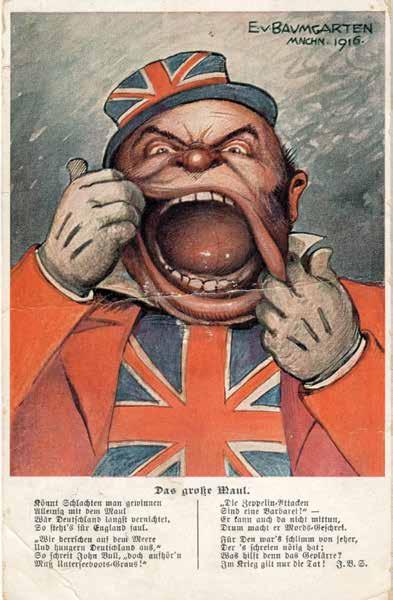
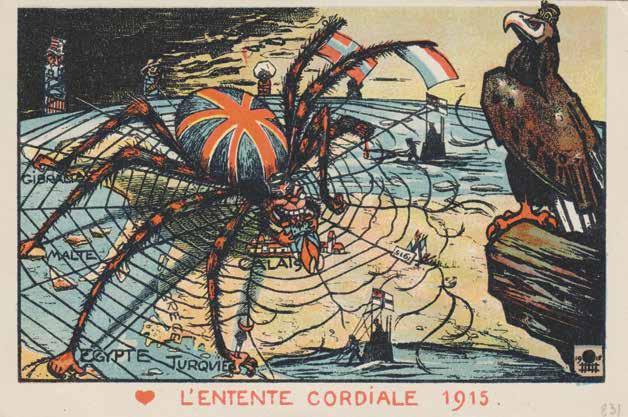
Although German Chancellor Bethmann claimed that the British ultimatum regarding Belgian sovereignty came as a shock and a disappointment to a nation disposed to be Britain’s friend, in fact that was not the view of the German nationalists who had by then acquired the power to form the policies and plans of the Reich. The view of Britain entertained in those quarters is reflected by German postcard images 219 and 220.
Postcard image 219, depicting a grotesquely rendered John Bull, is captioned “The Big Mouth.” It reflects the view widely held in Germany that the ascendency of Britain left no scope for the realization of Germany’s reasonable geopolitical ambitions: voracious Albion was bent on devouring everything.
Postcard 220 depicts Britain as a malign spider at the center of a web in which is enmeshed most of Europe and the Middle East. The French flag flies from one of the spider’s legs, suggesting that France was functioning as Britain’s cat’s paw (at the risk of mixing metaphors) in a scheme to dominate the world. The postcard is captioned Entente Cordiale, employing Britain’s 1904 understanding with France as a shorthand for the steps that Britain had taken in weaving its web. The symbol of the one nation not ensnared in Britain’s web, the German eagle, is poised on a ledge at the card’s right extreme—proud and free.
Bethmann’s protestations notwithstanding, most of Germany’s leadership, and much of its citizenry, viewed Great Britain as a scheming rival—not a friend.
Belgium clarified issues[.]
~ Barbara Tuchman
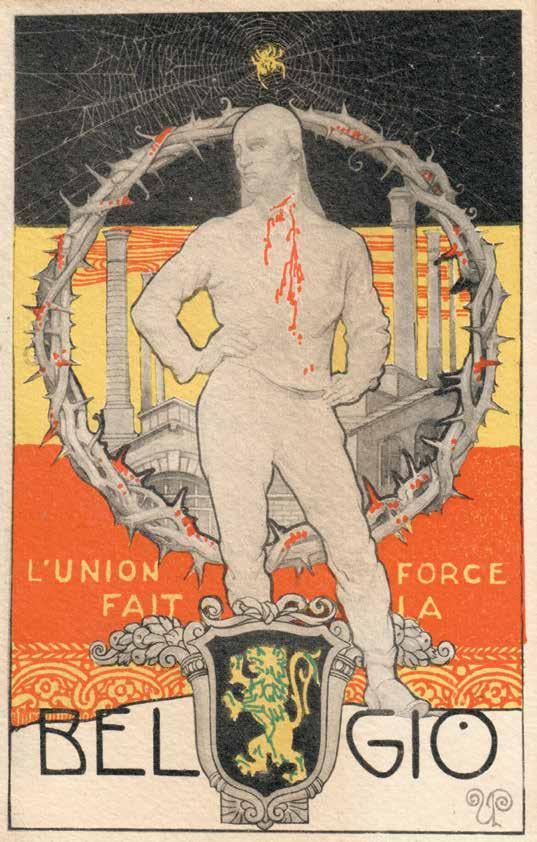
Postcard 257 was published in France. Bloodied Belgium standing before a crown of thorns was an image that required little explication in 1914, and captured with graphic economy how nations not among the Central Powers viewed the treatment Belgium had received at the hands of the German Army. On a number of similar postcards the words “Belgium” and “martyr” appear in the same caption.
The significance of Belgium in the larger context of the war is captured in a statement made while the war was still being fought by J. Murray Allison, the editor of a collection of Louis Raemaekers’ political cartoons. “Belgium,” and the graphic images of what had occurred there, wrote Mr. Allison, “made intensely clear to the people [fighting Germany] the single issue upon which the war is joined.” Allison, in other words, agreed with Raemaekers that “Belgium” revealed the war to be a struggle between Good and Evil—and arrayed the nations prosecuting the war against Germany as those fighting to ensure that Good would prevail.
Swiss postcard 258 was probably issued just after August 28, 1916, the date of Italy’s declaration of war on Germany. The card shows Italy approaching to join the Cause to which France, Great Britain, and Russia have already pledged themselves—that pledge made, significantly, over the fallen lion of Belgium. “Belgium” thus had become, and still remained, the metaphorical (moral) embodiment of the Allied cause. (Of course, propa-
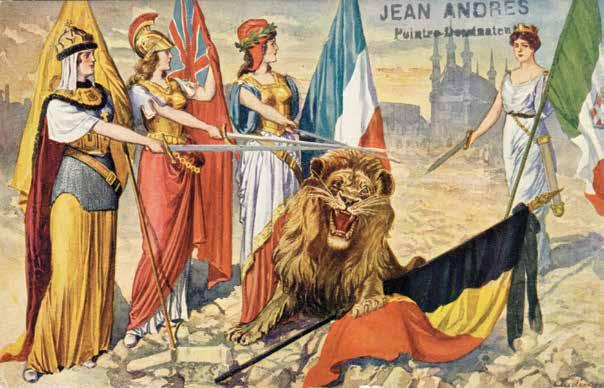
ganda postcards could not have existed without the shorthand offered by such graphic symbols.)
After the two warring alliances had spread on the public record their respective charges and defenses with regard to Belgium, and what had occurred there, troubling auguries should have been seen by Germany in how matters were being perceived across the Atlantic. Postcard 259, to that point, pictures an American man holding a newspaper account of the news of the day, and has him as saying, “Say, I’m neutral an’ I don’t care a darn who licks the Germans.” The postcard was printed in Britain, and thus represented a form of wishful thinking. But it would emerge in the fullness of time that the views ascribed to this postcard’s American closely mirrored opinions the majority of Americans did, in fact, entertain. As one historian observed:
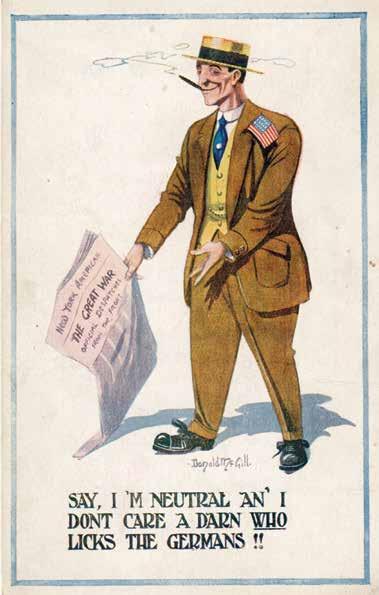
The ‘rape of Belgium’ served no military purpose whatsoever and did Germany untold harm, particularly in the United States, where the reputations of the Kaiser and his government were blackened from the outset by reports of massacre and cultural despoliation.
The evidence suggests that those views were formed during the German invasion of Belgium and were never thereafter changed.