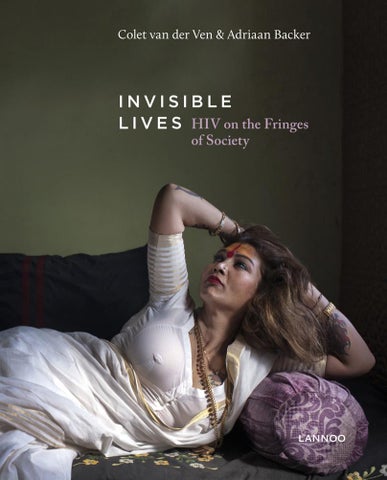
A cornerstone of the AIDS movement has been the active engagement of civil society in decision-making at the highest levels, including at UNAIDS and at the Global Fund to Fight AIDS, Tuberculosis and Malaria. This book keeps with that tradition by giving a public voice to those who have been historically marginalised and by compelling us to listen and act now to dispel HIV-related stigma and discrimination. //
Peter Piot — London School of Hygiene & Tropical Medicine
Introduction
at the 22nd International AIDS Conference. Invisible Lives reminds us that HIV infection is determined by a confluence of social, political, and economic factors. From the hijra community in India to prisoners in South Africa, the narratives presented in this book demonstrate that stigmatisation and discrimination are putting peoples’ lives at risk around the globe.
//
It shows both political courage and common sense to bring injecting drugs users, sex workers, transgenders, gay men, street children, prisoners – highrisk groups or ‘key populations’, to use the jargon – from the obscurity of the fringes of society and out into the open at the International Aids Conference of 2018. It is a valiant attempt to correct previous mistakes, or at least to avoid repeating them. For as the famous epidemiologist Elisabeth Pisani puts it, during the last few decades the international world has erected a wall of silence around injecting drugs users and male, female and transsexual prostitutes. If we do not wish to reduce the principle ‘Rid the world of Aids’ to an empty slogan, it is essential to raze that wall to the ground. We are glad to have been given the chance to reveal the faces of people from these groups, to let their voices be heard. We are grateful to them for admitting us to their world. We talked with women in patriarchal Tadzhikistan, with victims of political violence in Kenya, with black homosexuals in the deeply religious southern states of America, with transgenders in India, with (ex-)prisoners in South Africa and with drugs users in Myanmar. We also interviewed a representative of the first generation of AIDS patients in the Netherlands, and a female refugee in the Ukraine. They were our outspoken and committed guides. In the overwhelming majority of cases, HIV is contracted through sex and drugs, twin concepts surrounded by an aura of sinfulness, immorality and licentiousness. The hotbeds of HIV and AIDS lie in – what are regarded as – the darkest recesses of the Sodoms and Gomorrahs of our time. As recently as the International Aids Conference in Bangkok in 2004, the United States Agency for International Development (USAID) rejected every presentation that featured sex workers, injecting drugs users or transgenders in the title: that would frighten off potential sponsors and arouse revulsion rather than compassion. And as a natural result of – among other things – the taboo that rests on the most important sources of infection, sex and drugs, the above-mentioned, often already marginalised groups are stigmatised even more.
8
9
The concept of the stigma stems from Greek antiquity, and referred to the symbol burned or cut on a person’s body, to show that the bearer was a slave, traitor or criminal: to be regarded at all events as inferior. A stigma was both a physical brand and a public mark of shame. The sociologist Erving Goffman developed the concept in his famous book Stigma: Notes on the Management of Spoiled Identity (Stigma, aantekeningen over het omgaan met een geschonden identiteit [translated 1978]). The subtitle reveals the profound influence of a brand, a mark of shame on the whole person. On how the person is seen, and on his or her self-image. On his or her identity. Goffman distinguishes three types of stigma. Firstly, the physical stigma. Handicaps or deviations from the accepted norm: not only birthmarks on the face, dwarfism or obesity but also infectious diseases. Then, the social stigma. Not, as in antiquity, the slave and the traitor, but the criminal, the unemployed, the psychiatric patient. And finally, the collective stigma: a religion, nationality, ethnicity or identity regarded as inferior. Those with one of these three stigmas face discrimination and prejudice. Goffman illustrates this with the following example: ‘For some, there may be a hesitancy about touching or steering the blind, while for others, the perceived failure to see may be generalized into a gestalt of disability, so that the individual shouts at the blind as if they were deaf or attempts to lift them as if they were crippled.’ Prostitutes, drugs users, prisoners and transgenders with HIV or AIDS fall into not one but two of the categories distinguished by Goffman. They are burdened with both a physical and a social stigma. Black homosexual men in the religious south of America have to cope with as many as three forms of stigma. And inevitably, the anxious, disapproving or evasive glance with which others regard them has an effect on their view of themselves. That view is transformed into one of shame and self-contempt. And that interiorised stigma causes the bearer to avoid the gaze of others. In the case of these groups, that may mean in concrete terms that they avoid seeking help. Social psychologist G.M. Herek focuses more closely on the stigma attached to HIV and AIDS, and distinguishes four elements. The first is the commonly held view that the virus is transmitted by avoidable, voluntary behaviour that is often also seen as reprehensible: prostitution, homosexuality, drugs use. This ignores socio-psychological factors such as powerlessness and coercion. The second, the widespread misconception that the virus is incurable and lethal. The third, the fact that infectious or contagious diseases have negative connotations of their own. And finally, the reinforcing effect
10
of the stigma by the visible elements of the disease – although this effect was much stronger during the first few decades than it is now. Stigmatisation is not synonymous with stereotyping, but the two are closely connected. A brand accentuates the negative characteristics of the bearer and results in discrimination. In 35 per cent of countries with available data, half of the population admits to discriminating against people with HIV. The socio-economic and judicial consequences are far-reaching. Being ostracised by family or community, curtailment of rights, lack of treatment or inadequate treatment by clinics – one in eight people with HIV throughout the world is deprived of health care – bullying at school or university: in short, not only severe psychological but also severe physical damage. The World Health Organisation regards fear of stigmatisation and discrimination as the most important reason why people avoid being tested, are reluctant to reveal their HIV status or refuse to take medicine. It is therefore vitally important to attack the root of the problem and to put an end to stigmatisation and discrimination. The parties involved have various reasons for not wishing to disrupt the status quo. Such as the Christian American president who donated billions to combat HIV, but laid down certain conditions: a substantial share must be reserved for promoting abstention from pre-marital sex, and not a penny of it was to be spent on providing clean needles. Going by the results, a great waste of those billions. Money simply poured down the drain. Or the conservative party that claims that replacing used needles with clean ones would only lead to further infection. Or the relief agency that is afraid of increasing stigmatisation by focusing openly on prostitutes and drugs users. In undermining stereotypes, it is important that the groups concerned feel supported by policy makers, relief workers, religious and political leaders. First of all, judicially, by breathing new life into anti-discrimination legislation and making people aware of their rights. By regarding the first sentence of the Universal Declaration of the Rights of Man – All human beings are born free and equal in dignity and rights – as a commandment, and by punishing those who break it. By putting scientific insights before ideological views. By fighting fear with knowledge. By decriminalising AIDS. Policy should not be decided on the basis of sentiment or emotion, or with an eye to winning votes or attracting donors, but with an eye to the
11
bare facts. Apart from in Africa, the highest percentage of HIV infections are to be found in the above-mentioned groups. It is they who have the most need of preventative services, for whom the gates to health care cannot be opened wide enough. The money, the knowledge and the means to help them exist. What they need now is AIDS programmes which are based not on ideology or politics but on reality. Pisani uses the image of the train. ‘We know where we are headed with HIV. We’ve seen the train coming in one country after another and we know which switches we have to flick to stop the crash. But a lot of the time we’re not doing that. We just look at the train and say: What are all those people doing sitting on top of the train anyway? That’s illegal. And stupid.’ Let us hope that political courage and common sense are not only prevalent during the International AIDS Conference, but that the participants take both of these attitudes home with them to their own countries, and bombard their political and religious leaders with them. Less stigmatisation, less discrimination, less suffering, less AIDS, less HIV and a more humane society will be the reward. //
Adriaan Backer — photographer Colet van der Ven — author
12
INDIA
The right to exist
INDIA
The right to exist
INDIA
//
Sitting cross-legged on her double bed, Laxmi Tripathi (38) languidly applies her make-up. A laborious, time-consuming process, during which she conjures up her feminine alter ego, layer for layer, line by line. She apologises for the enormous heap of bras at my back, but when you own hundreds of saris and need a matching set of lingerie for every sari, the heap grows quickly. Her partner Viki, fourteen years younger, with a brightly coloured tattoo of the Virgin Mary on his bodybuilder’s arm, comes into the room to fish out a shirt from the overfull wardrobe. ‘I’ve had countless men’, says Laxmi. ‘Lovers, boyfriends, one night stands, brief flirtations, but I’d never had such a strong feeling before that I wanted to stay with someone. The next morning I usually wanted the man out of my bed and out of my life. It’s different with Viki. I feel responsible for him, I want to be a safe haven for him. He’s my boss, I’ve given myself to him completely. I always called the tune with men, but now I’m the one who does the adapting. For the first time in my life. Viki finally made me a woman.’ Laxmi is a hijra. There is no equivalent for that in English, but you could describe a hijra as a biological man who rejects his male identity and sees himself as ‘woman’, ‘non-man’, ‘between male or female’ or ‘neither man nor woman’. Transvestites, transgenders, eunuchs, intersexuals: hijras include all of these, but none of these concepts corresponds exactly. ‘Hijras form a third gender, with a culture and history all their own. It’s this collectivity that makes us different’, says Laxmi. A gender that has been recognised as such by Indian law since 15 April 2014. Nepal, Pakistan and Bangladesh preceded India in that respect. The report in which the new law was disclosed describes how society ridicules hijras and treats them as untouchables. How they are wrongfully denied civil rights and privileges. How they have only limited access to education, health care and work. How they suffer under many forms of repression and discrimination. Without mincing words the report states: ‘The moral bankruptcy lies in the social reluctance to accept different sexual identities and forms. A mindset that we must change.’
”
Viki finally made me a woman.
April 15 is engraved in the memories of many hijras, including that of Laxmi. ‘We are robbed of our dignity in life and in death. When a hijra
17
USA
THE STORY OF THE BIRD
USA
THE STORY OF THE BIRD
USA
//
In 2016 the city with the French name in the deep south of America is suddenly making world news: Baton Rouge. Alton Sterling is buying CDs at a local shop when the police receive a call. He’s reportedly brandishing a gun. Two policemen race to the scene, there’s a sharp exchange of words, they take their guns from the holster and shoot Sterling several times in the chest. He dies on the spot. The same year sees the publication of Between the world and me, the bestseller by Ta-Nehisi Coates. It is a letter to his son, with the virulent racism in America as leitmotif. In response to the death by police bullets of another black man, he writes: ‘... the police departments of your country have been endowed with the authority to destroy your body. It does not matter if the destruction is the result of an unfortunate overreaction. It does not matter if it originates in a misunderstanding. It does not matter if the destruction springs from a foolish policy. Sell cigarettes without the proper authority and your body can be destroyed. Resent the people trying to entrap your body and it can be destroyed. Turn into a dark stairwell and your body can be destroyed. The destroyers will rarely be held accountable. Mostly they will receive pensions.’ In Baton Rouge things turn out differently. Two weeks after the death of Sterling a 29-year-old black man takes the law into his own hands and shoots dead three policemen – white and black – and wounds three others.
S I L E NT S E G R E G ATI O N
Discrimination has a long history in the Mississippi delta, once the operating base of America’s biggest slave market, and later an important field of activity of the Ku Klux Klan. Segregation – introduced in 1896 under the veiled motto: separate but equal – was the legal framework of that discrimination. The parents of Cletis Tucker (54) experienced firsthand what it meant. Whenever they passed a white person on the street, they were obliged to step aside. At the cinema they weren’t allowed through the main entrance, but had to make use of a separate door at the back of the building. Once inside, they sat Two police officers shot Sterling several times in the chest. He died on the spot.
125
USA
apart from the rest of the audience, in the gallery. They travelled in separate trains and used separate public toilets.
Isaac shares the view that racial segregation lives on in people’s minds.
After the Second World War, black resistance grew under the leadership of such heavyweights as Martin Luther King and Rosa Parks. And that was not without effect. In 1964 President Lyndon Johnson signed a new Civil Rights Act, banning discrimination on the labour market and in education, as well as segregation in public spaces. Not long afterwards Cletis entered the world of school for the first time. There were three black children in the class. ‘At school I played with white boys, but we didn’t mix after school hours. Later, at high school, one Afro-American boy had a white girlfriend. That raised a few eyebrows, it was unprecedented. Segregation had been officially abolished, but it lived on in people’s minds.’ Both at school and on the street. At first all the Afro-Americans in his home town lived on the other side of the railroad tracks, but when the city started to burst out of its seams, some of them, included Cletis’ family, moved to a white neighbourhood. They were the first blacks in the street. Their new neighbours prepared a warm welcome for them by throwing burning crosses, symbol of the Ku Klux Klan, into their garden. Isaac Gilliard (33) agrees with Cletis that racial segregation lives on in people’s minds. He calls it ‘silent segregation’. He describes how a white female shop assistant laid his father’s change on the counter rather than in his open hand. Fear of contamination on the basis of skin colour. ‘But there are also black people who’d never have anything to do with a white woman like you, out of resentment. Because why couldn’t we have the things or do the things that you could?’ The white mother of James Carlson (39) always had black boyfriends, to the dismay of his white grandmother, who talked disparagingly about ‘niggers’. Only when she had coloured grandchildren did she make an about-face. ‘If you’re connected to someone, you’ll love him or her, never mind the colour, and that happened with her.’ James came to Baton Rouge four months ago to kick his drugs and drink habit. He experienced the transition from tolerant Minneapolis, where he grew up, to that of this racist Mississippi delta as a culture shock. ‘My group of friends consisted of Indians, Afro-Americans, Asians. Race wasn’t a topic of conversation. We found discriminatory language unacceptable, and everyone stood up for everyone else. People here are in the habit of using the N-word. It’s not done for white men to come home with coloured or black guys, or to date them in public. Because of that taboo, both white and black men resort to superficial and anonymous sexual
127
USA
contacts. The more deeply they’re involved in that, the more they become entangled in it, partly because drugs and alcohol are often involved.’ Cletis, Isaac and James agree: when you’re black, you have to overcome twice as many barriers as when you’re white. And when you’re black and homosexual, twice as many again.
DOWN AND LOW
David’s mother gave birth to her oldest son at the age of fifteen, after being raped by her stepfather. Through church intervention, David ended up in an adoptive family. When he was seven his foster-mother told him that he wasn’t her biological son. She said nothing about the reason for adoption. He was very reserved and rebellious and accordingly became the odd one out in the family. He had frequent rows with his mother, during which she’d sigh that she should never have adopted him. At the age of ten David discovered his homosexuality, without actually knowing the word. Playing with his best friend naturally merged into eroticism. ‘The neighbourhood where I lived was rough, with a high proportion of drugs dealers. Because I played football and basketball nobody realised that I was gay. At high school I developed a sort of gothic style. I wanted to be different from everyone else. If anyone judged me because of that, I gave as good as I got. At school they knew I was gay, but also that they couldn’t push me around. The boys I went around with had sex with boys, but also with girls. That was the method of keeping their homosexuality to themselves; “down and low”, as we call it here. Because people in my neighbourhood came down hard on gays, we did everything behind closed doors. One day my adoptive mother came home unexpectedly and found me with a boy. All hell broke loose, she insisted that I’d been brainwashed and one furious row followed another. The situation became impossible and I ran away and started living on my own. From that moment – I was seventeen – I was dependent on nobody, and openly gay. That earned me a lot of respect from the other boys. Not from my adoptive mother though. When I rang her, she’d hang up. That lasted a year. She found it hard to deal with effeminate homosexuals, she said, but I replied that I was still a man.’ James’ parents started a relationship when his father was 34 and his mother was 14. Five years later James was born and six months after that, his father was put behind bars for twenty years. Removed from society and from
128
left: James came to Baton Rouge to kick his drugs and drink habit. right: At the age of ten David discovered his homosexuality without even knowing the word.
www.stigma2018.com www.lannoo.com
Register on our website to regularly receive our newsletter with information about new books and interesting, exclusive offers. Translation — Jo Nesbitt Book design & typeset — Studio Lannoo (Mieke Verloigne)
D/2018/45/413– ISBN 978 94 014 5332 5– NUR 740 © Lannoo Publishing, Tielt, 2018, Colet van der Ven and Adriaan Backer All rights reserved. No part of this publication may be reproduced or transmitted in any form or by any means, electronic or mechanical, including photocopy, recording or any other information storage and retrieval system, without prior permission in writing from the publisher.