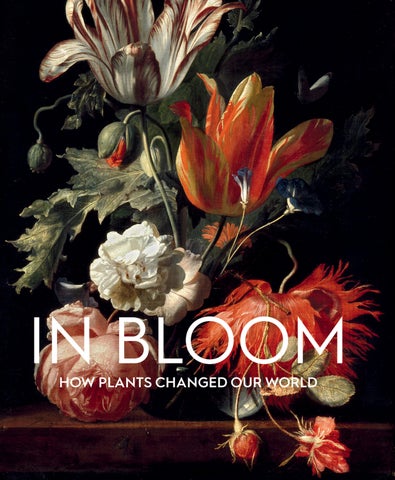
Contents In Bloom: How Plants Changed Our World 19 March to 16 August 2026 Copyright © Ashmolean Museum, University of Oxford, 2026 Stephen Harris, Francesca Leoni, David A. Berry, Mike Webb, India Cole, Martyn Rix, Lyyn Parker, Vinita Damodaran and Matthew Winterbottom have asserted their moral rights to be identified as the authors of this work. British Library Cataloguing in Publications Data A catalogue record for this book is available from the British Library. ISBN: 978-1-910807-74-3 All rights reserved. No part of this publication may be transmitted in any form or by any means, electronic or mechanical, including photocopy, recording or any storage and retrieval system, without the prior permission in writing of the publisher. Catalogue designed by Stephen Hebron Printed and bound in Wales by Gomer Press Frontispiece: Fiona Strickland (b.1956), Tulipa ‘Blumex Parrot’, 2019, watercolour on Kelmscott vellum, 28 × 41.1 cm, Shirley Sherwood Collection For further details of Ashmolean titles please visit: www.ashmolean.org/shop
Exhibition supported by: Mr Barrie and Mrs Deedee Wigmore The James & Shirley Sherwood Foundation The Patrons of the Ashmolean Museum Richard Mayou The Finnis Scott Foundation Kilroot Foundation Dr. Lee MacCormick Edwards Charitable Foundation Claire and David Swan We are most grateful to all of our lenders who are supporting our exhibition: Oxford University Herbaria, Department of Biology The Sherardian Library, The Bodleian Libraries, University of Oxford The Weston Library, The Bodleian Libraries, University of Oxford The Board of Trustees of the Royal Botanic Gardens, Kew Anahita Nourouzi and Galerie Nicolas Robert, Montréal, Canada The Shirley Sherwood Collection Kate Friend and Lyndsay Ingram Gallery, London Fran Monks Alexandra Daisy Ginsberg Işık Güner Justine Smith The Pitt Rivers Museum, University of Oxford The Duke and Duchess of Beaufort The Bank of England The Principal, Fellows and Scholars of Hertford College, Oxford The Warden and Fellows of Wadham College, Oxford Mercer Art Gallery, Harrogate, North Yorkshire Council Collection And those who wish to remain anonymous
Foreword
7
Acknowledgements The Tradescants and Their Circle David A. Berry
11
In Focus: The ‘Tradescants’ Orchard’, MS Ashmole 1461 Mike Webb
28
Networks of Exchange: The Oxford Physic Garden Stephen Harris
33
In Focus: Mary Somerset, Duchess of Beaufort India Cole
54
Botany and Books Stephen Harris
59
In Focus: Making the Flora Graeca Stephen Harris
76
Art and Botany Martyn Rix
81
In Focus: The Bauer Brothers Stephen Harris
106
In Focus: ‘Brilliant in the extreme’: The Botanical Drawings of Sarah Anne Drake Lynn Parker
110
The Business of Plants Stephen Harris
115
In Focus: Tulips: Bulbs and Blooms between Asia and Europe Francesca Leoni
134
Botany and Empire Vinita Damodaran
139
In Focus: Seven Eminent Botanists Matthew Winterbottom
157
26 in bloom
footer 27
26 in bloom
footer 27
Opposite: Fig.23 Leaf of American lotus (Nelumbo lutea), collected by Mark Catesby (1683–1749) in North America 1722, dried and pressed plant mounted on paper and ink, 36.5 × 24 cm (sheet), Oxford University Herbaria, Department of Biology, Sher-1090a Above: Fig.24 Mark Catesby (1683– 1749), Field sketch of American lotus (Nelumbo lutea), 1722, ink on paper, 31.3 × 38.2 cm (sheet), Oxford University Herbaria, Department of Biology, Sher-1090a
46 in bloom
cotton (Gossypium), sugar (Saccharum officinarum) and pineapple (Ananas comosus), plus tender rarities from James Sherard’s garden at Eltham.50 By the mid-eighteenth century, trees and shrubs, often raised from Mark Catesby’s North American collections, were scattered throughout the Garden.51 In Dillenius’s 1740s Garden, among the wild-collected plants, there were many procured from the nursery of Robert Furber (1674–1756) in Kensington, London, especially among the extensive rose collection.52 Unfortunately, little provenance data has been preserved about the plants growing in the Bobart’s garden, or indeed the Garden generally, until the mid-twentieth century. Potential evidence of provenance, and the associated networks, were sold, discarded, or burnt on at least three separate occasions.53 The English naturalist Mark Catesby had been sponsored by a group of British gentlemen, organised by William Sherard, to collect plants (figs 23 and 24).54 For four years, between 1722 and 1726, Catesby travelled through the Carolinas, into Georgia and Florida, and finally to the Bahamas, collecting networks of exchange 47
52 in bloom
footer 53
52 in bloom
footer 53
and have flourished to the present day. Before the early twenty-first century, classification systems focused on morphological characters. Today, backbones for classification are sought among the chemistry of DNA strands and evolutionary relationships. As botanical experimentation became more frequent, botanical data accumulated, and it was necessary to use forms of publication that were more rapid than those offered by books. Academic, peer-reviewed journals, directed at specialists, became the preferred avenue for publication of such results. The papers illustrated with tables of numbers or diagrams distilling abstract ideas. As public interest in science increased during the nineteenth century, publications summarising and synthesising research findings became popular.32 Evolving illustration-reproduction technologies, and falling paper and printing costs, combined with general enthusiasm for gardening contributed to the emergence of a burgeoning market for horticultural books, newspapers, and journals; although many titles were short lived.33 Unlike publications aimed at strictly botanical audiences, such publications often focused on practical advice, and perhaps provoked envy of the plants that nurserymen could provide – at a price. Examples included Curtis’s Botanical Magazine (founded 1787), The Botanical Cabinet (1818–33), The Botanical Register (later Edward’s Botanical Register; 1815–47), L’Horticultueur Belge, Journal des Jardiniers et Amateurs (1833–8), The Gardeners’ Chronicle and Agricultural Gazette (founded 1841), and Flore des Serres et des Jardins de l’Europe (1845–88), where old-style gardening advice and plant science were sometimes combined. The illustrations, usually the costliest element of any publication, were frequently copied among these journals. Some publications, such as the weekly Gardeners’ Chronicle, took on advocacy roles, even encouraging readers to send in questions to the editor, although these sometimes met with short shrift:
Opposite: Fig.41 Johann Jacob Dillenius (1684–1747), ‘Aloe Africana maculata’ (Aloe perfoliata) from Hortus Elthamensis, vol. 1, 1732, bound volume with handcoloured engravings, 47 × 29.5 cm (page), Sherardian Library, Bodleian Libraries, University of Oxford, Sherard 643, pl. 18
There is little difficulty in making out the names of plants, provided a student will do two things; viz. – 1, Make himself acquainted with the meaning of technical words; and 2, Ascertain the structure of the plant under examination. If he does not do these things he must guess; and a guesser is a blockhead.34 The 1700s and 1800s saw the publication of many botanical books, often elab orately illustrated with hand-coloured intaglio prints by talented illustrators sponsored by, and aimed at, wealthy connoisseurs. Johann Jacob Dillenius’s Hortus Elthamensis (1732), with 324 plates drawn and engraved by its author, describes rare and unusual plants growing in royal apothecary James Sherard’s private garden at Eltham, Greater London (formerly Kent) (fig.41).35 This folio is among the most important accounts of horticultural plants growing in eighteenth-century England.36 Yet Dillenius thought the book a complete waste of his time, as he tried to balance Sherard’s pretensions with his own strictly botanical interests.37 The nineteenth-century enthusiasm for orchids (‘orchidomania’) produced a market for elegant books on this subject. One of the most singular of these is the The Orchidaceae of Mexico and Guatemala 68 in bloom
botany and books 69
Fig.67 Sarah Anne Drake (1803–1857), Cyrtopodium punctatum (L.) Lindl., c.1838, watercolour and wash drawing on paper 41.8 × 26.4 cm, prepared for John Lindley, Sertum Orchidaceum: A Wreath of the Most Beautiful Orchidaceous Flowers, London, 1838, pl. 12, The Board of Trustees of the Royal Botanic Gardens Kew
Fig.66 Sarah Ann Drake (1803–1857), Galeandra devoniana, 1830s, watercolour and graphite on paper, 42.5 × 28 cm (sheet), The Board of Trustees of the Royal Botanic Gardens, Kew, Sarah Ann Drake 009
112 in bloom
The illustration would be approved through an exchange between artist, botanist, and publisher, to achieve a finished figure that was scientifically accurate, and typically depicted life sized, while retaining a pleasing visual aesthetic, which helped to drive the fascination with new species that pervaded the nineteenth century. Drake’s career ended abruptly when, in 1847, the same year as the final issue of the Botanical Register was published, she retired from painting and moved back to Norfolk. Throughout her years in Acton Green, Drake shared a warm and productive working relationship with Lindley and maintained a position of great affection within the Lindley clan. It seems most likely that Drake decided to discontinue, and Lindley, already
busy with other projects, decided to retire the publication rather than find another artist. In 1851, Drake was living in the household of her uncle, Daniel Drake. She continued to take on occasional work, producing line drawings for private commissions, but did not contribute to further large-scale publications.13 Sarah Anne Drake died 15 days shy of her fifty-fourth birthday. The cause of death was recorded as diabetes, and though there has been speculation that the accumulation of toxic materials in her paints may have been a contributing factor, no clear evidence exists to positively confirm this.14 She is buried at St Andrew and St Peter Churchyard, Longham Norfolk.
‘brilliant in the extreme’ 113
132 in bloom
footer 133
132 in bloom
footer 133
Creative Visions and Alternative Futures Francesca Leoni
Opposite: detail of Fig.116
160 in bloom
While the exhibition In Bloom: How Plants Shaped Our World focused mainly on the trajectory of plant collecting and cultivation through the lenses of pre-modern art, the significance of this experience could not be addressed in full without considering the implications of these processes for today’s ecological emergency. In the fifth edition of its report, State of the World’s Plants and Fungi, published in 2023, the Royal Botanic Gardens at Kew estimated that 45 per cent of flowering plants are now threatened with extinction, a seven per cent jump since the previous report in 2020, and one that is likely to increase by 2026, when the next will be published.1 The decision to integrate the work of five contemporary artists into the exhibition – that of Anahita Norouzi (b.1983), Justine Smith (b.1971), Işık Güner (b.1983), Alexandra Daisy Ginsberg (b.1982) and Kate Friend (b. 1983) – was therefore designed as a bridge between past and present, and a platform from which to reflect on the ramifications of the ongoing clash between man and nature, as well as to imagine possible new directions for their future coexistence. Meditating on the effects of the overexploitation of natural resources and the cultural loss derived from the collapse of traditional ecosystems on the one hand, and providing alternative – at times utopian – solutions to reset our interaction with the natural world, on the other, these practitioners alert us to art’s creative possibilities towards this change of course. The first contemporary artist one encountered in In Bloom is Anahita Norouzi, an Iranian multidisciplinary artist based in Canada, whose interest lies in the legacies of nineteenth- and twentieth-century botanical exploration and resource extraction. Over time, Norouzi’s artistic practice has become concerned with how scientific research has been historically linked with colonial exploitation, and particularly how plants sourced in Asia have been transferred, rediscovered, and reinvented in Europe. The many ways in which specific Asian cultivars have come to acquire new meanings and significance in the West provide her with a window into the interactions between Europeans and the ‘outer world’, and into the long-term impact of imperial policies, above all the present divide between the Global North and the Global South. Childhood memories, a strong attachment to her Iranian heritage, and the belief in the interconnectedness of the natural and the human spheres underpin the works by Norouzi included in the exhibition. Both What Is in a Name? (2022) and Circuit of Dispossession (2022) revolve around the iris, particularly the violet-petalled variety Iris demawendica, which originates from northern Iran. The destiny of this species is especially representative of the impact that foreign botanical exploitation, first, and mounting economic interests, after, had on her country of origin. Collected around the Alborz mountain range by the German explorer Joseph F. N. Bornmüller (1862–1948) in 1902, and not long after obtained by Kew Gardens, the Iris demawendica was the base of new creative visions and alternative futures 161
174 in bloom
footer 175
174 in bloom
footer 175
Image credits All images are Ashmolean Museum, University of Oxford unless otherwise stated p.2
© Fiona Strickland, Courtesy The Shirley Sherwood Collection p.13 Photo: © Bodleian Libraries, University of Oxford p.16 Photo: © Bodleian Libraries, University of Oxford p.23 Photo: © Bodleian Libraries, University of Oxford p.26 By permission of the Principal, Fellows and Scholars of Hertford College, Oxford. Photo: Ashmolean Museum, University of Oxford p.29 Photo: © Bodleian Libraries, University of Oxford p.35 Oxford University Herbaria, Department of Biology p.38 Photo: © Bodleian Libraries, University of Oxford p.42 Oxford University Herbaria, Department of Biology p.45 Oxford University Herbaria, Department of Biology p.46 Oxford University Herbaria, Department of Biology p.47 Oxford University Herbaria, Department of Biology p.49 Photo: © Bodleian Libraries, University of Oxford p.50 Oxford University Herbaria, Department of Biology p.51 Photo: © Bodleian Libraries, University of Oxford p.52 Oxford University Herbaria, Department of Biology p.54 © National Portrait Gallery, London p.56 Badminton Estate, Gloucestershire p.58 Photo: © Bodleian Libraries, University of Oxford p.60 Photo: © Bodleian Libraries, University of Oxford p.61 Photo: © Bodleian Libraries, University of Oxford p.63 Courtesy of The Linda Hall Library of Science, Engineering & Technology p.64 Photo: © Bodleian Libraries, University of Oxford p.65 Photo: © Bodleian Libraries, University of Oxford p.67 Uppsala University Library. Waller Rar St. fol. 11501 p.69 Photo: © Bodleian Libraries, University of Oxford p.70 Photo: © Bodleian Libraries, University of Oxford p.72 Photo: © Bodleian Libraries, University of Oxford p.74 Photo: © Bodleian Libraries, University of Oxford p.77 Photo: © Bodleian Libraries, University of Oxford p.78 Photo: © Bodleian Libraries, University of Oxford p.80 © Rory McEwen, Courtesy The Shirley Sherwood Collection p.82 Royal Collection Trust / © His Majesty King Charles III, 2025 / Bridgeman Images p.83 © Gabinetto Fotografico delle
224 in bloom
Gallerie degli Uffizi. By courtesy of the Italian Ministry of Culture – Uffizi Galleries p.87 The Stapleton Collection / Bridgeman Images p.88 Photo: © Bodleian Libraries, University of Oxford p.89 © Victoria and Albert Museum, London p.90 © The Board of Trustees of the Royal Botanic Gardens, Kew p.92 © The Board of Trustees of the Royal Botanic Gardens, Kew p.94 © The Board of Trustees of the Royal Botanic Gardens, Kew p.97 The Metropolitan Museum of Art, New York. Gift of Kathy and Michael Mouron, in honor of W. Graham Arader III, 2018 p.98 Photo: © Bodleian Libraries, University of Oxford p.101 Photo: © Bodleian Libraries, University of Oxford p.102 © The Board of Trustees of the Royal Botanic Gardens, Kew p.107 LIECHTENSTEIN. The Princely Collections, Vaduz–Vienna p.108 Trustees of the Natural History Museum, London p.109 Sherardian Library, Bodleian Libraries, University of Oxford p.111 © The Board of Trustees of the Royal Botanic Gardens, Kew p.112 © The Board of Trustees of the Royal Botanic Gardens, Kew p.113 © The Board of Trustees of the Royal Botanic Gardens, Kew p.114 © Brigid Edwards, Courtesy The Shirley Sherwood Collection p.119 © Pitt Rivers Museum, University of Oxford p.119 The Board of Trustees of the Royal Botanic Gardens, Kew [K-EBC:000071993] p.120 Jan Breughel (II), Satire of Tulipomania, c.1640, oil on panel, Inv.no. os 75-699. Frans Hals Museum, Haarlem, purchased with the support of the Rembrandt Society. Photo: R. Gerrirsen p.122 Photo: © Bodleian Libraries, University of Oxford p.123 The Board of Trustees of the Royal Botanic Gardens, Kew [K-EBC:000091712] p.124 © The Board of Trustees of the Royal Botanic Gardens, Kew p.125 Shirley Sherwood Collection. p.126 Dombrain, Henry Honywood, Burbidge, F. W., Dean, Richard, Fitch, J. N., Fitch, W. H., Smith, Worthington George, Vincent Brooks, Day & Son, Gilbert & Rivington, & Taylor & Co. (London, England), (1861). The floral magazine; comprising figures and descriptions of popular garden flowers (Vol. 5). L. Reeve & Co. https://www.biodiversitylibrary. org/page/46012664
p.129 Photo: Ashmolen Museum, Univeristy of Oxford. © The Artist’s Estate – Courtesy of Liss Llewellyn p.130 © Laura Silburn, Courtesy The Shirley Sherwood Collection p.137 Christie’s Images / Bridgeman Images p.138 Photo: © Bodleian Libraries, University of Oxford p.141 The Board of Trustees of the Royal Botanic Gardens, Kew [K-EBC:000099478] p.141 The Board of Trustees of the Royal Botanic Gardens, Kew [K-EBC:000044098] p.143 Roxburgh, William, Banks, Joseph, Bulmer, William, Mackenzie, D., & Nicol, G. (1795). Plants of the coast of Coromandel: selected from drawings and descriptions presented to the hon. court of directors of the East India Company (Vol. 1). Printed by W. Bulmer and Co. for G. Nicol, Bookseller. https:// www.biodiversitylibrary.org/ page/280100 p.144 Bayerische Staatsbibliothek p.145 Hortus Indicus Malabaricus, continens regni Malabarici apud Indos cereberrimi onmis generis plantas rariores, Latinis, Malabaricis, Arabicis, et Bramanum characteribus hominibusque expressas ... addita ... descriptione, qua ... praecipuae in medicina vires ... demonstrantur / Adornatus per Henricum van Rheede, van Draakenstein [sic] et Johannem Casearium [vols. III-V, J. Munnicks, vol. VI, T.J. van Almeloveen] .... Notis adauxit et commentariis illustravit Arnoldus Syen [vols. II-XII, J. Commelinus]. [Vols. VII-XII, In ordinem redegit et Latinitate donavit Abrahamus a Poot]. Source: Wellcome Collection. p.148 San Diego Museum of Art / Edwin Binney 3rd Collection / Bridgeman Images p.149 © The Board of Trustees of the Royal Botanic Gardens, Kew p.150 © The Board of Trustees of the Royal Botanic Gardens, Kew p.151 © The Board of Trustees of the Royal Botanic Gardens, Kew p.154 © The Board of Trustees of the Royal Botanic Gardens, Kew p.162 Photo: Paul Litherland p.163 Photo: Paul Litherland p.164 Courtesy of Justine Smith, London p.166 Courtesy of Justine Smith, London p.167 Işık Güner, Botanical Artist p.168 Işık Güner, Botanical Artist p.170 Courtesy of the artist and Lyndsey Ingram p.170 Courtesy of the artist and Lyndsey Ingram p.170 AC Manley/ Alamy p.171 © Royston Hunt/ Eden Project
p.172 Alexandra Daisy Ginsberg, Pollinator Pathmaker: a4WNehdyCgdiKwVhXKGDBM (Pollinator Vision, Midsummer), 2025. Tapestry – Woven, Mixed Fibre. Courtesy the artist. © Alexandra Daisy Ginsberg Ltd p.172 Alexandra Daisy Ginsberg, Pollinator Pathmaker: a4WNehdyCgdiKwVhXKGDBM (Pollinator Vision, Early Spring), 2025, Tapestry – Woven, Mixed Fibre. Courtesy the artist. © Alexandra Daisy Ginsberg Ltd p.176 © Annie Hughes, Courtesy The Shirley Sherwood Collection p.179 © Fran Monks p.181 © Fran Monks p.183 © Fran Monks p.185 © Fran Monks p.187 © Fran Monks p.191 By kind permission of the Warden and Fellows of Wadham College, Oxford p.194 Oxford University Herbaria, Department of Biology p.197 © Pitt Rivers Museum, University of Oxford p.198 Oxford University Herbaria, Department of Biology p.201 Photo: © Bodleian Libraries, University of Oxford p.202 © The Board of Trustees of the Royal Botanic Gardens, Kew p.202 © The Board of Trustees of the Royal Botanic Gardens, Kew p.203 Photo: © Bodleian Libraries, University of Oxford p.204 Photo: © Bodleian Libraries, University of Oxford p.204 Mercer Art Gallery, Harrogate, North Yorkshire Council Collection p.204 © Stephanie Berni, Courtesy The Shirley Sherwood Collection p.205 Photograph courtesy of the Richard Green Gallery, London p.205 © Marilyn Jones, Courtesy The Shirley Sherwood Collection p.206 Courtesy of the artist and Lyndsey Ingram p.206 Courtesy of the artist and Lyndsey Ingram p.206 Courtesy of the artist and Lyndsey Ingram p.206 Courtesy of the artist and Lyndsey Ingram p.207 Işık Güner, Botanical Artist p.207 Courtesy of Justine Smith, London p.208 Courtesy of Justine Smith, London p.208 Courtesy of Justine Smith, London p.208 Courtesy of Justine Smith, London