Introduction I ’m very much obsessed with my work. I am a painter … I go to bed dreaming of figures, forms, and colours and wake up to translate my visions and dreams into works of art. 1 Ibrahim El-Salahi Ibrahim El-Salahi is a pioneer of African and Arab Modernism and a world-renowned artist. His paintings, drawings and book illustrations draw from a vivid imagination rooted in the traditions of his homeland, which he fuses with inventive forms of calligraphy, African abstraction and a profound knowledge of European art history. The story of the artist’s life reads like a novel. Born in Omdurman, Sudan in 1930 to a family with a long history of Islamic scholarship, ElSalahi became fascinated with calligraphy as a child. After attending the School of Design at Gordon Memorial College in Khartoum, he received a scholarship to study at the Slade School of Fine Art in London between 1954 and 1957. Here he encountered European tradition, ranging from Giotto to Cézanne to Mondrian, and contemporary art, as well as historic manuscripts in the British Museum. Returning to Khartoum, he began teaching at the Painting Department at the College of Fine and Applied Art and, together with fellow painters Ahmed M. Shibrain (b.1931) and Kamala Ibrahim Ishag (b.1939), became a key member of the renowned ‘Khartoum School’ which actively contributed to the growth of modern art in Africa.2 El-Salahi established a new artistic vocabulary by uniting Islamic, African and European elements in a unique surreal style. From 1969 to 1972 he worked as Assistant Cultural Attaché at the Sudanese Embassy in London, following which he returned to Khartoum as Director General of Culture and then Undersecretary at the Ministry of Culture and Information. In 1975, when Sudan was ruled by the dictator Gaafar Nimeiry, ElSalahi was falsely accused of participating in a failed anti-government coup and imprisoned in the notorious Kober prison for over six months. Sharing a cell with ten other prisoners, he secretly continued drawing on small paper scraps. Two years later El-Salahi chose to move to Qatar, where he worked in different expert roles for the Ministry of Information and Culture and then as a translator and biographer at the Diwan Amiri. Since 1998 El-Salahi has lived and worked in Oxford. His memories of 8
9
Sudan, its culture, folklore and landscape remain an important inspiration for his artistic practice. This exhibition at the Ashmolean Museum is the first solo exhibition of Ibrahim El-Salahi’s works in Oxford. It presents early works on paper never before exhibited, as well as the distinctive multi-panel paintings for which he is best known. The project places a particular emphasis on the Tree series, which represents the artist’s interest in the abstracted motif of the tree, using it as a metaphorical link between heaven and earth, creator and created. It also features new work, such as the meditative, small-scale drawings that El-Salahi has made on envelopes and medicine packets since last summer, and his first sculptural work, The Tree, 2018. The show provides an opportunity for some visitors to engage with his art for the first time; it also presents a new understanding to those familiar with his practice by setting it into dialogue with specially selected ancient Sudanese objects from the collection of the Ashmolean Museum. Examples of ancient Sudanese pottery, ranging in date from 2250 bc to ad 350 and decorated with images of the people, plants and animals of the region, were chosen together with the artist for inclusion in the exhibition. In El-Salahi’s words, ‘the past is linked with the present.’ 3 This illustrated book introduces works in the exhibition and themes with which El-Salahi has been concerned. A conversation between ElSalahi and myself draws attention to the artist’s voice, vividly describing his experiences and the concepts behind his work. Liam McNamara’s text provides a brief introduction to the Ashmolean’s archaeological collections from ancient Sudan, among the most significant outside Khartoum. Nazar Eltahir pays homage to El-Salahi as a member of the Sudanese community in Oxford. Federica Gigante’s illustrated artist’s chronology lists important dates in El-Salahi’s biography. What we traditionally understood in Western Europe as the canon of twentieth-century art is intertwined with Western imperialism. It neglects artistic developments occurring beyond North America and Western Europe and it has been exported to the rest of the world. In the words of Edward Said in Culture and Imperialism, ‘most histories of European aesthetic modernism leave out the massive infusions of nonEuropean cultures into the metropolitan heartland during the early years of this century, despite the patently important influence they had on modernist artists like Picasso, Stravinsky, and Matisse … A huge and remarkable adjustment in perspective and understanding is required.’ 4 This adjustment has begun: since Said wrote this text in 1993, great progress has been made in art museums and art historical scholarship. However, to understand truly the contributions by non-European artists
such as El-Salahi to Modernism and to create more inclusive narratives of twentieth-century art history, much work still needs to be done. I agree with art historian and curator Salah M. Hassan that it requires a rigorous effort ‘to transcend traditional Eurocentric dichotomies rampant in art historical discourse, dividing West and non-West and giving primacy to one and derivative status to the other.’ 5 This exhibition at the Ashmolean views El-Salahi’s art as a major contribution to Sudanese art and to African and Arab Modernism, whilst strongly suggesting that we should also include it more prominently in the global art historical canon of the twentieth century. From Omdurman to Oxford – El-Salahi has come a long way. His art transcends geographical as well as cultural barriers. El-Salahi’s recent solo exhibitions include a major touring retrospective, opening at the Sharjah Art Museum before travelling to the Katara Arts Center, Doha and Tate Modern, London in 2012–13. His works receive enthusiastic attention in the global art market and are included in the permanent collections and displays of a growing number of international museums, ranging from the Mathaf: Arab Museum of Modern Art, Doha to the Museum of Modern Art, New York and Tate Modern, London. However, there will be many local visitors in Oxford for whom this exhibition is the first opportunity to view El-Salahi’s work. The artist settled in Oxford in 1998 – 20 years ago. What better time and place could there be for celebrating El-Salahi’s distinctive practice and for reflecting on its role in global art history?
10
11
Lena Fritsch Curator, Modern and Contemporary Art
Notes 1 2
3 4 5
Ibrahim El-Salahi, ‘The Artist in his Own Words’, in Ibrahim El-Salahi. A Visionary Modernist, ed. Salah M. Hassan. New York: Museum for African Art, 2012, p.91. For more details about the ‘Khartoum School’, see Salah M. Hassan, ‘Ibrahim ElSalahi and the Making of African and Transnational Modernism’, in Ibrahim El-Salahi. A Visionary Modernist, ed. Salah M. Hassan. New York: Museum for African Art, 2012, pp.15–19. Ibrahim El-Salahi in conversation with the author in his home in Oxford, 2 December 2017. Edward Said, Culture and Imperialism. New York: Knopf, 1993, pp.242–3. Salah M. Hassan, ‘Ibrahim El-Salahi and the Making of African and Transnational Modernism’, in Ibrahim El-Salahi. A Visionary Modernist, ed. Salah M. Hassan. New York: Museum for African Art, 2012, p.11.
From Omdurman to Oxford The earliest work by Ibrahim El-Salahi in this exhibition is an expressive painting of an elongated face from 1957 that the artist created in his twenties, at the end of his studies at the Slade School of Fine Art in London. His most recent work is a sculpture, The Tree, 2018, finished just in time for this show. El-Salahi is now 87 years old; he has created works in different countries and during different phases of his rich life, extending over a period of more than 60 years. Thematically and aesthetically they are diverse, and it goes beyond the scope of this exhibition to examine all aspects of El-Salahi’s art. This project thus focuses on selected themes and concepts that have been important in his artistic practice.
The human and the spiritual
Untitled, 1957 Ink and gouache on paper, 36.2 × 21 cm Private Collection
12
One motif that appears repeatedly in El-Salahi’s work is the human. He is shown in different forms, ranging from dynamic, full-body figures to surreal fantasy faces. The earliest example in this exhibition is Untitled, a work on paper from 1957. Here an abstracted, elongated face, painted in black ink on a white background, dominates the composition of the work (p.12). On the right side three snail-shaped curls seem to represent hair. The nose is long, with ornamental, snail-shaped nostrils and the mouth is wide open, displaying large teeth. The black contours of the face are complemented by yellow, blue and red brush strokes and colour drips, suggesting a rapid application of the gouache. The clear lines offer no illusion of depth, but proudly present the two-dimensional nature of the image. The complementary colours and dynamic brush strokes, the power of the face in the composition and the facial expression all create a highly charged atmosphere. The elongated shape and abstracted form of the face are reminiscent of African masks, while the two-dimensionality and the ornamental style of the nostrils and hair suggest calligraphic influences. The strong colours and dynamic gesture may recall Expressionist or NeoExpressionist portraits. When El-Salahi left Sudan in 1954 to study at the Slade School in London, he had already learnt to paint in a naturalistic style, using oil paint in a technically highly competent way. As Chika Okeke-Agulu has pointed out, El-Salahi had ‘already demonstrated a mastery of mimetic representation’ despite still searching for his own ‘formal style’ and ‘thematic focus.’ 1 At the Slade he first studied traditional European 13
techniques and realist painting before making a deliberate shift in his final year; he then decided to focus on ideas of two-dimensional representation and abstraction, partly inspired by studies of manuscripts in the British Museum. The artist recollects the context of Untitled, 1957: ‘At the time, I was thinking about my personal identity and how I see things … I wanted a sense of the two-dimensional. I think this face was supposed to be my long face.’ 2 This ‘self-portrait’ is a key early work that visualises a turning point in El-Salahi’s approach to painting. The artist represents his own face in a unique language that links influences of abstract writing with African and European visual culture, showing that he has developed his own artistic identity. Elongated facial shapes can be found in numerous other works of the late 1950s and 1960s, for example They Always Appear, 1958–60 (p.15). This small piece is part of a series of drawings and paintings with the same title. It depicts a group of faces in black ink on white ground, and is based on a vision that El-Salahi used to have in which three tall figures appeared before him. He remembers: ‘The first time I saw them was when I was with my older brother. … The donkey saw them and I saw them. I said to my brother that we couldn’t move because of the three figures in front of us – I saw their silhouettes, but he couldn’t see them.’ The faces in They Always Appear are inspired by human ones, but their elongation also conveys a dream-like atmosphere. The artist has referred to the elongated facial shapes in his work in different ways, comparing them to animals, humans, or ‘humans’ animal souls’, to Nubians, to Sudanese women who cover their faces, to donkeys and also to his own long face.3 Such observations show that El-Salahi finds inspiration in the people, animals and works of art that he sees and lives with. However, these inspirations are only starting points. The figures in his works come into existence through an intuitive artistic process; they relate to the artist’s inner self rather than to the outside world. The motif of the human, and human-like, has continued to play an important role in El-Salahi’s work. This is apparent in both his large paintings and drawings, such as Meditation Tree, 2008 (p.37), and in small works on paper, including the most recent Pain Relief Drawings, 2017–18 (pp.44–47). Deeply colourful paintings, such as Untitled, 1976, Untitled, 1999 or Head of the Undersecretary, 2000, complement black and white diary drawings to present a surreal language that draws attention to the inner mind (pp.17–20). The faces suggest a spiritual dimension: in El-Salahi’s art, human existence is linked to a world of dreams and meditations.
14
They Always Appear, 1958–60 Ink on paper, 22 × 19.5 cm Private Collection
15
Untitled, 1976 Watercolour on newspaper, 37.1 × 26.4 cm Private Collection
Untitled, 1976 Coloured ink on watercolour paper, 38 × 38 cm Collection of the artist
16
17
Untitled, 1976 Watercolour on newspaper, 37.1 × 26.4 cm Private Collection
Untitled, 1976 Coloured ink on watercolour paper, 38 × 38 cm Collection of the artist
16
17
Oxford Tree, 2003 Pen and ink on Bristol board, 121 × 95 cm Modern Forms
Oxford Tree, 2001 Pen and ink on Bristol board, 121 × 95 cm Modern Forms
34
35
Oxford Tree, 2003 Pen and ink on Bristol board, 121 × 95 cm Modern Forms
Oxford Tree, 2001 Pen and ink on Bristol board, 121 × 95 cm Modern Forms
34
35
Meditation Tree, 2008 Indian ink on paper, 36.8 × 111.8 cm Pizzuti Collection
The Tree, 2008 Acrylic on canvas, 203.2 × 121.9 cm Private Collection
The Tree, 2018 Aluminium, 77 × 55 cm Collection of the artist
36
37
Meditation Tree, 2008 Indian ink on paper, 36.8 × 111.8 cm Pizzuti Collection
The Tree, 2008 Acrylic on canvas, 203.2 × 121.9 cm Private Collection
The Tree, 2018 Aluminium, 77 × 55 cm Collection of the artist
36
37
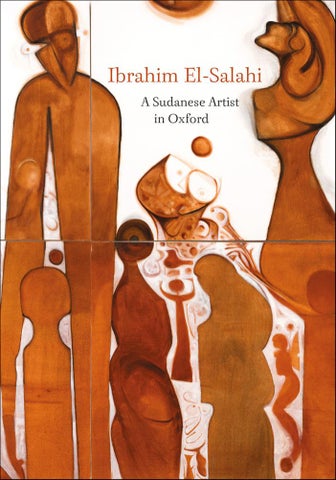
Dancing and celebrating life Flamenco Dancers, 2012 (p.39, p.70) is a large-sized oil painting consisting of six panels. It shows a vivid composition of biomorphic forms, pillar-like elements and dynamic, abstracted human figures in different shades of warm brown on a white background. A small figure in the lower middle of the composition – painted first, according to the artist – and a large figure on the right side wrap their arms around their heads, stretching their bodies energetically. The painting is dominated by curved lines and circular shapes, conveying a natural and feminine impression; it recalls dancing movements while also reflecting the influence of Islamic decorative patterns. The composition of the work is intriguing. Its brown figures and pillarlike forms are juxtaposed with the white background through clear dark contours; different shades of brown create a sense of volume. The panels on the lower half are dominated by a large number of figures and abstract shapes, in contrast to the upper half which features more white background. This creates a dynamic impression of growth, reflecting the artist’s statement that he leaves it to the ‘nucleus’ of the painting to grow naturally. The upwards movement is emphasised by the fact that many of the forms are confined by the canvas. The dancing figure on the right seems to rise up, as does a biomorphic form in the middle, reaching outside the canvas. The viewer becomes part of the fantastical work, continuing the image in his or her mind. Flamenco Dancers belongs to a series of paintings and drawings that the artist created after a visit to Andalusia in 2009. He was one of three artists invited to spend time in the region by the art collector Abdul Magid Breish. The group visited Cordoba, Granada, Malaga, Marbella and Toledo, observing the architecture, landscape and culture. In the evenings they dined in restaurants and attended flamenco performances.7 El-Salahi drew much inspiration from the Moorish influences across the region. He was particularly fascinated with the medieval Alhambra palace in Granada and the art of the flamenco dance. The artist recollects: ‘Every night we went to see the flamenco dance. I liked the music that the dancers create with their feet.’ The Arabic name Al-Ħamrā (literally ‘the red one’) refers to the natural red of the sun-dried bricks from which the fortress walls were built. Reminiscent of the colours of Sudan as well as the Alhambra, El-Salahi used earthy reds and warm shades of brown in many of the paintings. Flamenco Dancers, 2012 is a vivid celebration of the artist’s memories and dreams of Andalusia, evoking its warm colours, decorative patterns and vibrant flamenco. El-Salahi’s works are often concerned with socio-political or spiritual themes. Flamenco Dancers is representative of another important (and often overlooked) aspect of his oeuvre: it celebrates life, nature and beauty.
Flamenco Dancers, 2012 Oil on canvas, 170 × 312 cm Vigo Gallery
38
39
13 Sarah Dwider, ‘“Understood and Counted”: A Conversation with Ibrahim ElSalahi’, (https://www.guggenheim.org/blogs/checklist/understood-and-counted-aconversation-with-ibrahim-el-salahi) . 14 Hudson, ‘Ibrahim el-Salahi’. 15 Ibrahim El-Salahi, Prison Notebook, quoted in Salah M. Hassan, ‘Prison Notebook : A Visual Memoir’, in Ibrahim El-Salahi: A Visionary Modernist, ed. Salah M. Hassan, London 2013, pp.93–103 (94). 16 El-Salahi, Prison Notebook, p.96. 17 El-Salahi, ‘The Artist in His Own Words’, p.86. 18 ‘In Conversation with Ibrahim El-Salahi’, p.54. 19 ‘In Conversation with Ibrahim El-Salahi’, p.55. 20 ‘In Conversation with Ibrahim El-Salahi’, p.53. 21 Casey Lesser, ‘Ibrahim El-Salahi: The Pioneering Sudanese Artist That You Should Know’, 4 March 2016 (https://www.artsy.net/article/artsy-editorial-ibrahim-el-salahithe-pioneering-sudanese-artist-that-you-should-know, accessed 16 February 2018).
Curator’s Acknowledgements This exhibition would not have been possible without Ibrahim El-Salahi and Katherine El-Salahi – it has been a great pleasure and honour working with them. Deep thanks are also due to Toby Clarke, Pia Austin-Little and Nadia Zayan from Vigo Gallery, for their tireless support and insightful advice. The exhibition and catalogue were generously supported by Christian Levett. We owe him a huge debt of thanks. I would also like to deeply thank the institutions and individuals who have agreed to part with much treasured works from their collection. At the Ashmolean, I would like to thank Liam McNamara, Lisa and Bernard Selz Curator for Ancient Egypt and Sudan, who provided expert advice on the ancient Sudanese objects from the Ashmolean’s collection. Trainee Curator Federica Gigante offered valuable curatorial support. For the exhibition design, credit is due to Byung Kim. Aisha Burtenshaw, Head of Public Engagement, has shepherded the loans with assiduousness while the exhibition logistics were capably overseen by Agnes Valencak, Head of Exhibitions. Thanks go to Dec McCarthy, Head of Publishing & Licensing, who worked tirelessly to accomplish the successful completion of this publication. The elegant design of the book is down to Stephen Hebron, and I would like to thank Catherine Bradley for her copyediting. I am also grateful to the teams in Art Handling, Communication, Conservation, Design, Development, Education, Press and Marketing, Public Programme, and Visitor Experience for their skilful work throughout the process. Full-page illustrations: p.2: Portrait of Ibrahim El-Salahi, by Isam Abdel Hafeez. Presented to the artist in 2015. Courtesy of the artist. p. 6: Page from Diary 3, 2012–13; pen and ink on paper (bound diary-book), 29.5 × 19 cm; Vigo Gallery. pp. 8, 48, 62: Pages from Diary 2, 2012–13; pen and ink on paper, 27.5 × 18.5 cm; Vigo Gallery. p. 58: Red polished spherical jar decorated in purple and cream with four faces of Hathor. From Faras, Cemetery 1, Grave 974/3. Meroitic Period, about 270 BC–AD 350. Ashmolean Museum (AN1912.370).
72