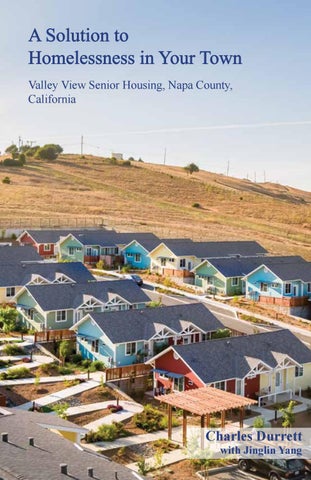
A Solution to Homelessness in Your Town Valley View Senior Housing, Napa County, California
Charles Durrett with Jinglin Yang
A Solution to Homelessness in Your Town Valley View Senior Housing, Napa County, California
No part of this document may be reproduced without written permission from McCamant & Durrett Architects. Copyright Š 2021 by Charles Durrett.
Contents Introduction The Location The Site Hill Town Village Inspiration Homeless and Seniors The New Birth Abandoned Retaining Walls Client-Approved Design Why a Village? Common House, Common Facilities Clubhouse Interior Exterior Spaces The Grand Opening The Look: A Vernacular Style Floor Plans Affordability Services Site Planning Creativity Funding Accessibility Safety and Security Fire Suppression Systems in Fire Prone Areas Sustainable Materials Sustainable Construction Renewable Energy
2 10 12 13 15 17 25 26 27 30 31 33 35 38 40 42 45 49 51 54 56 59 61 63 66 69
Contents In Conclusion Acknowledgments Appendix: A - Affordable Villages Elsewhere B - Picturing the Homeless in California C - The FEMA Emergency Criteria D - Sample Resident Agreement E - Benefits of an Opportunity Village in Eugene, Oregon and to any Americans Experiencing People Without a Roof in Their Town. F - Faces of Change: Formally Homeless About the Author Afterword Feasibility for New Sites Bibliography
72 75 81 82 83 85 88 89 93 95 96 97
Introduction Close to one million people are unhoused in the United States today. Millions and millions are ill-housed—people living in shanties or leaky, moldy trailers. And millions more are mis-housed—in houses that are abusive in their loneliness, forlorn and empty at so many levels. We can do something about it. Actually, it’s lowhanging fruit, should we choose to do something; impossible, if we do not. And it’s essential, not only for the well-being of the individual, but also for the well-being of the State, and the society.
Current studies are overwhelmingly show that it is more cost effective, in terms of tax dollars earmarked for city, county, state, and federal governments, to house people than it is to just leave them outside. About $20k to $40k cheaper for each person per year. In the case of the unhoused, it also taxes our psyches and our emotions to see our neighbors sleeping on the sidewalk. It is difficult, if not impossible, to explain to our children and grandchildren how we Americans leave people outside in the cold—mentally challenged or not. Then, there is the moral issue.
There are too many camp sites, too few compact efficient, but comfortable and safe houses.
2
horror. After all, the homeless have no shelter in which to shelter-in-place.
If you are motivated to get a new homeless housing project moving in your town, this book is the best place to start. I wrote this book in 2020, right in the middle of the COVID-19 pandemic. An inordinate number of homeless people in this country are already extremely vulnerable. For them Covid-19 is horror atop of 3
Valley View Senior Housing is an affordable senior housing community built in 2019 in American Canyon, Napa County, California. Its housing consists of 70 units with an average of 500 ft2. If no one were to die from COVID-19 at Valley View Senior Housing because the members of this community discipline each other. And its residents are successfully sheltering-in-place—because they have a place.
7
8
The New Birth
First sketch, like everyone else’s.
On a Saturday, just weeks before the proposals were due, I traveled to the site to find inspiration. When I left my studio in Nevada City, California (two hours away), I had resigned myself to the idea that a single building was the only option for this site. At that point, I was going there simply to seek inspiration on how to decorate the big box. And I was feeling pretty dispirited that all I was doing was searching for the best of the contemporary architectural styles to virtually warehouse people.
17
Second sketch, starting to pull apart.
Third sketch, mitosis beguns in earnest.
When I arrived, I climbed to the highest northwest corner of the site and just sat there to wonder about other possibilities. I first considered the lives of the people who would be living there, and the fact that each of them had faced significant adversity. I also thought about the role that community needed to play
One building solution. The best solution these days is rarely the obvious one.
in their lives going forward, and whether that could be created with the current singlebuilding, big-box design. I began sketching and measuring, and when I left the site that evening, a new design began to emerge that broke with the 28 other proposals. Instead of one building it would be 24. I knew that a multistory, one-building, double-loaded corridor solution didn’t feel right at all; it would be more or less “hoteling” people. Outside of an urban context, a single large building doesn’t make sense for housing. Put another way, one big building in a rural setting would feel a little bit like people storage.
Early feasibility sketch.
18
Affordability Since the late 1980s, MDA has designed more than 50 cohousing communities, and cost control was absolutely essential to every one of them. The main requirement of the Valley View clients, the City of American Canyon and the nonprofit Satellite Affordable Housing Associates (SAHA), was affordability. All the prospective residents sat at the bottom of the
Social Security income spectrum, and now many of them could finally receive Social Security benefits because they would have an address. American Canyon is not a wealthy town, and it is subject to careful oversight from every angle. And SAHA was also stringently accountable. Every dollar spent needed to be accounted for and needed to add value.
42
The MDA architects, SAHA, and Midstate Construction met numerous times during the preconstruction phase. Unfortunately, one costly item that we had to remove from the plans to keep it affordable, was the elevator (which saved $100,000), but which reduced the roll-in (accessible to wheel chairs) units, by six. However, 64 units with roll-in access remained. It took several meetings to fit the project into budget. Meanwhile, in
43
the super-heated construction market in the San Francisco Bay area, construction costs could not have been more compounded. If a one-building, multi-level solution had been applied in this case, it would have very likely become too expensive to complete. One-story buildings (cottages) are simply cheaper to build—the one-building concept is simpler at the site plan level only. For example, Valley View Senior Housing had 21 framers
on the 39,000-square-foot project. From what I witnessed, only a couple of them had much prior experience. It is possible to build one-story cottages this way—that is, with less skilled labor. Between the extra million dollars it would have taken to remove the existing retaining walls, the two million dollars or more to build the podium, and more skilled labor, this project, like too many others in this era, might not have been built at all.
This is not to suggest that multistory buildings are inappropriate elsewhere. MDA had completed a five-story building for formerly homeless people in San Francisco, a 5-story affordable project in Oakland, and lots of multistory buildings, including an 11-story building in Tokyo. However, at the American Canyon site, that decision would have been preclusive, and the one-story solution was applied. Making this studied decision was founded on the all-important feasibility study.
44
Safety and Security People relating to each other, people helping each other: this is not rhetoric. This is how you keep people safe and promote emotional security. Few Valley View residents have vehicles. If they can, those who own cars give others rides to places, such as the doctor, relieving government entities of costly and inefficient elderly transportation programs. Offering rides also helps people who no longer feel comfortable driving. It is understood that the county would step up when needed; however, we
59
have found that the immediate community itself, working in its own best interest, actually serves itself well.
Donations so that people can set the house up.
Too often many precious resources are left on the table in affordable housing. Valley View’s primary asset for success has to be the residents themselves, and their motivations: They can save money in the longterm, they can help each other, and some can participate with management. In another affordable senior housing project, we utilized considerable community-building techniques. For example, we put on participation workshops where residents help landscape, clean, and even do some light maintenance. That approach paid off in huge dividends in helping to reduce the cost of management and in building camaraderie.
“We need communities that deliberately foster close social bonds. There are growing housing movements in which residents share chores and tend to common spaces together... There are about 150 cohousing communities in the U.S., but more are being built.” – Susan Pinker in Disconnection, published in Psychology Today, April 2018
A healthy community has to be the first priority.
60
Sustainable Construction The main point of this book is to get people housed, and housed in a community setting. This is critical. But other factors reside on top of that moral plateau as well. Challenges such as climate change, accessibility, low maintenance, sustainability, and being ready for the next pandemic and more.
Valley View Senior Housing project is certified as GreenPoint Rated “Platinum.� GreenPoint Rated is the most trusted home rating system in California. It provides proof that the home has been built to high environmental standards. All topics are taken into consideration, including energy efficiency, water conservation, indoor air quality, resource conservation, and livable communities.
Incessant construction overnight to keep on budget, on schedule, and no leaks.
66
1
Super efficient, blown-in insulation in the walls and roofs help maintain cool temperatures indoors during summer, and traps heat indoors and keeps the chilly temperatures outdoors during winter. Insulation helps the building work like a thermos.
2
cooler. During winter, it slows the transfer of winter indoor heat and keeps your home warm.
3
Radiant barriers installed in the roof reflect heat from the sun, and prevent heat from entering the building during summer months. Also maintains warm indoor temperatures during winter by blocking heat from escaping.
4 Extra thick and dense sheetrock in the walls and ceilings, and light weight concrete floor toppings help maintain a consistent temperature. It slows the transfer of summer outdoor heat and keeps your home
67
Solar panels on the roof collect heat from the sun and deliver it to the houses.
5
8
The low winter sun penetrates deep into your home through high windows. Overhangs outside protect the homes from summer sun and heat gain.
During cool nights in the summer, you can remove more hot air by turning on your bathroom exhaust fan. Open a window to allow cool air to replace the hot air you are getting rid of.
6
9 Ceiling fans can help keep you cool during hot days, but use them only while you are in the room, as they will cool the body but actually heat the room.
7
People can share resources. Households have equal access to the common facilities like the lounge area, dining room, craft room, computer lab, full facility kitchen.
Low-e windows for their higher insulation value.
68
“The story of Valley View Senior Housing exemplifies just what can be accomplished when designers, housing providers, government, and funding partners come together around the common purpose of creating affordable housing for those in need. While low-income housing is all too often reduced down to solving a statistical problem where the people that live in the housing are an afterthought, this book shows how we can create human solutions that put people first while also providing affordable housing.� - Andrew Heben, key homeless activist, developer of Opportunity Village, Eugene OR
McCamant & Durrett Architects 241B Commercial Street Nevada City, CA 95959 530-265-9980 www.cohousingco.com charles.durrett@cohousingco.com USD 19.95
ISBN-13: 978-1-935935-45-2