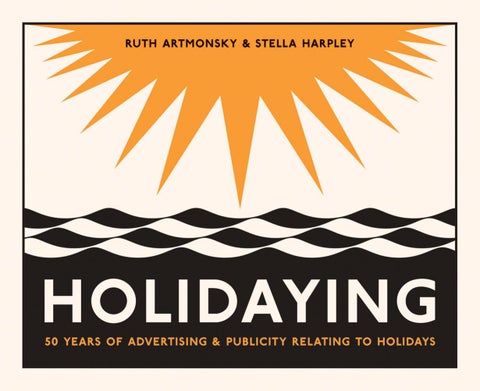
CONTENTS
Published by: Artmonsky Arts Flat 1, 27 Henrietta Street London WC2E 8NA artmonskyruth@gmail.com Tel. 020 7240 8774 Text © Ruth Artmonsky 2019 ISBN 978-0-9935878-7-0
Designed by: David Preston Studio www.davidprestonstudio.com Printed in England by: Northend Creative Print Solutions www.northend.co.uk
As usual, my thanks go to my designers David and Tamsin at David Preston Studio for their innovation and wit.
FOREWORD
07
INTRODUCTION
09
PACKING
18
PLACES AND PLEASURES
42
PACKAGES AND AGENTS
68
CRUISING
84
EPILOGUE
106
Bibliography
108
FOREWORD
6
Although I was born in London, I’d like to be considered at least an ‘honorary,’ if not a full, ‘sand-grown’un’. My grandmother ran a kosher theatrical boarding house in Southend; her cousin, Younkman toured the piers and resort theatres with his Czardas Band; I was brought up in Thorpe Bay and Blackpool; and over the years have holidayed regularly in Aldeburgh and Brighton. At various times, the family has had holiday homes at Brighton and St. Ives, and we haven’t been slouches when it comes to holidays abroad – I, with all my equipment on my back, nudist camping in the south of France to later sejours at the Negresco. The Danielli and the Mamounia; Stella was an undergraduate in Brighton, and has been altogether more adventurous, catamaran sailing in the Seychelles, walking the philosopher’s path in Japan, and riding a camel called Michael Jackson on the Pakistani border. But can we therefore be considered experts on holidays, on what attracts people to take breaks from their everyday life, just because we’ve taken a multitude of such breaks ourselves? When writing a book on the interior design of liners I came across a Lady Brocklebank, wife of a Cunard chairman, who considered that because she was much travelled on the company’s ships she was wellqualified to take over the interior design of a new one! So the answer to my question as to our expertise is definitely ‘No’! But we do know something about advertising and that has given us the excuse to plug into our nostalgia and enthusiasm for holidaying and holiday resorts, to compile this book. 7
Lancashire, they were able to gain informal arrangements for time off without pay and such time morphed into ‘wakes weeks’ where whole factories, and sometimes towns, would down tools, and for those who could afford it, holiday at the seaside. Savings or ‘going off’ clubs were started not only at works, but sometimes at a local pub or for a whole street, so that people could cover the likely costs of such breaks. Such arrangements were fewer in the south of England, where work tended to be organised in small workshops and workers consequently lacked the power to make deals. It was not really until the emergence of trade unions and the formation of the Labour party in the early years of the twentieth century, and until these bodies took any sort of interest in the ‘time off work’ issue, that national legislation was brought in. Well ahead of this, by 1920, some of the ‘white collar’ unions, such as those for the Civil Service and local government, had, by sheer force of numbers, achieved two weeks paid leave; whilst cotton mill workers, through their unions, had agreed annual holidays of one hundred and sixteen and a half hours, (just under five days), as early as 1906. The legislation, when it did come, with the Holidays with Pay Act of 1938, was a weak compromise, did not cover all workers, and was, in fact, delayed by the onset of war. Susan Barton, in her study of working class tourism, surprisingly asserted that until this Act the majority of workers could not even contemplate a week’s holiday and provides the statistic that until the Act only one third of workers took holidays away from home at all. Nevertheless, by 1960, some twenty-seven 10
Above: Advertisement from the Tatler for Revelation luggage, ‘The World’s Most Famous Suitcase’, 1937. Left: An early travel poster for Thos. Cook & Son, undated. Opposite page: Bookmark publicising the Royal Mail Steam Packet Company, 1921.
11
Above: Government attempt to control the post-war flood of holidaymakers. Poster by Dorrit Dekk, 1949.
million workers, either by legislation or by voluntary agreements had paid holiday provision. Meanwhile, at the other end of the social spectrum, the few, aristocratic and wealthy, who had taken Grand Tours on the Continent in the eighteenth century, ostensibly for educational purposes but largely for pleasure, had been replaced by larger numbers holidaying at spas and watering holes. The declared purpose of such visits was for improving their health, but alongside this much pleasure was derived from the socializing and entertaining laid on. And once King George III had dipped his toe in the sea at Weymouth in the 1780s, again because of possible health benefits. there followed a cascading that converted small villages and fishing harbours around the British coast into seaside resorts. Similarly, when the British discovered the south of France, it was not for summer holidays but for improved health in the winter – the ‘fashionable’ season did not shift to the summer months and from therapy to pleasure, until well into the twentieth century. Nevertheless, British holiday resorts continued to make much of the health-giving qualities of their respective boroughs in their advertising and publicity, detailing such matters as degrees of sunshine, cleanliness of tap water and control of sewage. And throughout the inter-war years the benefits of being out in the open air and being active were advocated by such voluntary bodies as the Youth Hostelling Association, the Ramblers Association and even the Labour Party in its campaigns for better recreational facilities; all encouraging people to use their free time for recharging, as well as for entertainment. 12
Pamphlet offering ‘Hints for a Happy Holiday’ for those travelling abroad, undated.
Poster encouraging holiday-makers to stagger their holidays, design by Eileen Evans, undated.
13
heads; women travelled with hats and gloves, but possibly were rather more brazen when on the beach. Susan Barton records their having rubber knickers to wear over their skirts to prevent them getting wet when paddling; and old holiday photographs show women tucking their flowery frocks into elasticated bloomers. Akhtar & Humphries concluded that – Most men, like T.S. Eliot’s Prufrock, considered that rolling up their trousers and perhaps loosening their tie or exchanging flat caps for knotted handkerchiefs as they paddled along the shore, to be quite daring enough. Opposite page, left: Advertisement for Wolsey bathing suits, from Punch, 1930. Opposite page, right: Jantzen advertisement, from Punch, 1939. Right: Martha Harris Autumn window display for Jaeger Sea Wear, 1933.
24
25
PLACES AND PLEASURES
The development of a town, village or hamlet into a holiday destination was frequently to do with health. Earlier on a site might acquire a reputation for being a place of healing by being associated with a saint, a holy relic, or the like; later by being near a well or spring of supposedly healing waters. By the seventeenth and eighteenth centuries Harrogate, Wells, Tunbridge and Epsom were flooded with visitors optimistically hoping that their complaints could at least be relieved if not cured by ‘taking the waters’. It is arguable whether these early spas can be classed as holiday venues, but they did become an attraction as much for the socialising and entertainment that went on, as well as for their possible therapeutic potential. The places that were to grow into holiday resorts continued to use ‘health’ in their publicity. ‘Healthy Herne Bay’, ‘Fleetwood for Health and Pleasure’, ‘Hastings for Health’ were typical headlines for posters, leaflets and brochures much of the following text resorting to medical flummery. Southend, once a small hamlet known only for its oysters and manufactured crystallised salt, in setting out its wares as a resort boasted – Pure sunlight of the ordinary intensity raises the antiseptic power of the blood and kills the germs of tuberculosis in 10 minutes.
Above: Poster publicising Brighton Carnival, Conrad Leigh, 1920s. Left: Early twentieth century poster, Harrogate ‘Britain’s 100% Spa’.
Walton estimates that by WWI there were over one hundred seaside resorts vying for visitors, on the east coast – Scarborough and 42
43
Below: ‘Brighton for Health & Pleasure: All the year round’ publicity poster, early twentieth century. Below right: 1950s brochure showing an aerial view of some of Scarborough’s attractions.
Skegness; on the west – Blackpool and Southport; in the south-east – Southend, Margate, Ramsgate, Broadstairs and Eastbourne; to the south – Hastings, Brighton and Bournemouth; and in Wales and the southwest – Prestatyn, LLandudno, Rhyl and Torquay. Each resort began to attract its own clientele, usually from the nearest manufacturing towns; the Lancashire cotton mill workers drifted to Blackpool, Cockneys to Southend, West Midland factory workers to Rhy and LLandudno. Much, of course, depended on the spread of the railways, so much so that some trains became known by the resorts they served, such as the Brighton Belle in 1934. Resorts began to compete not only on the grounds as to which was the healthiest, but which could offer the most sumptuous or
Above: ‘Torquay for sunshine and spa treatments’ advert, The London Illustrated News, July 1929. Right: 1930s advertisement for Weston Super-Mare stressing the benefits of ozone.
44
45
Opposite page: Poster for Orient Line Cruises, artist uncredited, 1937.
104
In the 1930s the Orient Line commissioned work from artists at the Reimann School Studio, lately established in London, and from one of the iconic graphic artists of the inter-war years, Edward McKnight Kauffer. His publicity work for the Line’s ‘Orion’ and his design of the company’s symbol, along with its posters, brochures and even luggage labels, brought modernism to shipping graphics. In the post-war years the Orient Line fished from yet another generation of artists, the New Zealander, John Bainbridge, the eccentric collagist Dorritt Dekk, and that generation’s icon, Abram Games. Dorritt Dekk, who was to design many advertisements and posters, particularly for Air France, was a rarity, for along with being female, she brought humour to cruise advertising, which was so surprisingly lacking.
105
EPILOGUE
Curiously, apart from odd exceptions issuing from the railway companies and a few shipping lines, much of the publicity and advertising in relation to holidaying tended to be conservative, even hackneyed, when it came to graphic design; and few companies and agencies went out of their way to attract and make use of the major graphic artists. Generally, they were to steer clear of ‘modernism’ or, indeed, of any other movement or trend in art or typography. The sky was always blue, the sea blue-green and the sand yellow; families were always smiling and seeming to really enjoy each other’s company, joining in with each other’s activities; where adults were portrayed the women were always slim, good-looking and fashionably dressed (but not outré), the men suitably muscular; and there might even be a slight hint of romance somewhere in the air. Although holidaying is about having fun, the advertising of holidays rarely tapped into the humour, the English whimsy, that was used so effectively, in the period, to sell such products as petrol, tobacco and drinks. Seasides could have their saucy McGill postcards, but there humour remained, not infecting the plethora of leaflets, brochures, and advertisements enticing would-be holidaymakers to resorts and their entertainments. For graphic design historians the field is something of a challenge, for relatively little of all this ephemera, where illustrated, carried the artist’s name. When auction houses have their occasional sales of travel and holiday posters, ‘anon.’ is to be seen as frequently
106
as a name. Yet advertisers and publicists obviously had some understanding of the pull of good graphics, for although the inner pages of their leaflets and brochures would be full of greyish photography, the covers would ofttimes be given over to the graphic illustrator and to colour. Holidaying publicity and advertising is likely to prove a richer vein to mine for social scientists, who, with patience and a little imagination, could well discern trends in social norms and mores in the different decades covered by this book, comparing the pre- and post-war periods – the well-heeled giving way to the masses, home resorts to far-away destinations, the railway to the car and the plane, family holidays to individual generation choices. But to those like ourselves, collecting and pouring over the holiday ephemera of the time, we must admit that it has been just an indulgence in nostalgia, and, as with most ephemerists, a happy haven in times of turmoil.
107