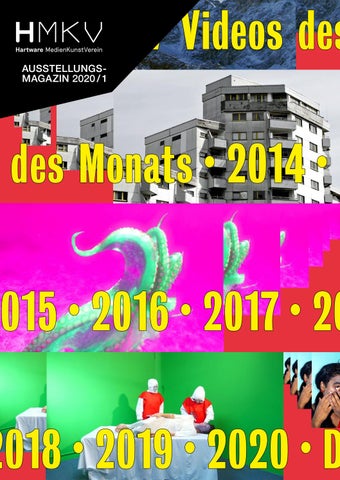
Die HMKV Videos des AUSSTELLUNGS MAGAZIN 2020 / 1
des Monats · 2014 · 2
015 · 2016 · 2017 · 20
2018 · 2019 · 2020 · D DEZEMBER
2014
A
Inke Arns
Fressen und gefressen werden Eat and be eaten
Die Reihe HMKV Video des Monats 2014 – 2020 The series HMKV Video of the Month 2014 – 2020
4
1 Dienstag, 2. Juni 2020 – wegen der Corona-Pandemie konnte leider keine Eröffnung stattfinden.
„Fressen und gefressen werden“ – unter dieses Motto könne man alle Videos stellen, die in der Ausstellung 25 von 78 zu sehen seien, meinte Isabella Fürnkäs, eine der teilnehmenden Künstler*innen, am ersten Öffnungstag zu mir.1 Auch ihr Video Selfiecalypse – Teen Hunger Ultra Death Attack 1.0 (mit Lukas von der Gracht) passt zu diesem düsteren Motto: Zwei Player – die Künstler*innen selbst – verfolgen sich gegenseitig auf einem Parkdeck und filmen die wilde Hetzjagd mit Selfiesticks. Die Ausstellung 25 von 78 präsentiert eine Auswahl aus der Reihe HMKV Video des Monats. Diese Reihe stellt seit März 2014 im monatlichen Wechsel aktuelle Videoarbeiten internationaler Künstler*innen vor. Sie ist entstanden aus dem Wunsch, aktuelle künstlerische Produktionen in schnellerem Wechsel zu zeigen als dies in den Ausstellungen des HMKV möglich ist. Und in der Tat lassen sich fast alle Videos, die in diesem Magazin dokumentiert werden, als jeweils sehr eigene künstlerische Erzählungen des Mottos „Fressen und gefressen werden“ lesen. Die fast 80 Videos erzählen Geschichten über seltsame Clowns (Preis, Wudtke), es geht um Arbeitsbedingungen (Wilson), Strukturwandel (Fischer / el Sani), spekulative Technologien (Meyer-Brandis), posthumane Maschinen (Allahyari & Rourke) und erniedrigende Talentshows (Steyerl). Der alten ‚neuen‘ Rechten und der Alt-Right widmet sich gleich eine ganze Gruppe von Videos: Die bewusste lancierte Falschnachricht um den Hashtag #pizzagate wird seziert (Neidich), es wird mit aufblasbaren Barrikaden gegen Rechts trainiert (van Balen), die rassis tische English Defence League (EDL) wird in „English Disco Lovers“ umgedeutet (Alton) und ein Wurm berichtet aus seinem Leben als rechter „Aufmerksamkeitsköder“ (Goerzen & Fornieles). Tiere spielen auch in anderen Videos eine Rolle: Wir sehen Vögel im urbanen Raum, deren Krallen wie Dinosaurierfüße, und deren Wimpern wie die einer Diva wirken (Braun), wir folgen intelligenten Tintenfischen im Meer (Al Qadiri), begleiten Großwildjäger*innen bei der Jagd und erschrecken über unser verlogenes Verhältnis zu Tieren, das zwischen „des Menschen bester Freund“ und rücksichtslosem Fleischkonsum und indus trieller Fleischproduktion oszilliert (NEOZOON). Ein weiteres Themenfeld ist Technologie(-geschichte) und Künstliche Intelligenz (Domanović, Goldbach, Krunglevičius). Einige Arbeiten blicken zurück auf den Sozialismus und entdecken unerwartete Verbindungen zur Gegenwart (von Wedemeyer, Bechtle, Fritz, Makhacheva, Rumyantsev / a). Und viele Videos wirken wie unheimliche Vorwegnahmen der aktuellen Corona-Pandemie: Protagonist*innen tragen DIE HMKV VIDEOS DES MONATS
2014 – 2020
5
Inke Arns
Fressen und gefressen werden Eat and be eaten
Die Reihe HMKV Video des Monats 2014 – 2020 The series HMKV Video of the Month 2014 – 2020
4
1 Dienstag, 2. Juni 2020 – wegen der Corona-Pandemie konnte leider keine Eröffnung stattfinden.
„Fressen und gefressen werden“ – unter dieses Motto könne man alle Videos stellen, die in der Ausstellung 25 von 78 zu sehen seien, meinte Isabella Fürnkäs, eine der teilnehmenden Künstler*innen, am ersten Öffnungstag zu mir.1 Auch ihr Video Selfiecalypse – Teen Hunger Ultra Death Attack 1.0 (mit Lukas von der Gracht) passt zu diesem düsteren Motto: Zwei Player – die Künstler*innen selbst – verfolgen sich gegenseitig auf einem Parkdeck und filmen die wilde Hetzjagd mit Selfiesticks. Die Ausstellung 25 von 78 präsentiert eine Auswahl aus der Reihe HMKV Video des Monats. Diese Reihe stellt seit März 2014 im monatlichen Wechsel aktuelle Videoarbeiten internationaler Künstler*innen vor. Sie ist entstanden aus dem Wunsch, aktuelle künstlerische Produktionen in schnellerem Wechsel zu zeigen als dies in den Ausstellungen des HMKV möglich ist. Und in der Tat lassen sich fast alle Videos, die in diesem Magazin dokumentiert werden, als jeweils sehr eigene künstlerische Erzählungen des Mottos „Fressen und gefressen werden“ lesen. Die fast 80 Videos erzählen Geschichten über seltsame Clowns (Preis, Wudtke), es geht um Arbeitsbedingungen (Wilson), Strukturwandel (Fischer / el Sani), spekulative Technologien (Meyer-Brandis), posthumane Maschinen (Allahyari & Rourke) und erniedrigende Talentshows (Steyerl). Der alten ‚neuen‘ Rechten und der Alt-Right widmet sich gleich eine ganze Gruppe von Videos: Die bewusste lancierte Falschnachricht um den Hashtag #pizzagate wird seziert (Neidich), es wird mit aufblasbaren Barrikaden gegen Rechts trainiert (van Balen), die rassis tische English Defence League (EDL) wird in „English Disco Lovers“ umgedeutet (Alton) und ein Wurm berichtet aus seinem Leben als rechter „Aufmerksamkeitsköder“ (Goerzen & Fornieles). Tiere spielen auch in anderen Videos eine Rolle: Wir sehen Vögel im urbanen Raum, deren Krallen wie Dinosaurierfüße, und deren Wimpern wie die einer Diva wirken (Braun), wir folgen intelligenten Tintenfischen im Meer (Al Qadiri), begleiten Großwildjäger*innen bei der Jagd und erschrecken über unser verlogenes Verhältnis zu Tieren, das zwischen „des Menschen bester Freund“ und rücksichtslosem Fleischkonsum und indus trieller Fleischproduktion oszilliert (NEOZOON). Ein weiteres Themenfeld ist Technologie(-geschichte) und Künstliche Intelligenz (Domanović, Goldbach, Krunglevičius). Einige Arbeiten blicken zurück auf den Sozialismus und entdecken unerwartete Verbindungen zur Gegenwart (von Wedemeyer, Bechtle, Fritz, Makhacheva, Rumyantsev / a). Und viele Videos wirken wie unheimliche Vorwegnahmen der aktuellen Corona-Pandemie: Protagonist*innen tragen DIE HMKV VIDEOS DES MONATS
2014 – 2020
5
Masken und tanzen wild in isolierenden Ballonanzügen (von Rudy) und ein Orchester spielt vor einem leeren Konzertsaal (Zdjelar). Das Motto „Fressen und gefressen werden“ wird von einem Video poetisch aufgelöst, das als eines der ersten in der Reihe HMKV Video des Monats gezeigt wurde. HOTEL von Benjamin Nuel erzählt vom Ende der Welt in Form einer absurden Komödie. Terroristen und Polizisten sind aus einem Computerspiel entkommen und verbringen ihren Ruhestand in einem merkwürdigen Hotel auf dem Land. Zum ersten Mal ohne Aufgabe, haben sie mit Langeweile zu kämpfen – sie spielen, diskutieren, philosophieren – während die Welt um sie herum langsam auseinander fällt. “Eat and be eaten” — one could classify all of the videos to be seen in the exhibition 25 of 78 according to this motto — was the opinion shared with me on the opening day by Isabella Fürnkäs, one of the participating artists.1 This gloomy motto suits her video Selfiecalypse — Teen Hunger Ultra Death Attack 1.0 (with Lukas von der Gracht): Two players, the artists themselves, pursue one another on a parking level and film the wild hunt with selfie sticks. The 25 of 78 exhibition presents a selection from the HMKV Video of the Month series. This series has been presenting current video works of international artists since March 2014 in a monthly rhythm. This arose from the wish to show current artistic productions in a more accelerated cycle than is possible in the exhibitions of the HMKV. In fact, almost all the videos documented in this magazine can be read respectively as very particular artistic narratives of the motto “Eat and be eaten”. The almost 80 videos tell stories about strange clowns (Preis, Wudtke), work conditions (Wilson), structural change (Fischer / el Sani), speculative technologies (Meyer- Brandis), posthuman machines (Allahyari & Rourke) and degrading talent shows (Steyerl). An entire group of videos dedicates itself to the old ‘new’ right and the alt-right: the deliberately launched fake news revolving around the #pizzagate hashtag is dissected (Neidich), training against the right takes place with inflatable barricades (van Balen), the racist English Defence League (EDL) is reinterpreted as “English Disco Lovers” (Alton) and a worm reports on his life as right-wing “attention bait” (Goerzen & Fornieles). Animals also play a role in other videos: We see birds in urban space with claws like dinosaur feet, and with eyelashes that are reminiscent of those of a diva (Braun). We follow intelligent squid in the ocean (Al Qadiri), accompany big game hunters on the hunt and are shocked at our own hypocritical relationship with animals, which oscillates 6
1 Tuesday, 2 June 2020 — we were unfortunately not able to organise an opening due to the corona pandemic.
between “man’s best friend” and the thoughtless consumption and industrial production of meat (NEOZOON). Another thematic field is (the history of) technology and Artificial Intelligence (Domanović, Goldbach, Krunglevičius). Several works look back at socialism and discover unexpected links with the present (von Wedemeyer, Bechtle, Fritz, Makhacheva, Rumyantsev / a). And many videos seem like a mysterious anticipation of the current corona pandemic: protagonists wear masks and dance wildly in isolating balloon suits (von Rudy) and an orchestra plays in an empty concert hall (Zdjelar). The motto of “Eat and be eaten” is poetically treated by a video that was shown as one of the first in the HMKV Video of the Month series. HOTEL by Benjamin Nuel tells of the end of the world in the form of an absurd comedy. Terrorists and police have escaped from a computer game and spend their retirement in an odd hotel in the country side. Finding themselves without anything to do for the first time, they must fight their boredom — they play, discuss and philosophise while the world around them slowly falls apart.
DIE HMKV VIDEOS DES MONATS
2014 – 2020
7
Masken und tanzen wild in isolierenden Ballonanzügen (von Rudy) und ein Orchester spielt vor einem leeren Konzertsaal (Zdjelar). Das Motto „Fressen und gefressen werden“ wird von einem Video poetisch aufgelöst, das als eines der ersten in der Reihe HMKV Video des Monats gezeigt wurde. HOTEL von Benjamin Nuel erzählt vom Ende der Welt in Form einer absurden Komödie. Terroristen und Polizisten sind aus einem Computerspiel entkommen und verbringen ihren Ruhestand in einem merkwürdigen Hotel auf dem Land. Zum ersten Mal ohne Aufgabe, haben sie mit Langeweile zu kämpfen – sie spielen, diskutieren, philosophieren – während die Welt um sie herum langsam auseinander fällt. “Eat and be eaten” — one could classify all of the videos to be seen in the exhibition 25 of 78 according to this motto — was the opinion shared with me on the opening day by Isabella Fürnkäs, one of the participating artists.1 This gloomy motto suits her video Selfiecalypse — Teen Hunger Ultra Death Attack 1.0 (with Lukas von der Gracht): Two players, the artists themselves, pursue one another on a parking level and film the wild hunt with selfie sticks. The 25 of 78 exhibition presents a selection from the HMKV Video of the Month series. This series has been presenting current video works of international artists since March 2014 in a monthly rhythm. This arose from the wish to show current artistic productions in a more accelerated cycle than is possible in the exhibitions of the HMKV. In fact, almost all the videos documented in this magazine can be read respectively as very particular artistic narratives of the motto “Eat and be eaten”. The almost 80 videos tell stories about strange clowns (Preis, Wudtke), work conditions (Wilson), structural change (Fischer / el Sani), speculative technologies (Meyer- Brandis), posthuman machines (Allahyari & Rourke) and degrading talent shows (Steyerl). An entire group of videos dedicates itself to the old ‘new’ right and the alt-right: the deliberately launched fake news revolving around the #pizzagate hashtag is dissected (Neidich), training against the right takes place with inflatable barricades (van Balen), the racist English Defence League (EDL) is reinterpreted as “English Disco Lovers” (Alton) and a worm reports on his life as right-wing “attention bait” (Goerzen & Fornieles). Animals also play a role in other videos: We see birds in urban space with claws like dinosaur feet, and with eyelashes that are reminiscent of those of a diva (Braun). We follow intelligent squid in the ocean (Al Qadiri), accompany big game hunters on the hunt and are shocked at our own hypocritical relationship with animals, which oscillates 6
1 Tuesday, 2 June 2020 — we were unfortunately not able to organise an opening due to the corona pandemic.
between “man’s best friend” and the thoughtless consumption and industrial production of meat (NEOZOON). Another thematic field is (the history of) technology and Artificial Intelligence (Domanović, Goldbach, Krunglevičius). Several works look back at socialism and discover unexpected links with the present (von Wedemeyer, Bechtle, Fritz, Makhacheva, Rumyantsev / a). And many videos seem like a mysterious anticipation of the current corona pandemic: protagonists wear masks and dance wildly in isolating balloon suits (von Rudy) and an orchestra plays in an empty concert hall (Zdjelar). The motto of “Eat and be eaten” is poetically treated by a video that was shown as one of the first in the HMKV Video of the Month series. HOTEL by Benjamin Nuel tells of the end of the world in the form of an absurd comedy. Terrorists and police have escaped from a computer game and spend their retirement in an odd hotel in the country side. Finding themselves without anything to do for the first time, they must fight their boredom — they play, discuss and philosophise while the world around them slowly falls apart.
DIE HMKV VIDEOS DES MONATS
2014 – 2020
7
2014: Florian Krepcik · Christian von Borries · Verena Seib → 10
→ 12
→ 14
eibt & Clea Stracke · Benjamin Tiven · Andrew Norman Wilso → 16
→ 18
Wilson · Thomas Galler · Emily Vey Duke and Cooper Battersb → 20
→ 22
attersby · Benjamin Nuel · Christoph Faulhaber · Abner Preis → 24
8
→ 26
→ 28
DIE HMKV VIDEOS DES MONATS
2014
9
2014: Florian Krepcik · Christian von Borries · Verena Seib → 10
→ 12
→ 14
eibt & Clea Stracke · Benjamin Tiven · Andrew Norman Wilso → 16
→ 18
Wilson · Thomas Galler · Emily Vey Duke and Cooper Battersb → 20
→ 22
attersby · Benjamin Nuel · Christoph Faulhaber · Abner Preis → 24
8
→ 26
→ 28
DIE HMKV VIDEOS DES MONATS
2014
9
Darko Fritz: Zagreb Confidential – Imaginary Futures (2015)
Darko Fritz
Zagreb Confidential — Imaginary Futures 2015 Video, 13:30 Min. Video, 13:30 min.
76
32
Mit Hilfe innovativer Schnitt techniken, die teils auf Computeralgorithmen basie ren, zeichnet der Film fünfzig Jahre urbaner Entwicklung eines Stadtviertels in Zagreb nach, das in den 1960er Jahren gebaut wurde. Das Erbe des Modernismus und des utopischen Urbanismus erscheint in einem neuen zeitgenös sischen Kontext, der sich durch eine Situation des Übergangs und das Fehlen jeglicher Stadtplanung auszeichnet. Zagreb Confidential – Imaginary Futures erforscht, wie sich Visionen der Zukunft in die Stadtentwicklung eingeschrieben haben. Der Film fungiert als eine Art Zeitstruktur und überprüft als solche nicht nur die Vision der Zukunft anhand eines gebauten Stücks Neuen Zagrebs, sondern hinterfragt auch die Struktur von Film als solchem. „Weniger tragisch als ambitioniert elegisch ist
Darko Fritzs Zagreb Confi dential – Imaginary Futures; mit Hilfe von Archivaufnahmen, Architekturmodellen, alten Fotografien und Computeranimationen zeichnet der Film die Expansion der kroatischen Hauptstadt in den 1960er und 1970er Jahren mit einer Mischung aus Witz und Ironie nach. Er beklagt die Verdrängung bäuerlicher Hütten und kleiner Gärten durch gradlinige Alleen und Wohnblöcke sowie die Unfähigkeit, durch Modernisierung ein stabiles politisches Gemeinwesen zu schaffen; das Scheitern der Modernisierung wird vorweggenommen durch die Performances von Tomislav Gotovac, die er in den 1970er Jahren auf dem Utrina Markt von Neu Zagreb gemacht hat und die den illusorischen Komfort der Moderne satirisch aufs Korn nehmen.“1 (Inke Arns) Darko Fritz, *1966 in Rijeka, YU, lebt und arbeitet in Amsterdam, NL
With the help of innovative editing techniques, partially based on computer algorithms, the film traces 50 years of urban development of a Zagreb neighbourhood that was built in the 1960s. The legacy of modernism and of utopian urbanism is placed in a new contemporary context distinguished by a situation of transition and the lack of urban planning. Zagreb Confidential — Imaginary Futures explores how visions of the future have been inscribed in urban development. The film functions as a kind of time structure and, as such, questions not only the vision of the future on the basis of a built section of New Zagreb, but also the structure of film as such. “Less tragic than ambiguously elegiac is Darko Fritz’s Zagreb Confidential — Imaginary Futures; flickering through archival footage, models, old photographs, and computer animation, it recreates the expansion
of the Croatian capital in the 1960s and 1970s with a mixture of wistfulness and irony. It laments the replacement of peasant dwellings and small orchards with rectilinear avenues and apartment buildings, as well as the failure of modernization to provide a stable polity; the failure of modernization is foreshadowed in the footage of performances carried out in the 1970s by artist Tomislav Gotovac in the Utrina Market of New Zagreb, satirizing the illusory comforts of modernity.“1 (Inke Arns)
OKTOBER
2016
Darko Fritz, *1966 in Rijeka, HR, based in Amsterdam, NL www.darkofritz.net
1 Juan A Suárez, „The Politics of ‘the Tiniest Things’: Oberhausen Short Film Festival 2016. Festival Report“, 2016, dt. Übersetzung von Inke Arns
77
Darko Fritz: Zagreb Confidential – Imaginary Futures (2015)
Darko Fritz
Zagreb Confidential — Imaginary Futures 2015 Video, 13:30 Min. Video, 13:30 min.
76
32
Mit Hilfe innovativer Schnitt techniken, die teils auf Computeralgorithmen basie ren, zeichnet der Film fünfzig Jahre urbaner Entwicklung eines Stadtviertels in Zagreb nach, das in den 1960er Jahren gebaut wurde. Das Erbe des Modernismus und des utopischen Urbanismus erscheint in einem neuen zeitgenös sischen Kontext, der sich durch eine Situation des Übergangs und das Fehlen jeglicher Stadtplanung auszeichnet. Zagreb Confidential – Imaginary Futures erforscht, wie sich Visionen der Zukunft in die Stadtentwicklung eingeschrieben haben. Der Film fungiert als eine Art Zeitstruktur und überprüft als solche nicht nur die Vision der Zukunft anhand eines gebauten Stücks Neuen Zagrebs, sondern hinterfragt auch die Struktur von Film als solchem. „Weniger tragisch als ambitioniert elegisch ist
Darko Fritzs Zagreb Confi dential – Imaginary Futures; mit Hilfe von Archivaufnahmen, Architekturmodellen, alten Fotografien und Computeranimationen zeichnet der Film die Expansion der kroatischen Hauptstadt in den 1960er und 1970er Jahren mit einer Mischung aus Witz und Ironie nach. Er beklagt die Verdrängung bäuerlicher Hütten und kleiner Gärten durch gradlinige Alleen und Wohnblöcke sowie die Unfähigkeit, durch Modernisierung ein stabiles politisches Gemeinwesen zu schaffen; das Scheitern der Modernisierung wird vorweggenommen durch die Performances von Tomislav Gotovac, die er in den 1970er Jahren auf dem Utrina Markt von Neu Zagreb gemacht hat und die den illusorischen Komfort der Moderne satirisch aufs Korn nehmen.“1 (Inke Arns) Darko Fritz, *1966 in Rijeka, YU, lebt und arbeitet in Amsterdam, NL
With the help of innovative editing techniques, partially based on computer algorithms, the film traces 50 years of urban development of a Zagreb neighbourhood that was built in the 1960s. The legacy of modernism and of utopian urbanism is placed in a new contemporary context distinguished by a situation of transition and the lack of urban planning. Zagreb Confidential — Imaginary Futures explores how visions of the future have been inscribed in urban development. The film functions as a kind of time structure and, as such, questions not only the vision of the future on the basis of a built section of New Zagreb, but also the structure of film as such. “Less tragic than ambiguously elegiac is Darko Fritz’s Zagreb Confidential — Imaginary Futures; flickering through archival footage, models, old photographs, and computer animation, it recreates the expansion
of the Croatian capital in the 1960s and 1970s with a mixture of wistfulness and irony. It laments the replacement of peasant dwellings and small orchards with rectilinear avenues and apartment buildings, as well as the failure of modernization to provide a stable polity; the failure of modernization is foreshadowed in the footage of performances carried out in the 1970s by artist Tomislav Gotovac in the Utrina Market of New Zagreb, satirizing the illusory comforts of modernity.“1 (Inke Arns)
OKTOBER
2016
Darko Fritz, *1966 in Rijeka, HR, based in Amsterdam, NL www.darkofritz.net
1 Juan A Suárez, „The Politics of ‘the Tiniest Things’: Oberhausen Short Film Festival 2016. Festival Report“, 2016, dt. Übersetzung von Inke Arns
77
Isabella Fürnkäs & Lukas von der Gracht
Selfiecalypse — Teen Hunger Ultra Death Attack 1.0
Lukas von der Gracht, lebt und arbeitet in Düsseldorf und Berlin, DE
Isabella Fürnkäs und Lukas von der Gracht inszenieren in der doppelten Adaption von Spielszenario und Smartphone-Selfie eine Jagd durch einen städti schen Ort, der gut ausgewählt ist; ebenso sind Outfit und Setting präzise gesetzt. Beides, die Kulisse des grauen Beton-Parkdecks und die Kleidung und Maske der Ego-Shooter, wirken in der Kombination wie Stilisierungen: als ein modisches Setting der Gegenwartskultur beziehungsweise viel mehr noch als der Versuch einer nächstmöglichen Annäherung an die Ästhetik der steril-glatten Game-Anima tionsbilder. Während die Ästhetik der virtuellen Reali tät große Anstrengungen unternimmt, der materiellfaktischen Realität gleich zu werden – das heißt in der Künstlichkeit des Mediums eine Illusion von Welt zu erzeugen – scheint hier die Ästhetik der materiell- faktischen Realität sehnsüchtig auf eine Illusion von animierter, also virtueller
Isabella Fürnkäs and Lukas von der Gracht stage a hunt through urban space in a hybrid adaptation of a gameplay mission and smartphone selfie with a well-chosen setting and carefully devised costumes. Both the gray concrete parking garage backdrop und nicht echter Gegenand the first-person shooter wart zu zielen. Auf dieser garb and face-paint work Ebene ist schließlich auch as stylization devices: redas Parkdeck mitsamt spectively as a fashionable dem darauf stattfindenden setting of contemporary Kamerarennen eine Metaculture and as an attempt pher, da die beiden Protato approximate the smooth gonisten sich hier in einem sterility of video-game Innenraum wie in einer animation aesthetics. While Möbiusschleife jagen und it normally takes a lot bewegen. Sie befinden sich of effort to render virtual- in einer Blase oder Kapsel – reality aesthetics that are ganz so, als gäbe es kein accurate with regard to Außen. Die Zweikanal the facts of material reality projektion aus Smartphone- (that is, artificially generatKameras aktualisiert dabei ing an illusion of the world auf interessante Weise inside the museum), the den Closed Circuit der Kon- material reality aesthetic zeptfilmer der 1960er und here seems to be seeking 1970er Jahre:1 Deren Thethe illusion of an animated matisierung der Kamera als (that is, virtual, not actual) Spiegel beziehungsweise referent. And on this level, konkurrierende Realität ist finally, the parking garage jetzt Allgemeingut. (Susanne together with the pacing Titz) camera inside of it are ultimately a metaphor, in Quelle: which two protagonists Ein ahnungsloser Traum vom Park / Von chase each other and move den Strömen der Stadt, Ausst. Kat., Hg. Museum Abteiberg und MAP Markus through a self-contained Ambach Projekte, Köln: Verlag der Buch- space that is like a Möbius handlung Walther König, 2017, S. 190. strip – a bubble or capsule, as if it had no exterior. The Isabella Fürnkäs, *1988 in split-screen projection from Tokio, JP, lebt und arbeitet the smartphone cameras in Berlin und Düsseldorf, DE is an interesting update of
78
33
2016
Video, 10:50 Min. Video, 10:50 min.
the closed-circuit thematic of conceptual filmmakers of the 1960s and ’70s;2 their camera, posed as both a mirror and a competing reality, has now become a facet of everyday life. (Susanne Titz) Source: An Innocent Dream of a Park / On the Currents of the City, exhibition catalogue, eds. Museum Abteiberg and MAP Markus Ambach Projekte, Cologne: Verlag der Buchhandlung Walther König, 2017, p. 192
Isabella Fürnkäs, *1988 in Tokyo, JP, based in Berlin and Düsseldorf, DE Lukas von der Gracht, based in Düsseldorf and Berlin, DE www.isabellafuernkaes.com www.luki.love
Isabella Fürnkäs & Lukas von der Gracht: Selfiecalypse — Teen Hunger Ultra Death Attack 1.0 (2016)
1 Vgl. Dan Graham, Body Press (1970/1972), Roll. Filming Process (1970), dazu: Dan Graham, „Film und Performance. Sechs Filme 1969–1974“, und ders.: „Videos in Beziehung zu Architektur“, in: Ulrich Wilmes (Hg.), Dan Graham. Ausgewählte Schriften, S. 33 – 4 3, S. 57 – 89. 2 See Dan Graham, Body Press (1970/72), Roll. Filming Process (1970), Text: Dan Graham, “Film and Performance. Six Films 1969–1974,” and “Videos in Relation to Architecture,” in Ulrich Wilmes (ed.), Dan Graham. Ausgewählte Schriften, pp.33 – 4 3, 57 – 89.
DEZEMBER
2016
79
Isabella Fürnkäs & Lukas von der Gracht
Selfiecalypse — Teen Hunger Ultra Death Attack 1.0
Lukas von der Gracht, lebt und arbeitet in Düsseldorf und Berlin, DE
Isabella Fürnkäs und Lukas von der Gracht inszenieren in der doppelten Adaption von Spielszenario und Smartphone-Selfie eine Jagd durch einen städti schen Ort, der gut ausgewählt ist; ebenso sind Outfit und Setting präzise gesetzt. Beides, die Kulisse des grauen Beton-Parkdecks und die Kleidung und Maske der Ego-Shooter, wirken in der Kombination wie Stilisierungen: als ein modisches Setting der Gegenwartskultur beziehungsweise viel mehr noch als der Versuch einer nächstmöglichen Annäherung an die Ästhetik der steril-glatten Game-Anima tionsbilder. Während die Ästhetik der virtuellen Reali tät große Anstrengungen unternimmt, der materiellfaktischen Realität gleich zu werden – das heißt in der Künstlichkeit des Mediums eine Illusion von Welt zu erzeugen – scheint hier die Ästhetik der materiell- faktischen Realität sehnsüchtig auf eine Illusion von animierter, also virtueller
Isabella Fürnkäs and Lukas von der Gracht stage a hunt through urban space in a hybrid adaptation of a gameplay mission and smartphone selfie with a well-chosen setting and carefully devised costumes. Both the gray concrete parking garage backdrop und nicht echter Gegenand the first-person shooter wart zu zielen. Auf dieser garb and face-paint work Ebene ist schließlich auch as stylization devices: redas Parkdeck mitsamt spectively as a fashionable dem darauf stattfindenden setting of contemporary Kamerarennen eine Metaculture and as an attempt pher, da die beiden Protato approximate the smooth gonisten sich hier in einem sterility of video-game Innenraum wie in einer animation aesthetics. While Möbiusschleife jagen und it normally takes a lot bewegen. Sie befinden sich of effort to render virtual- in einer Blase oder Kapsel – reality aesthetics that are ganz so, als gäbe es kein accurate with regard to Außen. Die Zweikanal the facts of material reality projektion aus Smartphone- (that is, artificially generatKameras aktualisiert dabei ing an illusion of the world auf interessante Weise inside the museum), the den Closed Circuit der Kon- material reality aesthetic zeptfilmer der 1960er und here seems to be seeking 1970er Jahre:1 Deren Thethe illusion of an animated matisierung der Kamera als (that is, virtual, not actual) Spiegel beziehungsweise referent. And on this level, konkurrierende Realität ist finally, the parking garage jetzt Allgemeingut. (Susanne together with the pacing Titz) camera inside of it are ultimately a metaphor, in Quelle: which two protagonists Ein ahnungsloser Traum vom Park / Von chase each other and move den Strömen der Stadt, Ausst. Kat., Hg. Museum Abteiberg und MAP Markus through a self-contained Ambach Projekte, Köln: Verlag der Buch- space that is like a Möbius handlung Walther König, 2017, S. 190. strip – a bubble or capsule, as if it had no exterior. The Isabella Fürnkäs, *1988 in split-screen projection from Tokio, JP, lebt und arbeitet the smartphone cameras in Berlin und Düsseldorf, DE is an interesting update of
78
33
2016
Video, 10:50 Min. Video, 10:50 min.
the closed-circuit thematic of conceptual filmmakers of the 1960s and ’70s;2 their camera, posed as both a mirror and a competing reality, has now become a facet of everyday life. (Susanne Titz) Source: An Innocent Dream of a Park / On the Currents of the City, exhibition catalogue, eds. Museum Abteiberg and MAP Markus Ambach Projekte, Cologne: Verlag der Buchhandlung Walther König, 2017, p. 192
Isabella Fürnkäs, *1988 in Tokyo, JP, based in Berlin and Düsseldorf, DE Lukas von der Gracht, based in Düsseldorf and Berlin, DE www.isabellafuernkaes.com www.luki.love
Isabella Fürnkäs & Lukas von der Gracht: Selfiecalypse — Teen Hunger Ultra Death Attack 1.0 (2016)
1 Vgl. Dan Graham, Body Press (1970/1972), Roll. Filming Process (1970), dazu: Dan Graham, „Film und Performance. Sechs Filme 1969–1974“, und ders.: „Videos in Beziehung zu Architektur“, in: Ulrich Wilmes (Hg.), Dan Graham. Ausgewählte Schriften, S. 33 – 4 3, S. 57 – 89. 2 See Dan Graham, Body Press (1970/72), Roll. Filming Process (1970), Text: Dan Graham, “Film and Performance. Six Films 1969–1974,” and “Videos in Relation to Architecture,” in Ulrich Wilmes (ed.), Dan Graham. Ausgewählte Schriften, pp.33 – 4 3, 57 – 89.
DEZEMBER
2016
79
Wilf Speller
BlkBx.mov 2014
HD-Video, 6:10 Min. HD video, 6:10 min.
Black Box, Hauptwort: Ein System oder ein Gerät, das eine spezifische Funktion bzw. einen spezifischen Output hat, dessen innerer Mechanismus aber nicht untersucht oder verstanden werden kann. Das Video bedient sich formal der Internet-Ästhetik von verschwörungstheoretischen YouTube-Videos bis hin zu Lehrvideos zum Umgang mit Desktop-Oberflächen. Es nutzt neue bildgebende Verfahren, um den Begriff der Black Box als Geste der Macht und der Ideologie zu beleuchten – Gesten, die im Glauben und in Illusionen begründet sind. Die Black Box hat Erha benheit jenseits der Sichtbarkeit; ihrer Definition nach ist sie nicht-visuell, ein prosaisches NichtObjekt, welches Größe hat jenseits aller Berechen barkeit, Bedeutung, Vorstellung und Imitation; es ist ein schwindelerregendes Konstrukt; ein Spiegelkabinett. Dies ist das Paradox,
Wilf Speller: BlkBx.mov (2014)
80
34
gleichzeitig aber auch die Macht der Black Box. (Wilf Speller) Wilf Speller, *1991 in London, UK, lebt und arbeitet in London, UK Black Box, noun: A system or a device having a specific function or a specific output, but whose internal mechanism cannot be inspected or understood. The video borrows formal aspects from Internet aesthetics ranging from YouTube conspiracy theory videos to instructional videos for desktop interfaces. It uses new imaging processes to illuminate the notion of the Black Box as a gesture of power and ideology; gestures founded in faith and illusion. The Black Box has sublimity beyond visuality; by definition, it is non-visual, a prosaic non-object, yet it has greatness beyond all possibility of calculation, meaning, imagination and DEZEMBER
imitation; a vertiginous construct; a hall of mirrors. This is the paradox but also the power of the Black Box. (Wilf Speller) Wilf Speller, *1991 in London, UK, based in London, UK www.wilfspeller.co.uk
2016
81
Wilf Speller
BlkBx.mov 2014
HD-Video, 6:10 Min. HD video, 6:10 min.
Black Box, Hauptwort: Ein System oder ein Gerät, das eine spezifische Funktion bzw. einen spezifischen Output hat, dessen innerer Mechanismus aber nicht untersucht oder verstanden werden kann. Das Video bedient sich formal der Internet-Ästhetik von verschwörungstheoretischen YouTube-Videos bis hin zu Lehrvideos zum Umgang mit Desktop-Oberflächen. Es nutzt neue bildgebende Verfahren, um den Begriff der Black Box als Geste der Macht und der Ideologie zu beleuchten – Gesten, die im Glauben und in Illusionen begründet sind. Die Black Box hat Erha benheit jenseits der Sichtbarkeit; ihrer Definition nach ist sie nicht-visuell, ein prosaisches NichtObjekt, welches Größe hat jenseits aller Berechen barkeit, Bedeutung, Vorstellung und Imitation; es ist ein schwindelerregendes Konstrukt; ein Spiegelkabinett. Dies ist das Paradox,
Wilf Speller: BlkBx.mov (2014)
80
34
gleichzeitig aber auch die Macht der Black Box. (Wilf Speller) Wilf Speller, *1991 in London, UK, lebt und arbeitet in London, UK Black Box, noun: A system or a device having a specific function or a specific output, but whose internal mechanism cannot be inspected or understood. The video borrows formal aspects from Internet aesthetics ranging from YouTube conspiracy theory videos to instructional videos for desktop interfaces. It uses new imaging processes to illuminate the notion of the Black Box as a gesture of power and ideology; gestures founded in faith and illusion. The Black Box has sublimity beyond visuality; by definition, it is non-visual, a prosaic non-object, yet it has greatness beyond all possibility of calculation, meaning, imagination and DEZEMBER
imitation; a vertiginous construct; a hall of mirrors. This is the paradox but also the power of the Black Box. (Wilf Speller) Wilf Speller, *1991 in London, UK, based in London, UK www.wilfspeller.co.uk
2016
81
2017: Julia Weißenberg · Giulia Bowinkel & Friedemann Ban → 84
→ 86
Banz · Florian Dedek · Nicolaas Schmidt · Niklas Goldbach · Goldbach · Ar → 88
→ 90
→ 92
Artúr van Balen / Tools for Action · Johannes Post & Julian → 94
→ 96
an Scherer · Pola Sieverding Sieverding · Alisa Berger · Stefan Panhan → 98
→ 100
→ 102
ns · NEOZOON → 104
82
DIE HMKV VIDEOS DES MONATS
2017
83
2017: Julia Weißenberg · Giulia Bowinkel & Friedemann Ban → 84
→ 86
Banz · Florian Dedek · Nicolaas Schmidt · Niklas Goldbach · Goldbach · Ar → 88
→ 90
→ 92
Artúr van Balen / Tools for Action · Johannes Post & Julian → 94
→ 96
an Scherer · Pola Sieverding Sieverding · Alisa Berger · Stefan Panhan → 98
→ 100
→ 102
ns · NEOZOON → 104
82
DIE HMKV VIDEOS DES MONATS
2017
83
Julia Weißenberg
Intangible Standard 2016
HD-Video, 4:15 Min. HD video, 4:15 min.
Julia Weißenberg: Intangible Standard (2016)
84
35
Das Video Intangible Stan dard besteht aus einer Mischung von eigener, auf einem Bluescreen aufgenommener Videofootage, und gefundenem Videomaterial, 3D Clips und Standbildern, die die Künstlerin zu einer dichten Collage verwoben hat. Das visuelle Material wird auf weißem Hintergrund präsentiert. Außerdem tauchen wiederholt Bilder eines körperlosen Mundes auf, der einen Auszug aus William Carlos Williams‘ Spring and All (1923) rezitiert. Julia Weißenberg fragt in ihrem Video nach der Herkunft der Bilder, wie man sie unter anderem in der Werbeindustrie findet. Die multiplen Vervielfältigungen und Löschungen der Motive verweisen auf die Objekthaftigkeit dieser Bilder sowie auf ihre radikale Dekontextualisierung. Ihre ursprünglichen Bedeutungen werden teils komplett gelöscht – was die Voraussetzung ist, um zur perfekten Werbeoberfläche zu werden. Das Video ist Teil der – gemeinsam mit Mia Boysen entwickelten – Installation Soft Company (2015). (Inke Arns)
The video Intangible Standard consists of a mix of the artist’s own video footage recorded in front of a bluescreen, and found video material, 3D clips and images, which the artist has woven into a dense collage. The visual material is presented on a white background. In addition, pictures of a bodiless mouth reappear, reciting an extract from William Carlos Williams’ Spring and All (1923). In her video, Julia Weißenberg asks about the origin of images, as one finds them in the advertising industry, among other places. The multiple duplications and deletions of the motifs point to the objectness of these images, as well as to their radical decontextualization. Their original meanings are in some cases completely erased, which is the prerequisite for becoming the perfect advertising surface. The video is part of the installation Soft Company (2015), developed together with Mia Boysen. (Inke Arns) Julia Weißenberg, *1982 in Bergisch Gladbach, DE, based in Cologne, DE
Julia Weißenberg, *1982 in Bergisch Gladbach, DE, lebt und arbeitet in Köln, DE
www.juliaweissenberg.de
JANUAR
2017
85
Julia Weißenberg
Intangible Standard 2016
HD-Video, 4:15 Min. HD video, 4:15 min.
Julia Weißenberg: Intangible Standard (2016)
84
35
Das Video Intangible Stan dard besteht aus einer Mischung von eigener, auf einem Bluescreen aufgenommener Videofootage, und gefundenem Videomaterial, 3D Clips und Standbildern, die die Künstlerin zu einer dichten Collage verwoben hat. Das visuelle Material wird auf weißem Hintergrund präsentiert. Außerdem tauchen wiederholt Bilder eines körperlosen Mundes auf, der einen Auszug aus William Carlos Williams‘ Spring and All (1923) rezitiert. Julia Weißenberg fragt in ihrem Video nach der Herkunft der Bilder, wie man sie unter anderem in der Werbeindustrie findet. Die multiplen Vervielfältigungen und Löschungen der Motive verweisen auf die Objekthaftigkeit dieser Bilder sowie auf ihre radikale Dekontextualisierung. Ihre ursprünglichen Bedeutungen werden teils komplett gelöscht – was die Voraussetzung ist, um zur perfekten Werbeoberfläche zu werden. Das Video ist Teil der – gemeinsam mit Mia Boysen entwickelten – Installation Soft Company (2015). (Inke Arns)
The video Intangible Standard consists of a mix of the artist’s own video footage recorded in front of a bluescreen, and found video material, 3D clips and images, which the artist has woven into a dense collage. The visual material is presented on a white background. In addition, pictures of a bodiless mouth reappear, reciting an extract from William Carlos Williams’ Spring and All (1923). In her video, Julia Weißenberg asks about the origin of images, as one finds them in the advertising industry, among other places. The multiple duplications and deletions of the motifs point to the objectness of these images, as well as to their radical decontextualization. Their original meanings are in some cases completely erased, which is the prerequisite for becoming the perfect advertising surface. The video is part of the installation Soft Company (2015), developed together with Mia Boysen. (Inke Arns) Julia Weißenberg, *1982 in Bergisch Gladbach, DE, based in Cologne, DE
Julia Weißenberg, *1982 in Bergisch Gladbach, DE, lebt und arbeitet in Köln, DE
www.juliaweissenberg.de
JANUAR
2017
85
Giulia Bowinkel & Friedemann Banz
Serendipity_The Exponential Entrepreneur 2015 Video, 13:17 Min. Video, 13:17 min.
Giulia Bowinkel & Friedemann Banz: Serendipity_The Exponential Entrepreneur (2015)
Serendipity_The Exponential Entrepreneur ist ein Video über die (Denk-)Figur des exponentiellen Wachstums. Dazu haben Giulia Bowinkel & Friedemann Banz Videoschnipsel aus Vorträgen über exponentielles Wachstum u. a. von der Singularity University zusammengeschnitten. Die Singularity University ist ein Think Tank im Silicon Valley, der 2009 u. a. von Google, Nokia und Autodesk gegründet wurde. Sie basiert auf der Idee der „technologischen Singula rität“ von Ray Kurzweil. Darunter wird ein Zeitpunkt verstanden, ab dem sich Maschinen mittels künstlicher Intelligenz (KI) rasant selbst verbessern und
damit den technologischen Fortschritt derart beschleunigen, dass die Zukunft der Menschheit nach diesem Ereignis nicht mehr vorhersehbar ist. Quantitatives Wachstum soll also irgendwann in qualitative Veränderungen umschlagen. Ein „exponentieller Unternehmer“ ist dabei – so beschreibt im Video einer der Dozenten diese Figur – „ein Unternehmer, der auf exponentiell beschleunigende Technologie – vernetzte Sensoren, AI, Robotik, synthetische Biologie, 3D-Druck – setzt, also Technologien, die alle exponentielle Wachstumskurven aufweisen.“ Das Ziel dieses mit „Serendipity“ (dt. „Spürsinn“) ausgestat
86
36
teten Unternehmer*innen tums ist jedoch nicht einfach die Verbesserung der Welt, sondern, man ahnt es, das exponentielle Wachstum der Märkte: „Drei Milliarden neuer Köpfe online – was passiert? … Eine neue Generation von Konsumenten“. Die 15.000 neuen strategischen Ideen, die aus diesen drei Milliarden neuen Köpfen geboren werden, dienen ebenfalls diesem Ziel. (Inke Arns) Giulia Bowinkel, *1983 in Düsseldorf, DE, lebt und arbeitet in Berlin, DE Friedemann Banz, *1980 in Mainz, DE, lebt und arbeitet in Berlin, DE
Serendipity_The Exponential Entrepreneur is a video about exponential growth as a figure of thought. For this video, Giulia Bowinkel & Friedemann Banz have compiled video clips from lectures on exponential growth from the Singularity University, among other sources. The Singularity University is a think tank in the Silicon Valley that was founded in 2009 by Google, Nokia, Autodesk and other partners. It is based on Ray Kurzweil’s idea of the “technological singularity”. This is understood as the moment in which machines will begin to rapidly improve themselves by way of Artificial Intelligence (AI), thus
accelerating technological progress to such an extent that the future of humanity beyond this event is no longer foreseeable. An “exponential entrepreneur”, as described in the video by one of the professors, is thus “an entrepreneur who relies on exponentially accelerating technology, including networked sensors, AI, robotics, synthetic biology and 3D printing; these technologies that are all on exponential growth curves”. However, the goal of this entrepreneurship equipped with serendipity is not simply the improvement of the world but, one suspects, the exponential growth of the
markets: “Three billion new minds online — what happens? … a new generation of consumers.” The 15,000 new strategic ideas born out of these three billion new minds will also serve this goal. (Inke Arns)
FEBRUAR
2017
Giulia Bowinkel, *1983 in Düsseldorf, DE, based in Berlin, DE Friedemann Banz, *1980 in Mainz, DE, based in Berlin, DE www.banzbowinkel.de
87
Giulia Bowinkel & Friedemann Banz
Serendipity_The Exponential Entrepreneur 2015 Video, 13:17 Min. Video, 13:17 min.
Giulia Bowinkel & Friedemann Banz: Serendipity_The Exponential Entrepreneur (2015)
Serendipity_The Exponential Entrepreneur ist ein Video über die (Denk-)Figur des exponentiellen Wachstums. Dazu haben Giulia Bowinkel & Friedemann Banz Videoschnipsel aus Vorträgen über exponentielles Wachstum u. a. von der Singularity University zusammengeschnitten. Die Singularity University ist ein Think Tank im Silicon Valley, der 2009 u. a. von Google, Nokia und Autodesk gegründet wurde. Sie basiert auf der Idee der „technologischen Singula rität“ von Ray Kurzweil. Darunter wird ein Zeitpunkt verstanden, ab dem sich Maschinen mittels künstlicher Intelligenz (KI) rasant selbst verbessern und
damit den technologischen Fortschritt derart beschleunigen, dass die Zukunft der Menschheit nach diesem Ereignis nicht mehr vorhersehbar ist. Quantitatives Wachstum soll also irgendwann in qualitative Veränderungen umschlagen. Ein „exponentieller Unternehmer“ ist dabei – so beschreibt im Video einer der Dozenten diese Figur – „ein Unternehmer, der auf exponentiell beschleunigende Technologie – vernetzte Sensoren, AI, Robotik, synthetische Biologie, 3D-Druck – setzt, also Technologien, die alle exponentielle Wachstumskurven aufweisen.“ Das Ziel dieses mit „Serendipity“ (dt. „Spürsinn“) ausgestat
86
36
teten Unternehmer*innen tums ist jedoch nicht einfach die Verbesserung der Welt, sondern, man ahnt es, das exponentielle Wachstum der Märkte: „Drei Milliarden neuer Köpfe online – was passiert? … Eine neue Generation von Konsumenten“. Die 15.000 neuen strategischen Ideen, die aus diesen drei Milliarden neuen Köpfen geboren werden, dienen ebenfalls diesem Ziel. (Inke Arns) Giulia Bowinkel, *1983 in Düsseldorf, DE, lebt und arbeitet in Berlin, DE Friedemann Banz, *1980 in Mainz, DE, lebt und arbeitet in Berlin, DE
Serendipity_The Exponential Entrepreneur is a video about exponential growth as a figure of thought. For this video, Giulia Bowinkel & Friedemann Banz have compiled video clips from lectures on exponential growth from the Singularity University, among other sources. The Singularity University is a think tank in the Silicon Valley that was founded in 2009 by Google, Nokia, Autodesk and other partners. It is based on Ray Kurzweil’s idea of the “technological singularity”. This is understood as the moment in which machines will begin to rapidly improve themselves by way of Artificial Intelligence (AI), thus
accelerating technological progress to such an extent that the future of humanity beyond this event is no longer foreseeable. An “exponential entrepreneur”, as described in the video by one of the professors, is thus “an entrepreneur who relies on exponentially accelerating technology, including networked sensors, AI, robotics, synthetic biology and 3D printing; these technologies that are all on exponential growth curves”. However, the goal of this entrepreneurship equipped with serendipity is not simply the improvement of the world but, one suspects, the exponential growth of the
markets: “Three billion new minds online — what happens? … a new generation of consumers.” The 15,000 new strategic ideas born out of these three billion new minds will also serve this goal. (Inke Arns)
FEBRUAR
2017
Giulia Bowinkel, *1983 in Düsseldorf, DE, based in Berlin, DE Friedemann Banz, *1980 in Mainz, DE, based in Berlin, DE www.banzbowinkel.de
87
2018 · 2019 · 2020 · Alle HMKV Videos des Monats 2014–2020 komplett – in einem Magazin! Das vorliegende Magazin dokumentiert die Reihe HMKV Video des Monats, die seit März 2014 im monatlichen Wechsel aktuelle Videoarbeiten internationaler Künstler*innen vorstellt. Die fast 80 Videos erzählen Geschichten über seltsame Clowns, es geht um spekulative Technologien, posthumane Maschinen und erniedrigende Talentshows sowie um Tiere und die alte ‚neue‘ Rechte. Ein weiteres Themenfeld ist Technologie (-geschichte) und Künstliche Intelligenz. Einige Arbeiten blicken zurück auf den Sozialismus und entdecken unerwartete Verbindungen zur Gegenwart. Und als würden sie die aktuelle CoronaPandemie vorwegnehmen, tragen einige Protago nist*innen Masken, tanzen wild in isolierenden Ballonanzügen und ein Orchester spielt vor einem leeren Konzertsaal.
Teilnehmende Künstler*innen/ Participating artists Monira Al Qadiri Mounira Al Solh Nora Al-Badri / Jan Nikolai Nelles Morehshin Allahyari & Daniel Rourke Halil Altındere Chris Alton Artúr van Balen / Tools for Action Fabian Bechtle Alisa Berger Christian von Borries Giulia Bowinkel & Friedemann Banz Julius Brauckmann Ulu Braun Peggy Buth Nadja Buttendorf Callum Cooper Florian Andreas Dedek Aleksandra Domanović Emily Vey Duke & Cooper Battersby Christoph Faulhaber Nina Fischer / Maroan el Sani Darko Fritz Isabella Fürnkäs & Lukas von der Gracht Thomas Galler Stefani Glauber Matt Goerzen & Ed Fornieles Niklas Goldbach Fabian Heitzhausen Bastian Hoffmann Kerstin Honeit Brendan Howell Sohrab Hura Sven Johne Florian Krepcik
Csilla Könczei Martin Kohout Ignas Krunglevičius Joep van Liefland Jeroen van Loon Taus Makhacheva Agnes Meyer-Brandis Jennifer Lyn Morone Warren Neidich NEOZOON Benjamin Nuel Marisa Olson Stefan Panhans Sascha Pohflepp Johannes Post & Julian Scherer Abner Preis Laure Prouvost Marie Reinert Magdalena von Rudy Alla Rumyantseva, Alexey Rumyantsev Nicolaas Schmidt Sebastian Schmieg Silke Schönfeld Maya Schweizer Verena Seibt & Clea Stracke Pola Sieverding Vanja Smiljanić Wilf Speller Hito Steyerl Benjamin Tiven Clemens von Wedemeyer Weekend & Plaste Julia Weißenberg Andrew Norman Wilson Ming Wong Ina Wudtke Katarina Zdjelar
20 · Die HMKV Videos All HMKV Videos of the Month 2014 – 2020 complete — in one magazine! This magazine documents the HMKV Video of the Month series, which has presented current video works of international artists in a monthly rhythm since March 2014. The nearly 80 videos tell stories about strange clowns, speculative technologies, posthuman machines and degrading talent shows, as well as about animals and the old, ‘new’ right. Another thematic field is (the history of) technology and Artificial Intelligence. Several works look back at socialism and discover unexpected links with the present. As if they were anticipating the current corona pandemic, several protagonists wear masks, dance wildly in isolating balloon suits, and an orchestra plays in an empty concert hall.
des Monats · 2014 · 2
2015 · 2016 · 2017 · 2 2015 · 2016 · 2017 ·