Isabelle Payot Wunderli – Project manager since 2016 at the Ariana Museum, Geneva; curator of the exhibition Meissen Folies de porcelain. Trésors dévoilés de collections suisses (7 Feb–6 Sept 2020). Before that, active at the Musée d’art et d’histoire in Geneva as curator of numerous exhibitions and specialising in Swiss painting. Haydn Williams – Formerly director and head of the portrait miniatures, objects of vertu, and Russian Works of Art Department at Sotheby’s, now an independent fine art consultant. Editor and principal author of Enamels of the World 1700–2000 and curator of the related exhibition in 2009–10 at the State Hermitage Museum, St Petersburg. Published Turquerie, An Eighteenth-Century European Fantasy in 2014 and author of several privately printed collection catalogues. Contributor to the catalogue for the exhibition Treasures from the Al Thani Collection at the Palace Museum, Beijing, in 2018.
Röbbig_Cover_final_29102020.indd 1
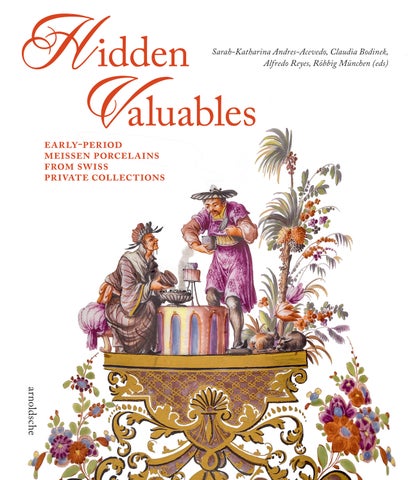
early-period meissen porcelains from swiss private collections
Sarah-Katharina Andres-Acevedo – Art historian with Galerie Röbbig, Munich. 2019 Doctoral thesis on the porcelain sculptures modelled by Johann Joachim Kaendler and his workshop. Several publications on various aspects of Meissen porcelain from the eighteenth century. Cordula Bischoff – Freelance art historian and exhibition curator, notably in Japan and China. 1989 PhD in Marburg, 2001 postdoctoral lecturing qualification in Trier. Numerous publications on the art of the sixteenth to eighteenth century, focal areas: gender research, court art, interiors and chinoiserie. 2014–17 Research project entitled Early Asiatic Works and Chinoiseries at the Saxon Court in Dresden’s Kupferstich-Kabinett (Prints Collection). Curated The Art of the Enlightenment, an exhibition in 2011–12 at the National Museum of China in Beijing. Claudia Bodinek – Trained as a porcelain painter, doctorate in art history. Research work on Meissen porcelain from the eighteenth century and its evaluation in cultural history terms, paying special attention to the graphic sources underpinning its painted decoration.
Thomas Michie – Senior Curator of European Decorative Arts and Sculpture at the Museum of Fine Arts, Boston, since 2009. Trained in the history of art with degrees from Williams College (A.B.) and Yale University (M.Phil.). Author of exhibition and collection catalogues at MFA, Boston, Los Angeles County Museum of Art and Rhode Island School of Design. …
arnoldsche
9 783897 905863
arnoldsche
ISBN 978-3-89790-586-3
H idden Valuables
Sarah-Katharina Andres-Acevedo, Claudia Bodinek, Alfredo Reyes, Röbbig München (eds)
authors
Meredith Chilton, CM – Curator Emerita of the Gardiner Museum in Toronto, Canada. Historian of early European porcelain as well as of dining and social culture in the eighteenth century.
röbbig · münchen
Switzerland is well-known for its host of remarkable collections of eighteenth- century European porcelain. The extraordinary collectors Albert Kocher and Marcel Nyffeler are two such exemplary representatives of these. Now, as a result of endowments or gifts, a number of these magnificent collections can be found in Switzerland’s prestigious institutions. Today Swiss connoisseurs are still fascinated by the ‘white gold’ from Saxony. This publication, enriched by articles by renowned art historians and porcelain experts, is dedicated to their passionate collecting and exceptional treasures. An impressive overview of the most precious Meissen porcelain of the early period!
early-period meissen porcelains from swiss private collections
H idden Valuables
Hans Ottomeyer – Art historian with studies in London, Paris and Munich. 1967 Thesis on the Empire Style and Charles Percier. Curator at the Munich Stadtmuseum. 1995 Director of the Kassel Staatliche Museen, 2000–11 Director General of the Deutsches Historisches Museum in Berlin. Publications on architecture and styles, political iconography, gilt bronzes, furniture and questions of design and display.
30.10.20 13:30
6
Röbbig_Umbruch_final_26102020.indd 6
27.10.20 10:09
foreword A number of important private collections have been built up in Switzerland over the past few decades, largely unnoticed by the wider world, that are primarily devoted to Meissen porcelain from the first half of the eighteenth century. The backgrounds and approaches adopted by the eight collector personalities involved are as varied as they themselves are, a point equally evident in the way items from their collections were set out for the Meissen – Porcelain Follies exhibition in Musée Ariana, Geneva. Röbbig art dealers of Munich have, with very few exceptions, remained in close contact with the collectors concerned and, as the exhibition’s principal promoters, acted as key intermediaries between collectors and the museum. Of the collectors, we would like to make particular mention of Pierre Darier (d. 2018), whose passion for Meissen porcelain came late but was all the more intense for that and who did not unfortunately live to see the completion of our project. Housed in a prestigious late-nineteenth-century building that nestles in a municipal park imposingly framed by mountains, Musée Ariana specialises in glass and ceramics and is one of the most important museums of its kind. In the course of our endeavours to sustain and, indeed, widen interest in eighteenth-century Meissen porcelain, we had already been seeking for some time to establish contact with institutions with whom it would be possible to cooperate to this end. The fact that many of the items presented here are from private collections held in places near Geneva proved to be a strong case for cooperating with the Musée Ariana, which itself disposes over remarkable examples of early Meissen porcelains. It may come as no surprise to discover that Switzerland serves as a refuge for collectors from all over the world, with roots elsewhere than in Switzerland. Their manifold origins may explain why it was predominantly Meissen porcelain that found its way into their collections, genuinely Swiss holdings such as the Kocher Collection in Berne or the Christen Collection in Basle constituting exceptions in this respect. Collecting a specific era or genre has always been akin to holding a mirror up to the age in question. The economic upturn following the end of the Second World War saw a resurgence of interest in collecting porcelain in both Germany and Switzerland. A robust art market evolved in tandem with this trend that was well-versed in fulfilling the wishes of such ravenous collectors. Seminal publications on hitherto uncharted areas of ceramics now enabled information virtually untapped until then to be accessed and made available to a broader public. Specialist knowledge of this kind, coupled with unerring taste, led to collections materialising during this new beginning that celebrated the Baroque and Rococo styles and, far from being exclusively confined to specific categories, focused attention on an era’s overall impact, with the upshot that porcelain was combined with furniture, paintings and whole interiors in suitably adapted domiciles.
7
Röbbig_Umbruch_final_26102020.indd 7
27.10.20 10:09
14
Röbbig_Umbruch_final_26102020.indd 14
27.10.20 10:10
the art of collecting Hans Ottomeyer
C
<< Fig. 1. Frans Francken II (1581–1642), A Cabinet of Curiosities, detail, 1641, oil on oak, 74 × 78 cm (29.13 × 30.71 in). Vienna, Kunsthistorisches Museum, inv. 1048.
ollecting works of art and beautiful things is a phenomenon as old as our culture itself and is deeply linked to the fostering of knowledge and the appreciation of fine craftsmanship. It has allowed us to discover the exceptional and the unique and to evaluate them accordingly. This should not obscure the fact that collecting is closely bound up with human nature, being a universally valid anthropological constant. Collecting is an archetypal, primal action through which people secure their livelihoods and store supplies. The prerequisite therefore was and is that collected objects be tenable and imperishable. In addition to products of nature and labour, the items gathered are frequently those that attract attention because of their outstanding properties. This attention then provokes aesthetic enjoyment, from which develops the pleasure of possession, by virtue of which the objects are properly looked after and preserved. Primal ‘hunting and gathering’ remains a fundamental impulse of human behaviour even when transformed into ‘discovering and preserving’. There are many ways to organise large, disorderly masses of items in order to appreciate them and get to know them better. Similarly, different methods are required to grasp the resultant collecting empire in its historical and spatial dimensions and to present it in its essential outlines: while some collections aim to achieve completeness, others seek to facilitate scientific comparisons, or to impress visitors and thus create prestige through references to a venerable ancienneté. Collecting things that are beautiful and aesthetically outstanding is primarily d irected towards pleasure experienced through the senses, which is first experienced by the collector and subsequently by others for whom the collection is put on display. The purpose of such collections lies in the extended field of the experience of seeing and understanding. With this is associated the phenomenon of comparison in which the beholder recognises the ingenuity and artistic craftsmanship that forms the basis of artworks and which, once it is recognised, allows for the assessment of artistic quality. Only through
15
Röbbig_Umbruch_final_26102020.indd 15
27.10.20 10:10
38
Röbbig_Umbruch_final_26102020.indd 38
27.10.20 10:11
heinrich count von brühl as reflected in his collections Claudia Bodinek
<< Fig. 15. Unknown artist, copy after Marcello Bacciarelli, Heinrich Graf von Brühl, after 1753, oil on canvas, 140 × 105 cm (55.12 × 41.34 in). Staatliche Kunstsammlungen Dresden, Gemäldegalerie Alte Meister, inv. Mo 679.
1
2 3 4 5
The best biography of Brühl is still that by Boroviczény 1930, who was the first to repudiate Frederick the Great’s falsification of history, long taken as being a true account of events. His sources included the Brühl family archives at Pförten Palace (today Brody, Poland), which were destroyed in 1945. Further biographies were written by Fellmann 1989, who largely dispenses with sources, thus rendering his book worthless for scholarly purposes, and Vogel 2003, who goes to the other extreme, stringing together sources without comment. Quoted from Chilton 2007, p. 281 (Lewis Walpole Library, CHW 29-1094, fols. 49–50). Koch 2010, pp. 151–152. Boroviczény 1930, pp. 6–7. In this context Pietsch 2000, p. 25, drawing on Fellmann 1989, p. 94, mentions an anecdote according to which the king retired at nine o’clock in the evening while everyone else went on to join Count Brühl. Fellmann names as his source the memoirs of the later king of Poland Stanisław Poniatowski (1732–1798, r. 1764–1795). In fact, Poniatowski was referring to a hunting party at Schloss Hubertusburg, where those in attendance first went to the heir to the throne and his wife before spending the later part of the evening with Countess Brühl (Poniatowski 1917, pp. 57–58).
Röbbig_Umbruch_final_26102020.indd 39
H
einrich Count von Brühl (1700–1763), from 1746 prime minister at the court of Augustus III (1696–1763), Elector of Saxony and King in the Polish-Lithuanian Commonwealth, made a name for himself as a diplomat but also with his building projects and superb collections of art. At the same time, little is known about what the Count was like as a person (fig. 15). One could almost say he was a born statesman in that he was adept at shielding his privacy and refrained from expressing his own opinions.1 As drily noted by Sir Charles Hanbury Williams (1708– 1759), E nglish envoy to the Dresden court, ‘he talks in so general a manner that it is almost impossible to find out what His Opinion is from what he says’.2 In the context of his loyalty to the reigning king Augustus III, Brühl’s actions and policies seem to have been primarily directed towards continuing the Saxon-Polish state in the same way as under his mentor King Augustus the Strong (1670–1733). Foremost among his aims was to permanently secure Saxon claims to the Polish crown, which he endeavoured to achieve by means of an ingenious policy of alliances.3 However, in doing so he ran counter to the interests of Frederick the Great (1712–1786), thus earning himself the Prussian king’s lifelong enmity.4 For Saxony, the possession of the Polish crown was of elemental importance, since its position on the international stage – and in particular in the Holy Roman Empire – depended on the royal title. In this Saxony was not alone, as similar ambitions for a crown and concomitant elevation in rank were harboured around 1700 by the electors of Brandenburg (Kingdom of Prussia from 1701), Hanover (from 1714 in personal union with the United Kingdom of Great Britain) and Bavaria (unsuccessful attempts to claim the Spanish crown). Hand in hand with Saxony’s new position went a magnificent court which Augustus the Strong modelled on that at Versailles. While his son Augustus III continued in the same style, he not infrequently left the performance of his official duties to Count Brühl, who from 1738 effectively ranked immediately below the king 5 (fig. 16).
39
27.10.20 10:11
4 teabowl and saucer Model Meissen, painting Augsburg, Seuter’s workshop (Abraham Seuter) No Manufactory mark Possibly lustre mark Incised mark ‘|’ on bowl and saucer Teabowl H 4.4 cm (1.73 in), Ø 7.1 cm (2.8 in); saucer Ø 12.4 cm (4.88 in), H 2.1 cm (0.83 in) Berne, Bernisches Historisches Museum, Albert Kocher Collection, inv. H/27987/a–b Catalogue entries 4 and 5 both involve museum pairings of a teabowl and saucer whose common identity is, however, questionable on account of their differing ornamentation. The chinoiserie scenes on the two saucers, for instance, are played out on intricate strapwork consoles, whereas a broad, continuous strip of ground has been used as a floor line on the teabowls whose typically scalloped bottom edge is enriched with alternating C-scrolls and dots. The inner layout of figures and objects has been drawn in great detail with an agate stylus.
148
Röbbig_Umbruch_final_26102020.indd 148
27.10.20 10:22
Gilt Chinoiseries
149
Röbbig_Umbruch_final_26102020.indd 149
27.10.20 10:22
Fig. 105. Johann Gregorius Höroldt (1696–1775), 1726, etching, 144 × 112 mm (platemark). Leipzig, GRASSI Museum für Angewandte Kunst, inv. B.1962.5.
176
Röbbig_Umbruch_final_26102020.indd 176
27.10.20 10:24
177
Röbbig_Umbruch_final_26102020.indd 177
27.10.20 10:24
40 teabowl and saucer Decoration by Johann Gregorius Höroldt and his workshop Meissen, c. 1730 No Manufactory mark Gilt mark ‘3.’ on teabowl and saucer Incised mark on footrim: ‘/’ (teabowl), ‘X’ (saucer) Teabowl H 4.7 cm (1.85 in), Ø 7.6 cm (2.99 in); saucer Ø 13.2 cm (5.2 in), H 2.5 cm (0.98 in) Basle, Historisches Museum, Hans-Rudolf Christen-Züst Collection, inv. 1994.502.1–2 The three teabowls and saucers (cat. 38–40) are impressive testimony to Höroldt’s endeavours to subordinate his chinoiserie paintings to a uniform visual code. The similarities in design are immediately apparent and would seem to be rooted in a common approach, though the differing cartouches and gilded ornament indicate that the teabowls were not from one and the same service. The scenes portrayed, each of which is confined to a single figure, differ stylistically too. It’s very likely that each teabowl and saucer was decorated by a different painter, a theory supported by the patterning of garments and how vegetation is rendered.
212
Röbbig_Umbruch_final_26102020.indd 212
27.10.20 10:27
213
Röbbig_Umbruch_final_26102020.indd 213
27.10.20 10:27
248
Röbbig_Umbruch_final_26102020.indd 248
27.10.20 10:30
Johann G regorius H öroldt 54 covered vase with a red ground Meissen, c. 1730–1735 AR monogram, underglaze Thrower’s mark ‘XII’ on footrim: Rückert 1996, p. 73, fig. 7, no. 33 ( Johann Christoph Leibnitz, 1702–1748, thrower from 1730) Vase H with cover 38.5 cm (15.16 in), without cover 27.5 cm (10.83 in), Ø at mouth 8.3 cm (3.27 in); cover H 9.6 cm (3.78 in), Ø 11 cm (4.33 in) Berne, Bernisches Historisches Museum, Albert Kocher Collection, inv. H/28118 published d’Agliano 2003, pp. 52–53, no. 19.
26 Cf. the garniture of seven vases in: exh. cat. Dresden 2010, p. 271, no. 230.
As well as forming the background to cartouches enclosing Höroldt chinoiseries, coloured grounds were also popularly adorned with motifs in the Kakiemon style so as to create the illusion of genuine East Asian porcelain. Lush flowers, a crane and a lizard yield a formal composition on the covered vase shown that, far from being based on some Japanese prototype, is very much in a European vein. Vases such as this one served purely decorative purposes. They were often produced as sets comprising an uneven number of vases, some of differing shape and size. The ground colours could likewise vary.26 They were arranged in mirror-image formation around a central vase. Such sets were known as ‘mantelshelf garnitures’ on account on where they were most commonly positioned. The two preceding vases (cat. 53) similarly belonged to ‘garnitures’ of this kind. Flowers, birds and largerthan-life insects populate the olive-green ground here, whilst the reserved cartouches enclose polychrome birds perched on flowering branches.
249
Röbbig_Umbruch_final_26102020.indd 249
27.10.20 10:30
59 tankard (walzenkrug ) Meissen, c. 1730–1735 Silver cover dated to 1825, with Danish medallion dated 1717 No Manufactory mark, no other marks H with cover 18.7 cm (7.36 in), without cover 16 cm (6.3 in), Ø at mouth 9 cm (3.54 in), at foot 10.7 cm (4.21 in) Berne, Bernisches Historisches Museum, Albert Kocher Collection, inv. H/28128 A female ruler holding audience – this thematic image is surely rare, even for the genre of the Höroldt chinoiserie, in whose imaginary world so much is unusual. A canopy surmounted by statues shades the throne of the female ruler, who turns to one of the supplicants kneeling before her. A turbaned man armed with a lance stands as a guard of honour by her side, whilst two attendants have taken up position behind the throne. Lush vegetation in a fenced-in garden adds an exotic touch to the scene that is reinforced by crude birds and larger-than-life insects in the sky. Oval panels with scenes of maritime commerce are incorporated into the lavishly decorated cartouche on both sides, whilst decorative gilding all the way round the top and bottom of the vessel’s body encloses miniature scenes in purple camaieu.
266
Röbbig_Umbruch_final_26102020.indd 266
27.10.20 10:32
Johann G regorius H öroldt
267
Röbbig_Umbruch_final_26102020.indd 267
27.10.20 10:32
Landscapes and Maritime Commerce Landscapes were one of the earliest subjects to appear on white Meissen porcelain. They are already to be found painted in monochrome iron-red,1 along with chinoiseries, in the early 1720s.2 Works by the Florentine engraver Stefano della Bella (1610–1664) were often adopted as graphic sources during this period, possibly on account of his prints being rather small in size. Scenes of maritime commerce only differ from landscape paintings in minor respects. Both are commonly to be encountered on the same piece (cf. cat. 69). The term ‘maritime commerce’ (Kauffahrtei) is used when figures and stacks of merchandise are depicted against a harbour backdrop, frequently including one or more ships. It is to be assumed that Höroldt himself forged a link between maritime commerce and his chinoiseries by imbuing the characters portrayed with oriental traits and adding tropical vegetation such as palm trees to the picture (cf. cat. 67). Figures from both the Far and the Middle East were wont to appear, the latter recognisable by their splendid turbans (cf. cat. 72). One thing for which landscape paintings of the period were notable is that the sky was invariably traversed by greyish-blue clouds. This is a phenomenon shared with hunting and battle scenes, though not with ‘standard’ chinoiseries, which abandoned the practice early on, in the second half of the 1720s.3 The examples covered here were produced over a 20-year period from 1725 to 1745 and, besides straightforward landscapes and scenes of maritime commerce, also depict hunts, a battle and erotic scenes tucked away in landscapes. All these pictorial themes continued to form part of the Manufactory repertoire after 1740.
1
2
284
Röbbig_Umbruch_final_26102020.indd 284
3
This assumption is based on a contemporaneous source stating that Höroldt ‘fired the first service, which he had painted red, on 19 July 1720 and brought it to Dresden’ / ‘das erste service, so er roth gemahlet, am 19. Juli 1720 eingebrandt und nacher Dresden mitgenommen’: Meissen archives, AA I A 6, fol. 334. – Conversely, services painted in iron-red exist that already bear the ‘K.P.M.’ mark introduced in 1723: cf. footnote 2 below; on the mark, see exh. cat. Munich 1966, p. 15. E.g. parts of a privately owned tea service with chinoiseries (exh. cat. Dresden 1996, pp. 36–41, nos. 7–12) and Staatliche Kunstsammlungen Dresden, Porzellansammlung, inv. PE 3410, with a maritime landscape after Stefano della Bella (SKD/Bodinek 2018, vol. 2, p. 51, no. 35a). d’Agliano 2003, p. 32.
27.10.20 10:33
Johann G regorius H öroldt
285
Röbbig_Umbruch_final_26102020.indd 285
27.10.20 10:33
76 covered tureen with stand Decoration by Johann Ehrenfried Stadler Meissen, c. 1726–1730 Crossed-swords mark (stand: with rounded pommels), underglaze, no further marks Tureen Ø 20.6 cm (8.11 in), H with cover 15.8 cm (6.22 in); stand Ø 29.5 cm (11.61 in), H 4.6 cm (1.81 in) Berne, Bernisches Historisches Museum, Albert Kocher Collection, inv. H/28131/a–b provenance According to Wyss and d’Agliano formerly Baron Erich von Goldschmidt-Rothschild Collection. Not however locatable in the catalogue cited: Hermann Ball and Paul Graupe, Berlin, auction 23–25 March 1931. published Wyss 1965, pp. 128−129; den Blaauwen 1966, p. 5, figs. 1−2; d’Agliano 2003, pp. 44−45, no. 15; SKD/Bodinek 2018, vol. 2, pp. 373 and 376–377, nos. 288a and 290a–b. This small tureen is quite without parallel in the sphere of Meissen porcelain painting. All the scenes on the tureen, cover and stand were taken from consecutive sheets in a work entitled Nieuwe geinventeerde Sineesen and published in Amsterdam by Petrus Schenk the Younger (1693–1775) (figs. 147–151). True to their source, the figural scenes portrayed do not have an overly Chinese feel about them, and the scenery, too, could easily be thought of as European were it not for the vegetation with oriental flowers and a palm tree. And yet the style is restrained in comparison with cat. 78. The exotic factor here is provided by the colours – a pink rock, yellow houses, a yellow horse with black blotches or an ostrich with polychrome plumage. However unique the decorative scheme may be, the écuelle is nevertheless not a one-off. Two further specimens are known of, an écuelle with stand in Munich and an écuelle on its own in Nuremberg.14 The two stands are decorated with the same scene in all respects except for a few minor details. The tureens and their covers, on the other hand, are not painted alike, though all the scenes portrayed are taken from Nieuwe geinventeerde Sineesen as they are on the Berne specimen.
Fig. 147. Sheet 32, used for tureen and cover.
14 Munich, Bayerisches National museum, inv. Ker 1766–1767 (exh. cat. Munich 1966, p. 81, nos. 222–223); Nuremberg, Germanisches Nationalmuseum, inv. Ke555 (exh. cat. Hohenberg/ Selb 2010, p. 43, no. 34; http://objektkatalog.gnm.de/ objekt/Ke555).
Fig. 148. Sheet 36, used for tureen.
308
Röbbig_Umbruch_final_26102020.indd 308
27.10.20 10:35
Johann G regorius H öroldt
309
Röbbig_Umbruch_final_26102020.indd 309
27.10.20 10:35
Röbbig_Umbruch_final_26102020.indd 322
27.10.20 10:36
E ast A sian Patterns from M eissen
Röbbig_Umbruch_final_26102020.indd 323
27.10.20 10:36
103 two seated chinese men mounted as two-armed candelabra Modelled by Johann Joachim Kaendler, 1734 Porcelain, Meissen, manufacture and decoration, c. 1734 Ormolu mounts, France, Régence period, c. 1740 Soft-paste porcelain flowers, France, mid-eighteenth century No visible mark H 20 cm (7.87 in) and 22 cm (8.66 in) literature Exh. cat. Dresden 2010, p. 309, no. 331. written source Extract from Kaendler’s work report, February 1734 (entry 8): ‘Modelled 3 Indian figures half an ell high’.7 compare Basle, Historisches Museum, Pauls-Eisenbeiss Foundation: Pauls-Eisenbeiss 1972, pp. 74–75; Menzhausen 1993, pp. 88–89.
7
‘3 Indianische Figuren pussiret von einer halben Elle hoch’: quoted after Pietsch 2002, p. 23.
360
Röbbig_Umbruch_final_26102020.indd 360
27.10.20 10:38
Johann Joachim K aendler
361
Röbbig_Umbruch_final_26102020.indd 361
27.10.20 10:38
presented to the Roman emperor Augustus (63 B.C.–14 A.D.) in 20/19 B.C. The rhinoceros was shipped via Antioch and Alexandria to Rome, where she lost her life in a battle with an elephant in 8 A.D.18 The animal depicted by Dürer was that of a diplomatic present from Sultan Muzaffar Shah II (r. 1511–1526), ruler of Gujarat, to the Portuguese Governor General in India, Alfonso de Albuquerque (1453–1515), who in turn bestowed the animal to his king, Manuel I (1469–1521). On the sailing boat Nostra Señora da Ajuda, the animal went from Goa to Portugal and lived there until the beginning of 1516 in the menagerie of the Portuguese king. During this time – just as Augusta had to many hundreds of years before – this rhinoceros had to fight against an elephant. Both animals were generally known as archenemies and thus frequently depicted together in graphic works of the sixteenth and seventeenth centuries. Reports state that the elephant saw the rhinoceros trotting towards it and instantly ran away, breaking through the fencing of the arena and seeking shelter in its stable. This same animal, with the melodious name Hanno, was given to the Medici pope Leo X (1475–1521; pope 1513–1521) in 1515, where it later found its immortalisation in Gian Lorenzo Bernini’s (1598–1680) Elephant and Obelisk, which is adjacent to the church S. Maria sopra Minerva in Rome. At the end of 1515, Pope Leo X was also given a rhinoceros, splendidly adorned with a velvet collar and chains, as a diplomatic gift. It was shipped by vessel from Lisbon to Rome but the boat fell victim to a storm in the Gulf of Genoa and, regrettably, sank without trace near La Spezia on a stormy January night, with the rhinoceros chained to the deck. The animal’s dead body washed up ashore and the skin was sent back to Lisbon. In 1516, Leo X fi nally received the taxidermied animal. For a long time, Dürer’s depiction of the real, great one-horn rhinoceros, which particularly distinguishes itself with a small horn located between the shoulder blades, was considered to be true to life. It was not until almost 200 years later that the European image of the rhinoceros was renewed by the arrival of the female rhino named Clara, although three more specimens of its kind had landed on the European continent by then. As early as 1579, another animal came to the court of King Philipp II of Spain (1527–1598), in Madrid via Lisbon, and was depicted in an engraving by Philippe Galle (1537–1612)19 in 1586. In 1684 merchants brought a rhinoceros from the East India Company to London to sell to the highest bidder. An unknown artist was the only one to execute a graphic work of this animal,20 which shows the rhinoceros chained and led by a black person, in front of a European landscape background. The third animal reached London on 1 June 1739 and was promoted in numerous posters and articles. On 22 July 1741, Clara, the fourth Indian rhinoceros to come to Europe since the sixteenth century, reached Rotterdam in the Netherlands, having been transported from Bengal on the Knabenhoe by Davitmont Van der
19 Reproduced in Clarke 1986, p. 29, fig. 11. 20 Ibid., fig. 16.
Fig. 159. Albrecht Dürer (1471–1528), Rhinocerus, 1515, woodcut, 212 × 299 mm (8.35 x 11.77 in). Amsterdam, Rijksmuseum, inv. RP-P-OB-1473.
370
Röbbig_Umbruch_final_26102020.indd 370
27.10.20 10:40
Johann Joachim K aendler
371
Röbbig_Umbruch_final_26102020.indd 371
27.10.20 10:40
410
Röbbig_Umbruch_final_26102020.indd 410
27.10.20 10:44
Johann Joachim K aendler
411
Röbbig_Umbruch_final_26102020.indd 411
27.10.20 10:44
135
136
134
416
Röbbig_Umbruch_final_26102020.indd 416
27.10.20 10:44
Johann Joachim K aendler
137 138
139
417
Röbbig_Umbruch_final_26102020.indd 417
27.10.20 10:44
134 harlequin with a monkey hurdy-gurdy Modelled by Johann Joachim Kaendler and workshop, c. 1740–1741 Meissen, manufacture and decoration, c. 1740–1745 No Manufactory mark Impressed numeral ‘45’ H 16.9 cm (6.65 in) graphic source Scaramucia, engraving by Bernard Picart (1673–1733), published in Amsterdam in 1696.60 compare Hamburg, Museum für Kunst und Gewerbe, Behrens Collection, inv. 1922.149. – Toronto, Gardiner Museum, inv. G83.1.914: Chilton 2001a, p. 298, no. 79. – Private collection: exh. cat. Düsseldorf/Dresden 1997, p. 74, no. 46.
60 Reproduced in Chilton 2001a, p. 135, fig. 223.
418
Röbbig_Umbruch_final_26102020.indd 418
27.10.20 10:44
419
Röbbig_Umbruch_final_26102020.indd 419
27.10.20 10:44
162 indiscreet harlequin Modelled by Johann Joachim Kaendler and workshop, c. 1742 Meissen, manufacture and decoration, c. 1742–1745 No Manufactory mark, no other marks H 15.6 cm (6.14 in), W 15.4 cm (6.06 in) graphic source The group of lovers probably dates back to a scene from the painting L’Automne by Nicolas Lancret (1690–1743) from 1738 (fig. 175), which was used as a model for an engraving by Nicholas-Henri Tardieu (1674–1749) (fig. 176). The strong similarity is particularly shown when comparing it with a drawing in chalk by Lancret entitled Gilles Embracing Columbine,95 which is held in a private collection today. compare Basle, Historisches Museum, Pauls-Eisenbeiss Foundation, inv. 1975.1078: Pauls-Eisenbeiss 1972, pp. 268–269; Menzhausen 1993, p. 134. – Berlin, Staatliche Museen, Kunstgewerbemuseum, inv. HF 243. – Hartford, Connecticut, Wadsworth Atheneum Museum of Art, J. Pierpont Morgan Collection, inv. 1917.1370. – Munich, Bayerisches Nationalmuseum, Fritz Thyssen Collection, inv. 66/267: exh. cat. Berlin 2001, p. 46, no. 20. – New York, The Metropolitan Museum of Art, Jack and Belle Linsky Collection, inv. 1982.60.303. – Offenburg, Franz E. Burda Collection: Kunze-Köllensperger 1997, p. 173, no. 103. – Paris, Musée des Arts Décoratifs, inv. D13.170. – Rome, Pinacoteca Capitolina, Count Cini Collection, inv. Cini 165. – Toronto, Gardiner Museum, inv. G83.1.913: Chilton 2001a, p. 304, no. 93. – Formerly Henry Arnhold Collection: exh. cat. New York 2008, p. 263, no. 51. – Formerly Patricia and Rodes Hart Collection: Abraham 2010, p. 42. – Private collection: exh. cat. Düsseldorf/Dresden 1997, p. 77, no. 49 and p. 242, no. 196. – Private collection: exh. cat. Dresden 2010, p. 318, no. 353.
Fig. 175. Nicolas Lancret (1690 -1743), L’Automne, oil on canvas, 113.3 × 93.4 cm (44.61 × 36.77 in). Private collection.
95 Published in Holmes 1991, p. 116, no. 24, pl. 29.
Fig. 176. Nicholas-Henri Tardieu (1674–1749), L’Autonne , etching after a painting by Nicolas Lancret (1690–1743). Staatliche Kunstsammlungen Dresden, Kupferstich-Kabinett, inv. A 63643.
460
Röbbig_Umbruch_final_26102020.indd 460
27.10.20 10:49
Johann Joachim K aendler
461
Röbbig_Umbruch_final_26102020.indd 461
27.10.20 10:49
183–195 fifteen figures from the monkey orchestra with music stands Modelled by Johann Joachim Kaendler and workshop, c. 1753 Meissen, manufacture and decoration, c. 1753–1755 literature Exh. cat. Düsseldorf/Dresden 1997, p. 270, no. 240; Sonntag 2006. graphic sources Preliminary sketches by Christophe Huet (1700–1759) from 1753 which remain in the archive of the Staatliche Porzellan-Manufaktur Meissen to date. These are closely related to engravings by Jean-Baptiste Guélard (active in Paris 1733–c. 1755) after Christophe Huet from the series Singeries, ou différentes actions de la vie humaine représentées par des singes (1741/42). The painting Concert de singes by Christophe Huet (fig. 195) features further music-making monkeys which, however, do not harken back to the above-mentioned series but can be found in a similar form as in the Meissen Monkey Orchestra.
183 conductor Modelled by Johann Joachim Kaendler and workshop, c. 1753, revised 1765 Meissen, manufacture and decoration, c. 1753–1755 Crossed-swords mark, underglaze, on the back of the base H 18 cm (7.09 in) written source Work report of Peter Reinicke, September 1765 (entry 2): ‘Mended in clay 1 monkey who is depicted as a conductor’.135 graphic source Drawing by Christophe Huet, 1753, with description: ‘No. 2 Le maistre de musique qui bai La mesure il doit avoir devant luy un pulpitre avec un Livre de musique et etre bien caracterisé a un grand movement’ (fig. 184). The monkey shows the same motif of movement as the engraving L’Oiseau de Proye by Jean-Baptiste Guélard from the series Singeries, ou différentes actions … (1741/42) after Christophe Huet (fig. 183).
Fig. 183. Jean-Baptiste Guélard (active in Paris 1733–c. 1755), L’Oiseau de Proye, engraving after Christophe Huet (1700–1759) from the series Singeries, ou différentes actions de la vie humaine représentées par des singes, 1741/42. Paris, Bibliothèque nationale de France, département Estampes et photographie, inv. 4-TF-11.
135 ‘1 Affen, der einen Cantor vor stellet, in Thon repariret’: Meissen archives, AA I Ab 40, fol. 142b.
Fig. 184. Christophe Huet (1700–1759), Le Maistre de musique, 1753, washed pen and ink drawing. Meissen archives, inv. VA 400/1.
502
Röbbig_Umbruch_final_26102020.indd 502
27.10.20 10:54
Johann Joachim K aendler
503
Röbbig_Umbruch_final_26102020.indd 503
27.10.20 10:54
516
Röbbig_Umbruch_final_26102020.indd 516
27.10.20 10:55
Johann Joachim K aendler
517
Röbbig_Umbruch_final_26102020.indd 517
27.10.20 10:55
Röbbig_Umbruch_final_26102020.indd 520
27.10.20 10:56
H einrich C ount von Brühl
Röbbig_Umbruch_final_26102020.indd 521
27.10.20 10:56
207 six dinner plates Modelled by Johann Joachim Kaendler, 1738 Meissen, cast from moulds 1738/39 Crossed-swords mark, underglaze, a and c with rounded pommels; On a–c: thrower’s mark ‘’: Rückert 1996, p. 73, fig. 7, nos. 8–9 ( Johann Elias Grund, 1703–1758, thrower from 1723); On d–f: thrower’s mark ‘••’: Rückert 1996, p. 73, fig. 7, no. 13 ( Johann Martin Kittel, 1706–1762, thrower from 1727) Ø 23.1–23.5 cm (9.09–9.25 in), H 3.0–3.7 cm (1.18–1.46 in) literature Exh. cat. Dresden 2000, pp. 155–156, no. 24, with further examples of this type. written sources Extracts from Kaendler’s work reports April 1736 (entry 5): ‘Shallowly cut 2 floating swans along with 2 other aquatic birds and reeds into a plate mould shaped like a sea-shell’.42 January 1738 (entry 3): ‘Further produced an ordinary dinner plate not so deep as the preceding one but in the shape of a shell on its upper side in which water, reeds and birds are to be seen, likewise for Count von Brühl. The shell on this latter plate has, in fact, been altered so as to create two different types’.43 May 1738 (entries 6 and 8): ‘Went back over a plaster plate mould and rendered it usable again for His High Excellency, Count de Brühl, […] also neatly re-engraved 2 plaster moulds for plates in the High Count Brühl’s service’.44 June 1738 (entry 10): ‘Went back over two moulds for plates in Count Brühl’s service for the thrower Grund and, because they were worn, sharpened them back up’.45 November 1738 (entry 6): ‘Repaired several moulds for plates in Count Brühl’s service for the throwers Grund and Kittel and, where they had become unusable, sharpened them up again’.46 The Swan Service first saw the light of day in April 1736, when Kaendler modelled a number of trial plates for the new Gräflich Brühlische Service (Count Brühl Service).47 Series production was but a distant prospect at this juncture, though, for there were countless other jobs needing to be seen to beforehand, including the Sulkowski Service48 and the ‘service auf Indianische Art’ for Count Brühl.49 Eighteen months were to pass before, in December 1737, Kaendler attended to a model for a Confect Tafel (sweetmeat table-centre) full of Muschel Werck (‘shell-work’ and, by extension, ‘rocaille’) and sea creatures whose relatedness to the Swan Service is beyond all doubt due to the manner of its decoration alone. Work on the project commenced in earnest the following month, in January 1738. As Kaendler observes in his work report: ‘Spent three days in Dresden, where I copied various rare shells in the Natural History Collection and studied them closely in order that the aforementioned service may be designed all the more naturalistically’.50 Moulds for the dinner plate, soup plate and assiette (high-sided dish) were produced that same month. With regard to the dinner plate, Kaendler even speaks of Zweyerley Arten (two kinds), though without divulging in what way they differ. Happily, Kaendler’s ‘mystery’ has long since been solved: not on all of the dinner plates does the erect heron hold a fish in its beak.51 Kaendler was repeatedly required to repair plate moulds in the course of 1738, with production now in full swing. Kaendler himself mentions the throwers Johann Elias Grund and Johann Martin Kittel, whose ciphers duly appear on the six plates presented here. The thrower Johann George Grund was evidently also involved. We learn from the only partially extant work reports written by the throwers that the Grund brothers cast 108 plates in April and May 1738, whilst in June and July Johann Elias Grund actually notched up 244 plates and Johann Martin Kittel 286 plates.52 Though these figures may seem astonishingly high at first glance, they need to be adjusted downwards to the extent that a proportion of them are bound to have failed during firing. By way of comparison, Brühl’sches Allerlei, Count Brühl’s other major porcelain service, which is estimated to have been similarly large, is known to have included 263 dinner plates, as revealed by the Count’s post-mortem inventory.53 In April 1739, Kaendler notes that not all ‘dishes and plates are as yet complete’.54 This would strongly seem to suggest that most of the dinner plates were produced in 1738/39.
42 ‘In eine Teller Forme Welche in Gestalt einer See Muschel war, 2 schwimmende Schwäne nebst 2 anderen Waßer Vögeln, und Schilf flach hinein geschnitten’: quoted after Pietsch 2002, p. 38. 43 ‘Ferner einen ordinaren Tafel Teller Welcher nicht so tieff als Voriger, aber oben in gestalt einer Muschel Worinnen Waßer, Schilf und Vögel zu sehen sind Ebenfalls Vor den Herren Grafen Von Brühl gefertiget, Und zwar sind diese Tellern Was die Muschel betrifft Noch Einmal Verändert Damit Zweyerley Arten sind’: quoted after Pietsch 2002, p. 51. 44 „Einer Teller Forme in Gieps Nach geholfen und Wieder brauchbar gemacht Vor Ihro Hoch Gräfl. Excellenz de Brühl […] Annoch 2 Teller Formen in Gieps Sauber nach Radtiret so zum Hoch Gräfl. Brühl Service gehörig’: quoted after Pietsch 2002, p. 54. 45 ‘Zwey Teller Formen Vor den Dreher Grund Nach geholfen, und weiln sich solche abgenützet wieder aufgefrischet Welche zum Service Vor den Herren Grafen Von Brühl gehörig’: quoted after Pietsch 2002, p. 55. 46 ‘Vor den Dreher Grund und Kütteln etliche Teller Formen repariret und nachdem es unbrauchbar worden Wieder auf gefrischt Welche Zu dem Gräflichen Service gehörig’: quoted after Pietsch 2002, p. 58. 47 On the trial plates and the genesis of the decorative scheme, cf. Kunze- Köllensperger 2020. 48 Cf. exh. cat. Dresden 2010, pp. 279–280, nos. 243–249. 49 Exh. cat. Munich 1966, pp. 119–120, nos. 497–507. 50 ‘Drey Tage in Dresten zu gebracht alda in der Naturalien Cammer unterschiedliche Rare Muscheln abgezeichnet und in genauen Augenschein genommen Damit Vorerwähntes Service Desto Natürlicher darnach eingerichtet werden kann’: quoted after Pietsch 2002, p. 51. 51 Of the present lot, only plates c and f depict the heron without a fish. 52 Exh. cat. Dresden 2000, p. 156. 53 Cf. Bodinek 2019, p. 14 (total items in the Brühl’sches Allerlei service) and p. 23 (number of dinner plates). 54 Cf. note 48.
544
Röbbig_Umbruch_final_26102020.indd 544
27.10.20 10:59
H einrich C ount von Brühl
b
c
e
f
a
545
d
Röbbig_Umbruch_final_26102020.indd 545
27.10.20 10:59
215 size 5 dish Modelled by Johann Friedrich Eberlein, same type as cat. 214 Meissen, 1745 or thereafter Crossed-swords mark, underglaze Impressed numeral ‘22’ Incised ‘5’ as size number in footrim On the underside ‘C.’ in purple Ø 43.5 cm (17.13 in) provenance As cat. 214. published Bodinek 2019, p. 111, no. DE-7. graphic source Weinmann pl. 618 (fig. 199): Lactuca crispa / Krauser Salat (Lettuce)
564
Röbbig_Umbruch_final_26102020.indd 564
27.10.20 11:00
H einrich C ount von Brühl
Fig. 199. Johann Wilhelm Weinmann (1683–1741), Phytanthoza iconographia, vol. 3, 1742, pl. 618 (g: Lactuca crispa / Krauser Salat), engraving, coloured. Meissen archives, inv. VA 1168.
565
Röbbig_Umbruch_final_26102020.indd 565
27.10.20 11:01
217
566
Röbbig_Umbruch_final_26102020.indd 566
27.10.20 11:01
H einrich C ount von Brühl
216
Röbbig_Umbruch_final_26102020.indd 567
567
27.10.20 11:01