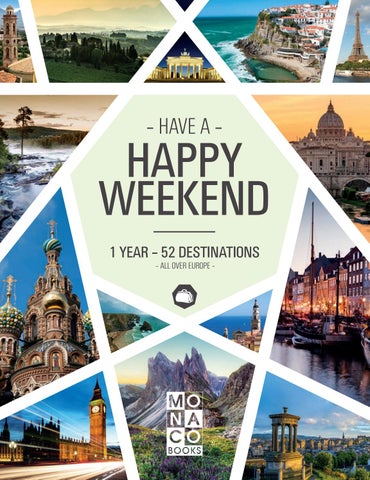
– HAVE A –
THERE ARE 52 WEEKENDS IN A YEAR; ALL JUST INVITING FOR A SHORT BREAK TO RELAX, RECHARGE AND RECONNECT. EUROPE OFFERS A MYRIAD OF DESTINATIONS, AND THIS BOOK IS THE KEY TO DELIGHTFUL METROPOLISES AND CHARMING REGIONS. IT PRESENTS A COLOURFUL MIX OF CAPTIVATING DESTINATIONS – SUITABLE FOR EVERY SEASON. ATTRACTIONS, HOTELS, RESTAURANTS, SHOPPING HOT-SPOTS AND TRAVEL TIPS – ALL AT A GLANCE. INCLUDED ARE THOSE UNIQUE AND MEMORABLE EXPERIENCES THAT SHOULD NOT BE MISSED!
ISBN 978-3-95504-705-4 UK £ 25.00 US$ 35.00
– HAVE A –
HAPPY WEEKEND
WOULD YOU START THE WEEKEND WITH A RELAXING STROLL THROUGH THE ALMOND ORCHARDS IN MAJORCA? OR WOULD YOU PREFER A FASTER PACE AND GO ICE-SKATING OUTDOORS IN STOCKHOLM? TAKE A MID-YEAR BREAK FROM YOUR EVERYDAY ROUTINE AND JOIN IN THE WILD MEDLEY OF THE EXTRAVAGANT HORSE RACE IN SIENA, OR, IMMERSE YOURSELF IN THE SPECTACULAR SIGHTS AND SOUNDS AT THE EDINBURGH FESTIVAL FRINGE. TANTALISE YOUR TASTE BUDS WITH FRESHLY GRILLED SARDINES IN THE NARROW STREETS OF LISBON, OR, HAVE A FEW GLASSES OF LATE AUTUMN SOUTH TYROLEAN WINE STRAIGHT FROM THE WINE PRESS.
1 YEAR – 52 DESTINATIONS ALL OVER EUROPE
HAPPY WEEKEND
HAPPY WEEKEND 1 YEAR – 52 DESTINATIONS – ALL OVER EUROPE –
CONTENTS SPRING 12 18 24 30 34 40 46 52 58 64 70 76 82 88 94
#01 Amsterdam #02 Andalusia #03 Basel #04 Cinque Terre #05 Cornwall #06 Côte d’Azur #07 Dublin #08 Hamburg #09 Copenhagen #10 London #11 Madrid #12 Majorca #13 Prague #14 Rome #15 Valencia
SUMMER 100 106 112 116 120 126 130 136 142 148 156 160 166
#16 Edinburgh #17 Flandern #18 Helsinki #19 Krakow #20 Lisbon #21 Ljubljana #22 Paris #23 Provence #24 Riga #25 Salzburg #26 St. Petersburg #27 Tuscany #28 Verona
AUTUMN 172 176 182 188 194 200 204 210 216 222 228 234 240
#29 Amalfi Coast #30 Barcelona #31 Bern #32 Budapest #33 Dubrovnik #34 Graz #35 Ibiza #36 Corsica #37 Milan #38 Munich #39 South Tyrol #40 Sylt #41 Tallinn
WINTER 246 252 258 264 270 276 282 288 294 298 304
#42 Berlin #43 Geneva #44 Innsbruck #45 Cologne #46 Lapland #47 Nuremberg #48 Porto #49 Stockholm #50 Strasbourg #51 Venice #52 Vienna
310 Registers 311 Image Credits 312 Imprint
Right: Sitting at a street café and absorbing the relaxed atmosphere of a small city and leaving the everyday life behind – that’s what Calvi in Corsica has to offer.
—8—
—9—
#13
PRAGUE
HERE SHE WOULD RATHER BE ABLE TO PAINT THAN WRITE, AS THE ROMANTIC CAROLINE DE LA MOTTE FOUQUÉ ONCE SAID. THERE IS A POINT AT THIS HEIGHT FROM WHERE THE VIEW BECOMES ALMOST INTOXICATING, SINKING INTO THE FULLNESS OF THE GREATEST POSSIBLE WEALTH. IMMEDIATELY BELOW THE SLOPE THE VLTAVA, ABOVE IT SITS THE ROYAL PRAGUE! THIS CITY WAS INDESCRIBABLE, PERHAPS INCOMPARABLE, AND THAT IS PRECISELY WHAT FASCINATED VISITORS AT ALL TIMES. THE “GOLDEN PRAGUE” WITH ITS HISTORIC CENTRE PROTECTED AS A UNESCO WORLD HERITAGE SITE, THAT HAS CHANGED THROUGHOUT ITS HISTORY AND HAS ALWAYS REMAINED THE SAME – IT IS, INDEED, “INCOMPARABLE”. AND IF, MORE THAN TWO DECADES AFTER THE “VELVET REVOLUTION“, EVERYTHING CONTINUES TO CHANGE, THE WORDS OF THE POETS STILL APPLY HERE: “ALL OF PRAHA IS A GOLDEN NET OF POEMS“, WROTE DETLEV VON LILIENCRON.
x
CASTLE OF PRAGUE
Not only visually, the castle located on the “Hradschin” hill overlooking Prague has dominated the city for over 1,000 years; today, it is still the political centre of the country. From the early 12th century to the second half of the 16th century, the three-storey old Royal Palace served as a residence for the respective rulers. The showpiece is the Vladislav Hall, built in 1493-1503. Due to its enormous dimensions - 62 metres long, 16 metres wide, 13 metres high - not only could markets be held in it, but even equestrian games and tournaments can take place here. x
Left: For centuries, the “Golden City“ has been an important spiritual-cultural
MONASTERY ST. GEORGE
One would not initially suspect viewing the Baroque façade from around the year 1670, that the two-towered St. George‘s Basilica on the north side of the Georg’s square is the oldest surviving church building in the area of the Prague Castle. But if you walk through the entrance way, a three-aisled building opens-up, the Romanesque character of which was largely restored during renovations. The church was donated around the year 920 by Prince Vratislav I.
centre characterised by a
GOLDEN LANE
uniquely beautiful urban
x
ensemble.
Legend has it that alchemists tried to make gold here. In fact, it was just a poor settlement with tiny houses - Franz Kafka lived in one of them - which are now souvenir shops.
Right: The St. George‘s Basilica dates back to around 915. After several
SAINT VITUS CATHEDRAL
fires, the visible part seen
x
today was built in the
The St. Vitus Cathedral stands for the glorious history of the Kingdom of Bohemia, and is the coronation church of 30 rulers. Herzog Wenzel in the year 925 built a round chapel where it stands today, in honour
12th century.
— 83 —
of the early Christian martyr, Vitus (Veit). Wenzel, later also sainted, ascended to be the patron Saint of Bohemia, his grave in the chapel he himself founded became a place of pilgrimage. In 1344, the foundation stone was laid for the Gothic cathedral, the construction of which was completed after many interruptions in 1929. The building captivates with its rich artistic design as well as its over-sized dimensions, with an outside length of 124 metres, this is the largest church in Prague. x
MONASTERY STRAHOV
The Premonstratensian monastery is open for visitors - a stunning library, a picture gallery and a wondeful chamber with many archaeological findings. x
MALA STRANA
The Malá Strana, also known as the Lesser Town, is the district below the castle and the castle hill Hradschin. A walk through the district with its countless
PRAGUE
WHY VISIT IN SPRING? THE “PRAGUE SPRING”, WHICH TAKES PLACE FROM MAY 12 UNTIL THE BEGINNING OF JUNE, IS THE ANNIVERSARY OF THE DEATH OF FRIEDRICH SMETANA. THIS IS THE MOST PRESTIGIOUS INTERNATIONAL MUSIC FESTIVAL IN THE WHOLE OF THE CZECH REPUBLIC, COMBINING THE LATEST TRENDS WITH AN INTERPRETER COMPETITION. IT HAS BEEN HELD ONCE A YEAR SINCE 1946.
magnificent palaces seems like a journey into another time. The centre of the Mala Strana is the Town Square, which is lined with important buildings. x
ST. NICHOLAS CHURCH
The monumentality of St. Nicholas, the largest Baroque church in Prague, is also explained by the fact that the church was built in the 17th and 18th centuries at the time of the Counter Reformation and Re-Catholization of the Bohemian lands: the power and splendor of the architecture should also symbolise the triumph of the christian orthodoxe doctrine over the deviant doctrines of the Protestants. x
CHARLES BRIDGE
The first stone bridge in Prague, the Judith bridge built in the 12th century, originally crossed the Vltava. After breaking during a flood in 1342, a replacement was needed, as a firm connection across the river was vital to the city. However, the construction of the new bridge first began in 1357 with the laying of the foundation stone by Emperor Charles IV and was completed after about 50 years. Here the Coronation processions of the Bohemian kings were led. x
OLD TOWN SQUARE
After an extension to the Vltava around the year 1900, today already around 9,000 square metres, this large old town ring had already developed in the 11th/12th century as a central marketplace of merchants. But they were also home to the pillory and blood courts, and throughout history, the square has many times been the scene of cruel, often bloody events. x
OLD TOWN CITY HALL AND CLOCK
A visit to this Gothic town hall is certainly worthwhile, particulary for the astronomical clock from the 15th century. Every hour figures of the twelve apostles appear to the sound of the bells.
Left: Stars of the scene like cellist Alisa Weilerstein, or the London Philharmonic Orchestra conducted by Vladimir
x
CHURCH OF OUR LADY TÝN
After St. Vitus Cathedral, the Týn Church is the most significant religious building in Prague. Although the three-aisled basilica is not directly located on the east side of the Old Town Square, but being slightly offset, by the upstream Teyn Parish School, it still dominates the appearance of the square as otherwise only challenged by the town hall.
— 84 —
Jurowski, are also on the program in the “Prague Spring”, as well as newcomers. The final climax is always a performance of Beethoven‘s Ninth Symphony.
TUSCANY
NOT TO BE MISSED PARTICIPATE IN THE PALIO OF SIENA The Piazza del Campo plays host to a traditional festival twice a year since the beginning of the 14th century: the Palio di Provenzano. This is held on the 2nd of July in honour of the Blessed Virgin, the Palio dell‘Assunta as part of the Assumption Day on the 16th August. In the tournament, ten out of a total of 17 districts will compete against each other. Worth seeing at the Palio di Siena is also for the procession of the representatives of the Contraden who are dressed in historical robes.
RELAX IN THE THERMAL SPRINGS NEAR LUCCA Bagni di Lucca is about 30 kilometres from Lucca. Its natural springs attracted travellers as early as the 19th century, such as Napoleon‘s sister Pauline, after whom the one grotto (Paolina) is named, or Heinrich Heine. Sick people often find relief here; while healthy people will truly get the full body & soul relaxation in the superb natural thermal spa. The location alone will already take your breaths away: exceptional caves with naturl thermal springs are the grottoes Grandale and Paolina.
VISITING VAL D‘ORCIA BY STEAM TRAIN Val d‘Orcia, located about 25 kilometres southeast of Siena, is a man-made Renaissance landscape whose aesthetically pleasing design reflect the model of good care and respect to nature. Cypress trees, scattered farmhouses and small churches sitting on hills are still considered typical Tuscan. From Siena, you can take a leisurely ride on the Steam Train Ferrovia Val d‘Orcia u. a. through the Orcia Valley, around the Amiata Mountain, and into the valley of the Ombrone.
TRACING THE LIFE OF NOBILITY IN PALAZZO DAVANZATI If you want to know how they lived in an old Florentine city palace, Casa Forientina is the place to visit. It is a “house-style“ museum, which displays furniture, sculptures and everyday objects from the Middle Ages, Renaissance to Baroque periods.
SIP A HOT CHOCOLATE IN CAFFÈ RIVOIRE This Traditional Noble Café of the Florentines is located in Piazza della Signoria. The price should not put you off and you should absolutely try their speciality hot chocolate. This place has, since 1827, held an expert status for this noble drink - the hot chocolate “drink“ is so dense that the spoon will stand on its own.
— 165 —
ORTSNAME
FAQ
— 166 —
MUNICH
NOT TO BE MISSED 7$.( $ 9,.78$/,(10$5.7 '(/,&$&< 7285 The Viktualienmarkt was once meant for the daily groceries, but has now evolved into selling all sorts of luxury goods and delicacies available from this land of plenty. With this extraordinary guide, you will find so much sausages and cheeses, both sweet and hearty, that are a feast to the eyes as well as your stomach. You may find out some very interesting things about the history, customs and cultures of places you may not know existed!
$ 9,6,7 72 0h//(5©6&+(1 92/.6%$' You probably can’t get any more “stylish” a pool than this one. The Art Nouveau indoor pool with Gargoyles and Baroque decor is probably one of the most beautiful bathing houses in Europe. There are two swimming pools that you can choose from - originally, one was only for women and the other for men - but, now both pools are accessible for all. There is also a delicious menu on offer in the café next door.
:$7&+ 7+( (,6%$&+685)(51 ,1 7+( (1*/,6+ *$5'(1 Despite being far away from the sea, the Eisbach wave is the centre for the surfer’s scene. The best way to watch the surfing is from the bridge at the House of Art.
9,6,7 7+( 0h1&+1(5 %,(5*$57(1 Together with an ice-cold beer that goes perfectly well with chuncky grilled sausage, salad or filled meat rolls. There is a familiar atmosphere and self-service is not uncommon. Popular beer gardens are those around the Chinese Tower or in the Augustiner Brewery.
&/,0% 7+( +($' 2) 7+( %$9$5,$ 21 7+( 7+(5(6,(1:,(6( The bronze lady is 18 metres high, perched in front of the Hall of Fame. From the top, you have a great view over the Theresienwiese, where the Oktoberfest and flea markets take place.
— 227 —
ORTSNAME
FAQ
— 228 —
INNSBRUCK
NOT TO BE MISSED TAKE A RIDE IN THE NORTHERN FUNICULAR Those who want to see Innsbruck from above, have to take a ride with the northern funicular to the Hafelekar peak, which is 2,334 metres high. The railway has three sections covering the Karwendel mountain range. The first section is covered by the “Hungerburg funicular”, travelling to the corresponding district of Innsbruck. All stations are examples of modern architecture. British star architect Zaha Hadid, who passed away early in 2016, won the competition organized in 2004 for the re-design of the northern funicular. On the ride, you will be able to enjoy a wonderful view of the regional capital, as well as, on the way towards the peak, see the finest modern architecture.
ADMIRING THE “EAGLES” DURING FLIGHT Every year, between the end of the December and the Epiphany, the whole world is concentrated on the “Eagles” (German. “Adler”), who measure their strength in Oberstdorf in Allgäu, in Garmisch-Partenkirchen, in Innsbruck and in Bischofshofen. The international Four Hills Tournament is a ski jumping world event, which has been organized since 1952.
VISIT THE KULTURGASTHAUS BIERSTINDL Emerging from the Pradler Knights Games ("The villainous Kuno"), the Kulturgasthaus Bierstindl is now an institution in Innsbruck. From the boulevard to the knight's game to the cabaret, from literature reading to jazz brunch, the range of the program reaches far beyond Innsbruck's borders.
STROLLING ON MARIA-THERESA STREET The most frequented street of the city is today a shopping paradise and a promenade. A long time ago, craftsmen and businessmen settled into this new town and, in the 17th and 18th century, baroque and renaissance houses of those prosperous burghers were built here. Since 2009, the northern part has been a pedestrian zone. Those who visit Innsbruck in December should not miss the Christmas market!
— 263 —
ORTSNAME
FAQ
— 264 —
NÜRNBERG
NOT TO BE MISSED WALK THROUGH THE GERMAN NATIONAL MUSEUM This is one of the biggest museums of art and cultural history in the German-speaking countries. The sculptures of Adam Krafft and Veit Stoß or the globe of Martin Behaim are among the most valuable pieces. The affiliated library is a valuable collection of works, with 3,380 manuscripts, 1,000 early printed books and 3,000 prints from the 16th century.
VISITING THE DOCUMENTATION CENTRE OF THE NAZI PARTY RALLY GROUNDS On the former Nazi Party rally grounds, panels inform about this dark part of history. There is a permanent exhibition in the documentation centre, which is dedicated, first and foremost, to the mass meetings of the NS propaganda, being presented under the title “Fascination and Force”.
VISIT THE ZOO The spacious, landscaped zoo has numerous enclosures for mammals, a tropical house, a water park, as well as a dolphinarium and a manatee house to captivate visitors of the zoo.
DISCOVERING THE STONE PASSAGE In the past, there was a network of stone passages under the city that was used by the breweries, in order to cool their beer stocks. These passages can be visited as part of the guided tours by the association of “Nürnberger Felsengänge” (Nuremberg Stone Passages), as well as the castle casemates and the war bunkers.
TRY THE "DREI IM WECKLE" AT THE CHRISTMAS MARKET A must in November/December! World-renowned and absolutely original are the Nuremberg grilled sausages, which can be purchased here only around Christmas time. For over 700 years, everything in the city has been about the sausage (Wurst).
— 281 —
ORTSNAME
— 282 —
ORTSNAME
FAQ
— 288 —
ORTSNAME
#49
STOCKHOLM
THE SWEDISH CAPITAL IS KNOWN AS ONE OF THE MOST BEAUTIFUL CITIES IN THE WORLD, NOT LEAST BECAUSE OF ITS UNIQUE POSITION. IT IS EMBEDDED BETWEEN LAKE MALAR, AN INLAND BODY OF WATER WHICH STRETCHES OVER 115 KM FROM WEST TO EAST, AND THE BALTIC SEA. THE “VENICE OF THE NORTH” SPREADS OVER 14 ISLANDS, BEING PROTECTED FROM THE OPEN SEA BY A MYRIAD OF ISLETS, KNOWN AS THE SWEDISH ARHIPELAGO. THE CITY IS RICH IN HISTORIC TOURISTIC ATTRACTIONS AND PRESENTS ITSELF AS A MODERN, COSMOPOLITAN METROPOLIS. RESTAURANTS OFFER SPECIALTIES BELONGING TO THE INTERNATIONAL CUISINE, ENSURING A METROPOLITAN FLAIR. DOZENS OF MUSEUMS ARE LOCATED IN STOCKHOLM, MAKING THE CITY A TRUE MECCA FOR ART LOVERS.
x
Above: Narrow alleys are representative for the Old Town of Gamla Stan. The Stortorget (public square) is an absolute tourist spot. Left: Water is omnipresent in the capital of the Swedish kingdom, which is spread over numerous islands, peninsulas and the mainland. As it has many bridges, it has often been described as the “Venice of the north”.
GAMLA STAN
x
The actual centre of the Swedish capital has moved to other parts of the city long ago; however, the Old Town on the Stadsholmen Island is still a major tourist attraction. The maze of streets and alleys invite for flâneurs to go for a stroll. The neighbourhood, which has grown over the centuries, has buildings from all periods of the city’s history. Inside of the old walls you can find numerous cafés, restaurants and galleries. VÄSTERLÅNGGATAN The Västerlånggatan is the main shopping street in Gamla Stan. Here, as everywhere in the Old Town, not much has changed since the 16th century. Only the houses that border the narrow alleys date from the 18th and 19th centuries. Today, you can find numerous boutiques, souvenir shops, pubs and restaurants here. On its south end, the Mårten TrotzigsGränd branches off from the Västerlånggatan – with a width of only 90 cm, it is the narrowest alley in all of Stockholm.
— 289 —
ROYAL PALACE
The Royal Palace is located at the northeast end of Gamla Stan – with 608 rooms, it is one of the biggest Palaces in the world. This magnificent building was erected in the first half of the 18th century on the site of a medieval royal residence, which had been destroyed in a fire, and it represents an excellent example of architectural transitioning from baroque to rococo. The Palace is rarely used by the Swedish king, who resides today at Drottningholm Palace. Therefore, many rooms have been opened to the public. A particular moment of interest is the daily changing of the guards in the palace courtyard, which takes place at 12 o’clock. x
STORKYRKAN
Millions of people from all over the world followed how the Crown Princess Victoria and Daniel Westling exchanged their wedding vows on 19th of June 2010 in Stockholm’s Catehdral, the Storkyrka. The wedding and the Coronation Church of the Swedish monarchs
#51
VENICE
THE MAGIC OF VENICE – IT ALL ADDS UP: NARROW STREETS AND SERENE CANALS, PIAZZA SAN MARCO WITH THE MAGNIFICENT BASILICA, CANAL GRANDE AND THE PARADE OF PALACES, THE TRADITIONAL CAMPI IN DORDODURO AND THE AMAZING VIEW FROM THE TOWER OF SAN GIORGIO MAGGIORE CHURCH. AND, OF COURSE: ALL THE PEOPLE WITH THEIR LIVELINESS, THE ELEGANCE OF THEIR FASHION, THE TRADITIONAL MASKS OF THE CARNIVAL, THE LIVELY BARS, THE BUSTLING MARKETS AND THE NOBLE HOTELS. AND THOSE WHO WANT TO GET AWAY FROM ALL THE BUSTLE, CAN TAKE A BOAT TO ONE OF THE ISLANDS AND DISCOVER THE LAGOONS WITH THE WORLD OF THE GLASS BLOWERS OR LACEMAKERS.
x
PIAZZA SAN MARCO
x
This is the heart of the city and apparently, Napoleon called it the “most beautiful salon in the world”. Here pigeons fly, the Viennese Coffee house music enchants and two giant figurines strike the hour on the clock tower. The square is surrounded by the Arcades of the Procuratie, the old seat of the city administration. Towards the lagoon, you can find a smaller piazzetta with its two pillars (one the Lion of Venice and the other Saint Theodore of Amasea) completing the whole area. x
Left: St. Mark’s Square is the heart of the Serenissima. Those who arrive by water, can enter it via the piazzetta, which opens into the lagoon, where you'll find the Doge’s Palace and the the Biblioteca Marciana at the
SAN MARCO
x
The Church, which was founded in the early Middle Ages, owes its styling to the connection of Venice to Constantinople. Just as in former times, the marble-clad Cathedral with its five domes is decorated with mosaics. The mosaics in the right entrance hall dome are particularly beautiful. The domes themselves, and also the Pala d’Oro, a Byzantine altar piece from gold, enamel and gemstones, are among the special treasures you can find here.
opposite end x
Right: The richly decorated façade of Basilica di San Marco with its golden shining mosaics, pillared portals, Gothic tabernacles and statues draws all the attention in St. Mark’s Square. The former Chapel of the Doge and the State Church of the Republic is the most important medieval
CAMPANILE UND LOGGETTA
The tower of San Marco offers a spectacular view over the city. The 95-metre high construction collapsed on 14th of July 1902, but was later re-built. The Loggetta, built by Jacopo Sansovino, lying at the foot of the Campanile, was badly affected by the collapse but it was faithfully re-built as well. Originally, it was as a representative building and used as a backdrop for the ceremonies of the Serenissima; later on, the Palace guard moved here. Rich sculpture-like decorations show the power and importance of Venice: you can see the ancient Gods Minerva, Apollo and Mercury, who stood for science, art and commerce, as well as an allegory of peace carved in stone.
construction of Venice.
— 299 —
BIBLIOTECA MARCIANA
Built by Jacopo Sansovino and later extended to the lagoon, it is one of the most representative examples of Renaissance building in the city. The sculpturally-embodied style, however, has its roots in Rome, where Jacopo Sansovino completed his education. Nevertheless, the preference for small-scale decorative forms and the uniformity of the long front are characteristic for the lagoon city of Venice. You will also find the Archaeological Museum inside. Today, the library is located near Zecca, which was the former mint.
THE DOGE'S PALACE
Initially, it was the seat of the Venetian City Republic, a Castle surrounded by water – however, in the 12th century, it already looked more like a Palace than a Castle. Its façade, which can be traced back to the Gothic period, is light and delicately adorned. Inside, you can visit the giant steps in the yard, on which the Doges were crowned, and in the Palace itself, the golden steps. Additionally, there are the representative rooms, the council chambers with their coffered ceilings, paintings (among others, by Tizian, Tintoret-
VENICE
WHY VISIT IN WINTER? THE MOST POPULAR BAROQUE COSTUME PARTY IN THE WORLD, THE CARNIVAL OF VENICE IS AS EXTRAVAGANT AS THE ONE IN RIO. THE VENEZIANS HAVE CELEBRATED THEIR CARNIVAL AT LEAST SINCE THE 15TH CENTURY. IT OFFICIALLY OPENS TWO WEEKS BEFORE ASH WEDNESDAY, WHEN THE PARADE OF MASKS LEAVES FROM ST. MARK’S SQUARE AROUND 16 O’CLOCK. THE HIGHLIGHTS INCLUDE THE DOGE BALL (FOR THE DANCING EXPERTS WEARING ELABORATE COSTUMES) AND THE PARADE OF THE DECORATED BOATS AND GONDOLAS ON CANAL GRANDE. ASIDE FROM THE MAIN EVENTS, THERE IS A LOT HAPPENING. STREET ARTISTS EXHIBIT THEIR TALENTS IN THE SQUARES, SOMETIMES THERE IS ALSO A SKATING RINK IN CAMPO SAN POLO. SO, LET THE FUN START: FIND YOURSELF A MASK AND CHECK OUT THE CARNIVAL ATMOSPHERE!
to and Paolo Veronese), the residence of the Doges and the notorious prisons behind the Bridge of Sighs. x
SAN GIORGIO MAGGIORE
A vaporetto (a water bus) leaves for the San Giorgio Maggiore Island from the pier of St. Mark’s Square. The Monastery Church (1566-1610) stands out with its façade, scaling the succeeding two antique temple fronts. Two paintings of Tintoretto are worth seeing inside. The view of Venice from Campanile is magnificent. x
VENETIAN ARSENAL
The Arsenal, which was already founded in 1104, was initially a shipyard protected by walls, as part of the dreaded Venetian maritime fleet. In 1420, as many as 16,000 people worked there. The Venetian ship hard biscuits are also produced here in the Arsenal. x
IL REDENTORE
The Church of the Redeemer, completed in 1592, a later work of Andrea Palladios, was commissioned in 1576, just as the plague conquered Venice. Each year, as gratitude for overcoming the distress, a large procession of the Doge and his cortege came to San Marco over the boat bridge. The Redeemer Festival is still celebrated on the third Sunday in July. The Church façade shows the characteristic successive gable motifs of Palladio, while bright white dominates the interior. x
GRANDE CANAL
The main – wet – street of Venice is lined with magnificent Palaces and a few Churches, but only four bridges traverse it: directly next to the train station of Ponte Scalzi and the new Calatrava Bridge, and further along, in the direction of the centre, the Ponte Rialto and the Accademia Bridge. Gondolas and vaporetti represent the major means of transportation covering the distance of almost four kilometres and, on average, only five metres deep waterway.
Left: The game with masks and costumes: there are no limits to the imagination at the Carnival of Venice. The carnival was officially opened by a disguised civil servant in the 18th century. The wearing of the masks was allowed for two months until Ash
x
CA’ PESARO
The massive construction, erected by Baldassare Longhena, with its heavy column decoration, placed in front of a row of windows and with many sculptural accents is representative for the baroque style. Inside the palace, you will find the Gallery of Modern Art (among others, with works by De Chirico, Boccioni,
— 300 —
Wednesday. Venice was once considered the most amusing city in Europe: The authorities believed that “Those who amuse themselves, will not start a revolution”.