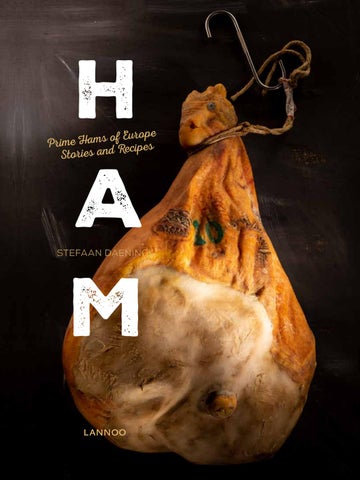
H A M
Europe f o s m a H e Prim es ip c e R d n a s ie Stor
STEFAAN DAENINCK
A rich tradition with much respect for the basic product Start with a quality piece of ‘terroir’ pork that has a story. Add salt of course and give it the necessary time to develop the taste (nuances). This is a rich tradition with much respect for the basic product, a tradition that goes back more than a thousand years … The book Ham by Stefaan, dedicated to this tradition, is something I can be enthusiastic about. It is an ode to the product, the craftsmanship and the animal, the pig. Let a ham slowly ripen, dry and then hope that after many months of patience this results in a tasty and delicately scented ham. Magnificent! There is much that binds ham producers together. In the end, they all make the same delicacy. Yet every producer has his own story and history, and each ham retains its own identity. There is more than enough material here to fill a book about ham.
At Ganda Ham we have been salting and drying Belgian hams in the traditional way for about 30 years. All this time, we have been working without preservatives to produce a genuine and pure Belgian product. Recently we have also been doing the same with exclusive types of beef, because we noticed that there is a demand for these new products with a story. This book introduces you to our colleagues throughout Europe. I am persuaded that this reference work will help you realize what a beautiful and delicious product dried ham is. It is also an invitation to enjoy ham even more intensely in the future. Enjoy reading and enjoy ham! Dirk Cornelis Managing director of Ganda Ham
Add the various viewpoints and recipes of three top chefs, plus the 50 creative and tasty recipes of Stefaan, and you have a true reference book for ham lovers, a book that appeals to foodies, hobby chefs and professional chefs!
5
CONTENTS HAM My reasons for writing this book What is (raw) ham? The history of pigs Pig breeds The history of raw ham Quality labels From pig to ham Manufacturing process Factors that determine taste The importance of salt European hams The art of slicing ham Different types of packaging
8 10 12 14 26 31 32 37 48 56 59 82 86
The choice of top chefs
88
GEERT VAN HECKE Ham, a culinary mainstay, ideal ingredient and tasty condiment 91 ∙∙ Ganda Ham with oysters 93 ∙∙ Fine cream of green asparagus with Ganda Ham and morel mushrooms 95 ∙∙ Wild salmon topped with Ganda Ham, poivrade, artichoke and wild garlic sauce 96 ∙∙ Cheese terrine with Ganda Ham and raisins 99
MASSIMO BOT TURA Come with me to Italy 101 ∙∙ ∙∙ ∙∙ ∙∙ ∙∙ ∙∙
Tartar of Chianina, Parma ham foam Ice cod, katsuobushi broth, Parma ham Ravioli bathed in tomato sauce Asparagus, Parma ham, Parmesan cheese The taste of the river The garden of Italy, the best of fruits and vegetables
102 102 103 104 105 105
PIET HUYSENTRUY T ‘With a dish, not only the taste and the appearance are important, but also the aroma.’ 107 ∙∙ An open sandwich from Flanders 108 ∙∙ My Blood sausage 111
6 | CONTENTS
Culinary ham ∙∙ ∙∙ ∙∙ ∙∙ ∙∙ ∙∙ ∙∙ ∙∙ ∙∙ ∙∙ ∙∙ ∙∙ ∙∙ ∙∙ ∙∙ ∙∙ ∙∙ ∙∙ ∙∙ ∙∙ ∙∙ ∙∙ ∙∙ ∙∙ ∙∙ ∙∙ ∙∙ ∙∙ ∙∙ ∙∙ ∙∙ ∙∙ ∙∙ ∙∙ ∙∙
Breakfast 114 Breakfast new style 115 Apple cucumber shot with Black Forest ham 116 Bell pepper gazpacho with Serrano ham 118 Fennel Bayonne ham salad, the sun on your plate 121 My favourite bruschetta 122 Green asparagus, cheese sauce and Mangalica ham 124 Spring rolls 127 Bouillon of mushrooms with courgette and San Daniele ham 128 Ham with cauliflower 130 Plate of Iberico ham with guacamole and sage 132 Tomato carpaccio with burrata and Serrano ham 135 Pea soup with ham froth 136 Parma rolls, Pesto Genovese and Grana Padano cheese 138 Tarte Tatin with tomato and Bayonne ham 141 Gazpacho full of flavour 142 Grilled scallops with dried ham 144 Spanish sardines with Serrano ham 147 Stewed scallops, beetroot, San Daniele ham 148 Scampi, ham and chicory 150 Potato pie with Parma ham and poached egg 153 Oysters, Bayonne ham and basil emulsion 155 Jambon d’Ardenne, red chicory, squash and radicchio 156 Carpaccio made with omega bass, Iberico ham and cavaillon melon 158 Semi-cooked salmon and Bayonne ham, avocado, melon and port wine 161 New potatoes, farm ham and fried eggs, farm style 162 The Volcano 165 Bruschetta party 166 Potato, olive oil and Iberico de Bellota 167 Aubergine puffed in the oven with Grana Padano cheese and Parma ham 168 Snack of grilled green asparagus and Black Forest ham 171 Watermelon with Ganda Ham 172 Zeeland mussels, Ganda Ham, tomato and saffron 175 Southern ratatouille … from the cartoon 176 Risotto with Parma ham, tomato and mozzarella di bufala 179
112 ∙∙ Caramelised chicory, Jambon d’Ardenne, three kinds of cheese from Chimay ∙∙ Scrambled eggs, Ganda Ham, and ketchup ∙∙ Little rolls of Bayonne ham and Basque piperade ∙∙ Puff pastry with Bayonne ham and spinach ∙∙ Rolled pork tenderloin roast, Chimay cheese and Jambon d’Ardenne ∙∙ Lentils with ham rolls ∙∙ My favourite herring ∙∙ Ravioli with mushrooms and Parma ham ∙∙ Ganda Ham roll-ups ∙∙ Wrap rolls with Ganda Ham and Le Larry goat cheese ∙∙ Rolls of ham ∙∙ Oriental Ganda cannelloni ∙∙ Crispy Ganda Ham roll-ups ∙∙ Savoury strudel ∙∙ Bruschetta Ganda Ham with green olives ∙∙ Ganda Ham with tasty tapenade ∙∙ Sweet-salty-sour, my jam pastry ∙∙ Salad and toast with mushrooms and Iberico ham ∙∙ Salad Niçoise
7
180 183 184 186 189 191 192 195 198 198 199 199 200 200 201 201 203 204 206
The history of pigs The chicken or the egg? The pig or man? Which came first? This is a question that we will probably never be able to solve. Are there two living beings with more in common? Where evidence of man has been found, the pig is also there, and vice versa.
About four million years ago, the first ape-like creature appeared that walked on two rather than four legs. Australopithecus (literally ‘southern ape’) appeared in Africa and was much smaller and had more hair than people of today. In about the same period, but in another part of the world, the wild boar came into being. This animal appeared in southeast Asia and spread to
12 | The history
of pigs
other areas. About two million years ago, the boar managed to colonize the mainland of Eurasia. A good million years ago, the European and Asian swines separated from each other, among other things, because of the successive ice ages that resulted in a massacre among the many genetic variants. Particularly in parts of southern Europe, various pig populations managed to survive.
In prehistoric times, the wild boar (the primal pig) was the most important source of food for humans. When some 6,000 years ago, human beings (first in Asia-minor and afterward in Africa and Europe) changed from a roaming to a sedentary existence, the pig was perhaps their first domesticated animal. And that would have been true, of course, not only because of the companionship of this social animal but especially because of its tasty and nutritious meat. The wild pig was easy to domesticate. Taming this animal was an obvious choice for prehistoric man because by having the pig as his friend he could prevent it from eating everything in sight! Another factor that contributed to the taming of the wild pig was the fact that the pig supplied large quantities of edible meat.
Dans le cochon, tout est bon. [In a pig, everything is good]
Around 5000 BC, the territory of present-day Belgium consisted mainly of wooded areas. Wild boars and wild pigs ran rampant and could feed on an abundance of wild roots, fruits, grasses, ferns and all kinds of nuts, such as walnuts, beech nuts, acorns and chestnuts. These nuts, along with the lush grasslands, were an ideal source of food for large herds of pigs that populated our regions. At that time, the hunters could easily capture enough animals without endangering the population. They were fond of the taste of pork and treated the animals with respect. Already, the Celts understood that the unrivalled taste of pork was due to the food pigs could find in the forest. As the hunters developed into farmers who stayed in one place, the pig became a welcome guest, a friend of the family. The pigs were allowed to roam free, albeit in demarcated areas, so the animals had sufficient room to move about and develop delicious
muscle fat. This was common practice in our region around 3500 BC, and it is still done today in the rugged Huelga in southwestern Spain where the famous Iberico pigs can roam free in gigantic areas and feed on acorns and wild roots. Acorns are an important flavour component for pork and consequently also for ham. Acorns are also responsible for fat that melts in your mouth and they supply various flavours and flavour components. About 6,000 years ago, in parts of Asia, especially in Anatolia, large herds of pigs were bred. These bred animals were introduced to Europe by farmers. There, farmers also began to keep and domesticate local swine. In the early AD period, the pig became increasingly important in Europe. Due to the population growth, the demand for meat continued to increase, and the pig turned out to be a useful animal for breeding. For millennia the pig, which was still roaming around, paired with wild boar so that the gene pool was constantly being replenished. Thus, the genetic variation in domesticated pigs is even greater than in wild boars. The pig was a versatile farm animal. Not only was it a supplier of meat, but the animal was also used to plough the fields, and it provided fertilizer for soil that was often poor. Thus, the pig was not an expensive boarder. In addition to providing food for the table, it processed the farm’s nutrition-rich waste materials into valuable manure. For religious reasons, the pig was not bred in the Jewish or the Islamic world.
13
Pig breeds Many pig breeds have developed during the course of history. Originating from their wild ancestors, as time went by, various breeds were crossed, which has resulted in a number of remarkable varieties.
The Iberian pig
Porc Noir de Bigorre
The Iberian pig is a semi-wild pig breed that has run around on the Iberian Peninsula for centuries. The animal stands quite high on its legs and is very mobile. Most pigs of this breed are dark-grey, but brown tints also occur. Pata negra ham owes its name to the black hooves of the animal. Traditionally, these pigs are fed with acorns. The animals fatten themselves naturally with acorns, which ensures a high content of unsaturated fats in their meat. This fat is stored in the muscle tissue and gives the meat a particularly fine, marbled structure. Some Iberian pigs are the basis for the world-famous Pata Negra. Now the name Pata Negra may be used only for the black label, the highest grade, the 100% Ibérico Bellota Pata Negra.
This black pig, described as noble, was abundant in the landscape of the French Bigorre region at the time of the Romans. The animal flourished as a noble pig breed with the famous Cistercian monastery of Escaladieu in the background. The animal almost went into oblivion in the course of the 20th century, however, after a count of Mediterranean pig breeds in 1980, researchers sounded the alarm. Only a handful of these pigs still lived in their natural habitat. The Padouen collective intervened and sixty united breeders managed to give the Noir de Bigorre a new future. Under the motto ‘grow together’ a scenario was drawn up in which strict requirements for the pig ‘Noir de Bigorre new style’ were drawn up. For example, this animal must be purebred and crosses with other breeds are strictly prohibited. The animals may be reared with up to 25 per hectare, and the feed is exclusively made up of grass from the meadows on the basis of clover and grains such as barley, rye and wheat, supplemented with chestnuts and other natural food that the animals find on the spot. All steps of the pig’s life cycle, from birth to slaughter, cutting, salting and commercialization take place under the strict supervision of the collective.
There are four regions in southwest Spain where Iberian pigs (Bellota) are found: Huelva, Extremadura, Córdoba and Salamanca. These Iberians are divided into four different categories (see pages 75-76).
Mangalica The Mangalica pig is a typical Hungarian pig. This animal stands firmly on its legs and is physically well-armed against the combination of cold and severe heat on the Hungarian Pannonian steppes (from -30° C in winter to +30° C in summer). The animal is resistant to many diseases and is very resistant to stress. During the winter, the coat of the Mangalica pig (except for the muzzle) is covered with thick, long, woolly hair up to its ears. In terms of breed, Mangalica pigs are related to Spanish Iberian pigs. The animal is of a friendly nature and lives on a natural diet of corn, grains and grass. When ready for slaughter, the animal is almost twice as heavy as our varieties. The meat is richly veined with fat and has its own distinctive taste.
22 | Pig breeds
Historians have learned that the Romans knew and had perfected methods of drying ham. In remnants of the old city of Tarragona, a fossilized ham was found, showing that the Romans had mastered the
d Fossilize m h a m fr o na Tarr ago
technique of salting pork.
23
In Huelva in Spain, the hams, here palettas or shoulder hams, are stacked together during the salting process. The salt master determines how and for how long; this may vary by a few days. The minerals in the salt are already a first tastedetermining factor.
European hams There are five major ham nations in Europe: Belgium, Germany, France, Italy and Spain. This does not mean that no hams are dried elsewhere in Europe, but through the centuries these five countries have established solid reputations in the culinary landscape. Their hams are distinguished by their specific history, taste and quality. The quality of hams is strictly and closely monitored by numerous European authorities. Below I will discuss these five countries in detail and I will examine the most famous ham varieties.
Ham also inspires artists. Enfant terrible Jan Fabre caused the customary controversy when he covered eight large pillars at the entrance of Ghent University
Ham and art
in the Voldersstraat with slices of ham as part of the Over-theEdge / On-the-Corner art project. He used no less than 360 kg of Ganda Ham for this. The choice of this quality product was not accidental. According to the artist, ‘the dark-red colour and the capricious white patches of fat look like the marble pillars’. Artist Dwight Kalb from Chicago also used ham to make a statue of Madonna. He needed 90 kg of ham for this.
64
GRILLED SCALLOPS WITH DRIED HAM
INGREDIENTS •• 4 slices of Bayonne ham •• 12 scallops •• 50 g [2 oz] coconut oil •• 200 g [7 oz] paprika tapenade FOR THE GARNISHES
•• 1 cucumber •• 1 Jonagold apple •• 1 dl [½ US cup] cucumber vinegar •• 20 g [½ oz] sunflower seeds •• fresh dill plumes
PREPARATION •• Preheat the oven to 100° C [210° F]. •• Arrange the ham on butter paper and place in the oven. Allow to dry for 1 hour. •• Rub the scallops with the coconut oil and grill them in a hot grill pan for 1 minute on each side. •• Cut the cucumber in half and remove the seeds, remove the core from the apple. Cut both into fine cubes. Moisten with the vinegar and mix in the sunflower seeds and dill.
SERVING INSTRUCTIONS
TIP
Paprika tapenade: Cut 2 large red peppers (with skin and seeds removed), 1 tomato (with skin and seeds removed) and 1 shallot into cubes. Braise in 5 cl [3 US tbsp] of olive oil and 1 gram of oregano. Let it simmer for 5 minutes and mix until smooth in a blender.
•• Form a strip of paprika tapenade and place the brunoise of vegetables on it. •• Serve three scallops with slices of dried ham in between.
145
STEWED SCALLOPS, BEETROOT, SAN DANIELE HAM
INGREDIENTS •• 12 scallops •• 2 red beets, cooked •• 200 g [7 oz] of red beet tapenade •• 200 g [7 oz] red beets, cooked (parings) •• 20 g [½ oz] green olives •• 50 g [2 oz] sesame paste •• 3 g [¾ tsp] honey •• 4 slices of San Daniele ham •• 2 salt biscuits, crumbled, type TUC biscuits •• 1 bowl of chilli cress FOR THE VINAIGRET TE
•• 1 dl [½ US cup] olive oil •• 1 dl [½ US cup] sushi vinegar •• 5 cl [3 US tbsp] red beet juice •• 3 g [¾ tsp] acacia honey
PREPARATION
SERVING INSTRUCTIONS
•• Cut each scallop into three equal slices. •• Mix all ingredients for the vinaigrette. •• Cut the red beet into cylinders and then into slices the size of a scallop. Marinate them for 20 minutes in the vinaigrette. •• Mix the ingredients for the tapenade in a blender until smooth and put in a piping bag.
•• Make a ring of the scallops and the beetroot slices. •• Place the strips of ham on top and squirt tufts of beetroot tapenade around it. Finish with the crumble of salt biscuits and a few sprigs of chilli cress. •• Serve the vinaigrette with it and finish with a spoonful of vinaigrette just before serving.
149
WATERMELON WITH GANDA HAM INGREDIENTS •• 1 small watermelon •• 1 red onion •• 8 slices of Ganda Ham •• 4 cl [2 ⅔ US tbsp] balsamic glaze •• 2 g [½ tsp] black poppy seeds •• shoots of olive herb •• anise flowers FOR THE SOUP
•• pulp of watermelon •• 5 cl [3 US tbsp] gin, type Tanqueray •• juice of 2 pink grapefruit (ca. 2 dl [1 US cup])
PREPARATION •• Peel the watermelon and remove the seeds. Cut 20 nice little bars of watermelon of 2 × 4 cm. •• Peel and cut the red onion into fine rings. •• Make the soup: Place the rest of the watermelon with the gin and grapefruit juice in a blender and mix finely. Pour through a fine sieve and then through a kitchen towel to obtain clear soup. Let the onion marinate in it for 20 minutes. Put in the refrigerator.
SERVING INSTRUCTIONS •• Arrange the bars of watermelon in a chilled serving bowl with strips of Ganda Ham and some rings of red onion. •• Pour the soup over it and finish with the balsamic glaze, poppy seeds, olive spice and some anise flowers. •• Fantastic dish for a sultry summer evening, served with a delicious Tanqueray gin and finished with grapefruit juice.
172 | Culinary ham
TIP
Fantastic dish for a summer evening, served with Tangueray gin and grapefruit juice.
SALAD NIÇOISE INGREDIENTS •• 4 slices of Bayonne ham (12 months) •• 4 pieces of 100 g [3 ½ oz] of tuna fillet •• 20 g [¾ oz] baharat spices, mixed with 1 dl [½ US cup] olive oil •• 8 quail eggs FOR THE GARNISHES
•• 4 piquillo peppers, rolled up in slices •• 8 cherry tomatoes, in quarters •• 2 banana shallots, in ultra-fine slices •• 200 g [7 oz] of green beans, cooked al dente •• 4 ratte potatoes, cooked well-done, peeled and sliced •• 8 conserved and stretched anchovy fillets •• rucola shoots
PREPARATION •• Heat a cast-iron frying pan. Dip the tuna in the herb oil and fry briefly in the hot pan (for a few seconds on each side). Allow to cool and cut the fillets into four equal pieces. •• Fry the quail eggs in the hot pan with a stainless steel egg mould.
SERVING INSTRUCTIONS •• Serve a slice of Bayonne ham with the four pieces of tuna on it. •• Finish with the different garnishes and a squirt of olive oil.
Tip
Baharat is a widely used blend of herbs from Arabic cuisine and is popular around the Persian Gulf, in the Middle East, northern Africa and southern France. Baharat has a complex, savoury taste and a warm and sweet aroma, just like the Arabic cuisine. It literally means ‘spice’ in Arabic and is one of the oldest Arabian herbal mixtures.
www.lannoo.com Register on our web site and we will regularly send you a newsletter with information about new books and interesting, exclusive offers. Text: Stefaan Daeninck Photography: Tom Swijns, Bart Van Leuven, Sven Everaert Graphic design: Steven Theunis, Armée de Verre Bookdesign If you have observations or questions, please contact our editorial office: redactielifestyle@lannoo.com © Lannoo Publishers, Tielt, 2018 D/2018/45/556 – NUR 440 ISBN 978 94 014 4921 2 All rights reserved. Nothing from this publication may be copied, stored in an automated database and/or be made public in any form or in any way, either electronic, mechanical or in any other manner without the prior written consent of the publisher.