INTRODUCTION
Non-figurative art is timeless. It has existed since antiquity, it
machine technology and solar systems or nature and
still exists, and it always will. Gunnar S. Gundersen (1921–
natural phenomena, but the artist never falls into the typical
1983) was a non-figurative artist (FIG. 1). His work expresses
national romanticism that was practiced by some of his
something generally human and is therefore eternally valid.
contemporaries in Norway.
It will remain relevant for all time, just like Functionalist archi-
Gunnar S. Gundersen belonged to the generation of
tecture, which is as modern today as when it was made in
young post-war artists who, in addition to being in oppos-
the early twentieth century. One proof of non-figurative
ition to the reigning doctrine at the art academy in Oslo,
art’s lasting relevance is the large number of younger artists,
had to fight to be acknowledged. But they had ardent sup-
both in Norway and internationally, who in recent decades
porters among art historians, critics, museum curators and
have turned to non-figurative painting.
art dealers who were close to their own age and who pro-
1
Artists reflect the time in which they live. The Hungarian-
moted them. Even though they were negatively received
born artist and art theorist György Kepes, in the introduction
by certain older art critics and the public, this was of little
to his book Education of Vision, states that artists are ‘living
consequence. They were commissioned to produce large
seismographs, as it were, with a special sensibility to the
works of public art, and they sold their pictures to museums
human condition. They record our conflicts and hopes, and
and private collectors alike in the 1950s. This fact contra-
their immediate and direct response to the sensuous quali-
dicts earlier art historians’ claims that non-figurative art did
ties of the world helps us to establish an entente with the
not gain a foothold in Norway until around 1960.3 The break-
living present’.
through for non-figurative art in Norway came about
2
Gunnar S., as he was called, was not merely a living seis-
through two important exhibitions in 1950: Jakob Weide-
mograph when it came to capturing his era’s technology
mann’s solo exhibition at the art institution Kunstnernes Hus
and optimism about the future but also the alienation, fear
in Oslo, and an exhibition of works by Gunnar S. Gundersen,
of terrorism and nuclear threat in the 1950s, 1960s and
Gudrun Kongelf and Ludvig Eikaas at the artist-owned gal-
1970s. In his later works, we can also take the pulse of his
lery Kunstnerforbundet, also in Oslo.
own turbulent psyche and feel the rhythm of his heart and
The art historical treatment of Gunnar S.’s life and works
the tension in his body, which was sometimes resolved, oth-
has thus far been sketchy, lenient and riddled with error.
er times not. But first and foremost, Gunnar S.’s art is forceful,
Just before his death, in 1983, a monograph was published
colourful and dynamic in ways that we do not find in the
about him by the journalist and author Jahn Otto Johansen.
works of other Norwegian artists of his generation.
This presentation is at times anecdotal and imprecise, even
Gunnar S. worked in a style that has been given many
though it also contains important information which the art-
names: abstract, non-figurative, Concrete, Constructivist. In
ist himself supplied in interviews. Like Johansen, Terje Huser
art historical literature, there is almost complete conceptual
was a close friend of Gunnar S.’s, and in connection with a
confusion. Each and every art historian seems to have his or
retrospective of the artist’s works at the Henie Onstad
her own definition of the concepts. As regards Gunnar S., it
Kunstsenter near Oslo in 1983, he published a booklet about
is probably correct to say that he was primarily a non-figu-
Gundersen’s works of public art. This is an important text
rative artist, but that during certain periods, he can also be
about a significant part of the artist’s oeuvre. Huser was also
called a Concretist, especially around 1950 and 1960. In the
responsible for the catalogue and the exhibition on Gunnar
1950s he was clearly influenced by international non-figura-
S. Gundersen’s art at Henie Onstad Kunstsenter in 2006
tive artists, particularly Victor Vasarely, whose works he saw
(FIG. 2). Both Johansen’s book and Huser’s booklet and
at Galerie Denise René in Paris. At the same time, he experi-
catalogues are, however, marred by a number of factual
mented with different expressions before he developed, in
errors. In writing this present book, it has been important to
the 1960s, a unique style within international non-figurative
correct these and other mistakes that have emerged in
art. You will always be able to recognise a painting by
earlier presentations of the artist. Among Gundersen’s con-
Gunnar S. from the 1960s and 1970s. It can bring to mind
temporaries, the writings of the art historians Jan Askeland,
10
Gundersen_K5_25032020_final.indd 10
25.03.20 18:15
INNLEDNING
1 Gunnar S. Gundersen foran utsmykningen i Rikstrygdeverket, Oslo. 1960. / Gunnar S. Gundersen in front of the wall painting at the National Health Insurance Service, Oslo. 1960.
Den nonfigurative kunsten er tidløs. Den har eksistert siden
special sensibility to the human condition. They record our
antikken, den er her nå og den vil alltid være der. Gunnar S.
conflicts and hopes; and their immediate and direct
Gundersen (1921–83) (FIG. 1) var en nonfigurativ kunstner.
response to the sensuous qualities of the world helps us to
Hans verk uttrykker noe allment menneskelig og er derfor
establish an entente with the living present’.2
evig gyldig. Den var da den ble skapt på begynnelsen av
Gunnar S., som han ble kalt, var ikke bare en levende
det 20. århundre. Et bevis på den nonfigurative kunstens
seismograf når det gjaldt å fange inn sin tids teknologi og
evige aktualitet er den store gruppen av yngre kunstnere
framtidsoptimisme, men også fremmedgjøringen, terrorismen
både nasjonalt og internasjonalt som de siste par tiårene
og atomtrusselen på 1950-, 60- og 70-tallet. Gjennom
har vendt seg mot det nonfigurative maleriet.1
kunstnerens senere bilder får vi også tatt pulsen på hans
Kunstnere reflekterer sin egen samtid. Det har de gjort til
eget turbulente indre og følge hjerterytmen og kroppens
alle tider. Den ungarskfødte kunstneren og kunstteoretikeren
spenninger, som noen ganger fikk utløsning, andre ganger
György Kepes sier det slik i introduksjonen til Education of
ikke. Men først og fremst er Gunnar S. Gundersens kunst
Vision: ‘Artists are living seismographs, as it were, with a
kraftfull, fargerik og dynamisk.
11
Gundersen_K5_25032020_final.indd 11
25.03.20 18:15
YEARS OF STUDY
22 Komposisjon. 1949. Olje på lerret. 69 × 74.5 cm. Tangen-samlingen, AKO Kunststiftelse. / Composition. 1949. Oil on canvas. 69 × 74.5 cm. The Tangen Collection, AKO Art Foundation.
50
Gundersen_K5_25032020_final.indd 50
25.03.20 18:16
STUDIEÅR
OPPRØR MOT KUNSTAKADEMIET
Gunnars arbeidslyst var det ikke noe å si på. Julen 1947 har han prioritert malingen:
Gunnar S. skulle ganske snart få nok av Storsteins noe gammeldagse undervisning på akademiet. Allerede mot slutten av første semester droppet han ut av klassen.76 Han ser imidlertid ut til også å ha vært registrert i Per Krohgs klasse. Per Krohg (1889–1965) hadde vært elev av Henri Matisse i Paris og var en av de såkalte freskobrødrene. Han var helt klart den mest meriterte av lærerne ved akademi-
Jeg har forresten f.t. en slik enorm trang til å arbeide at jeg har aldri opplevd makan. Selv mitt under de verste sjøslag har jeg plutselig gitt faen i alt og alle og gått i gang. En blir likesom plutselig kastet inn i en ny verden av nye, uhyggelig sterke fornemmelser, som hos meg må ha utløsning gjennom bildet (FIG. 22).79
et, men hadde vel i likhet med de andre lite å gi den unge generasjonen av malere som ønsket å gå nye veier. Det utviklet seg da også til en åpen konflikt. Tor Hoff, som
GIFTERMÅL
hadde begynt på akademiet i 1945, forfattet i samarbeid med Gunnar S. og Eikaas et protestskriv mot undervisningen
I 1945 hadde Ole Berg truffet sin neste kone i forbindelse
i 1947:
med at kunstakademiet i Stockholm var på besøk i Oslo. To år senere møttes de igjen: ‘Friherrinnan, målarinnan Marga-
For at vi kan være sanne mot oss selv, må vi ha mot til å bekjenne at Revold og hans ‘skole’ som malere kjeder oss. De har ikke noe å gi oss. Av den gode grunn at de er uten kontakt med det som skjer i dag. Tross det sitter de som øverste domstol over det unge og det nye i kunsten. Det de vil, er at vi skal ta varig opphold der de befinner seg. Det kan vi ikke. De representerer for oss det gamle, det som er utbrukt og dermed verdiløst.77
ret fra Sverige har vært her en uke etter å ha vært i Collioure i ½ år, og hun var jo så jäkligt tørst da, og hadde værelse på Astoria, så Ole og jeg har jo koset oss de dagene’.80 Denne malerinnen var Margaret Gadd (1917–86). Hun var utdannet ved Konsthögskolan i Stockholm 1943–48.81 Ole skilte seg fra sin første kone Eva Øien, flyttet til Stockholm i 1949 og giftet seg med Margaret som tok navnet Gadd-Berg.82 Kjærligheten nærmet seg også for andre enn Ole Berg. Odd Tandberg traff sin Numme Grøn-Hansen som var elev
De var lei ‘stabbursmaleriet’ og selvgodheten blant lærerne
av Vilhelm Lundstrøm ved akademiet i København i 1946,
og ‘den mentalitet vi møter her på Akademiet, er at vi er så
Tor Hoff fant sin danske Ida i Oslo og giftet seg med henne i
flinke her hjemme. Så framifrå, at vi greier oss med vårt
1948. Samme år giftet også Gunnar S. Gundersen seg første
eget’. Axel Revold (1887–1962), en annen av Matisse-
gang, med en malerkollega, Gudrun Kongelf (1909–87) fra
elevene, hadde riktignok gitt seg som professor ved
Norderhov på Ringerike (FIG. 23).83 Hun var 12 år eldre enn
akademiet etter 20 års virksomhet i 1946, men var blitt et
Gunnar og hadde allerede en lang utdannelse bak seg.
symbol på alt det gamle i undervisningen: ‘Matisse-elevenes
Kongelf hadde vært elev av Carl von Hanno og Per Krohg
syn og vårt kan ikke forenes. Det eneste vi har felles er
ved Kunst- og håndverksskolen 1932–34 og under Krogh-
materialene. Det som skiller er innholdet. Vi vil ha sagt noe
Fladmark 1937–38. Hun hadde også vært innom Engebrets
annet enn dem, og på vår måte!’.
malerskole og igjen på Kunst- og håndverksskolen under
Mange av de unge kunstnerne var nå i fullt oppbrudd
Chrix Dahl 1946–47. Det må ha vært i denne tiden hun ble
fra akademiet. Hoff og Eikaas forlot akademiet og reiste til
kjent med Gunnar. Hun debuterte på Høstutstillingen i 1946,
København der banebrytere innenfor det nonfigurative
og etter at de to ble kjent kom de til å følge hverandre
maleriet var i full gang med å utvikle nye former; i første
stilmessig til langt ut på 1950-tallet. Kongelf var svært radikal
rekke Richard Mortensen (1910–93), Robert Jacobsen (1912–
i sin tilnærming til maleriet og kom til å utvikle det mot non-
93) og Ib Geertsen (1919–2009). Men omgangskretsen i
figurasjon i like høy grad som sin mann.
København var like gjerne litterær, med diktere som Jens August Schade, Illitch Johansen og Piet Hein.78
Våren 1948 reiste Gunnar S. og Gudrun Kongelf til København. Her møtte de både norske og danske kunstnervenner,
51
Gundersen_K5_25032020_final.indd 51
25.03.20 18:16
BREAKTHROUGH
and human element that had been prominent in Romanti-
according to Glambek, was not to confuse the picture’s
cism and Naturalism.
But, he argued, there was still no
subject matter with its painterly quality. He pointed to
reason to reject the new art, for Romanticism and Natural-
Gundersen as the most consistent artist, in that he had
ism had exhausted their role. What was most important
liberated himself entirely from figurative painting:
113
was to try to understand the young artists.114 According to Ortega, artists should henceforth concentrate on their means of expression; the content was less important. Ortega’s book was discussed by several prominent art critics, also in Norway. Johan Fredrik Michelet, in his book Moderne maleri (1951), opposed Ortega’s theory and claimed instead that the process of abstraction humanised art. Peter Anker was of the same opinion: modern art was a
The form in his pictures is cold and hard, but the colours often glow intensely – like cathedral windows. It cracks and blares in all the colours of the spectrum – not always beautifully, but always effectually. His works tell first and foremost about an artist who tirelessly experiments with colour, who has come a long way in expressing the possibilities of colour.117
cultivation and distillation of what was human because it was an individual and personal type of art.115
For the exhibition at Kunstnerforbundet in Oslo, the three artists took a step further in the non-figurative direction.
‘NOT VISUAL ARTS, BUT ORNAMENTATION’
Gundersen presented 15 untitled paintings, and Eikaas and Kongelf each presented 13 paintings (FIG. 26). Kongelf also displayed seven ceramic reliefs. Based on photos from the exhibition and on identified paintings, we can confirm that
The year 1950 would be an important one for both Gunnar
the main focus was on non-figurative and Concrete motifs
S. Gundersen and Gudrun Kongelf. It marked the break-
(FIGS. 27 and 28).118 Karin Hellandsjø has emphasised that
through of Concrete painting in Norway, an achievement
the exhibition at Kunstnerforbundet ‘must be described as
that was reflected in easel paintings as well as in the first
the first presentation in Norway that focused solely on Con-
commissions to produce works of public art. On 25 February,
crete-abstract art’.119 This assertion is confirmed by Gudrun
Gundersen, Kongelf and Ludvig Eikaas opened an exhib-
Kongelf’s statement to Aftenposten in connection with the
ition at Kunstnerforbundet in Oslo with non-figurative pic-
exhibition’s opening: ‘I’m inclined to call it Concrete. It’s
tures. These three, in addition to Odd Tandberg, had exhib-
the materiality, form, rhythm and expression of colour that
ited at Bergens Kunstforening (Bergen Art Society) one year
we work with.’120
earlier. However, several of the pictures in that exhibition
Once again, Håkon Stenstadvold is the most critical
contained figurative elements and still showed influence
voice: writing in Aftenposten under the heading ‘Appeal at
from artists such as Klee, Miró and Kandinsky. A written ex-
an Exhibition’, he begins by saying that ‘we are in a phase
planation of abstract art was published to coincide with the
of development in which more and more young painters
exhibition, and Gunnar S. Gundersen also gave a lecture.116
are losing interest in painting pictures and instead turning
Most of the public who saw the exhibition in Bergen found
towards arranging coloured fields on a canvas’.121 This is
the pictures incomprehensible, especially Gundersen’s
nothing new, he says, but an experiment that was already
paintings, which were the most non-figurative of the works
completed in the 1920s by the Bauhaus artists. He follows up
on show. The art critic Knut Glambek, however, was accom-
with a claim that has often been quoted: ‘This is not visual
modating in his review for the newspaper Bergens Tidende.
arts in the European sense of the term. But it is something
He criticised the lack of titles, for the absence meant the
equally interesting; it is ornamentation.’ Stenstadvold there-
public were cheated of having a clue to understanding the
fore ends his critical review with an appeal:
pictures. But Glambek thought that if one was open-minded when viewing the pictures, they would not be difficult to understand. The most important requirement for the viewer,
Architects, builders, craftsmen, textile people! Visit Kunstnerforbundet and have a look. […] Imagine these forms
62
Gundersen_Blaupausenkorrektur_02042020_final_RM.indd 62
02.04.20 17:01
26 Gunnar S. Gundersen i atelieret med flere av bildene som ble vist på utstillingen i Kunstnerforbundet i 1950. Øverst på staffeliet Komposisjon (Fig. 27) som er i Stenersensamlingen, Munchmuseet, Oslo. / Gunnar S. Gundersen in his studio with several of the pictures that were shown in the exhibition at Kunstnerforbundet in 1950. At the top on the easel, Composition (Fig. 27), which is in the Stenersen Collection, Munch Museum, Oslo.
63
Gundersen_K5_25032020_final.indd 63
25.03.20 18:16
BREAKTHROUGH
36 En av de dekorerte fontenene på Karl Johans gate i forbindelse med Oslo Bys 900-årsjubileum i 1950. / One of the decorated fountains on Karl Johans gate, in connection with the 900th anniversary of the city of Oslo in 1950.
in January 1951, he writes again to his family, saying he has
with the architecture – a principle of importance in the Bau-
been preoccupied with making a design for Norden. In an
haus School’s ideology.
addendum to the same letter, Gudrun adds that they will start ‘at full steam’ the following day.160
The embellishment at Norden did not attract much attention in the press. This is probably because it was made
Kongelf, Eikaas and Gundersen were each allotted their
for a private company and was not readily accessible to
own wall section in the stairwell (FIG. 34 ). The technique was
the general public. But Håkon Stenstadvold, who had initi-
casein tempera on cement.
Gunnar S. made his part of
ated the decorative project, commented on Gunnar S.’s
the decoration in a style similar to that of the Swedish Con-
contribution in a way that was for him quite typical: ‘The
cretist Pierre Olofsson by using large round and oval forms
decoration represents nothing. It is a play with coloured
(FIG. 35 ). The motifs in the wall painting gave the impression
forms across the wall, a little stimulus for workers who walk
of something continuous, an eternal movement typical for
up and down the stairs.’164
161
Olofsson’s works.162 There are unfortunately no colour photos of the decorative commission, but based on the photos that do exist, it seems they were done in bright and partly light colours. Kongelf’s work was probably inspired by the
OSLO’S 900TH ANNIVERSARY, 1950
façade décor at Kunstnerforbundet, while Eikaas painted large planes in black and white, partly interrupted by hori-
Henrik Sørensen’s slogan ‘Colour the city!’ also became
zontal lines.163 All three artists wanted to integrate the art
relevant for another project in 1950: the celebration of
80
Gundersen_K5_25032020_final.indd 80
25.03.20 18:16
EN LEKEN TRIO
59 Rød komposisjon. 1954. Olje på plate. 30 × 37 cm. Gunnar S. Galleriet, Høyanger. / Red Composition. 1954. Oil on wood. 30 × 37 cm. Gunnar S. Galleriet, Høyanger.
113
Gundersen_K5_25032020_final.indd 113
25.03.20 18:16
TOWARDS CONCRETE PAINTING
84 Komposisjon. 1959. Akryl. 100 × 100 cm. Tangen-samlingen, AKO Kunststiftelse. / Composition. 1959. Acrylic. 100 × 100 cm. The Tangen Collection, AKO Art Foundation.
150
Gundersen_K5_25032020_final.indd 150
25.03.20 18:17
MOT DET KONKRETE MALERI
85 Odd Tandberg. Komposisjon. 1957. Olje på lerret. 64.5 × 80 cm. Tangen-samlingen, AKO Kunststiftelse. / Odd Tandberg. Composition. 1957. Oil on canvas. 64.5 × 80 cm. The Tangen Collection, AKO Art Foundation.
1961 og 1962 med i alt 44 arbeider av Gunnar S., Christensen,
Gunnar S. Gundersen ble av kritikerne ofte sammenlignet
Eikaas, Heramb, Sitter, Rumohr, Tandberg og Weidemann.
med de andre norske abstrakte og nonfigurative kunstnerne
Den ble vist i Corcoran Gallery of Art i Washington og i
på 1950-tallet. Naturlig nok ble han oftest sammenlignet
Munson-Williams-Proctor Arts Institute i Utica i staten New
med Odd Tandberg, som han lå nærmest i uttrykk. Men selv
York. Utstillingen var satt sammen av norskættede Gudmund
om Tandberg hadde vært mer konsekvent konkret i sin kunst
Vigtel, assisterende direktør ved Corcoran Gallery of Art.
304
gjennom 1950-tallet, er det ganske stor forskjell i uttrykk
Jan Askeland hadde skrevet introduksjonen til katalogen.
mellom de to kunstnerne når vi sammenligner deres kon-
Gunnar S. var representert med seks konkrete komposisjoner
krete arbeider. Tandberg var tilsynelatende mest opptatt
malt mellom 1959 og 1961 (FIG. 83). Alle var utlånt av Galleri
av det tvetydige forholdet mellom figur og grunn i ganske
Haaken ved Haaken A. Christensen, som nå var blitt Gunnar
enkle flatekomposisjoner, mens Gunnar S. er langt mer
S.’ gallerist.
dynamisk og komplisert i sine formale strukturer (FIG. 84 og 85).
151
Gundersen_K5_25032020_final.indd 151
25.03.20 18:17
102 Sort sol. 1967. Akryl. 150 ×135 cm. Astrup Fearnley Museet, Oslo. / Black Sun. 1967. Acrylic. 150 ×135 cm. Astrup Fearnley Museet, Oslo.
180
Gundersen_Blaupausenkorrektur_02042020_final_RM.indd 180
03.04.20 10:26
103 Vintersol. 1966. Akryl. 165 × 110 cm. Nasjonalmuseet for kunst, arkitektur og design, Oslo. / Winter Sun. 1966. Acrylic. 165 × 110 cm. The National Museum of Art, Architecture and Design, Oslo.
181
Gundersen_K5_25032020_final.indd 181
25.03.20 18:17
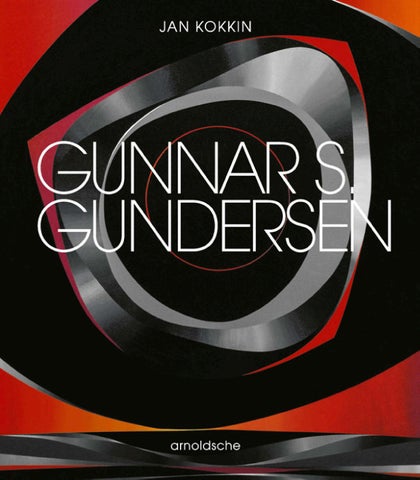
JAN KOKKIN
GUNNAR S. GUNDERSEN NORWEGIAN POST-WAR MODERNIST
JAN KOKKIN
Gunnar S. Gundersen (1921–1983) was one of the most important Norwegian artists of the post-war period. He was a crucial figure in the breakthrough of non-figurative art in Norway cosmic visions in a series of colourful paintings in the late 1960s. An important part of his oeuvre comprises the many public and private wall decorations he made between 1950 and 1980. Gundersen is regarded as one of the few groundbreaking Concrete artists in Scandinavia, together with Richard Mortensen in Denmark and Olle Bærtling in Sweden. JAN KOKKIN is a former director of the art consultancy service Kunst på Arbeidsplassen (Art in the Workplace) and art critic for the Norwegian newspapers Dagens Næringsliv and Morgenbladet. He has published biographies and books on several Norwegian nineteenth-century artists and is currently working as a freelance curator and author.
GUNNAR S. GUNDERSEN EN BANEBRYTENDE ETTERKRIGSMODERNIST Gunnar S. Gundersen (1921–1983) var en av etterkrigstidens mest betydelige norske kunstnere. Han var en sentral aktør i det nonfigurative maleriets gjennombrudd i Norge på 1950-tallet. Gunnar S., som han ble kalt, ble senere inspirert av teknologi og kosmiske visjoner i en serie fargesterke bilder på slutten av 1960-tallet. En viktig del av hans oeuvre er de mange offentlige og private veggutsmykningene han utførte mellom 1950 og 1980. Gundersen regnes som en av få banebrytende konkretister i Skandinavia, sammen med Richard Mortensen i Danmark og Olle Bærtling i Sverige. JAN KOKKIN er tidligere daglig leder for Kunst på Arbeidsplassen og kunstkritiker i Dagens Næringsliv og
GUNNAR S. GUNDERSEN
in the 1950’s. Gunnar S., as he was called, was later inspired by modern technology and
GUNNAR S. GUNDERSEN
Morgenbladet. Han har utgitt flere biografier og bøker om norske 1800-talls kunstnere. Han er for tiden frilans kurator og forfatter.
9 783897 905634 >
Gundersen_Cover_Screenkorrektur_200402_final.indd 1
arnoldsche
ISBN 978-3-89790-563-4
arnoldsche
03.04.20 10:24