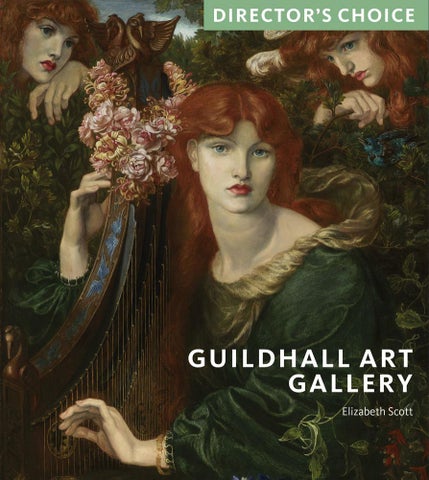
DIRECTOR’S CHOICE
GUILDHALL ART GALLERY Elizabeth Scott
DIRECTOR’S CHOICE
GUILDHALL ART GALLERY Elizabeth Scott
INTRODUCTION On 24 June 1886 the City of London Fine Art Gallery, now the Guildhall Art Gallery, opened to the public for the first time. The Gallery was to display the City of London Corporation’s growing art collection, inspired by the success of civic galleries in Liverpool, Manchester and Leeds, and catering to Victorian society’s increased interest in art. Established as ‘a Collection of Art Treasures worthy of the capital city’, the origins of the collection date back some 200 years prior. In 1670 the Court of Alderman commissioned 22 paintings to hang in the newly restored Guildhall. These were portraits of the Fire Judges – men who had been appointed to assess compensation claims following the Great Fire of London in 1666. These portraits were the inception of the Corporation’s art collection, and from this initial commission the collection continued to grow. It now numbers approximately 4,000 works, including oil paintings, works on paper, sculpture, photography and tapestries. Twenty of the Fire Judge portraits were damaged in December 1940 when the Gallery was bombed in an air raid during the Second World War. Two survived intact, one of which, the portrait of Sir Hugh Wyndham, is on display today. Later, the Victorian Gallery was almost entirely destroyed by fire during a severe air raid on 10 May 1941. Whilst large parts of the collection had been removed to underground storage in Wiltshire, 164 paintings, drawings, watercolours and prints, and 20 sculptures were lost. A temporary structure was built on the cleared site in 1946 for use as a ceremonial venue and exhibition space. In 1985 the City of London Corporation decided to redevelop the site. As work commenced, in 1987, the Museum of London Archaeological Service discovered the remains of London’s Roman Amphitheatre, and the building was redesigned to incorporate this astounding piece of architectural history. The new Guildhall Art Gallery finally opened to the public in August 1999 and the Amphitheatre in 2002.
4
|
GUILDHALL ART GALLERY
The Victorian Gallery
London’s Roman Amphitheatre
The Fire Judge portraits were the beginning of the Corporation’s long history of commissioning works of art, including Defeat of the Floating Batteries at Gibraltar (c.1783–91) by John Singleton Copley and, more recently, Martin Parr’s Unseen City (2013). However, as with most other galleries, the collection has also been shaped by bequests from individuals and acquisitions of new material. One of the earliest gifts was from Alderman John Boydell, a former Lord Mayor and successful publisher, who presented the Corporation with 28 paintings in the 1790s. These included portraits of military commanders and paintings of naval battles, historical subjects and allegorical scenes. The Gallery’s first Director, Sir Alfred Temple, added significantly to the contemporary nineteenth-century paintings, which now form the core of the Gallery’s collection. The Guildhall Art Gallery’s rich variety of works can be roughly divided into four broad categories: London (from 1662 to the present day), Victorian, Matthew Smith, and seventeenth-century Dutch and Flemish; and then we have some works, like all museums and galleries, which fall between these divisions. In my selection I have included works from all but the latter, which is comprised in the main of the Harold Samuel bequest of 83 paintings from the Dutch and Flemish Golden Age, on display at the Mansion House. We look after this collection, but as they have been written about extensively elsewhere and you cannot normally see them at the Gallery, I have omitted them from my selection. Readers who are familiar with the Gallery will notice I have selected certain popular highlights and excluded others, simply because they are not my particular favourites. In addition, my choices are a combination of works on display and others that are not, as we have a very active loans programme and our works are rotated often. I hope this selection of my favourite works will reveal some surprising gems and inspire you to visit the Gallery and London’s Roman Amphitheatre where you can experience and enjoy over 2,000 years of London’s history.
INTRODUCTION
|
5
Lawrence Alma-Tadema 1836–1912
The Pyrrhic Dance, 1869 Oil on panel, 31 x 81 cm Bequeathed by Charles Gassiot, 1902 637
‘…the general effect was exactly like a microscopic view of a small detachment of black beetles, in search of a dead rat’ – this was Ruskin talking about The Pyrrhic Dance in one of his Art of England series of lectures in 1884. I’m not sure I see what Ruskin saw, although admittedly I have never witnessed a group of beetles on the hunt for a dead rat. It’s hardly surprising that Ruskin would make such a bitter attack considering he declared Alma-Tadema ‘the worst painter of the 19th century’. That I have selected the painting is evidence that I completely disagree with Ruskin. We have three works by Alma-Tadema in the collection, Pleading (1876) and The Wine Shop (1869–1874) being the other two, but The Pyrrhic Dance is my favourite. Named after its inventor Pyrrichos, the Pyrrhic dance was one of the most popular forms of entertainment in Ancient Greece. The fast dance, which imitated the movements of attack and defence, was performed by men in full armour, and here AlmaTadema suggests the speed of their movements through the clouds of dust kicked up by their feet. Alma-Tadema visited Pompeii and Herculaneum on his honeymoon in Italy in 1863. On his return to Antwerp he abandoned his former medieval subjects in favour of the domestic genre subjects of classical – mainly Roman – life that were to bring him enormous fame. This is a rare Greek subject by the artist, and together with A Lover of Art (1868), was one of the first of his works to be exhibited in England at the Royal Academy in 1869.
6
|
GUILDHALL ART GALLERY
THE PYRRHIC DANCE
|
7
Liz Johnson Artur b. 1964
Top Shelf, 2018 C-Type, black-and-white fibre-based paper, 111.2 x 195.5 cm Presented by the Contemporary Art Society with the support of the Friends of Guildhall Art Gallery and the City of London Corporation, 2018/19 4551
This was my first acquisition for the Gallery’s collection and it is just one of the many reasons the work is special to me. There is an intimacy in Johnson Artur’s approach and portrayal of South London’s Black communities over more than 25 years, each photograph capturing beautiful and compelling moments of everyday life, mostly in Brixton and Peckham. Top Shelf interweaves different diasporic narratives, highlighting family, love and friendship, whilst also exploring nuances of what it means to be Black. Through her wellobserved, tender and empathetic images Johnson Artur is not only documenting the lives of Black people, she is also subtly drawing attention to and challenging perceptions and stereotypes of Black communities in the popular imagination. Images of men with children confront the cliché of absent Black fathers, whilst the image of a man in a dress and wig on a night out raises the subject of being LGBTQI within the Black community. The Guildhall Art Gallery recently changed its collecting policy, directing the focus to collecting works of art about London by artists who live and work in the capital, and which reflect the communities we seek to serve. Top Shelf is the first acquisition under the new policy and sets a course for the Gallery’s exciting future. It also represents a historic moment for the Gallery, as Johnson Artur is the first woman artist of dual heritage to be represented in the collection and the Gallery is the first public collection in the UK to acquire her work.
8
|
GUILDHALL ART GALLERY
TOP SHELF
|
9
Jiro Osuga b. 1968
In the City, 2017 Oil on canvas, 90 x 78.5 cm Purchased from Flowers Gallery, 2019 4554
Jiro Osuga was born in Tokyo and raised in London, and his playful paintings capture his experience of both cities. Living and working in London as he does, the capital features more often than not in his paintings. We have many works in the collection which depict moments in London’s history, and the ones I like most are those which convey the artist’s feelings towards the capital – the ones in which we get a glimpse into the artist’s psyche. In the City is as much about London as it is a self-portrait of the artist. Osuga stands tall amongst towering skyscrapers in the ‘Eastern Cluster’, the part of the Square Mile covering the areas around Bishopsgate, Leadenhall Street and St Mary Axe. The Gherkin, Cheesegrater and Walkie Talkie loom over small Victorian buildings, whilst another structure (presumably a glass tower) goes up behind Osuga, signalled by the crane over his shoulder. He is standing amongst the tall towers but also stands out from them. Osuga describes his experience of being both a Londoner and an outsider – of living somewhere in between two cultures.
58
|
GUILDHALL ART GALLERY
John Pearce b. 1942
Blackberries in August, Muswell Hill, 1980 Acrylic on hardboard, 90 x 123 cm Transferred from the Greater London Council through the London Residuary Body, 1989 3945
Pearce is known for his pictures of gardens, nature subjects and ‘plantscapes’ – his preferred term for his paintings, which are usually referred to as landscapes. Pearce paints urban gardens, the green corners of a metropolitan city, partially tended and partially in states of neglect. In this picture, Pearce captures a private wilderness in Muswell Hill, the urban environment co-existing with nature, a paint chipped barrier surrounded by a blackberry bush in the foreground. At the time, the artist was looking to paint a subject with long grass and was given permission to use this garden in August 1980, while the owners were on holiday. Pearce renders London and nature in his distinctive way, depicting natural subjects observed directly, completing each work entirely on location, and often taking several months painting plein air to capture a scene. He completed this picture in four weeks, working eight hours a day. Encountering one of Pearce’s paintings brings all of the joy of discovering a small urban wilderness in London. Blackberries in August, Muswell Hill offers us a view of a house garden, a small fenced-off area of land that brings the viewer closer to nature and at the same time creates the feeling of being cut off from the world. It illustrates the juxtaposition of two worlds coming together: the sense of escape felt when sitting in an urban garden full of lush vegetation, the sounds of unseen birds and insects in the background, together with the knowledge that one is surrounded by concrete, cars and pollution. Pearce treats modest subjects on a grand scale, rendering foliage brilliantly with his wonderful observation and accuracy.
60
|
GUILDHALL ART GALLERY
BLACKBERRIES IN AUGUST, MUSWELL HILL
|
61
Ethel Sands 1873–1962
Nan Hudson Playing Patience at Auppegard, France Oil on canvas, 64 x 52 cm Presented by the trustees of Colonel M.C. Sands’ Will Trust and the executors of Mrs J.W. Sands, 2003 4450
This is an intimate and touching painting by Ethel Sands of her lifelong partner, Anna ‘Nan’ Hope Hudson. Once regarded as unmarried friends cohabiting, the romantic relationship between the two is now widely acknowledged. The work captures a quiet, relaxed moment of leisure, with Hudson playing cards in the seventeenthcentury Château d’Auppegard, Normandy, which she owned with Sands. The couple split their time between France and England, and we have several works in the collection by Sands depicting the interior of their homes in both countries. The domestic setting and soft light, texture and colour are typical of Sands’ style. Whilst I normally prefer her elegant interiors, I find this moment between painter and sitter especially charming. For me, Sands’ work represents autonomy. She did not bow down to male influence, continuing to paint domestic interiors even when eminent friends, such as Walter Sickert, made clear their hostility towards her interests. I would like to say she was free of men’s prejudice, too; however, she was forbidden to join the Camden Town Group because she was a woman.
66
|
GUILDHALL ART GALLERY
Matthew Smith 1879–1959
Self-Portrait, 1909 Oil on canvas, 72 x 49 cm Presented by Mrs Mary Keene, 1973 2002
We have the largest number of Smith’s works in a public collection, with over one thousand paintings, drawings, watercolours, pastels and sketchbooks. This is one of only three self-portraits in oil and is considered his most important early work, painted a year after he moved to France from the UK. What struck me first about the self-portrait is that it has none of the vibrant colours, exaggerated design and intensified tonality of his later work. This picture is muted in colour, except for hints of bright blue which appear through the separated brush marks of the background. The picture has been painted over another composition, likely a landscape. Whilst the overall colours in the painting are not typical of Smith’s work, the composition – a frontal presentation with the subject in close proximity to the viewer – is characteristic of and was of extreme importance to Smith. The vigorous, thick brushstrokes express determination, evident in the intense expression and stance of the figure, but the painting also conveys a sense of self-doubt. Painted a year after Smith completed his art education, it reveals something of his low self-esteem and self-effacing character, suggesting a conflict between his wish to paint and his fear of failure. His right hand, the painting one, is tucked away in his coat, which could be due to the difficulty of painting hands, which Smith never felt confident doing, but it could also be a sub-conscious gesture pointing to his lack of confidence in painting – permanently restricting on canvas the hand with which he paints.
68
|
GUILDHALL ART GALLERY
This edition © Scala Arts & Heritage Publishers Ltd, 2020
image credits
Text © Elizabeth Scott
pp. 8–9 © Liz Johnson Artur
All images © Guildhall Art Gallery, City of London Corporation
pp. 10–11 © Sharon Beavan
(except those listed opposite)
pp. 12–13 © Boyle Family. All rights reserved, DACS 2019
First published in 2020 by
pp. 24–25 © The artist’s estate
Scala Arts & Heritage Publishers Ltd
p. 37 © Ben Johnson
10 Lion Yard
p. 38–89 © Lucy Jones courtesy
Tremadoc Road
Flowers Gallery, London
London SW4 7NQ, UK
pp. 40–41 © Roderick Jordan
www.scalapublishers.com
pp. 44–45 © Carl Laubin courtesy Plus One Gallery
In association with Guildhall Art Gallery,
p. 51 © The artist’s estate
City of London Corporation
p. 55 © The artist’s estate
www.guildhall.cityoflondon.gov.uk/art-gallery
pp. 56–57 © Brendan Neiland p. 59 © Jiro Osuga courtesy Flowers
ISBN: 978 1 78551 281 0
Gallery, London pp. 60–61 © John Pearce
Project editor: Sandra Pisano
p. 62 © Julian Perry
Designer: Heather Bowen
p. 69 © The artist’s estate
Printed and bound in Turkey
p. 79 © John Virtue
10 9 8 7 6 5 4 3 2 1 All rights reserved. No part of this book may be reproduced, stored
front cover
in a retrieval system or transmitted in any form or by any means
Dante Gabriel Rossetti,
electronic, mechanical, photocopying, recording or otherwise,
La Ghirlandata, 1873
without the written permission of Guildhall Art Gallery, City of
(see pp. 64–65)
London Corporation and Scala Arts & Heritage Publishers Ltd. back cover Every effort has been made to acknowledge correct copyright
Liz Johnson Artur, Top Shelf, 2018
of images where applicable. Any errors or omissions are
(see pp. 8–9)
unintentional and should be notified to the Publisher, who will arrange for corrections to appear in any reprints.
frontispiece Carl Laubin, 12.18 and 10 seconds, 2010
Director’s Choice ® is a registered trademark of Scala Arts & Heritage Publishers Ltd.
80
|
GUILDHALL ART GALLERY
(see pp. 44–45)