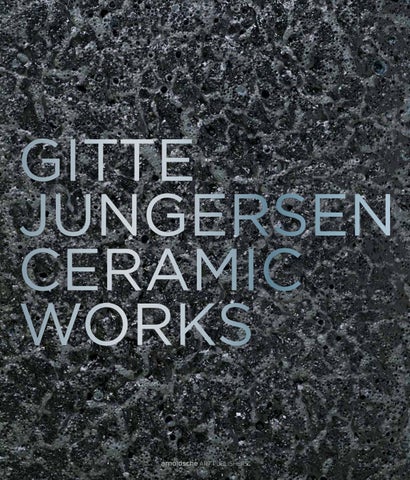
GITTE JUNGERSEN CERAMIC WORKS
978-3-89790-523-8
GITTE JUNGERSEN CERAMIC WORKS
Since her debut in 1995, the Danish ceramist Gitte Jungersen has gained much attention for her innovative work with ceramic glazes. She experiments with extremely active glazes that melt and run during firing, and form individual masses and cracks in a way that is reminiscent of geological processes. After cooling, the works appear as congealed traces, balancing on the edge between chaos and control. Whether we can expect an imminent dissolution, or a new narrative is taking shape is open to question. The objects give rise to a feeling of something uncontrollable and catastrophic, yet at the same time her ceramics has a sensually enticing feel to it as well as great visual appeal.
Graphic design: Nete Banke, Imperiet.dk
CONTENTS
Introduction / Lars Dybdahl
7
Between Control and Chaos / Jorunn Veiteberg A Frozen Moment / Gitte Jungersen All is Flux – selected works
15
31
34
Little Hybrids – selected works
62
Place to Be Lost – selected works
90
Boiling, Bubbling and Growing / Stephanie Serrano Sundby Vessels – selected works Notes
134
Bibliography
135
Curriculum Vitae
137
116
112
Introduction
Lars Dybdahl
Introduction
Lars Dybdahl
Little Hybrids, the organic glaze substances form a colourful ‘plastic explosive’ on the upright rectangular frames. And in her large glaze objects from recent years, the glaze has taken over completely. While ceramic glazes traditionally serve as decoration, here the multilayered objects attain a state of autonomy as substantial forms in their own right, without a clay body. Just as bubbles are a rich, often clustered, recurring motif in her work, the large objects made of combined glazes capture a single moment in time, as sudden cooling has ‘frozen’ the hot, liquid glaze in its boiling, seething stage. The possible resemblance of the glazes to minerals returning to their original state in the earth’s crust does not mean that Gitte Jungersen seeks or strives for any ‘deep’ essence of the ceramic means of production. In a time defined by radically renewing technological development processes and smart, intelligent material design, her intense fascination with the hybrid and mutating is, by contrast, associated with the current absence of fixed material identities. In harmony with the postmodernist breakthrough in ceramics, Gitte Jungersen also abandoned the static, emotive and naturesimulating tradition in Danish ceramics and struck out on her own path with expressive and transformative abstractions on the cubic vessel. A form that is in itself far removed from common everyday types and thus appears strictly as a rhetorical reference to utilitarian forms and functionality. One of her choices in this process was stark, artificial colour notes, a sign of the times, and, in her distinctive work, a reflection of an innovative temperament.
8
9
Little Hybrid #11 (2015). 25 x 16 x 21 cm. Clay and glazes.
Lars Dybdahl
Introduction
Lars Dybdahl
Introduction
Lars Dybdahl
Little Hybrids, the organic glaze substances form a colourful ‘plastic explosive’ on the upright rectangular frames. And in her large glaze objects from recent years, the glaze has taken over completely. While ceramic glazes traditionally serve as decoration, here the multilayered objects attain a state of autonomy as substantial forms in their own right, without a clay body. Just as bubbles are a rich, often clustered, recurring motif in her work, the large objects made of combined glazes capture a single moment in time, as sudden cooling has ‘frozen’ the hot, liquid glaze in its boiling, seething stage. The possible resemblance of the glazes to minerals returning to their original state in the earth’s crust does not mean that Gitte Jungersen seeks or strives for any ‘deep’ essence of the ceramic means of production. In a time defined by radically renewing technological development processes and smart, intelligent material design, her intense fascination with the hybrid and mutating is, by contrast, associated with the current absence of fixed material identities. In harmony with the postmodernist breakthrough in ceramics, Gitte Jungersen also abandoned the static, emotive and naturesimulating tradition in Danish ceramics and struck out on her own path with expressive and transformative abstractions on the cubic vessel. A form that is in itself far removed from common everyday types and thus appears strictly as a rhetorical reference to utilitarian forms and functionality. One of her choices in this process was stark, artificial colour notes, a sign of the times, and, in her distinctive work, a reflection of an innovative temperament.
8
9
Little Hybrid #11 (2015). 25 x 16 x 21 cm. Clay and glazes.
Lars Dybdahl
Residency at Danish Art Workshops, Denmark (2015).
Introduction
12 13
Lars Dybdahl
Residency at Danish Art Workshops, Denmark (2015).
Introduction
12 13
Lars Dybdahl
Between control and chaos
Jorunn Veiteberg
BETWEEN CONTROL AND CHAOS Gitte Jungersen belongs to a generation of ceramicists who have done a great deal to change people’s conceptions about what ceramics can be. When she made her debut in the 1990s, pots based on shapes that were basically geometrical, were still the standard repertoire of Danish ceramicists. Her first work was no exception to this rule. At the Charlottenborg Spring Exhibition in 1995, she showed a number of cubic vessels. It was, even so, not form and function that these invited the observer to reflect on, for it was already obvious in these early works that what interested her most is the glaze: viscous and full of porous air bubbles, it forms a contrastive mass to the strict cubic shape. Not making the glaze subordinate itself to or merely enhancing the form
Dr Jorunn Veiteberg is an independent art historian who works internationally as a writer, adviser and lecturer in the fields of arts and crafts.
was a breach of long-standing conventions within the field of ceramics. A convention Jungersen was familiar with from her own education from 1988 to 1993 at the Danish School of Design in Copenhagen, where the ideals from Bauhaus and modernism still reigned supreme. This also meant that the main focus was on the production of functional design. But her own preferences were more far-ranging. Her models were the Dane Gutte Eriksen (1918-2008) and the American Ron Nagle (b. 1939). It is harder to imagine more contrasting artists than these, but in Jungersen’s work it proves possible to unite them in an original way. Not in the sense of their being traceable as direct quotations; it is more a question of a kinship of attitude and approach. Gutte Eriksen had studied under Bernhard Leach and there become acquainted with Japanese ceramics. From this tradition she took with her an interest in what can be referred to as the basic element of ceramics. She mixed her own clay and was deeply taken up with what the firing temperature and addition of fire and air during the firing process could add to the surfaces of various textures and colour nuances. Jungersen shares her interest for exploring the actual material and firing process, but she departs from the traditional attitude to glazes. Eriksen’s simple, classical pots are based on the idea that form and glaze are a totality, and that it must be possible to read the way in which the pot has come into being from the end product. In Jungersen’s work, the glaze is ‘allowed’ to follow its own paths, and this often plays a major role. Ron Nagle resides in California, and his ceramics are typified by a life of surfing, rock music and the ‘hot-rod’ culture. Colours such as lilac and pink, and
15
Introduction
Lars Dybdahl
22
Introduction
23
Lars Dybdahl
Introduction
Lars Dybdahl
22
Introduction
23
Lars Dybdahl
Detail, All is Flux #8 (2017).
Detail, All is Flux #7 (2017).
Detail, All is Flux #8 (2017).
Detail, All is Flux #7 (2017).
Lars Dybdahl
56 All is Flux #1 (2016). 108 x 85 x 7 cm. Several glazes in layers.
Introduction All is Flux
Lars Dybdahl
56 All is Flux #1 (2016). 108 x 85 x 7 cm. Several glazes in layers.
Introduction All is Flux
Little Hybrid #29 (2017). 33,5 x 12,5 x 18 cm. Clay and glazes.
Little Hybrids
70
71
Little Hybrid # 26 (2017). 21 x 12 x 13 cm. Clay and glazes.
Little Hybrids
Little Hybrid #29 (2017). 33,5 x 12,5 x 18 cm. Clay and glazes.
Little Hybrids
70
71
Little Hybrid # 26 (2017). 21 x 12 x 13 cm. Clay and glazes.
Little Hybrids
Little Hybrids
Little Hybrids
The Great Escape (2010). 95 x 85 x 25 cm. Clay and glazes.
Place to be lost
111
The Great Escape (2010). 95 x 85 x 25 cm. Clay and glazes.
Place to be lost
111
Introduction
VESSELS
117
Lars Dybdahl
Introduction
VESSELS
117
Lars Dybdahl