CONTENTS
INTRODUCTION From conservation to re-evaluation: an interdisciplinary approach to the Ghent Altarpiece Maximiliaan P.J. Martens & Danny Praet p. 10
Chapter I (ART) HISTORY THE CITY Ghent and the Burgundian state in the fifteenth century Marc Boone p. 16 THE CLIENTS A noble altarpiece: the socio-historical context of the painting Frederik Buylaert & Erik Verroken p. 50 THE CREATORS The role of Hubert Van Eyck in the Ghent Altarpiece Maximiliaan P.J. Martens p. 116 Jan Van Eyck and his workshop: organisation, collaborators, legacy Till-Holger Borchert p. 138
6
Chapter II ANALYSIS AND INTERPRETATION SCIENCE Virtual restoration and mathematical analysis of the pearls in the Ghent Altarpiece Aleksandra Pižurica, Ljiljana Platiša, Tijana Ružić, Bruno Cornelis, Ann Dooms, Maximiliaan P.J. Martens, Marc De Mey & Ingrid Daubechies p. 182 PERCEPTION De visione Dei: optics, theology and philosophy in the Ghent Altarpiece Marc De Mey p. 202 VIRTUES De virtutibus Dei: ancient and medieval philosophy of the virtues in the Ghent Altarpiece Danny Praet p. 240
7°Contents
Chapter III NACHLEBEN CRIME AND MYTH The Ghent Altarpiece: the most stolen artwork ever Karel Mortier p. 302 FILM The Silence of the Mystic Lambs: film, Van Eyck, Panofsky and Cauvin Steven Jacobs p. 320 PHOTOGRAPHY The post-war life of the Ghent Altarpiece p. 330
NOTES p. 339 BIBLIOGRAPHY p. 351 ABOUT THE AUTHORS p. 364 ACKNOWLEDGEMENTS p. 367 COLOPHON p. 368
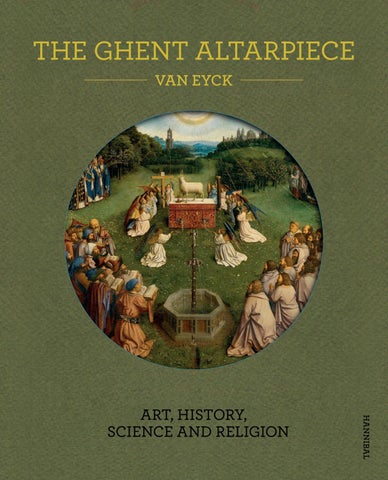
A depiction of the whole world, the Ghent Altarpiece (also known as the polyptych of the Mystic Lamb) portrays the Christian vision of world history. But it is also a synthesis of the material world. Revealing amazing technical raffinesse and boundless erudition, the polyptych depicts a wide variety of plants and the play of light on every conceivable material, from wood and marble to brocade, pearls and precious stones. The spiritual world and the Christian history of salvation are interwoven with this grandiose materiality. The Van Eyck brothers included the key moments in the religious history of mankind in their altarpiece: Adam and Eve refer to the creation and fall of man; the lunettes with Cain and Abel to the biblical start of agriculture and animal husbandry, but also to the first murder and the deadly sins of envy and anger. But the Ghent Altarpiece also has a positive message to convey: its key religious theme is the reconciliation between God and mankind. In the polyptych’s closed state, the viewer sees in the middle the Annunciation to the Blessed Virgin Mary by the Archangel Gabriel. In its open state, all groups depicted in the lower register converge in their adoration of the Lamb: the end of history for the chosen few. The altarpiece itself is not without its own history; perhaps more than any other work of art, the contemporary world had an influence on the Ghent Altarpiece. In this book, we will attempt to contextualise the polyptych, looking at the history of Ghent itself as well as the history of Flanders and what is now Belgium, as all this played a determining role in its creation. Perhaps the world’s most stolen work, it is indeed a miracle that the altarpiece is for the most part still intact. It survived the Iconoclastic Fury (Beeldenstorm) that raged in the Low Countries in the sixteenth century, and its confiscation by the French revolutionary troops. Shortly afterwards, the altarpiece was split up, with the short-sighted officials of St Bavo’s Cathedral selling several panels, and at a knockdown price too. In Berlin, several panels were sawn through in order to exhibit them side by side in a museum. The Treaty of Versailles in 1919 led to the panels being returned to Belgium as a reparations payment. In 1934, two panels – one of John the Baptist, the other of the Just Judges – were stolen. Speculation about whether the latter panel still exists and, if so, where it could be, is now part of modern Belgian folklore. Indeed, this could itself be an interesting subject of scientific research into conspiracy theories and collective paranoia: interesting meta-reflections could be formulated, looking at the subject from an anthropological, psychological and philosophical perspective. However, this book focuses on a scientific approach to the Ghent Altarpiece itself.
11°Introduction
Although the panels were put into safe keeping in the French Pyrenees at the start of the Second World War, they came into the hands of the Nazis through the complicity of the Vichy regime. They were taken first to the Bavarian castle of Neuschwanstein and then, at the end of the war, to the Altaussee salt mines where they were ultimately found by the Third US Army and the ‘Monuments Men’. Under the supervision of Ghent professor Paul Coremans (1908-1965), they were subsequently returned to Belgium. These tragic episodes in the history of the Ghent Altarpiece necessitated the conservation of the panels in 1950-51, again under the supervision of Coremans, the founder of what is now the Royal Institute for Cultural Heritage (Koninklijk Instituut voor het Kunstpatrimonium / Institut royal du Patrimoine artistique, KIK-IRPA). The emphasis he placed on interdisciplinarity, the collaboration between conservators, the natural sciences and cultural sciences, and his scientific report L’Agneau mystique au laboratoire: examen et traitement (Antwerp: De Sikkel, 1953) has served as an example for all large-scale conservation projects undertaken since then. This applies in particular to the altarpiece’s latest conservation. One of the most exciting examples of scientific collaboration ever undertaken, the project started in October 2012 and is being carried out by a team of conservators from the KIK-IRPA. Ghent University (UGent) is one of the many partners who have teamed up to study and preserve this 600-yearold masterpiece, using the most advanced techniques. The spectacular results of the conservation and research will undoubtedly attract wide public and media interest. There is a great emphasis on openness. The Ghent Museum of Fine Arts (Museum voor Schone Kunsten, MSK) has established a secure but open studio for the conservation, allowing the public to follow the work from behind a glass screen. The Province of East Flanders has organised a series of exhibitions at the Caermersklooster Cultural Centre on the material history and other aspects of the Ghent Altarpiece. The public broadcaster VRT is regularly showing the progress of the conservation on its website (www.vrt.be/vrtnws/nl/dossiers/2017/11/-het-lamgods-/), while the KIK-IRPA has set up a dedicated website (http://closertovaneyck.kikirpa.be/) to provide a wealth of information on all aspects of the research and conservation project, including technical documents and photos in the highest resolution possible. Within this scientific conservation project, art and science are working hand in hand. High-tech specialist analysis techniques are producing valuable new data, so that the Ghent Altarpiece can be restored to its former splendour, and also to refute former hypotheses concerning the origin, material history,
meaning and function of the altarpiece – and to come up with new ones. For example, no one had any idea of the extent and impact of the many overpaintings undertaken since the sixteenth century. With the conserved panels now returning to St Bavo’s Cathedral, it is becoming increasingly clear what fantastic results this entire project has already achieved. Bearing witness to the principles of openness and interdisciplinary cooperation, this book is based on the latest results of the studies being undertaken, mirroring the open communication strategy of the whole project. It contains articles written by specialists associated with Ghent University and a number of extra muros colleagues from both the cultural and natural sciences. We hope that the articles can be understood by the interested layman. Standing humbly in front of the physical and spiritual universe of the Ghent Altarpiece, we are all just laymen after all: very interested, indeed fascinated by what we see.
12
FIG. 1 & 2 Ghent Altarpiece, Close-up of the Lamb’s head before conservation and during conservation (after removal of the overpaintings)
THE BURGUNDIAN ‘STATE’: A DYNASTIC CONSTRUCTION IN THE LOW COUNTRIES
FIG. 6 Mausoleum of Louis of Male (Louis II of Flanders), Margareta of Brabant and their daughter, Margareta of Male, Lille, St. Peter’s Church (no longer existent) (Brussels, Royal Library of Belgium, Ms. 11, 1862/1 f ° 55 (Antoine de Succa, 1602)
19°
The city
How should we go about describing the political construction established by the Dukes of Burgundy in the Low Countries? Used by many historians, the term ‘state’ with its nineteenth- and twentieth-century connotations is, of course, an anachronism.5 This is why we use the term in quotation marks. People at that time referred to the ‘lands’ (landen) or ‘principalities’ (heerlijkheden), the pays de l’au-delà, highlighting the region’s territorial reality. De facto, a Duke of Burgundy ruled over Ghent in a direct successor capacity as ‘Count of Flanders’. All claims to the title date back to 1369, the year in which Philip, the younger son of the French King Jean II and brother of the reigning King Charles V, married Margareta of Male, hereditary princess and only legitimate child of the Flemish Count Louis of Male (aka Louis II of Flanders) in St Bavo’s Abbey in Ghent (Fig. 6).6 In 1384, Count Louis died, in the middle of an uprising of his Flemish subjects led by the city of Ghent. He was succeeded by Philip the Bold, not as a count but as consort to the princess. Philip took care to present himself with his official title ‘fils du roy de France, duc de Bourgogne, comte de Flandre’.7 On his death in 1404, his eldest son and successor John (the Fearless), though immediately becoming Duke of Burgundy in succession to his father, did not automatically become Count of Flanders. He had to wait for his mother, Margareta, to die in 1405 before being able to assume the title of Count of Flanders as ‘prince of the blood’. From then on, the House of Burgundy became the ‘natural’ ruler of Flanders, while at the same time gradually extending its claims to other regions (Fig. 7). It is a longstanding question: did the first Duke, Philip the Bold, conduct a conscious marriage policy to get his dynasty to play such a leading role in the Low Countries? He undoubtedly very quickly understood the growth prospects for a ruler in the Low Countries, a region characterised by an exceptional concentration of high-performing urban economies that promised tax revenues dreamt of by every ruler. In addition, his very productive marriage (ten children, seven of whom – three sons and four daughters – reached adulthood) offered opportunities to forge a network of marriage alliances. As the result of a number of demographic and dynastic coincidences, a remarkable concentration of principalities came into the possession of the House of Burgundy in the first decades of the fifteenth century. A key factor was the double marriage concluded on 12 April 1385 in the episcopal city of Cambrai between, on the one side, the Burgundian heir to the throne, Prince John, and his sister Margareta, and on the other side,
Margareta, Countess of Artois 1361-1382
Louis of Nevers Count of Flanders 1322-1346
Jean II King of France 1350-1364
Charles V King of France 1364-1380
Louis of Male Count of Flanders 1346-1384
Margaret
Philip the Bold Duke of Burgundy 1384-1404
John the Fearless 1404/1405-1418
Johanna Duchess of Brabant 1355-1406
Jacoba of Bavaria Countess of Hainaut, Holland, Zeeland 1417-1433
John IV Duke of Brabant 1415-1427
Arnold Duke of Guelders 1423-65/1471-73
Charles the Bold 1467-14777
1. Isabelle de Coucy 2. Bonne of Artois
John Count of Étampes 1461-1491
Agnes
John Duke of Bedford
Charles Duke of Bourbon 1434-1465
Adolph of Ravenstein 1. Beatrice of Coimbra 2. Anne of Burgundy Philip of Cleves
1. 1440 Catherine of France 2. 1454 Isabella of Bourbon 3. 1468 Margaret of York
Philip the Handsome 1482/1493-1506
Charles Count of Nevers 1415-1464
Anne
Adolph Duke of Cleves
Catharine 1430
1419 John of Bavaria Elector of Liège Regent of Holland and Zeeland 1419
Philip of St. Pol Duke of Brabant 1427-1430
Marie
1. 1409 Michelle of France 2. 1424 Bonne of Artois 3. 1340 Isabelle of Portugal
Albrecht of Bavaria Regent/Count of Hainaut, Holland, Zeeland 1358/1389-1404
Philip Count of Nevers and Rethel 1404-1415
1. 1402 Jeanne of St. Pol 2. 1409 Elizabeth of Görlitz Duchess of Luxembourg 1412-1451
1. 1415 John of Touraine Dauphin of France 2. 1418 John IV, Duke of Brabant 3. 1422 Humphrey of Gloucester 4. 1434 Frank of Borssele
Mary of Burgundy 1477-1482
2. 1354 Wenceslas Count of Luxembourg 1353-183
Antony Duke of Brabant 1040/1406-1415
1385 William of Bavaria
Philip the Good 1418-1467
1. 1336 William Duke of Hainaut, Holland, Zeeland 1337-1345
Margareta of Male Duchess of Flanders, Artois, Nevers, Rethel, Franche-Compté 1404-1405
Margaret
1405 Margaret of Bavaria
John III Duke of Brabant 1312-1355
John Duke of Bourbon
Charles of Bourbon Archbishop of Lyon
Catherine
Louis of Bourbon Bishop of Liège 1456-1482
Charles of Egmont Duke of Guelders 1492-1538
1477 Maximilian of Austria Regent 1482-1493 Holy Roman Emperor 1486 Emperor 1508-1519
1496 Joanna Queen of Castile 1504
Adolphe Duke of Guelders 1465-71/77
Margaret of Austria Regent 1507-1515 1518-1530
Dynasty family tree (Walter Prevenier & Wim Blockmans, Les Pays-Bas bourguignons, Antwerp 1983, p. 388)
FIG. 7
20
Charles V Ruler of the Low Countries 1515 King of Spain 1516 Emperor 1519-1555
1526 Isabella of Portugal
Ferdinand I Holy Roman Emperor 1556-1564 Emperor
GHENT, AN ‘ANCIENNE DÉMOCRATIE URBAINE’ (H. PIRENNE), IN COLLISION WITH THE BURGUNDIAN ‘STATE’ Enjoying constant growth from the twelfth century onwards, the towns and cities of the Low Countries, and especially in the old County of Flanders and Duchy of Brabant, had developed over the course of the late Middle Ages into variants of the urban communes also emerging in other European regions. These had developed a special relationship with established worldly and ecclesiastical rulers, to the extent that they constituted a separate phase of development in the emergence of Western society for the German sociologist Max Weber (1864-1920), in his typology of societal forms. In Weber’s view, four elements characterised the medieval urban commune: a market function, a defence organisation, the right to self-governance, and a legislative capacity.21 A contemporary of Max Weber, the Ghent-based medievalist Henri Pirenne, a man with an exceptional and very profound influence on his contemporaries and even afterwards on generations of historians, added to this, highlighting their international role.22 After writing a series of articles between 1893 and 1898 on the governance of medieval cities for the influential journal Revue Historique, Pirenne summarised his findings in 1910 in Les anciennes démocraties des Pays-Bas.23 His views were further disseminated after the publication in 1923, as a result of his grand tour of the United States, of his work Medieval cities: their origin and the revival of trade. The book became an instant classic and is still often given to undergraduates as basic reading.24 The visions and views of Pirenne, ideologically a product of late nineteenth-century liberalism, have of course been updated by recent research, although the underlying thinking remains clear.25 The strong image of ‘urban democracies’ remains seductive, inter alia because the late medieval cities (Pirenne himself thought first and foremost of the cities in the County of Flanders and of his native region, the heavily urbanised principality of Liège) appeared – in the spirit of Max Weber – as a variant of the major urban evolution from the Greek polis, via the medieval commune, to today’s ‘city-states’.26 Medieval cities were portrayed as hubs of creativity, in a constant state of renewal, also in the field of society and political involvement. This was, of course, not the first time in recent history that cities and urban life were subject to fundamental paradigm shifts.27 Many views on Ghent, whether or not influenced by the ideological issues of the moment, have been formulated, not all of which can withstand the critical test of historical research. One example is a comment by Victor Fris, a former city archivist and student of Pirenne, on the Ghent citizenry of the 26
late Middle Ages: ‘Il suffit de parcourir les annales gantoises du XVe siècle pour se rendre compte de l’humeur inconstante du “commun”: de 1432 à 1492, c’est une liste interminable de grandes et de petites révoltes des gens de métier. Et l’on est tenté de leur appliquer ce mot de Chateaubriand “qu’ils tendaient sans cesse à s’insurger, sans autre raison qu’une impossibilité d’être paisibles”.’28 Whatever the case, it should be noted that, as in the other major Flemish cities, the history of fourteenth-century Ghent was characterised by a seemingly constant series of internal disputes and insurrections, which brought the city into conflict with the central authority of the Count of Flanders (Fig. 13).29 Historians nowadays tend to take a fundamentally different view of insurrections and the use of violence, certainly in comparison with the period referred to by Fris. Though the Flemish and above all the Ghent guilds certainly resorted to violence fairly quickly and decisively, the insight has since grown that this was much more than a seemingly primitive reaction, instead being aptly measured and targeted.30 In other words, threatening opponents belonged to a repertoire of rebellious behaviour used by the guilds in their clashes with central authority.31 In the years prior to the creation of the Ghent Altarpiece, Ghent was a very restless place. In 1423, for example, head alderman Victor vander Zickelen had clashed with the top ducal official, Simon van Formelis, originally from Ghent. In a shouting match preserved for posterity, the latter had insulted Vander Zickelen, saying that Ghent politicians would never have any say as long as people like Vander Zickelen, in the spirit of Van Artevelde, continued to put Ghent privileges above public interest (the interests of the Duke).32 Above all in the years 1423-27, social and political tensions regularly occurred between weavers and fullers in Ghent, with the latter, dependent on the former from an economic perspective, putting in wage demands unacceptable for the weaver entrepreneurs in the relatively bad economic situation of the time (Fig. 14).33 This revived a collective ghost: that of the numerous and often very violent confrontations between weavers and fullers that had characterised fourteenth-century Ghent. The repeated clashes had ended in a form of truce, crystallising around 1360 into the system of the ‘Three Members’ (Drie Leden), who henceforth controlled the city: one represented the poorters (the leading citizens), one the influential guild of weavers, and one the fifty-three smaller guilds, though without the politically oppressed fullers. The fact that it was precisely the latter who were again up in arms in the 1420s must have evoked horror among Ghent citizens.
Fighting at the Vrijdagmarkt in Ghent, David Aubert, Chroniques de Flandre (Wells-next-the-Sea, the Holkham estate)
FIG. 13
27°
The city
FIG. 19 Allegory on the four marriages of Jacoba of Bavaria, ca. 1430 (Paris, Louvre, School of the Van Eyck brothers, drawing on watercolour paper)
32
33°
The city
Jan Castellan of Beveren-Waas
Clais (+1432)
Amelberga van der Elst (+1394)
Clais (+1390) knight
Christoffe (+1436/38) knight
Obrecht
Jan
Margaretha
Hendrik De Bie
Joos (+1439)
Elizabeth Borluut (+1453)
Agnes Jacob van Voorhoute
Adriaan
Elizabeth
Margaretha van Mater
Josine de Voorde
Gerard
Joos
Joos Triest
Jacob (Dean of Nivelles)
Mabelie
Adriaan
Joos Triest
Godevaert Raes
Lodewijk
Margaretha Goedele van Raes Lovendegem
GabriĂŤla de Meester
Jan Vilain
Maria (nun)
Willekine
Margaretha Barbara (nun)
Jan
‌
Joos
Amele
Christoffel
Christoffel Man, born into an aristocratic family
Man, born into an non-aristocratic family
(Child from a) legal marriage
(Child from an) extramarital relation
FIG. 32 F. Buylaert and E. Verroken, Vijd family tree
66
It was certainly no coincidence that the Vijd family, via Mabilie Vijd, extended its social network to the Duchy of Brabant in the 1390s, with the Vijds even attempting to purchase a manor there. Their focus on the neighbouring principality at the end of the fourteenth century is probably a consequence of the activities of Clais Vijd as castellan of Beveren. During the Ghent War (1379-85), Clais, in his capacity as castellan, controlled shipping on the Scheldt between Dendermonde – where his oldest son, the knight Clais Vijd, was involved in defending it against the Ghent militia – and Antwerp. In 1382, he ordered confiscated goods to be sold to cloth merchants from Mechelen, a hub in the Brabant-Flemish trade networks.57 After 1385, Clais continued to maintain these contacts, ultimately buying a house in Mechelen and lending money to the city council.58 Since Zemst is in the immediate vicinity of Mechelen, Clais Vijd the Elder and Godevaart Raes may have met in this city.59 The fact that Vijd family members managed to marry into wealthy and even noble families has a lot to do with the power and income that Clais Vijd derived from his positions as bailiff, castellan and master of the peat bogs in Beveren. Though we have no precise figures, we do know that in 1376 this section of the country, governed by the Vijds, provided revenues totalling no less than 758 lb. of forty groats (126 lb.gr.).60 How much of this was retained by Clais is not known. Nevertheless, it was an enormous sum, given that a skilled worker in those days earned 9-10 lb.gr. a year.61 Furthermore, he would probably have had other income as well. In January 1366, the castellan of Beveren also managed fiefs (lenen en manscepen) in the Land of Saaftinge.62 Between 1370 and 1373, he operated, together with two Waas noblemen – Jan de Jagere and Filips van der Couderborch – a conglomerate of three toll stations in Antwerp, the so-called Kleine Tol, the Buerchtrecht and the Grote Tol. To collect these tolls, they had to collectively pay rent of around 1,700 lb.gr., a sum indicative of the financial ‘clout’ of Clais Vijd.63 Besides its great wealth, the Vijd family was also very influential. Alongside the power that went with being the bailiff and castellan of Beveren, Clais was also able to purchase the so-called schouteetdom of Melsele in the 1360s from the knight Sir Willem van den Damme, a fief that gave him rights and privileges in the home village of his wife.64 In addition, he regularly worked as an alderman in Waas, and was its chief alderman in 1386. In that council, he would undoubtedly have worked in the same direction as the many members of the noble Van der Couderborch family who were also active as aldermen. This assumption is backed by the fact that Clais Vijd and Philip van der Couderborch together acquired the lease for the 67°
The clients
Antwerp toll stations.65 Similarly, it can be assumed that there was no opposition from the bailiff of Waas, who, in fact, as the count’s representative, had the task of acting as counterbalance to the Waas aldermen – up to 1385, the bailiff was Joos Triest, the son-in-law of Clais Vijd the Elder. Joos Triest was succeeded in this function by his brother-in-law Clais Vijd the Younger, who remained bailiff until 28 January 1390, when he took over as bailiff in the neighbouring Vier Ambachten.66 All of this goes to show how high-class families viewed mutual marriages not so much as an individual matter, but rather as a means to cement and expand their power. For instance, through the marriage between Joos Triest and Elisabeth Vijd, both families strengthened their position of power in both Waasland and the Vier Ambachten. To avoid conflicts of interests, there was actually a strict ban on the count’s bailiff coming from the region where he officiated. However, it is clear that the Land van Beveren and the surrounding Waas castellany were dominated by a network of powerful families, including the Vijd family. In 1390, the Vijds’ control over the Land of Beveren, which went back to at least 1353, came to an abrupt end. Following the death of Count Louis van Male in 1384, the County of Flanders fell to Philip the Bold, Duke of Burgundy. Under his rule, special inspectors were appointed to investigate whether the count’s domains were being properly managed. As a result of the investigation by Pieter Heins, Clais Vijd the Elder was found guilty by the ducal council in February 1390 of large-scale fraud and immediately relieved of all his roles as bailiff, tax collector, castellan and master of the Beveren peat bogs. The verdict gives an idea of how the Vijds had managed to maximise their income. As lord of the manor, Clais had systematically exaggerated the costs of maintenance and supplies in the accounts and falsified all sorts of expenses, thereby lining his own pockets. For example, many more soldiers and horses were listed in the accounts than were actually stationed in the castle. Moreover, the soldiers received less pay and served for shorter periods than stated in the accounts. Clais had also greatly exaggerated the costs for building the Scheldt dykes. As bailiff of Beveren, he had largely obscured income from fines deriving from his administration of justice.67 He had also misappropriated money by charging for prisoners in the castle, though the Duke had already awarded him a sum for that. To a certain extent, the fraud was a family affair: the accounts had been ‘cooked’ by the clerk Jan Vijd, probably an illegitimate brother of Clais.68 The latter had also bribed the accountant at the Chamber of Accounts in Lille tasked with checking his accounts on behalf of the Duke. It was not until
FIG. 51
Jan van Eyck, Madonna with Chancellor Rolin (Paris, Louvre)
140
Despite the erudite theological connotations that are, to a greater or lesser extent – but always in a sublime manner – incorporated into his religious paintings such as the Virgin and Child with Chancellor Nicolas Rolin, today in the Louvre (also known as the Rolin Madonna) (Fig. 51),4 we are always likely to admire the extraordinary mimetic skills and the fluid craftsmanship of the detailed execution of the panels. But most of all, and in contrast to earlier representations, we are still able to perceive Van Eyck’s image as a recognisable likeness of a seemingly real person in front of what would seem to us a realistic rendering of a panoramic landscape. It is in this sense that Jan Van Eyck must be considered as one of the founding fathers of our contemporary visual culture. All of his undisputed works display a remarkable refinement in the execution of the tiniest details, glowing colours and a wide range of pictorial concepts, which would adequately translate into monumental or microscopic depictions. Among his surviving paintings are undated works such as the Annunciation in Washington and the Lucca Madonna in Frankfurt, and the Virgin and Child with Canon van der Paele (Fig. 53) – executed between 1434 and 1436 – which makes it almost contemporary with the tiny Dresden Triptych, dated 1437. Once believed to be an early work because of its affinities to figure types of the International Gothic, the discovery – in 1956 – of the date of the Dresden Triptych came nothing short of a shock to art historians, who then also dated the very similar Madonna in the Church (Berlin) as towards the end of the painter’s career (Fig. 66).5 Several portraits, made between roughly 1432 and 1439, reveal that Van Eyck was among those Netherlandish artists who shaped the future Renaissance portrait in Europe in a fundamental way by introducing the three-quarter portrait and using light as a way of modelling. Van Eyck’s portraits range, roughly speaking, from the early Portrait of a Man in Bucharest, to the portrait of the Bruges goldsmith Jan de Leeuw of 1436. The portrait of his own wife Margareta, dated 1439, is among his later work, together with the tiny Madonna at the Fountain, in Antwerp, likewise dated 1439.6 In contrast to Van Eyck’s eminent role in the history of European painting, we know surprisingly little in the way of facts about his artistic origins, career or the original context of his works. Documentary evidence only exists for less than twenty years of his life, and those of his surviving paintings that are undisputed among scholars – fewer than twenty panels – were apparently produced in the final ten years of his life.
141°
The creators
FIG. 52 Flemish, Jacoba of Bavaria (Frankfurt, Städel)
COLOPHON
EDITORS
PUBLISHER
IMAGE CREDITS
Danny Praet Maximiliaan P.J. Martens
Hannibal
Alamy ( p. 92-93, 151, 208, 255, 271, 303) André Cauvin, L’Agneau mystique (p. 322, 324-326) and Le retour de l’Agneau Mystique (p. 327, 329) Belga Images (p. 4-5, 74-77, 80-83) Bibliothèque nationale de France (p. 22, 71, 84 top ) Bridgeman Images (p. 27) Flandrica (p. 18, 58,59, 63, 64 bottom) Karel Julien Cole/ Flickr (p. 122) KIK-IRPA (p. 118, 131 left, 137, 241 top left, 259 top left, 276 left, 300, 330-335) KBR – Koninklijke Bibliotheek België (p. 19, 156) J. Paul Getty Museum (p. 156 right) MET – The Metropolitan Museum of Art, New York (p. 292-293) Monastère royal de Brou, Bourg-en-Bresse, cliché Philippe Hervouet (p. 139 top) Österreichische Nationalbibliothek (p. 84 bottom) UGent – Ghent University (p. 182-195) Rijksarchief Brussel ARA, Kaarten en Plans, nr. 351 (p. 64 top) Rijksarchief Gent (p. 31 bottom) Rijksmuseum Amsterdam (p. 61) Sächsische Landesbibliothek – Staats- und Universitätsbibliothek Dresden (p. 249) SOMA (p. 320) Stadsarchief Gent (p. 25, 28, 29, 31 top, 56, 64 bottom) STAM (p. 306) Spaarnestad Photo (p. 307)
COORDINATION AUTHORS
Maximiliaan P.J. Martens Danny Praet Marc Boone Frederik Buylaert Erik Verroken Till-Holger Borchert Aleksandra Pižurica Ljiljana Platiša Tijana Ružić Bruno Cornelis Ann Dooms Ingrid Daubechies Marc De Mey Karel Mortier Steven Jacobs
Sarah Keymeulen GRAPHIC DESIGN
Tim Bisschop ART DIRECTION
Natacha Hofman IMAGE RESEARCH AND PROCESSING
Séverine Lacante COPY EDITING AND FINAL DRAFT
Catherine Philips Nadine Delamillieure TRANSLATION
Michael Lomax Richard Lomax PRINTER
die Keure, Brugge BINDING
Brepols, Turnhout
Wikimedia Common (p. 16, 17, 21, 23, 24, 30, 32-33, 59, 88, 116, 117, 119, 120, 123, 139 bottom, 140, 141, 142, 144, 147, 148, 149, 150, 152, 154, 158, 159,244 top, 248, 251-254, 256-257, 263, 291, 304, 311, 312, 314) www.lukasweb.be – Art in Flanders: photographs before conservation ©Hugo Maertens, photographs after conservation ©Dominique Provost (p. 8-14, 36-55, 72, 78-79, 94-115, 129, 131 right, 132-136, 153, 160-180, 196-207, 210-241 except top left, 242, 244 bottom, 245-247, 259 except top left, 260, 264-268, 272-274, 276 except left, 278-282, 285-290, 294-299, 304 middle, 305, 309, 336-337)
HANNIBAL © 2019 Hannibal Publishing Hannibal Publishing is part of Cannibal Publishing. All rights reserved for all countries. Nothing of this publication may be reproduced, stored in a database and/or made public in any form or by any means, electronic, mechanical or otherwise, without the prior written permission of the publisher. Hannibal has made every effort to apply the laws on copyright to all the images that appear in this publication and exhibition. Whosoever should still wish to assert copyright is requested to contact Uitgeverij Hannibal, Appelmarkt 8, 8630 Veurne. ISBN 978 94 9267 797 6 D/2019/11922/18 NUR 640
368