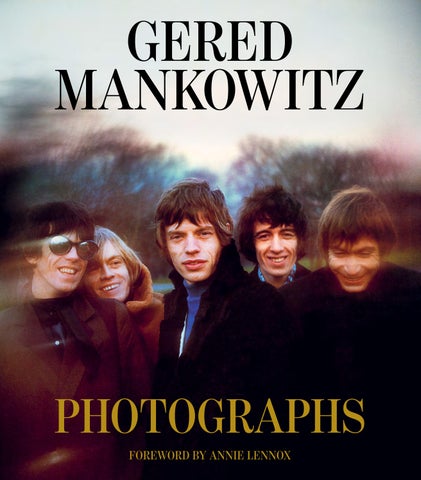
GERED MANKOWITZ
PHOTOGRAPHS FOREWORD BY ANNIE LENNOX
Contents
Foreword
Prologue
The 60s
The 70s
The 80s
The 90s
page 4
page 6
page 112
page 16
page 282
page 188
I would like to dedicate this book to the memory of my parents, Ann and Wolf Mankowitz. My brothers, Jonathan, Daniel and Ben. My dear wife, Julia, and our daughters, Jessie and Raisie, and our grandchildren, Lucas, Zachary and Ruby.
The 2000s page 308
Epilogue page 326
Foreword to Gered’s studio was always something to look forward to – “ Going we knew we’d be guaranteed some fun. We actually worked together before Eurythmics were conceived, in our previous incarnation as a punkish pop band called The Tourists. Gered had agreed to photograph our second album cover, Reality Effect, and we’d devised a concept: a white room, with white objects – table, chairs, etc. – pristine, constructed as a set within the studio. Into this environment of highly luminous colour devoid of chroma, each band member would slowly introduce their own personally squeezed paint contribution from a selection of five plastic paint bottles – our DIY Willem de Kooning-style interior decoration. The idea was to introduce each colour gradually so that Gered would have a constantly transforming subject before his camera lens. The only issue was that one of our merry pranksters had arrived a little worse for wear and was raring to go with a paint explosion. As soon as this carefully set-up idea was ready for action, from the word THREE it took just under a minute before the entire set-up was splattered in mainly blue – as evidenced by the album sleeve. Gered was somewhat taken aback, you might say… as was everyone else! In any case, it all turned out well in the end and it makes for a brilliant shared experience/memory. RIP Peet and Eddie… Much love always from yer auld Scots singer!
Annie Lennox
”
—
5
—
MARIANNE FAITHFULL I met Marianne socially in the summer of 1964, just after she had released her first single, ‘As Tears Go By’. She had an innocence and a fragility to her I found very appealing, and in spite of not feeling particularly at ease in front of the camera, she responded willingly to my basic directions, and we got some beautiful portraits. By doing several sessions together over the following weeks, we became close friends, and I hung out a lot at her Lennox Gardens flat. I started to cover her early recording sessions at Decca Studios in West Hampstead as she worked on her first albums, and suggested that a rather lovely Victorian pub I knew in St Martin’s Lane, called the Salisbury, might make a great location for a cover shot. Marianne never wore particularly explicit or sexy clothes,
—
26
—
but the combination of a buttoned-up dress and knee socks created a sense of sexuality that was both innocent and mesmerising. The crowd of blokes reflected in the mirrors behind her were much taken with her; due to their lecherous presence, Decca Records ultimately refused to use this shot on the album cover, and another one from the shoot was selected. I was with her at Bristol’s Colston Hall to see the Stones play, and that was the night when she and Mick started their relationship. I remember looking out of a window around dawn and seeing them both wandering by the river in the early-morning mist and thinking, That looks serious… Marianne and I continued to work together over the following decades, and remained friends until her death in early 2025.
—
27
—
IMMEDIATE RECORDS Rolling Stones manager and producer Andrew Loog Oldham and his partner Tony Calder formed Immediate in 1965. It was an independent label with a fantastic vision, and Andrew was a wonderful client to work with. I worked closely with many of their artists, including The Small Faces, P.P. Arnold, The Nice, Twice as Much, Chris Farlowe and Humble Pie. The Immediate office was a fun, exciting and creative place to be, and I loved working with Andrew and their incredibly talented roster of artists. I feel that much of my best work was done during their too-short existence of just five years, ending sadly in 1970. I am delighted to say that I remain close to Andrew, and to P.P. Arnold, with whom I continue to work to this day. Andrew Loog Oldham: colourised portrait. Mason’s Yard studio, 1967.
—
50
—
Twice as Much (l-r: David Skinner and Andrew Rose) and Vashti Bunyan: Twice as Much and Vashti Bunyan, photographed here on Primrose Hill in 1966, recorded one single together, ‘Coldest Night of the Year’, released by Immediate Records in 1968. Twice as Much’s album, produced by Andrew Loog Oldham, reached the singles chart with their version of the Jagger/Richards song ‘Sittin’ on a Fence’. Vashti Bunyan, disillusioned with the music business, left London for the far north of Scotland in a horse-drawn Romani caravan. There, apart from a few attempts to revive her musical career, she raised her three children and did not return to performing until some 30 years later – when she was met with considerable acclaim.
—
51
—
THE YARDBIRDS The incredibly influential supergroup, during the brief period when the band featured the lead guitars of both Jimmy Page and Jeff Beck. Photographed here in 1966 in Ormond Yard, which was on the other side of my studio.
Jeff Beck, photographed here at Mason’s Yard studio in 1967 as a solo artist, after he had left The Yardbirds and was making a record with producer Mickie Most.
“
We went along to Gered’s studio for the first publicity shots of me with The Yardbirds. It wasn’t my first professional experience with a photographer, but it was my first experience with someone of his stature. I’d had other photographs taken with various bands I appeared in during my session days, but now I had committed to The Yardbirds and stepped out of the session world – which had been quite a comfort zone – but I didn’t want that comfort. So, I was there to work with Gered. It was interesting to see where he was coming from; when you meet someone who clearly knows what they’re doing, you want to work with them. It was fascinating to see the various looks and perspectives he had achieved when we saw the proof sheets.
Jimmy Page
”
As told to Dave Brolan, published in Lid magazine.
—
76
—
—
77
—
THIEVES Mike Chapman and Nicky Chinn (whose story about this shoot is on the previous page) created this ‘supergroup’ when they brought together seven very talented session musicians, made a great album, and called them Thieves.
—
124
—
Left to right, Jerry Donahue, Sue Richman, Andrea Robinson, Gerry Conway, Steve Goldstein (sitting), Rusty Buchanan and Linda Lee Lawley. Cancún, Mexico.
—
125
—
GENERATION X Chrysalis Records asked me to work with Billy Idol and Gen X; I was delighted to shoot their first album cover and several promotional sessions. They were incredibly photogenic; Billy had great charisma and really understood the importance of image and the dynamics of photos. Left to right, Mark Laff, Tony James, Bob Andrews, Billy Idol. Great Windmill Street, 1978.
—
170
—
—
171
—
TOYAH I always enjoyed working with Toyah – she was creative and full of energy, and the shoots were dynamic and exciting. These portraits are from the session for The Blue Meaning in 1980 and the Four More from Toyah EP shoot. Old Chapel Studios, 1981.
—
192
—
—
193
—
TOYAH I always enjoyed working with Toyah – she was creative and full of energy, and the shoots were dynamic and exciting. These portraits are from the session for The Blue Meaning in 1980 and the Four More from Toyah EP shoot. Old Chapel Studios, 1981.
—
192
—
—
193
—
MALCOLM McLAREN
FUN BOY THREE
With the World’s Famous Supreme Team in his office in London’s Tin Pan Alley. 1982.
Photographed for Smash Hits magazine. Old Chapel Studios, 1982.
—
242
—
—
243
—
MALCOLM McLAREN
FUN BOY THREE
With the World’s Famous Supreme Team in his office in London’s Tin Pan Alley. 1982.
Photographed for Smash Hits magazine. Old Chapel Studios, 1982.
—
242
—
—
243
—
EDITORIAL
EDITORIAL Paula Yates was a somewhat changed person by the time we did these shots to promote her autobiography – still funny, beautiful and immensely photogenic but somehow burdened and sad. Old Chapel Studios, 1995.
—
306
—
Siân Phillips brought immense professionalism and all her skills to the studio to create this series of portraits for the poster for Marlene: A Tribute to Dietrich, a West End and Broadway success. Old Chapel Studios, 1997.
—
307
—
“Gered Mankowitz saw London the way I saw Laurel Canyon – through a lens lit with wonder, friendship, and the pulse of a moment in time. He lived among the artists he photographed, and his portraits remain some of my favorites: intimate, evocative reflections of the golden age we were lucky enough to call our own.” Henry Diltz “Gered pioneered the art of rock photography in the UK. His portraits built the iconography of many musicians and continue to inspire photographers worldwide.” Kevin Cummins “Gered has always been with me, even though I didn’t always realise it. Every now and then, another iconic image reminds me that I’ve known and loved his work my whole life.” Scarlet Page
“ To me, Gered Mankowitz always led the way in rock music photography. He was simply the best. Some of his images are so ingrained in music culture that they are the defining images of the Rock and Roll Era. Gered inspired love and trust in his subjects and it shows. This is an essential book for rock fans, photographers and museums and will be gazed upon in awe and reverence in a 100 years’ time. That’s how good it is.” Jill Furmanovsky “ I love Gered’s photos because, even after sixty odd years, they still breathe with a kind of honesty you rarely see. You feel that quick spark of real connection between photographer and subject. Whether it’s Kate Bush, The Jam or The Rolling Stones, his subjects look like who they are, I feel like I know them better by seeing his work.” Rankin
ISBN: 978-1-78884-354-6
9 781788 843546 www.accartbooks.com
58500 £65.00/$85.00