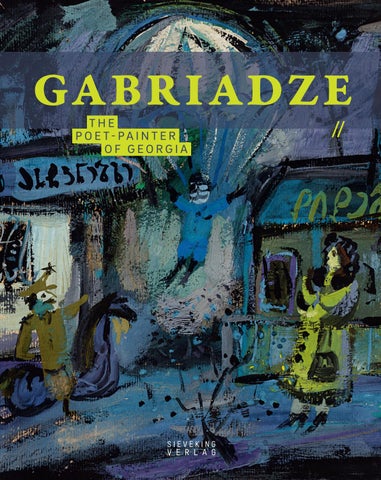
GABRI AD ZE THE P O E T- PA I N T E R OF GEORGIA
//
FOREWORD
FOREWORD
Rezo
Gabriadze
Michael Semff
T
bilisi, the cultural center of Georgia and home of Rezo Gabriadze, is—as his fellow
become apparent in all the media he employs. With the establishment of his puppet theater
countryman Zurab Karumidze has remarked—“a special site ... on the verge of the
in 1981, whose fame has spread from Tbilisi around the world, Gabriadze fulfilled what was
Occident and the Orient, a place where extremes meet and abide in difference.” The
likely his most heartfelt desire—to create what amounted to a synthesis of the arts in
country’s historical and cultural kaleidoscope is perpetually changing, and many of its artists
miniature, where he was responsible for all of the creative threads—from writing the scripts
share a sense of its subliminal meanings, both anecdotal and mythical, and its subtle humor
and directing the action to designing the costumes. In every performance since, he has
and poetic reverberations.
served as spiritus rector over this original, self-gestated world, a small yet infinite cosmos
Innately gifted with numerous and diverse talents, Gabriadze has lived them out over the
into every detail of which he has infused life, rigorously and self-critically, yet always with a
decades in an irresistible way, combining them into an inimitable idiom. Born in Kutaisi in
sense of humor and his signature warm-heartedness. With his love of music and his gentle
1936, the artist’s fame has derived, at the latest since the seventies, primarily from his
voice, it would be hard to imagine this creative spirit ever becoming loud or aggressive.
creative filmmaking—his more than thirty-five movies include such famous ones as Don’t
Gabriadze’s genius, in which intellectuality and naïve inventiveness maintain a fine balance,
Grieve, Mimino, and Kin-dza-dza. His contribution to these was that of a creative all-rounder
seems borne up by what might be called a higher sanguinity. The mood of his art entirely
who served as screenwriter and set and costume designer in one. In this context, works
lacks the obvious and the provocative. Instead, it occupies spheres in which the ancient folk
on paper—whether in the form of rapid sketches, finished drawings, or colorful, painterly
myths of Georgia subliminally reverberate. It is versatile and multilayered, sophisticated and
gouaches—already played a predominant role. After going on to finish a course in journalism,
philosophical, its poetic nature nourished by the power of the imagination.
Gabriadze felt inspired to begin illustrating his own and others’ publications. The master’s
According to Andrei Bitov, Pushkin “was never in Spain, yet he wrote about it in such a way
imagery is characterized by profundity, wit, pointedness, and an irony and satire that never
that any Russian who traveled there after him and in his stead would carry Pushkin as part
descend into cheap cynicism. He has illustrated more than fifty books, including works by
of his baggage and mutter his phrases.”2 And he wrote the poem “The Prisoner of the
renowned authors such as Alexander Pushkin, Daniil Kharms, Andrei Bitov, and Michail
Caucasus” (1821) before ever having been to the Caucasus.
Zhvanetsky. He has also produced a series devoted to great Russian minds, from Pushkin,
It is no coincidence that the kindred spirits chosen by Gabriadze over the decades seem to
Konstantin Stanislavsky, and Alexander Solzhenitsyn to Bella Akhmadulina, Bulat Okudjava,
have the character of accomplices. The figures he has created contain the fears, hopes, and
Merab Mamardashvili, and others.
dreams of these authors, with whom he has a deep affinity, and all of whom, often as near
Gabriadze’s talent for the two-dimensional arts of drawing and painting was supplemented
contemporaries, stood in subversive opposition to the political establishment of their day.
early on by a gift for sculptural expression. Back in 1952, at the age of sixteen, he had already
Still, Gabriadze’s aesthetic is entirely reflective of the autonomy of art, as far distant as
produced a bust of Nikolai Gogol that was selected for a competition on the occasion of
possible from the rules, restrictions, and logic of the real world. His everyday stories abound
the hundredth anniversary of the author’s death, held in Gabriadze’s birthplace. Further
with satire and comedy, the irrational and the unexpected, the surreal and the absurd.
sculptures are on public view in St. Petersburg and Odessa. The artist has evidently
A delicate, melancholy tone runs like a keynote through the creations of this gentle poet.
1
possessed a special sense for portraiture and physiognomy from the beginning, and this has
/ 6 /
For endnotes 1 and 2, please refer to p. 152
/ 7 /
FOREWORD
FOREWORD
Rezo
Gabriadze
Michael Semff
T
bilisi, the cultural center of Georgia and home of Rezo Gabriadze, is—as his fellow
become apparent in all the media he employs. With the establishment of his puppet theater
countryman Zurab Karumidze has remarked—“a special site ... on the verge of the
in 1981, whose fame has spread from Tbilisi around the world, Gabriadze fulfilled what was
Occident and the Orient, a place where extremes meet and abide in difference.” The
likely his most heartfelt desire—to create what amounted to a synthesis of the arts in
country’s historical and cultural kaleidoscope is perpetually changing, and many of its artists
miniature, where he was responsible for all of the creative threads—from writing the scripts
share a sense of its subliminal meanings, both anecdotal and mythical, and its subtle humor
and directing the action to designing the costumes. In every performance since, he has
and poetic reverberations.
served as spiritus rector over this original, self-gestated world, a small yet infinite cosmos
Innately gifted with numerous and diverse talents, Gabriadze has lived them out over the
into every detail of which he has infused life, rigorously and self-critically, yet always with a
decades in an irresistible way, combining them into an inimitable idiom. Born in Kutaisi in
sense of humor and his signature warm-heartedness. With his love of music and his gentle
1936, the artist’s fame has derived, at the latest since the seventies, primarily from his
voice, it would be hard to imagine this creative spirit ever becoming loud or aggressive.
creative filmmaking—his more than thirty-five movies include such famous ones as Don’t
Gabriadze’s genius, in which intellectuality and naïve inventiveness maintain a fine balance,
Grieve, Mimino, and Kin-dza-dza. His contribution to these was that of a creative all-rounder
seems borne up by what might be called a higher sanguinity. The mood of his art entirely
who served as screenwriter and set and costume designer in one. In this context, works
lacks the obvious and the provocative. Instead, it occupies spheres in which the ancient folk
on paper—whether in the form of rapid sketches, finished drawings, or colorful, painterly
myths of Georgia subliminally reverberate. It is versatile and multilayered, sophisticated and
gouaches—already played a predominant role. After going on to finish a course in journalism,
philosophical, its poetic nature nourished by the power of the imagination.
Gabriadze felt inspired to begin illustrating his own and others’ publications. The master’s
According to Andrei Bitov, Pushkin “was never in Spain, yet he wrote about it in such a way
imagery is characterized by profundity, wit, pointedness, and an irony and satire that never
that any Russian who traveled there after him and in his stead would carry Pushkin as part
descend into cheap cynicism. He has illustrated more than fifty books, including works by
of his baggage and mutter his phrases.”2 And he wrote the poem “The Prisoner of the
renowned authors such as Alexander Pushkin, Daniil Kharms, Andrei Bitov, and Michail
Caucasus” (1821) before ever having been to the Caucasus.
Zhvanetsky. He has also produced a series devoted to great Russian minds, from Pushkin,
It is no coincidence that the kindred spirits chosen by Gabriadze over the decades seem to
Konstantin Stanislavsky, and Alexander Solzhenitsyn to Bella Akhmadulina, Bulat Okudjava,
have the character of accomplices. The figures he has created contain the fears, hopes, and
Merab Mamardashvili, and others.
dreams of these authors, with whom he has a deep affinity, and all of whom, often as near
Gabriadze’s talent for the two-dimensional arts of drawing and painting was supplemented
contemporaries, stood in subversive opposition to the political establishment of their day.
early on by a gift for sculptural expression. Back in 1952, at the age of sixteen, he had already
Still, Gabriadze’s aesthetic is entirely reflective of the autonomy of art, as far distant as
produced a bust of Nikolai Gogol that was selected for a competition on the occasion of
possible from the rules, restrictions, and logic of the real world. His everyday stories abound
the hundredth anniversary of the author’s death, held in Gabriadze’s birthplace. Further
with satire and comedy, the irrational and the unexpected, the surreal and the absurd.
sculptures are on public view in St. Petersburg and Odessa. The artist has evidently
A delicate, melancholy tone runs like a keynote through the creations of this gentle poet.
1
possessed a special sense for portraiture and physiognomy from the beginning, and this has
/ 6 /
For endnotes 1 and 2, please refer to p. 152
/ 7 /
WHAT I REMEMBER
WHAT I REMEMBER
The town was built of stone, by a very ancient building culture. Our people understand stone, they know it well; they both understand and love it. When I went to Italy and France I was amazed by the similarity between their building techniques and ours. I lived on 1905 Revolution Street, just 500 meters long, in house no. 23. First came the chain bridge, the shrill roar of the river Rioni foaming beneath it. Stone houses, built a long time ago, cover the entire left bank, while the right bank and its population are even
I lived on 1905 Revolution Street, just 500 meters long, in house no. 23. / 12 /
emperor, would be swinging on a telegraph pole; the man pouring
more ancient. Later I’ll tell you more about my backyard and my
beer in the bar would be a runner straight off an Etruscan vase
neighborhood. First, let’s take a walk down the next street, one
who’d run all the way to Kutaisi!
that is twenty-six centuries old.
You never knew, but in some remote village you might see the
Three cypress trees growing in each other’s shade stand silently
broken and grass-covered remains of a stone table that had heard
together, and sway just as silently between stone walls. This is the
polyphony and remembered the smell of wine drunk before the
start of Thaelmann Street, one I used to walk down to visit my
Christian era. (Wine connoisseurs and specialists consider Georgia
private teachers when I was very small. For now, I’ll recall other
to be the home of wine.)
people.
One more feature we can talk of: Georgia sings in many voices,
A wide balcony. An elderly woman’s black eyes. She is holding
a polyphonic country, if one can put it that way. People will
hands with a child who has the same black eyes. After them a very
respectfully seek out one another on the slightest pretext for
old woman who is bent over double from radiculitis. She, too, has
merriment and singing. An “ensemble” is created before your eyes,
the same black eyes. They are trailed in ten-centimeter intervals
for an hour, from people who barely know one another, or, even
by the flu, conjunctivitis, angina, all of this covered by a black hat
better if a complete stranger comes under the balcony, even if he’s
under which you can see sad black eyes. All this is slowly, over a
a bass. This can happen for the most insignificant reasons: the
long period, crawling up toward the steps. On the other side is the
weather is good, wages have been paid, or there is a tiny bonus, a
synagogue. They will eventually get here at this pace.
fine has been annulled, a new cap has been unexpectedly received,
But in the window of the semibasement, a basement that is very
or a nail was driven into a wall with only one and a half blows of
badly lit, an ancient, aged man is lying on something even more
the hammer. Then people begin to sing!
ancient and incomprehensible. He is completely out of tune with
/ 13 /
WHAT I REMEMBER
WHAT I REMEMBER
The town was built of stone, by a very ancient building culture. Our people understand stone, they know it well; they both understand and love it. When I went to Italy and France I was amazed by the similarity between their building techniques and ours. I lived on 1905 Revolution Street, just 500 meters long, in house no. 23. First came the chain bridge, the shrill roar of the river Rioni foaming beneath it. Stone houses, built a long time ago, cover the entire left bank, while the right bank and its population are even
I lived on 1905 Revolution Street, just 500 meters long, in house no. 23. / 12 /
emperor, would be swinging on a telegraph pole; the man pouring
more ancient. Later I’ll tell you more about my backyard and my
beer in the bar would be a runner straight off an Etruscan vase
neighborhood. First, let’s take a walk down the next street, one
who’d run all the way to Kutaisi!
that is twenty-six centuries old.
You never knew, but in some remote village you might see the
Three cypress trees growing in each other’s shade stand silently
broken and grass-covered remains of a stone table that had heard
together, and sway just as silently between stone walls. This is the
polyphony and remembered the smell of wine drunk before the
start of Thaelmann Street, one I used to walk down to visit my
Christian era. (Wine connoisseurs and specialists consider Georgia
private teachers when I was very small. For now, I’ll recall other
to be the home of wine.)
people.
One more feature we can talk of: Georgia sings in many voices,
A wide balcony. An elderly woman’s black eyes. She is holding
a polyphonic country, if one can put it that way. People will
hands with a child who has the same black eyes. After them a very
respectfully seek out one another on the slightest pretext for
old woman who is bent over double from radiculitis. She, too, has
merriment and singing. An “ensemble” is created before your eyes,
the same black eyes. They are trailed in ten-centimeter intervals
for an hour, from people who barely know one another, or, even
by the flu, conjunctivitis, angina, all of this covered by a black hat
better if a complete stranger comes under the balcony, even if he’s
under which you can see sad black eyes. All this is slowly, over a
a bass. This can happen for the most insignificant reasons: the
long period, crawling up toward the steps. On the other side is the
weather is good, wages have been paid, or there is a tiny bonus, a
synagogue. They will eventually get here at this pace.
fine has been annulled, a new cap has been unexpectedly received,
But in the window of the semibasement, a basement that is very
or a nail was driven into a wall with only one and a half blows of
badly lit, an ancient, aged man is lying on something even more
the hammer. Then people begin to sing!
ancient and incomprehensible. He is completely out of tune with
/ 13 /
/ 46 /
/ 47 /
Funeral in Kutaisi
# 04 A WREATH FOR DESDEMONA, 1984
/ 46 /
/ 47 /
Funeral in Kutaisi
# 04 A WREATH FOR DESDEMONA, 1984
/ 66 /
/ 67 /
# 17 1905 REVOLUTION STREET, 1980
# 18 BOARDED-UP WINDOW, 2008
/ 66 /
/ 67 /
# 17 1905 REVOLUTION STREET, 1980
# 18 BOARDED-UP WINDOW, 2008
/ 98 /
# 43 THE PHYSICS TEACHER, 1997
/ 99 /
# 44 MILITARY TRAINING TEACHER, 1989
# 45 A COAT THAT HAS BEEN TWICE REFURBISHED, 2000
/ 98 /
# 43 THE PHYSICS TEACHER, 1997
/ 99 /
# 44 MILITARY TRAINING TEACHER, 1989
# 45 A COAT THAT HAS BEEN TWICE REFURBISHED, 2000
/ 102 /
/ 103 /
# 49 HAYDN IN THE STREET AFTER THE WAR, 2000
# 50 FEMALE FANS OF JULIUS CAESAR AT THE THEATER, 2012
/ 102 /
/ 103 /
# 49 HAYDN IN THE STREET AFTER THE WAR, 2000
# 50 FEMALE FANS OF JULIUS CAESAR AT THE THEATER, 2012
/ 106 /
/ 107 /
Circus
# 52 CIRCUS MARQUEE, 1987
# 53 BABAKHIDI, THE WHITE CLOWN, 1984
/ 106 /
/ 107 /
Circus
# 52 CIRCUS MARQUEE, 1987
# 53 BABAKHIDI, THE WHITE CLOWN, 1984
/ 135 /
# 74 ROKOSSOVSKY’S TANGO, 2003
/ 135 /
# 74 ROKOSSOVSKY’S TANGO, 2003
Editor: Dr. Michael Semff, Munich Editor’s Foreword, endnotes: 1 p. 6: Zurab Karumidze, Dagny, or a Love Feast (Champaign, IL, et al.: Dalkey Archive Press, 2014), p. 23. 2 p. 7: Andrei Bitov, Georgisches Album: Auf der Suche nach Heimat [Georgian Album: In Search of Home], trans. Rosemarie Tietze, new exp. ed. (Berlin: Suhrkamp Verlag, 2017), p. 269. Design and Production: Sieveking Verlag, Munich Copyeditor: Rebecca van Dyck, Hannover, DE Translation from Georgian and Russian: Donald Rayfield, Sevenoaks, UK Translation from Germann: John Gabriel, Worpswede, DE Rezo Gabriadze initially wrote his autobiographical essay in Russian, and later in his native language Georgian. It is no surprise that the two versions of the essay differ. The translator could therefore draw on the wealth of two originals—a rare stroke of luck. The original contribution by Andrei Sarabianov was written in Russian, the editor’s foreword in German. © 2018 Sieveking Verlag, Munich © 2018 Rezo Gabriadze and authors Published by Sieveking Verlag www.sieveking-verlag.com ISBN 978-3-944874-90-6 Printed in Germany