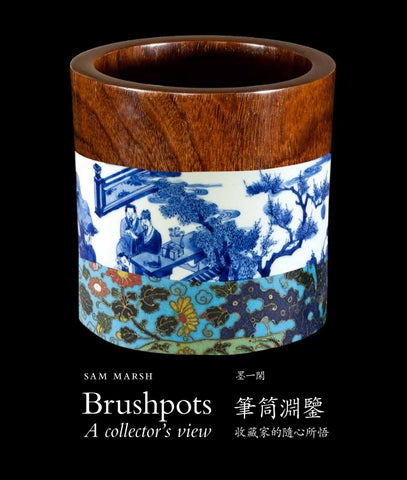
Sa m M arsh
墨一閑
Looking at brushpots
Fig. 1: m b 06 圖1:MB 06
Fig. 2: pb 75 圖2:PB 75
I n th is a rticle I attempt to explain some of my thoughts on the origins and dating of brushpots. Over time new pieces that can be accurately dated will be discovered, perhaps from a shipwreck or an archaeological excavation, and this could change the story, but the following are my conclusions based on currently available information. Brushpots have been described as the quintessential possession of a Chinese scholar, but this does not always seem to have been the case. As early as the Southern and Northern Dynasties (420-589 ce), the Four Treasures of the Study 文房四寶 were listed as being ink, ink-stone, paper and brush, but there was no mention of a brushpot. The origin of the brushpot, as we now recognise it, has been much discussed, but there seems to be very little evidence of brushpots – either in tombs or paintings – before the reign of the Ming Wanli Emperor (1573-1620). The pewter spill vase (Fig. 1) dates from the Wanli (1573-1620) reign; the shape seems to have been ‘softened’ in porcelain (Fig. 2) until it eventually became round, but note it still has an integral stand (Fig. 3, p. 92). At the same time, the use of the vessel may have changed from a spill vase to a small brushpot. We know that by the reign of the Chongzhen Emperor (1628-1644) brushpots were being produced and used, as we can see a painted brushpot – with brushes in it – on a desk in Fig. 3, but this is a narrow form and note it is on an integral stand. Around the same time, we see the appearance of a larger, heavierbased form, such as the example in Fig. 4 (p. 94), dated 1635, which is today the more recognisable form of a brushpot. Colin Sheaf has suggested this shape became popular because its wide cylindrical surface was ideal for decorating. The examples in Figs. 4 and 5 are contemporary in date but show the large, heavy style of brushpot contrasted with a narrower, lighter form. It is interesting to note that the integral stand has been dropped and that both brushpots have a flat unglazed base. Both the large, heavy style and the narrow, lighter style continue for some 20 plus years until the start of the Kangxi (1662-1722) reign, when we start to see a move away from the flat unglazed base to a glazed base with a grooved foot – as in the example shown in Fig. 6, dated c. 1672. Of course, the ‘grooved foot’ base style did not last very long as the kilns in Jingdezhen were largely destroyed during the Revolt of the Three Feudatories 三藩之亂 (1673-1681).
筆筒鑑賞 本文嘗試說明一下我對於筆筒的起源及斷代的看法,屬
景德鎮瓷窯在1680年代重開時,筆筒形制仍可大概分為兩
個人一點淺見。當新的考古發掘材料出現時,這些觀點自須
種:一種高度與直徑相差不遠,另一種較輕盈,直徑較小,高
修訂。以下論斷均基於目前已有的資料所作出。
度比直徑尺寸大。但約於1680年,筆筒底部的造型卻有很大
筆筒被視為中國讀書人不可或缺的案頭清翫。但最早見
變化,底部一半有釉,中間凹臍處亦有釉,其上偶有釉下彩
於南北朝(420-589年) 時期的「文房四寶」一說,四寶所指
款,屬典型康熙風格。
的是紙、筆、墨、硯,並沒有筆筒一物。 關於筆筒的起源已有很多論述,但似乎在明萬曆以前,無
底部有一圈無釉,代表筆筒入窯燒時是置於座上。至於陶 工為何採用此種相對繁複的做法,將底部局部上釉,原因不
論是墓葬出土或是歷代繪畫上,都極少看到筆筒的蹤影。
明。有一個解釋是,有加釉就不會弄花木案面。我個人就會
上圖錫製六方瓶 (圖1) 屬萬曆時期所製,此器形在瓷器上
選擇把筆筒放在絲質墊子上。
(圖2) 亦可見,但線條相對顯得柔和。類似器型最後演變成
雖然這種底部半上釉的造法較為複雜,卻是最常見的,
圓筒狀,但仍保留著外撇的底部,如同底座一般。同時,在
至今亦如此。
功能性上也從瓶子演變為筆筒。
檢視筆筒底部時,可進一步了解其胎體、釉質、製作年份
明朝崇禎時期,已有製作及使用筆筒,從青花筆筒 (圖3,
及方法等。我在本圖錄中歸納出各時期底部造型的變化,但
頁92) 外壁圖中,可看到文人桌上放著窄長的筆筒,底部做
當然這些變化規律有時也會有例外,讀者可以特別留意以下
法像是一個訂製的底座。
幾個特例。
器形較大的筆筒大概是在同一時期出現,如1635年製的
圖7一例底部在釉下刻雍正款,中央大塊凹臍處有上釉,
筆筒 (圖4,頁94),該器形是目前大家比較熟悉的。施福先生
外面一圈無釉。這種雍正刻款非常罕見,但除了底款外,這
曾推斷,此器形之所以受歡迎,是因為比較容易在外壁繪畫
種半上釉的底部我則在同期筆筒上見過。
紋樣。
圖8四小足,其它乾隆時期的四足筆筒包括LB 01 (頁80)
圖4及圖5中兩例乃同期所燒製,但器形不一,可供對比參
與JB 02 (頁12),分別是漆器和玉器例子。
考。有趣的是,兩器皆沒有底座式的底部,外壁直身沒有外
當您提起一隻筆筒時,可以感受到其重量,仔細觀察一下
撇,底部皆平坦無釉。
其釉色,判斷胎質是粗是幼?胎色白否?再觀其器形設計,
這兩種形制 (一種比較寬大,另一種比較窄長) 的製作持
外壁圖畫等。您亦可判定紋飾色彩是否與製作時期相符。
續了二十多年,直到康熙初年,開始出現有坑紋的足部,底部
此外還有更多要注意的細節。總之,上手筆筒越多,經驗越
施釉,就如圖6一例,年份定於1672年左右。
豐富,上述特點會越加明顯,對筆筒了解就越深。
有坑紋的圈足製作時期不長,因為不久之後三藩之亂 (1673 – 1681年)使景德鎮的瓷窯大都摧毀,破壞了瓷器 的生產。
Fig. 3: pb 63 (p. 92) 圖3:PB 75 8
9
Fig. 4: pb 58, dated 1635 (p. 94) 圖4: (頁94)PB 58,1635年製
When the Jingdezhen kilns reopened in the 1680s, the brushpots were still more or less divided into two styles: the first, in which the height is not dissimilar to the diameter, and the second smaller, lighter style where the height is significantly greater than the diameter. However, the base of the brushpots changed profoundly c. 1680 CE, into what is often referred to as ‘Kangxi style’, with a part-glazed base with a recessed, glazed, centre ‘button’, which may or may not carry an underglaze mark. The fact that this style has an unglazed circle on the base suggests that it was fired in the kiln on a stand. Why the potter should wish to adopt this more complicated procedure no one seems to know. One explanation could be that the glazed foot of the brushpot means that it would not scratch your polished wooden desk. Personally, I would have made life easy and stood the pot on a piece of silk instead. Despite the complications that are caused by finishing the foot in this manner, this part-glazed style is the most common finish for brushpots, and is used even today. By looking at the base of a pot, you can learn a lot about the clay, the glaze, possibly when or how the pot was made. I have tried to suggest that the way in which the base was finished varied over time. However, like all suggested rules, there are exceptions in every era. I would like to draw your attention to a few of these exceptions. The base of the example in Fig. 7 (p. 172) has an incised underglaze Yongzheng (1723-1735) mark, a large recessed glazed area and a wide unglazed foot. The underglaze Yongzheng mark is very rare, but I have seen the wide unglazed foot used on other pots of this period. The brushpot in Fig. 8 (p. 262) stands on four small feet. There are other fine Qianlong (1736-1795) brushpots which stand on similar small feet; see LB 01 ( p. 80) for this style in lacquer and JB 02 (p. 12) for a jade example. When you pick up a piece of porcelain, you can feel the weight of the piece – is it heavy or light? You can look at the glaze, and ask, for instance, how well does it adhere to the body? What is the body clay like? Is it rough or smooth, white or coloured? Look at the shape and the design of the pot, look at the painting. Are the colours what you would expect from this date? You should undoubtedly look at many other aspects as well, but the more pots you handle, the clearer some of these features become, and the more they can tell you about the brushpot.
Fig. 6: pb 25 (p. 118) Base with Kangxi mark and grooved foot 圖6:PB 25 (頁118) 雙圈足與底部康熙六字款
Fig. 7: PB 45 (p. 172) Base with Yongzheng mark
Fig. 5: pb 12, dated 1643 (p. 102) 圖5:PB 58,1635年製 (頁102)
圖7:PB 45 (頁172) 底款「大清雍正年製」
10
Fig. 8: PB 38 (p. 262) Marked ‘Qianlong yuzhi’ (Qianlong imperially made) 圖8:PB 38 (頁262) 朱印款識「乾隆」、「御製」
The Four Professions
漁樵耕讀
T h is squa r e f lat-si de d brush pot is made from a grey-green celadon-coloured jade with flecks of white. These white patches have been cleverly incorporated into the design of the sides to suggest features in the landscape, such as clouds and rocks. Stone of this colour became less fashionable at court after 1759, because after Xinjiang was conquered by China, a new source of fine white jade became available. However, jade carvers would still have had access to celadon-green jade boulders. The pot is expertly carved from one piece of jade and stands on four little feet, which are set well back from the edge. This position is very similar to the feet of a white square jade pot of similar size, but with landscape decoration, which is in the Palace Museum, Beijing, dated by them as mid-Qing.1 The inside of the brushpot shows subtle tool marks, where the jade was worked with discs and abrasive sand. Remember, when the pot was made no modern carving tools were available. Jade being harder than steel, the workers had no way of cutting it, so it had to be ground away. The removal of the cylindrical inside core of the pot must have been an unbelievable effort, but this ‘core’ would have been saved and used to make perhaps a jade animal. The four sides are decorated with subtly incised scenes, now gilded, of the ‘Four Professions’ – woodcutter, scholar, fisherman and farmer – all with matching couplets.2 Woodcutter: ‘[There is] a sound of firewood being loaded as the monkey cries at dusk.’ Scholar: ‘Wild pears and dates stop the cries of my little boy . . .’ No Phenergan in those days! Fisherman: This couplet is a Daoist thought on the subtle strength of water: ‘The metal is too hard and the wooden handle too weak to cleave the clear stream.’ Farmer: ‘As the man tends the bamboo, the rain stops and the field is fragrant.’ jb 02 | H 14 cm · w 9.5 cm Provenance Spink, London Notes 1 Classics of the Forbidden City: Scholar’s Paraphernalia, Forbidden City Press, Beijing, 2010, p. 58, pl. 34 2 Although this grouping of Four Professions seems rather random to us in the 21st century, it would have made perfect sense 300 years ago. These four professions were regarded as the most basic and humble pursuits in an agricultural society. Associating yourself with them was a way of displaying your humility. Even now modern readers of the famous Chinese martial arts novel The Legend of the Condor Heroes (1957-1959) by Jin Yong know that the Dali Emperor was protected by four guardians – scholar, woodcutter, fisherman and farmer – each armed with their personal weapon: pen, axe, fishing pole and rake.
12
此方型筆筒以青玉製成,工匠巧妙地運用玉石中的白斑㸃來呈現圖中的雲 和石等細節。清朝征服新疆後,宮廷開始獲得大量純白玉,也因此從1759年 後,青玉開始不太受歡迎,但還是會有青玉提供給工匠來進行雕琢。 此器以單一件玉材製成,底部的四足距離邊沿頗遠。此項特徵與北京故宮 所藏的一件清中期白玉方筆筒如出一轍,且兩器大小相若。[1] 此筆筒的內部有細微的磨痕,是雕琢過程中留下的痕跡。當時沒有現代的 工具,有時無法進行切割就只能用磨蝕方法處理玉材。要將筆筒內部玉材挖 空並非易事,而挖出的玉經常會保存下來,用以雕刻如小動物等玉件。 筆筒外壁上刻畫漁、樵、耕、讀四種職業,並有描金,配上詩句襯托圖畫。 JB 02 | 高14公分,寬9.5公分 來源:倫敦Spink [1] 《故宮經典: 文房清供》,紫禁城出版社,北京,2010年,頁58,圖34
Lucky rats
福鼠
I n m a n y pa rts of Ja pa n, worshippers rejoice when rats eat some of the kagami-mochi 鏡餅 (New Year rice cakes) left at the altar, as it is believed that this heralds a bumper harvest and a prosperous New Year. Also, people born in the Year of the Rat (1936, 1948, 1960, 1972, etc.) are believed to be charming, honest and ambitious, working hard to achieve their goals. Since you ask, no, my birth year is not the Year of the Rat. This ivory brushpot is superbly carved with numerous rats with amber eyes, climbing over rice baskets and each other. They have even started to eat away at the base of the pot. It is going to be a very good year. Around the rim are carved some of the takaramono 宝物 (Precious Objects) – the wheel, the conch shell, the umbrella, the canopy, the lotus, the vase, the paired fish, and the endless knot. These are all Chinese emblems but are sometimes used in Japanese art with slightly different interpretations. The pot is signed Masakuza 正 一, who died in 1891 and adopted the artist name of Kihōdō 奇峰堂. He was a prolific carver of wood and ivory netsuke featuring rats, but this piece, being so large, is a true tour de force. Perhaps this was made for a special client or an International Exhibition. Probably carved around 1880.
在日本各地均有此習俗:新年用來祭神的鏡餅(一種米造的餅食),如有 老鼠在祭台上偷吃一些,即表示來年五穀豐登,生活富足。屬鼠的人(於 1936、1948、1960、1972等年出生),一般認為性格靈活聰敏,人緣甚佳,會為 了達成目標而積極進取。我本人則不是鼠年出生。 此象牙筆筒巧妙地雕滿許多老鼠,都嵌有琥珀眼睛,爬在米筐上,互相堆 疊扭作一團,從底下看像咬穿了筆筒底部,生動活潑,象徵新一年如意吉祥。 沿口則雕有佛教的八件寶物(又稱八吉祥):法輪、寳螺、法傘、寶蓋、蓮花、 寶瓶、雙魚、無盡意結 (盤腸)。有時候道教的八寶 (暗八仙) 會與佛教的八寶 產生混淆,道教八寶即:扇、魚鼓、蓮花、葫蘆、寶劍、花籃、橫笛、陰陽板。上 述都是中國藝術中所見的寶物,在日本也有採用,但有稍微不同的解讀寓意。 此器署名正一所造,應為奇峰堂正一所刻。該藝術家在 1891年去世前曾 雕製衆多以老鼠為題材的木及象牙根付(墜子),此器屬於他的傑作,可能為 某位特別的客人或為國際展覽而作。 雕刻年份或為1880年。 IB 01 | 高14 公分,直徑11公分 來源: 倫敦S. Marchant & Son
I b 01 | H 14 cm · di a 11 cm Provenance S. Marchant & Son, London
70
72
72
Three Kingdoms
三國群雄
T h e sce n e decor at i ng this ivory brushpot is thought to be from The Romance of the Three Kingdoms 三國演義, one of the four great classics of Chinese literature. The story begins with the famous line, ‘It is said that what has long been divided in this world will inevitably unite, and that which has long been united will inevitably divide’ 話說天下大勢,分久 必合,合久必分. The Romance of the Three Kingdoms is a 14th-century historical novel attributed to Luo Guanzhong 羅貫中. It is an epic tale on the theme of human ambition. In the book there are villainous officers, treacherous eunuchs, death and betrayal and lots of battles. It remains an insightful look at how power can be maintained, and how it can be lost. The story centres on the events surrounding the end of the Han dynasty (220 CE). Three feudal lords emerge, each one vying for power – Liu Bei, the heir apparent of the dynasty; Sun Quan; and lastly the treacherous and bloodthirsty Cao Cao. Liu Bei decides to seize his birthright and there is much fighting, the famous naval Battle of the Red Cliff being but one engagement. Despite the fact that elephants were rare by the Tang dynasty, even in south and south-eastern China, ivory and bone carving has a long history in China, and has always been a luxury item. Ivory has a creamy white body with fine grain and smooth texture, which allows for fluid carving. The material can be polished to a soft lustre, and will retain its beauty if it is cared for. Carved ivory plaques have been found at the Neolithic site of Hemudu, Zhejiang province (c. 5500-3300 BCE). The late Shang dynasty (1200-1059 BCE) royal tombs at Xibeigang, Anyang province, revealed a small number of ivory vessels as well as ornamental pieces. Little ivory has been found in Han dynasty sites (206 BCE -220 CE), although some bi-shaped discs, a bracelet and some sword fittings were found in a Western Han tomb. Ivory was used more extensively in the Tang dynasty (618-907 CE), including for musical instruments and rulers. Uses for ivory in the Song period (960-1279) include the decoration of carriages and horse fittings. The Yuan (1271-1368) royal houses made extensive use of ivory in decoration, but ivory had been imported in significant quantities from Africa at least as early as the Tang dynasty, and in the Song dynasty was also part of tribute from states such as Khotan. The vast majority of surviving ivory works of art date to the Ming (1368-1644) and Qing (1644-1911) dynasties, and indeed by the end of the Ming officials carried an ivory sceptre as a mark of rank. Suzhou, Jiangsu province, about 100 kilometres south-west of Shanghai, which was famed for its wealth and beautiful gardens, became a centre for carving during the middle Ming dynasty. Later, during the Qing dynasty, ivory carving was categorised into two schools. The Northern or Beijing style favoured more natural designs and liked a high polish. The Southern or Canton style favoured elaborate carving and intricately worked designs. This elaborately carved brushpot, standing on a finely worked integral stand, with soldiers leaving a castle gate and going off into the forest, fits neatly into the Canton style. Due to its nice patina, I am dating it to about 1890. i b 06 | H 15 cm · di a 9 cm Provenance Berwald Oriental Art, London 74
此象牙筆筒上所雕的應是《三國演義》中的故事。 《三國演義》第一回裡著名的開場語是:「話說天下大勢,分久必合,合久 必分。」 《三國演義》是中國四大名著之一,原著小說據說出自元末明初羅貫中手 筆。故事講述漢末群雄爭霸,天下三分,北方魏國的曹操、東南吳國的孫權、 西方蜀國劉備,鬥智鬥力,角逐中原。其中如赤壁之戰等多場戰爭的描述、 人物性格的刻劃,精細入神。 雖然大象少見於中國,但到了唐代,象牙雕刻已有很長歷史,是珍貴的奢 侈品。由於象牙紋質細密,肌理柔順,非常適合雕刻。牙雕表面可抛光至亮 麗,而且只要保養得當,可經久不減其光澤。 以象牙雕成的牌子曾在浙江河姆渡的新石器時代 (約公元前5500 – 3300 年) 遺址發現,而少量象牙製的器皿更在安陽西北岡的晚商 (公元前1200 – 1059年) 王陵中被發掘出土。漢代 (約公元前206 – 公元後220年) 遺址很少有 發掘象牙雕刻,只有一個西漢墓中曾發現象牙璧形珮、手鐲及劍鞘配件等。象 牙在唐代(618 – 907年)較為廣泛使用,作為樂器及間尺等。宋代時期(960 – 1279年)則有用象牙來作車及馬的配飾。元代(1271 – 1368年)皇宮中更是 大量使用象牙作裝飾。事實上自唐代開始已有大量象牙從非洲輸入中原,宋代 更有從于闐 (和田) 等地區進貢的象牙。現存的象牙藝術品大部分是明清時期 的製品,晚明官員更會佩帶牙杖以示權貴。 明代中葉,蘇州成為牙雕中心,而到了清代,牙雕分為北派 (或京派) 及南 派 (或廣東派),前者較喜用自然的設計,打磨特別光亮,後者雕工則更為繁複 細緻。 此象牙筆筒雕工精巧,底座十分講究,以深雕描繪士兵離開城門的場景, 屬典型的廣東派作品。從表面光澤上看,我認為此筆筒約製於1890年。 IB 06 | 高15公分,口徑9公分 來源: 倫敦Berwald Oriental Art
The scholar collector buys a contemporary brushpot Joh n Be rwa ld
鑑藏家的現代青花筆筒 貝瓦德
閶門古吳越,陳椽如鱗比。骨董大紛雲,請從
In old Suzhou, at Changmen the city gate, Many shops stand neatly in rows of fish scales. Among the most numerous are antique shops. People in high places are so proud of their connoisseurship, They will keep on buying with all the money they have. How many authentic antiques can there be? No wonder the market is filled with forgeries. Shao Changheng (1637-1704)
書畫起。鐵石充逸少,朱繇作道子。 – 邵長蘅 (1637一1704年) 《贗骨董》
鑑藏家撫案沉思:「世上可有多少古董真品?」以他多年逛古董店的經驗, 他知道真品確實是越來越少了。 他凝視桌上的筆洗、筆山、插屏、水注等等,都是歷代珍品,也是在贗品充斥 市場前就買下的。
The scholar sat quietly at his painting table musing over this very question: how many authentic antiques can there be? Having visited antiques shops for many years, he concluded that the answer was undeniably fewer and fewer. He looked down at the pieces arrayed on his table, treasured items collected over many years. The brush washer and brush rest, the table screen and water dropper, all from previous dynasties and purchased well before the flood of forgeries had polluted the market. Curiously, there amongst the objects sat a piece of recent manufacture. It might well have been considered an interloper, there amongst the artists’ accoutrements from earlier dynasties, but while it was new it was certainly no forgery. The piece was a beautifully painted blue and white brushpot, tall and cylindrical in form. He remembered how excited he had been when it was first unwrapped and shown to him by his dealer, a man he had known for many years and whose judgement he respected. Being offered a contemporary ceramic had been a new and intriguing experience. After giving it some thought he had decided to judge the brushpot on two levels: with the eye of an experienced collector used to appraising pieces from the past, and as a member of the literati and an accomplished artist in his own right. On both levels he soon decided that the piece was comparable in quality to any ceramic he had seen produced at the famed Jingdezhen kilns in the past. The painterly hand delighted his artistic eye, particularly as the style echoed that of earlier masters, while the format, suggestive of a handscroll wrapped around a porcelain canvas, allowed for great freedom of expression. He mused that it would be the brilliance of the painter’s hand and the sureness of the potter’s, not the signature of a well-known artist, that would cause people to admire this remarkable brushpot in the future. 76
奇怪的是,這些古物當中有一件新製的作品,顯得格格不入,雖然是新造, 卻不是仿製的贗品。 這是一個造型簡約而美觀的青花筆筒,他記得古董商初次向他展示該筆筒 時,他有眼前一亮之感。那位古董商是他相熟多年的朋友,所以他相信他的鑑 賞眼光。 他還是頭一遭以潛在買家的身份與當代瓷器相遇,在考慮過後,決定以兩 種角度來審視此物。首先以一位資深藏家的視角,像判斷古物一樣檢視筆筒, 另外則以文人兼藝術家的身份去鑑賞。 無論從哪一種角度來看,他的結論都一樣,認為此筆筒的品質毫不比景德鎮 古代的作品遜色。那活潑卻又摹古的繪畫筆觸讓他眼睛一亮,而那將瓷土轉變 成畫軸般的形制也使得藝術表達更加地自由。 他仔細琢磨著,或許將來的人會因為畫家動人的筆觸與陶工精湛的技藝而 欣賞此筆筒,並不需要有名家的落款。 他的古董商朋友經常在抱怨,如今市面真品稀缺,而且太多富商不惜代價購 買,導致價格不斷地上漲。 這一點他也知道,因為商人賺了錢都想建立自己的收藏,附庸風雅一番。 雖然在儒家思想中,無論商人賺了多少錢財,其社會地位都及不上一個身無 分文的書生,但古董藝術市場上,各階層任何人士均可參與,只要有錢即可。 由此之故,真品越來越少,而需求卻越來越大,導致更多贗品的出現,隨而 改變了欣賞藝術品的準則。 現在連近代作品也被欣賞及收藏,就像眼前的筆筒,無論其年份久遠與否, 只要文人學者認為它美觀就已足夠。
77
194
194
Boy with frog
劉海戲蟾
I bough t t h is at t r act i v e, small, turquoise, later Kangxi period (1662-1722) brushpot because it had a cute scene of a boy up a tree, who has been startled by a frog which appears from under a rock. After further investigation, the explanation of the scene is much more interesting. The small boy is in fact the immortal God of Wealth, Liu Hai 劉海, in his youth. He usually carries a string of coins, with which he teases the three-legged toad (三 足蟾 sanzuchan), who is thought to live in the moon. To quote the excellent book Hidden Meanings in Chinese Art: Revered as the God of wealth, Liu Hai was actually a historical figure from the Han dynasty (206 BCE – 220 CE) who was once prime minister . . . One day he encountered a Taoist adept, who asked for ten eggs. The stranger proceeded to stack the eggs into the shape of a pagoda with coins in between. ‘Isn’t that dangerous?’ asked Liu Hai. ‘As dangerous as this merry world,’ said the Taoist adept. In a flash, Lui Hai became enlightened and left the world of mortals. The toad is an icon of wealth because of its association with Liu Hai.1 The brushpot would have first been fired unglazed, then dipped in rich turquoise enamel and fired for a second time at a lower temperature ‘on the biscuit’. These enamel glazes, being heavily fluxed, melt at a lower temperature than glaze and also have a tendency to run and pool, as in this example. The flat unglazed base shows the mark of cloth that the piece would have rested on whilst it dried. pb 59 | H 9.5 cm · di a 4.5 cm Provenance S. Marchant & Son, London Note 1 T. T. Bartholomew, Hidden Meanings in Chinese Art, Asian Art Museum of San Francisco, 2006, p. 150.
196
這個小巧可愛的孔雀藍釉筆筒, 是康熙 (1662 – 1722年) 晚期的作品。當 初買入時純粹被其有趣的圖像所吸引: 一個小男孩被一隻從石下爬出來的 蟾蜍嚇著了,躲在樹上。 後來翻查資料才發覺這是劉海戲蟾的故事。俗語說「劉海戲金蟾,一步一 吐錢」,由於金蟾能吐出錢來,於是劉海被視為有生財的法力,而三足金蟾也 成為民間流行的風水擺設物,除了可生財,據說還可辟邪、化小人。歷史上劉 海蟾是五代時人,曾為丞相,後得道成為道教全真五祖之一。民間故事說他 用一串金錢釣到海中的三足蟾,而這三足蟾據說也變成月亮上供嫦娥居住的 廣寒宮, 故又稱蟾宮。 製作此筆筒時,需在上釉前先窯燒一次,然後澆上孔雀藍釉,再以低溫複 燒一次。孔雀藍釉比一般釉的熔點低,因此流動性大,容易凝聚在凹陷的部 位,此一特色在此筆筒上也可見到。 復燒完畢後,將筆筒放在布上風乾。平坦而無釉的底部上,因而留下了布 紋的痕跡。 PB 59 | 高9.5公分,直徑4.5公分 來源:倫敦S. Marchant & Son
PB 49
PB 37
PB 48
PB 49
PB 37
PB 48
Carved elegance
素影浮瑩
T h e r e is a grou p of porce la i n wa r e s, often comprising scholar’s items, that seems to appear in the mid-Qing period (1820 onwards) with little warning and few if any precursors. These are the sophisticated biscuit-style carved porcelains. The reasons for their appearance are complex and not well understood; however, by the middle of the Jiaqing reign (1796-1820), because of financial constraints, the palace workshops in Beijing were beginning to close. The craftsmen in these workshops would have been some of the very best in their disciplines, whether it was carving jade, ivory, rhinoceros horn, painting or calligraphy. Presumably even in the different workshops within the palace ateliers, these craftsmen from all over the empire would have been able to swap techniques. The craftsmen would have known of the previous emperor Qianlong’s enjoyment of items which were not what they seemed – a porcelain masquerading as bronze, an ivory stained to resemble jade, glass made to look like realgar, and so on. These craftsmen would have had a reasonably steady salary. This situation is quite unlike that at the potteries at Jingdezhen, which has always been a factory town. At this time, the 19th century, porcelain wholesalers would have placed orders with middlemen, who in turn would have talked to the private kiln owners, informing them what the market wanted. The kiln owners were still at the mercy of the kiln gods and so if a firing was poor, no one would have got paid, certainly not the artist potter who was one of last in the line. These next three pots are different. Each piece was ‘one of a kind’. The scholar or wealthy merchant could thus show off his sophistication to his friends with a carved brushpot, seemingly of the finest ivory, and then enjoy their shouts of amazement when they realised the pot was in fact made of porcelain. This might explain why, for almost the first time, some of the best artists started to sign their work. Even in those days there was cachet in ‘designer’ labels, whether on a painting, an ink stick, a bamboo carving, a Dehua statue or a Yixing teapot. However, perhaps because of the painstaking nature of this technique, the fashion, at its finest, did not last too long. The Taiping rebels destroyed the Jingezhen kilns in 1855 and they were not revived for almost two decades. You can find carved wares even in the Republic times (1912 onwards), but in most cases the quality is lower. Even at the height of the fashion for carved porcelain, between 1820 and 1850, the quality varied rather like that of the products of a Flemish painting workshop; items might be made by the master or the chief assistant, or by apprentices, and so on down the line. As some of the artists seem to have had their own workshops, and as the output of these workshops could vary in quality, dating can be problematic. Some seal marks appear to denote the artist who made the piece, yet another fine piece seemingly by the same hand may have no mark. Sometimes the seal mark might refer to the patron, whilst other pieces may carry an apocryphal Kangxi or Qianlong reign mark. All that said, there are three artists who stand out from the crowd. These are Chen Guozhi 陳國治, Wang Bingrong 王炳榮 and Li Yucheng 李裕成.
自清中葉開始 (1820年起),一種特別的文房用瓷器橫空出世,那就是無釉 素燒雕塑瓷器。似乎無人真正了解此種瓷器面世的真正原因。在嘉慶年間, 由於財政緊絀,北京很多宮廷作坊都因此停止生產。無論是玉雕、象牙雕、犀 角雕或書畫,這些宮廷匠人的工藝水平當然是行內最頂級的。來自五湖四海 的工匠們擅長多種才藝,且能在宮廷的各個作坊中勝任不同的製作技巧。他 們的作品也承襲了來自先帝乾隆的特殊品味: 他特別喜愛以假亂真,例如製 作模仿青銅的瓷器、模仿玉器的染色象牙、模仿雄黃的料器等。 相較於景德鎮窯口技師靠成品計酬,宮廷作坊中的匠人收入相對穩定。在 十九世紀時,買家會透過仲介下訂單購買瓷器,仲介再向窯廠的管理人匯報 市場所需,倘若天公不作美,窯燒過程失敗,作品達不到買家要求,所有人都 分不到錢,遑論最底層的工匠了。 雕塑的瓷器每件都獨一無二,文人雅士或富有的商家可以拿來向朋友炫 耀自己的品味,遠觀乍看如頂級的象牙雕刻,湊近一看卻發現實則瓷雕,不 禁嘖嘖讚嘆。 可能因為瓷器上首次出現工藝師的簽署,在當時塑造了所謂的「名牌效應」, 同樣的現象也反應在書畫、墨硯、竹雕、德化白瓷雕塑、宜興紫砂茶壺等。 但雕瓷製作的風氣並不長久,或許是因為工藝要求太 高而導致燒成難度 提升。而1855年太平天國軍隊嚴重破壞景德鎮瓷窯,導致歷經二十年仍舊無 法復窯生產。直至民國年間雕瓷工藝再現,但工藝水平已普遍下降。 由於有時工藝師會假手徒弟或助手,因此即便是在雕瓷製作的 高峰期 (1820 – 1850年),器物的品質就像法蘭德斯大師的畫作一樣參差不齊。有些 工藝師或有自己的工作坊,出品不同種類及素質的器物,也因為種類繁多使 其 年份很難已斷定。作品更是時而有款,時而無款,款式可能是工藝師的個 人印款、出資人的名稱或是仿古的康熙或乾隆寄託款。 有三位雕瓷大師值得一提:陳國治、王炳榮及李裕成。 PB 37的筆筒雖無款,但傳是陳國治 (c.1800 – 1860) 的作品。他是極具 天賦的陶瓷畫家及雕刻家,可說是道光時期最多元化的陶瓷藝術家,當時就 已經享負盛名。金武祥在《粟香隨筆》中提到:「道光時,有鎮人陳國治者, 彩畫雕鏤,名重一時,又不輕作,每一器值數十金。」 PB 48的筆筒底部有王炳榮 (1820 – 1875) 款。王炳榮是道光期間,營造 作品市場價值最成功的瓷器雕刻家,陳國治在太平天國之亂後不久去世,相 對王炳榮的作坊則很快恢復製作,並持續數十年,讓其設計能維持一貫風格。 如此器上所見,他喜歡留白,作品並經常有一層薄薄透明釉。他的印款有時候 是刻上的,或如此器所見採模印上款。若採模印則其表面應是乾淨而非滿釉。 PB 49的筆筒無款,施透明黃釉,圈足無釉,未知出自哪位藝術家,但紋飾 精美,描繪牡丹、壽石及鳥兒。 關於雕瓷藝術的更多討論,參考苗學禮及許建勳著 《素影浮瑩: 景德鎮 清末雕瓷》,香港中文大學文物館,2006年。 PB 37 | 高14.5 公分,直徑 12.5 公分 來源: 倫敦 Robert Kleiner & Co. PB 48 | 高14.5 公分,直徑 13 公分 來源: 倫敦 Robert Kleiner & Co. PB 49 | 高13 公分,直徑 7.5 公分 來源: 倫敦 Robert Kleiner & Co.
200
PB 48
COLOPHON
墨一閑
Sa m M a rsh
筆筒淵鑒: 收藏家的隨心所悟
b r u s h p o t s : a c o l l e c t o r’ s v i e w
Contributors: Academic advisor: Translators: Chinese editors: English sub-editor: Photography: Design: Print:
Joh n Be rwa ld Rose m a ry Scot t Le i la de Vos Va n St e e n w ij k Rose m a ry Scot t Hoi- Ch eong Ch a n, I v y Ch a n I v y Ch a n, Ch i h-E n Ch e n mona ga i n e r-sa li m Joh n F i tzge r a ld | SE St u dio Sy lph E di t ions De sign sy l, ba rce lona
專文:
貝瓦德
蘇玫瑰
吳夜蕾
學術顧問: 蘇玫瑰 翻譯:
陳海昌 陳以昕
中文編輯: 陳以昕 陳之恩 英文校對: Mona Gainer-Salim 攝影:
John Fitzgerald | SE Studio
設計排版: Sylph Editions Design 印刷:
SYL, Barcelona
本書的中文題名《筆筒淵鑒: 收藏家的隨心所悟》,分別借引自清聖祖康熙《御定淵鑒 類函》及明萬曆《龍膺集》。「淵鑒」一詞假其原意,代表了本書試圖搜羅涵蓋各式筆 筒,強調收藏的廣度以及圖像立論,如同一本筆筒百科全書。此外,「鑒」為鏡子,用以 照面整容,也代表了藏家在鑒賞玩味中亦是自我省思成長。「隨心所悟」出自龍膺筆下 『隨身住處即一乘,隨心所悟為三昧。』龍膺(1560-1622年)乃晚明著名政治人物,對 儒釋道均參悟頗深,故撰《龍膺集》以抒懷。其文透過對日常之物的理解而悟道,與本 書遙相呼應,故以借題。 陳之恩 (Chih-En Chen) 五月二十六日 記於英國倫敦
The Collector’s Personal Chop: Mo Yi Xian is the Chinese name of Sam Marsh given by Chih-En Chen, inspired by Shu Shi’s The Dragon Tail Song: ‘I was born between Heaven and Earth as an idle thing; Master Su is also a man at odds.’ The chop was carved by Professor Cheng-Jung Lin from Normal University in Taipei.
筆筒淵鑒主人私章: 墨一閑為《筆筒淵鑒》作者Sam Marsh的 中文名,由陳之恩取自蘇軾《龍尾硯歌》 中所述「我生天地一閑物,蘇子亦是支離 人」。私章則委由師範大學美術系林政榮 助理教授所刻。