AR+D
AR+D
6
LOGISTICAL FULFILLMENT
MATERIAL FULFILLMENT
24
72
PREFACE Ashley Bigham
CLOUDS Leigha Dennis
BUILDING WITH AIR Ang Li
10
38
82
ON FULFILLMENT Ana Miljački
16
FOREWORD Keith Krumwiede
18
CONTRIBUTOR BIOGRAPHIES
NATURES OF FULFILLMENT Jesse LeCavalier
FULFILLED Michelle Chang
48
CLEANING UP Miles Gertler
ANTHROPOFORMING, OR LIVING WITH OUR SELVES Curtis Roth
60
92
104
OUT OF FAVOR Ashley Bigham
POSTCOMMODITY STRATEGIES FOR POSTCOMMODITY TIMES Laida Aguirre
AR+D
CULTURAL FULFILLMENT
EXHIBITION: FULFILLED
116
144
REAL ESTATE BUBBLE ARCHITECTURE Lluís Alexandre Casanovas Blanco
IF IT FITS, IT SHIPS® Ashley Bigham
RETURNED John McMorrough
148
176
FULFILLED EXHIBITION
126
172
ACKNOWLEDGMENTS
BLANKETS Current Interests
132
THE ARCHITECTURE OF DESIRE: AN ESSAY IN VI TANGOS Cristina Goberna Pesudo
138
UNMARKED GRIEF: THE INSTITUTION OF SILENCE The Destitute Institute
AR+D
6 FULFILLED
PREFACE Ashley Bigham
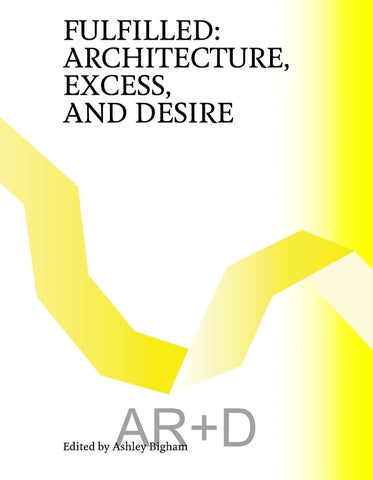
Based on the eponymous symposium and exhibition, Fulfilled: Architecture, Excess, and Desire considers the role of architecture in a culture shaped by excessive manufacturing and assuagement of desire. Until the term became synonymous with Amazon warehouses, the concept of fulfillment described the achievement of a desire— sometimes tangible, often psychological or spiritual. With the rapid growth of e-commerce, our understanding of fulfillment has evolved to reflect a seemingly endless cycle of desire and gratification—one whose continuity hinges on our willingness to overlook the cultural, economic, and environmental impacts of our ever-increasing expectation of quick and efficient fulfillment. A closer look at fulfillment reveals a social, typological, formal, aesthetic, and economic practice constructed collectively through both digital and physical interactions. It is a cultural practice which evolves like a language, both universally transferable and contextually specific. As a symposium, exhibition, and now publication, this project aims to draw out these new arrangements, sticky relationships, and material byproducts of cultural production and to ask again the age-old question, “What does it mean to be fulfilled?”
AR+D
LOGISTICAL FULFILLMENT
AR+D
24
CLOUDS Leigha Dennis
FULFILLED
To have and not to have, to own and to crave, finally collapsed in a single emotion. —Rem Koolhaas, Junkspace (Quodlibet, 2006): 151.
Clouds is a photo essay that documents the self-storage industry as cloud storage for domestic objects. If digital clouds provide data storage with remote servers, then aren’t self-storage facilities the analog clouds for our homes?
AR+D
CLOUDS — DENNIS
AR+D 25
FULFILLED
AR+D
26
AR+D
47 NATURES OF FULFILLMENT — LECAVALIER
erist leisure complexes such as server farms and regional distribution centers proliferate. Polluted parcels ironically create new forms as multiple species find ways to make do. This logistical-natural co-construction of the Meadowlands tells a story about the larger global entanglements between the two. Attending to these dynamics can help find ways of working that understand and take seriously the needs of those (human and non-human) for whom and for which the Meadowlands is important without assuming or repeating familiar development logics. As a complement to historical research into the Meadowlands, Natures of Logistics is a graphic documentation and speculative project about the potential of industrial vernacular to merge with in-site remediation efforts to create a series of “minor” infrastructures. By accepting the potential of its limited agency, distributed infrastructural installations can provide just enough repetitive recognition to give permission to explore, inhabit, and advocate for this place—as many already do. As this emergent collective language intersects with in situ remediation processes, new forms of nature emerge that are neither the sublime nature of wilderness nor the “tamed” nature of agriculture but a more unruly logistical nature that brings with it new landscapes, forms, and publics.
48 FULFILLED
ANTHROPOFORMING, OR LIVING WITH OUR SELVES Curtis Roth
AR+D
Painting produced with a software that allows online workers to exchange drawing labor for stock in a painting. Curtis Roth, Stock Painting 1 (2020).
AR+D
1 Keller Easterling, Subtraction, Critical Spatial Practice 4 (Sternberg Press, 2014). 2 Ibid.
63 POSTCOMMODITY STRATEGIES FOR POSTCOMMODITY TIMES: AN EVOLVING TOOLKIT — AGUIRRE
* Accounting: keep receipts Care: keep packaging and do not damage * goods B. Related scholarship — Easterling’s “Subtraction” Keller Easterling’s book “Subtraction” * asks architects to consider the possibilities of designing with intention for a building’s eventual removal. While design for subtraction, or building removal, offers more opportunity for design, it also provides an economy that “must also deploy active forms … time-released protocols that generate or manage these exchanges with a stream of objects and spaces.” Subtraction is “a heavy industry, a source of employment, a material resource, a global environmental protocol, and an alternative market that escapes the dominance of the Protecting returns. stock-a-studio. financial industry.”1 Courtesy of Laida Aguirre. * Easterling asserts that the subtraction economy “almost exists,” noting that the “creative trick lies in designing its political disposition—the spin that gives the idea enough traction and scale to interrupt free-market doom loops or other political stalemates.”2 * As global e-commerce exacerbates overconsumption by way of convenience, designing through the return policy can be an effective method to enact Easterling’s provocation. C. Work example: STOCK INSTAGRAM — 2015–2020, Instagram — Project: Construction product representation project that uses Instagram to create an alternative and speculative material catalog. — Concerned with access to material resources, the project takes advantage of big-box store return policies to create over 600 images by purchasing, staging, photographing, and returning construction materials on a $200 credit. — Reauthors off-the-shelf materials to create a new catalog. — Examines the ways we can reframe products and readymades as future-minded design elements that can compel new subjectivities, and with them, new forms of world-making and representation while shedding the ownership tendencies associated with commodities. — A scrappy, resource-limited approach to architectural projects that tries to take advantage of a commercial loophole. — Deploys conventional commercial gimmicks like fetishizing objects through portraiture, studio lighting, and calculated backdrops, yet creates no added commercial value. — This project did not affect the sale of cinder blocks or flexible PVC plumbing elbows in any given month. What STOCK really proposed was a method of producing a lot from very little, often proposing entire worlds using a single material texture or image. — Engages not only the spatial products of architecture but the material economies within which they exist and rendered explicit the often-silent
64
—
economies of architectural projects, big and small. Allows for the production of an extensive body of work while sidestepping many of the usual flaws of the temporary architectural project: waste, lack of sufficient funding, storage fees, etc., while, admittedly, exchanging those for my own labor.
FULFILLED
2. RESURFACE A. Main — Design for keeping — Spatial commodity resurfacing services that refresh architectures and furniture by simply changing the surfaces in order to renew or widen their appeal and keep them from being discarded. — Intends to re-appeal to our aesthetic desires by changing the surfaces of our existing commodities as a way to lessen waste. — Responds to the closed loop of influence between material and culture: to make it cool again is to renew our desires to keep things we already own. — Main assumption: We don’t throw away Furniture resurfacing. stock-a-studio. things that we continue to like. Courtesy of Laida Aguirre. — Main tactics: * Renew surface while maintaining material core intact Requires fine-grain material knowledge such as adhesiveness, * elasticity, product interaction specifications. B. Related scholarship — Sianne Ngai’s Our Aesthetic Categories: Zany, Cute, Interesting * In her book, Ngai lays out that the cute has to do with consumption, particularly with how we construct relationships with the objects we consume. The zany, she argues, has to do with production, and more specifically with the sorts of performance involved with contemporary labor. The interesting, finally, has to do with circulation, and draws attention to the relentless streams of information associated with advanced capitalism.3 — Iñaki Ábalos’s “Warhol at the Factory” * From 1962–1984, an industrial space turned social hub whose interior was fully wrapped in rugged tin foil became the creative pulse of the Beat generation. Otherwise known as Warhol’s “Factory,” the uncommon decor gave the otherwise “more neutral industrial space a progressive and contestatory charisma, a seductiveness” as well as an air of avant-gardism, which gave the space an identity as an urban commune but would later be commercialized into the notion of the “NY loft artist” space. In “Warhol at The Factory: from Freudo-marxist communes to the New York loft”, Iñaki Ábalos understands this as the
AR+D
3 Sianne Ngai, Our Aesthetic Categories: Zany, Cute, Interesting (Harvard University Press, 2015). 4 Iñaki Ábalos, “Warhol at The Factory: From Freudo-marxist communes to the New York loft,” The
Good Life: A Guided Visit to the Houses of Modernity (Park Books, 2017).
In her book Not One Day, the OuLiPo’s first female member and writer extraordinaire Anne Garréta describes a collection of women, unfolding 12 stories where the flashing fragility of desire shines as something alive, autonomous, and wayward.2 Where beauty is drawn as both, a retroactive elegy and a death, announced. An Architecture of Desire by definition is always aware of its end. But the end of architecture never seems to be contemplated, as its decay and destruction are historical taboos. Cristina Goberna Pesudo, “Suite Tokyoite,” The Book of Sins: Lust (2018).
“When will a Pritzker prize be given for the elimination of a building?” Keller Easterling asks in her book Subtraction, quoting A. P. Leeuven who lines up a number of built works that he assures share high and similar heights of bad taste.3 Gordon Matta Clark’s work Office Baroque was commissioned in 1977 by the International Cultural Centre in Antwerp to carry out a project in an empty office building, which he consequently proceeded to cut. In an interview published for the exhibition catalog, he explains how he received many positive letters about his piece. The angry ones, though, were penned by architects. One claimed that he had violated the building’s dignity by transitioning it to ruin or demolition; others accused him of holding an ideological position that was perfectly opposite to the role of the professional architect and everything related to solving human problems. Desire raises a tsunami of dilemmas. And the Architecture of Desire never solves problems.
AR+D
1 Tango: Interaction marked by a lack of straightforwardness. Something that, like desire, you have to dance to the end. 2 Anne F.Garréta, Not One Day, translated from the French by Emma Ramadan. Deep Vellum Press, 2017. 3 Keller Easterling, Subtraction, Sternberg Press, Critical Spatial Practice 4, Berlin, 2014.
133
Desire is the end of reason, a notorious little death, or a death straight. Death is associated with tears, and sometimes the sexual act is associated with laughter. But laughter is not so much the contrary of tears, just as tears are not so much the contrary of ecstasy most of the time.
THE ARCHITECTURE OF DESIRE: AN ESSAY IN VI TANGOS — GOBERNA PESUDO
I: The End
134
II: Unreason Our appetite for reason is also never enough. Searching for an end raises desire and by definition defies reason. The ultimate end of desire, as of love, is its rationalization. As Slavoj Žižek claims, if you know why you love someone, then you surely don’t really love them. An Architecture of Desire rejects reason. For their ’67 graduation Diplôme Collectif, the Parisian group A. J. Aérolande, founded by Jean Aubert, Jean-Paul Jungman, and Antoine Stinco, submitted an inflatable at the École de BeauxArts, an institution that measured quality by the degree of mastery of neoclassicism and adjacent styles. The inflatable in question not only defied the heavy structures of Beaux-Arts architecture, but also its representation. It was based in unreason: As a premise it was going to be rejected, as it was a projection toward an uncertain architectural future we did not yet have the means to build.
Cristina Goberna Pesudo, “Suite Tokyoite,” The Book of Sins: Lust (2018).
It was pure Architecture of Desire. III: Seduction The most sexual part of sex is not about gratification but about anticipation. The Architecture of Desire is a promise, a striptease in the making, erotism versus pornography, a field of exploration and a land of discovery, the foresight of worlds yet to come, of societies yet to arrive. Architecture is, historically, a dream of dreams, nightmares incorporated.
FULFILLED
Seduction is the opposite of what pornography offers. Pornographic language doesn’t play but communicates information instead. Pornography destroys desire in a more efficient manner than repression. Seduction versus pornography operates within architecture as the difference between a vibrant space for citizens, as opposed to a perfect area for consumption; the difference between an agora and a mall; the difference between an architec-
AR+D
Cristina Goberna Pesudo, “Suite Tokyoite,” The Book of Sins: Lust (2018).
149 AMELYN NG
A/P PRACTICE
AR+D
FULFILLED EXHIBITION
ANG LI
150 BESLER & SONS
FULFILLED
BUREAU SPECTACULAR
COMMON ACCOUNTS
AR+D
FULFILLED
AR+D
170
171 Fulfilled (2020). Photo: Erik Herrmann. Courtesy of Outpost Office.
FULFILLED EXHIBITION
AR+D
AR+D