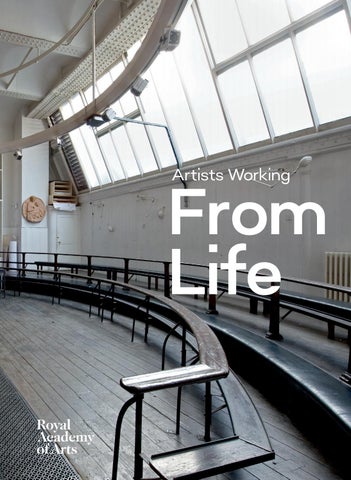
Artists Working
New 7-11-2017___RA_FROM_LIFE_001-025_FINAL.indd 3
07/11/2017 13:09
Contents 8
Introduction Rebecca Salter, Keeper of the Royal Academy
10
Looking at Life Drawing: From the Renaissance to the Royal Academy Annette Wickham, Curator of Works on Paper
26 32 38 46 52 60 68 76 82 88 94 102 108 114 122 128 136 142 150
Ellen Altfest Cai Guo-Qiang Jeremy Deller Stephen Farthing Lucian Freud Antony Gormley David Hockney Chantal Joffe Michael Landy Liane Lang Farshid Moussavi Humphrey Ocean Eddie Peake Cathie Pilkington Bridget Riley Jenny Saville Yinka Shonibare Gillian Wearing Jonathan Yeo
157
Contributors Further reading Acknowledgements
158
New 7-11-2017___RA_FROM_LIFE_001-025_FINAL.indd 5
07/11/2017 13:09
New 7-11-2017___RA_FROM_LIFE_001-025_FINAL.indd 6
07/11/2017 13:09
10
Looking at Life Drawing From the Renaissance to the Royal Academy Annette Wickham, Curator of Works on Paper
Charles West Cope RA’s depiction of a life class taking place at the Royal Academy in 1865 is an evocative image that seems to sum up the conventions of traditional academic training. The young, exclusively male, art students sit at their easels in a semicircular formation, facing a nude male model who strikes a heroic pose on a dramatically lit platform. The atmosphere among the students appears to be one of intense concentration on their task, which is to render the figure before them in black and white on a standard-size sheet of paper. Although traditional, these conventions give rise to various questions, especially if one looks at the scene with no prior knowledge of art history. Why, for instance, is life drawing usually a collective
New 7-11-2017___RA_FROM_LIFE_001-025_FINAL.indd 10
activity? Why do the models invariably have to be nude? And why was the life class – for centuries – the mainstay of art education, even for artists who did not intend to spend their career depicting figures? The answers lie in the Renaissance origins of life drawing. Like so many other innovations of the Renaissance, the evolution of the life class was inspired by the art of the classical world. As more and more ancient Greek and Roman statues emerged from excavations in Italy and beyond, it was immediately clear that their naturalistic yet highly idealised forms were the work of artists with a thorough understanding of the human body. Direct observation and
Charles West Cope RA Life School, Royal Academy 1865 Etching 15.2 x 24.7 cm Royal Academy of Arts, London
07/11/2017 13:09
11
Michelangelo Buonarroti Studies for the Libyan Sibyl (recto) c. 1510–11 Red chalk on paper 28.9 x 21.4 cm The Metropolitan Museum of Art, New York
study of the figure, Renaissance artists concluded, were the key to achieving similar results or even surpassing them. Michelangelo, in particular, was a prolific draughtsman whose surviving works include many striking figure studies and preparatory drawings for his major works. It was a logical step for artists to study anatomy and to draw from nude models, despite moral qualms over both. Theoretical justification was provided by the Italian architect Leon Battista Alberti in his treatise On Painting (1435). He recommended the following process in preparing a figurative painting: ‘Before dressing a man we first draw him nude, then we enfold him in draperies. So in painting the nude we place first his bones
New 7-11-2017___RA_FROM_LIFE_001-025_FINAL.indd 11
and muscles which we then cover with flesh so that it is not difficult to understand where each muscle is beneath.’ As Alberti suggests, life drawing was not seen as an end in itself, at least not for students. It was the ultimate stage in learning to draw, and was only to be approached after a prescribed course of preliminary studies, among them copying prints and drawings, drawing from ancient statues (or plaster casts of the same) and studying anatomy and the theory of perspective. This established progression is synthesised in an illustration in Diderot and d’Alembert’s eighteenth-century Encyclopédie (see overleaf). Students’ familiarity with the approved body types, poses and expressions of antique
07/11/2017 13:09
14
sculpture is also emphasised by the presence of casts after the Farnese Hercules, the Venus de’ Medici and other canonical works. An anonymous ‘young painter at Paris’ in May 1764 described the Académie royale life class: ‘there were at least 200 students, in a large hall … all busy copying from a living man, who was placed naked in a reclining posture … There are two rows of benches round the room; the highest for the statuaries [sculptors], the other for painters; every one has his own light placed at his right hand … There are students here from all parts of the world.’3 This British student had seen nothing quite like it at home. That is because a century of debate over the advantages and disadvantages of academic art education in Britain preceded the foundation of the Royal Academy of Arts in London in 1768. Several less formal art schools and associations, some providing life drawing, existed in various parts of Britain before this date, but the Royal Academy was the first state-sanctioned art school in the country to be set up along the lines of continental academies. As such, it aimed to raise the status of British artists and equip a new generation of art students with the necessary skills to produce paintings, sculpture and architecture that would be on a par with the achievements of the Old Masters and their classical precursors. Life drawing was crucial to this mission. When Johan Zoffany celebrated the foundation of the institution with his group portrait of the Academicians (1771–72), it is revealing that he chose to depict his fellow members gathered together in their Life Room. George Michael Moser, the first ‘Keeper’ (or head of the RA Schools), is busy setting the pose of the model. Intriguingly though, closer inspection reveals that none of the artists looks as if he intends to do any drawing. It has been suggested that Zoffany was playfully echoing Raphael’s Vatican School of Athens and tapping into the idea of an academy as a place of debate. Even though they are not actually drawing, there is a sense of the artists’ shared pride
New 7-11-2017___RA_FROM_LIFE_001-025_FINAL.indd 14
at having finally secured a national academy in Britain to promote the practice. The two curious oval portraits of women on the right of Zoffany’s painting are also significant. They depict the Royal Academy’s two female Foundation Members, Angelica Kauffman and Mary Moser. Unlike their male colleagues, they could not be shown attending the life class on the grounds of moral propriety, but Zoffany managed to shoehorn them in at one remove. The Academy’s attitude to women artists was only to become more problematic as time went on. Despite numerous women exhibitors at the annual exhibitions, no more female Academicians were admitted until the twentieth century. Likewise, no female students were enrolled in the Schools until 1860, when Laura Herford applied, giving only her first initial and surname. It was assumed that L. Herford was male and ‘he’ was offered a place. To their surprise, the Academicians found no written rule excluding women and Miss Herford was admitted. Others followed, but the women were initially confined to drawing casts and it was not until 1893 that they were allowed to draw from the male model – and then only if he was wearing a voluminous length of fabric thoroughly wrapped around his bathing trunks. There was one role in which a woman was welcome in the early days of the Royal Academy: as a model. This was a significant departure from continental academic tradition, which focused exclusively on the male figure, following the Renaissance theory that upheld the male body as the ‘perfect’ measure of all things (epitomised by Leonardo da Vinci’s Vitruvian Man). The Royal Academy preferred to follow the tradition of its less formal predecessors in London, including the private drawing school run by William Hogarth, which had always featured models of both genders. Once it was taking place in a group setting at an official teaching institution supported by the King, the practice of drawing from the female nude became more socially acceptable. However, the
Johan Zoffany RA The Academicians of the Royal Academy 1771–72 Oil on canvas 101.1 x 147.5 cm Royal Collection Trust, London
10/11/2017 08:17
New 7-11-2017___RA_FROM_LIFE_001-025_FINAL.indd 15
07/11/2017 13:10
26
Ellen Altfest New York-based painter Ellen Altfest (b. 1970) is known for canvases that capture male figures and natural objects in meticulous detail, the result of many hours of careful observation working from life. The artist’s paintings of bodies are tightly cropped, focusing on fragments of her male models’ forms.
The American painter Ellen Altfest once spent thirteen months in the Connecticut woods working on a single painting; her subject was an A4-size section of the trunk of a fallen tree, which she reproduced to scale on an A4-size canvas. She worked on Tree (2012–13; see page 31) in solitude through the winter cold and the summer heat to capture every crease and fold in the bark, every lacy filigree of moss, every variation in the leaves on the forest floor. Altfest’s forensic intensity is also focused on the human body, and if her artistic predecessor for Tree was Albrecht Dürer with his Great Piece of Turf (1503; Albertina, Vienna), for her paintings of bodies it is perhaps early Lucian Freud or the hyper-realism of Australian sculptor Ron Mueck. As with Tree, these paintings do not capture the whole subject, but just an individual part, in isolation. The Butt (2007), for example, is just that – a close-up of the lower back and squashed buttocks of a man sitting on a paint-spattered studio stool. There are no legs and no head; this is a slice of a person whose
New 7-11-2017___RA_FROM_LIFE_026-157_FINAL.indd 26
sole distinguishing feature is his hirsute back and the dense cluster of hairs at the cleft of his buttocks. The shape of the sitter suggests that he possesses some heft but Altfest offers no clue as to his looks nor to his identity. He has been deconstructed and turned from something recognisably human into an abstract shape. In her method Altfest takes the routine of the life class to its extremes. Drawing from life, she says, is ‘like all languages, something it is best to learn young’. Although she learnt the traditional way, from plaster heads, from casts of the flayed figure and eventually from the living model, she works only on parts, rather than using that training to treat the whole human body. Painting the whole figure ‘would take me forever’, she says. ‘I like choosing what the viewer looks at. The full figure can be generic, so I crop it.’ Altfest thinks of her pictures in terms of a related group rather than a concerted series: she doesn’t need one painting of each constituent part of the body. When she first started painting
The Butt 2007 Oil on canvas 33 x 33 cm
07/11/2017 14:13
New 7-11-2017___RA_FROM_LIFE_026-157_FINAL.indd 27
07/11/2017 14:13
32
Cai Guo-Qiang Chinese artist Cai Guo-Qiang (b. 1957) is celebrated for his signature use of gunpowder in drawings, paintings and spectacular events. Trained in stage design at the Shanghai Theatre Academy, Cai also produces mixed-media sculptures, installations and social projects. He is based in New York, where he has been the subject of shows at the Metropolitan Museum of Art (2006) and the Solomon R. Guggenheim Museum (2008).
Cai Guo-Qiang is most famous for using gunpowder as his paint and the sky as his canvas. He orchestrates awe-inducing pyrotechnic pieces that, he has said, seek ‘a sense of the eternal from the ephemeral’. But like many artists acclaimed today for radical processes, Cai came of age as a young artist while working from life. He began as a teenager, during the 1970s, taking his drawing materials around his home town of Quanzhuo in China, accompanied by his friends and family – his father, Cai Ruiqin, was a gifted traditional brush painter and calligrapher. ‘We went to farms and factories to portray the working people,’ recalls Cai. These were the years of the Cultural Revolution and Mao Zedong had dictated that art must serve the state by glorifying the proletariat. ‘On the rare occasions that I drew from models, I drew myself or other male friends. I only started figure drawings of nude models in college. From this experience of sketching, I learned about the relationship between the artist and
New 7-11-2017___RA_FROM_LIFE_026-157_FINAL.indd 32
subject, and about another person’s body, both physically and metaphysically.’ Western artistic processes such as working from life gained a foothold in China during the nineteenth century, as European imperialism exerted cultural influence. In the 1910s and 1920s, after the establishment of the Republic of China (1912–49), a new generation of art educators – many of whom had spent time in Europe – ensured that China’s art schools embraced Western techniques. These included making copies from casts of classical sculpture, a process that, in earlier centuries in Europe, had to be mastered before students could progress to living models. Yan Wenliang, for example, who founded the Suzhou Art Academy in 1922, shipped home hundreds of classical casts on his return from France. The practice of working from casts and models persisted through Mao’s years, when the state demanded heroic representations of the human form, and it continues to be a central element of Chinese art education today.
Self-portrait: A Subjugated Soul 1985/89 Gunpowder and oil on canvas 167 x 118 cm Collection of Leo Shih
07/11/2017 14:13
New 7-11-2017___RA_FROM_LIFE_026-157_FINAL.indd 33
07/11/2017 14:13
38
Jeremy Deller Jeremy Deller (b. 1966) is a British conceptual artist known for orchestrating large-scale collaborative projects, which often result in mixed-media installations and performances. His interest in music has led to several projects, including Acid Brass (1997), in which a brass band performed acid house. Winner of the Turner Prize in 2004, Deller lives in London and represented Great Britain at the 55th Venice Biennale in 2013.
On 21 February 2016 a group of 22 artists arrived at the New York Academy of Art for a life-drawing class. Ranging in age and artistic experience, they settled into their spots, arranged their materials and awaited the model. But there was another artist involved – Jeremy Deller, who had organised the class in collaboration with the Brooklyn Museum. The British conceptual artist had conceived the life class as an artwork in itself. The model was the musician Iggy Pop. ‘Most life models are anonymous,’ explains Deller, looking back at the work, Iggy Pop Life Class, one year later. ‘Their identity doesn’t interfere with the execution and appreciation of the drawing.’ Deller chose Iggy Pop for what his body means in cultural terms. Since the late 1960s, it has been more than flesh and bone; in half-naked form it has leapt, dived, thrashed and writhed on stage in angry performances, making it, in Deller’s words, ‘emblematic of the art form that is rock music’. By studying this body attentively, representing its every inch on
New 7-11-2017___RA_FROM_LIFE_026-157_FINAL.indd 38
paper, the participants were documenting an aspect of modern culture. Sixty-nine years old at the time of the life class, Iggy Pop has continued his stage theatrics as he has aged, and his still-muscular body remains magnetic and a central part of his on-stage persona. As Deller remarks: ‘We’ve watched that body change over nearly 50 years. At a certain point bodybuilders, wrestlers, boxers and athletes stop showing their body, because it’s past its absolute prime, whereas Iggy is quite happy to keep on showing it as it changes.’ The life-drawing class saw Iggy Pop captured in a range of styles, paralleling the diversity of ways in which he is perceived by the public. ‘I didn’t want just 22 accomplished, realistic drawings of him. We included people in the class who had only been drawing for a week, alongside people who had been drawing all their lives. I wanted a real breadth of interpretations, from the very detailed to an expressionistic vernacular. It was important there were different views of
Iggy Pop Life Class 2016 New York 21 February 2016 Organised by the Brooklyn Museum Overleaf left: Dancing Faun Nineteenth century Plaster cast after a Roman original by an unknown sculptor 151 cm high Royal Academy of Arts, London Overleaf right: Iggy Pop performing at the Apollo, Manchester, 25 September 1977
07/11/2017 14:13
New 7-11-2017___RA_FROM_LIFE_026-157_FINAL.indd 39
07/11/2017 14:13
60
Antony Gormley Sculptor Sir Antony Gormley OBE RA (b. 1950) creates wide-ranging figurative works whose basis is his own body. Winner of the Turner Prize in 1994, the London-based artist is celebrated for his public sculpture, which includes the 20-metre-high winged figure Angel of the North (1998) in Gateshead and Another Place (2007), comprising 100 cast-iron figures facing towards the sea from a Merseyside beach.
Antony Gormley has always been inclined to think that the Western tradition of working from life misses something essential: namely, life. ‘At art school, I had a really uncomfortable feeling during life-drawing classes that we were ignoring the main subject, which was the sensation of living. The Life Room was denying the most interesting thing. My memory of the Life Room is of a strange place where a real body was turned into a landscape – or, more to the point, an object. People were supposed to reproduce it dispassionately in two dimensions.’ So Gormley looked for ways of making art that was true to life. ‘From the late 1970s and early 1980s, by treating my own existence as subject, instrument and material, I tried to make the most accurate account I could of a moment of being. I was more interested in living inside a body than making a reproduction of what it looked like from the outside. In other words, I wanted to ask what it felt like to be alive and to see if there were ways of
New 7-11-2017___RA_FROM_LIFE_026-157_FINAL.indd 60
notating the answer. I felt that there were a number of ways that you could make the subject – the body – your tool.’ He tried some of these out as a teacher of art at Maidstone, then Brighton. ‘In classes I would lead exercises in which I would get one student to stand behind another and draw all over his or her body with a finger. Then the subject was supposed to replicate the feeling of the mark of the finger on his or her body on a piece of paper.’ Alternatively, he would ask the students ‘to do internal mapping, to feel the Earth pushing up against their feet and to try and follow that load-path.’ These exercises were ways of recognising, in the artist’s words, ‘what it feels like to inhabit a body’. This became a major theme in Gormley’s own art as it developed, as he began moulding his own body, the procedure by which much of his work was made in the 1980s and 1990s. ‘In my earlier work the moulds were empty, void and often sealed,’ Gormley recalls. ‘Then I went on to making massive solids from the inside of the moulds.’
INTO THE LIGHT 1986–87 Lead, fibreglass, plaster and air 193 x 50 x 38 cm Overleaf left: SCAFFOLD VII 2016 4 mm square section stainless steel bar 193.2 x 36.2 x 46.7 cm Overleaf right: GAZE III 2015 Cast iron 193.4 x 49 x 35.5 cm
10/11/2017 08:20
New 7-11-2017___RA_FROM_LIFE_026-157_FINAL.indd 61
07/11/2017 14:14
New 7-11-2017___RA_FROM_LIFE_026-157_FINAL.indd 74
07/11/2017 14:14
New 7-11-2017___RA_FROM_LIFE_026-157_FINAL.indd 75
07/11/2017 14:14
122
Bridget Riley One of Britain’s most significant living artists, Bridget Riley CH CBE (b. 1931) has explored the interaction of form and colour since the early 1960s, when she first began developing her dynamic geometric works that trigger optical sensations of vibration and movement. In 2010 the National Portrait Gallery in London – the city where she lives and works – presented ‘Bridget Riley: From Life’, an exhibition of her little-known life drawings.
Like most younger people thinking of a career as a painter, an eighteen-year-old Bridget Riley began by going to art school. She arrived at Goldsmiths in London in 1949. ‘Very slowly I began to find out what I didn’t know, what I could find out, and whom I could find to teach me, which is always a difficult thing.’ She counts herself fortunate that her drawing master, Sam Rabin, was an exponent of draughtsmanship in the tradition of Henry Tonks (1862–1937). The latter, a plastic surgeon during the First World War and later a teacher at London’s Slade School of Fine Art for many years, had taught earlier generations of British artists, David Bomberg, Paul Nash, Stanley Spencer RA and Gwen John among them. And what did he impart? Riley sums it up as ‘French classical drawing’ – in other words, a tradition that flowed back through Degas and Ingres to Raphael and the Florentine Renaissance. Looking back, Riley recalls that she realised that life drawing was ‘a firm and solid discipline’, and she was thankful to
New 7-11-2017___RA_FROM_LIFE_026-157_FINAL.indd 122
practise it. This might seem surprising, since her mature work is superficially very different from that of, say, Bomberg or Spencer. For one thing, it is abstract. But, she emphasises, the most important lessons she learnt were not about naturalism. ‘The way Sam Rabin taught drawing was not an approach to realism. It was not about verisimilitude. It was about re-creating a visual experience that had taken place in three dimensions on a two-dimensional surface. So it was actually very abstract.’ Like many teachers imparting the elements of drawing, Rabin taught only by demonstration. ‘Words wouldn’t come into it,’ she reflects, ‘but it was still a process of thought.’ For the young Riley, those life classes constituted ‘a most important piece of structural thinking’. Rabin posed questions rather than giving instructions. ‘For instance, he would say, “What is the model doing?” You would think it was quite obvious, because you were both looking at her. He was hoping for an answer such as “She’s standing” or
Young Girl Early 1950s Sepia Conté crayon on paper 56.5 x 38.5 cm
10/11/2017 08:50
New 7-11-2017___RA_FROM_LIFE_026-157_FINAL.indd 123
07/11/2017 14:15
New 7-11-2017___RA_FROM_LIFE_026-157_FINAL.indd 134
07/11/2017 14:15
New 7-11-2017___RA_FROM_LIFE_026-157_FINAL.indd 135
07/11/2017 14:15
First published on the occasion of the special exhibition project ‘From Life’, Royal Academy of Arts, London, 11 December 2017 – 11 March 2018
EDITORS’ NOTES Unless otherwise stated, all works of art are by the artist whose interview they illustrate. Dimensions of works of art are given as height before width (before depth).
Virtual Reality Partner ILLUSTRATIONS Cover and pages 2–3: the interior of the RA Schools Life Room. Photograph by Marcus Leith
Project Partners
Page 4: Jenny Saville, Umbilical (Study), 2009. Graphite on watercolour paper, 89 x 70.7 cm Pages 6–7: Ellen Altfest, Torso, 2011, Oil on canvas, 26 x 35.2 cm
EXHIBITION ARTISTS Modern and contemporary artists whose works featured in the exhibition, alongside historic and documentary works from the Royal Academy Collection, included: Ellen Altfest Cai Guo-Qiang David Dawson Jeremy Deller Lucian Freud Antony Gormley Chantal Joffe Michael Landy Liane Lang Humphrey Ocean Farshid Moussavi Jenny Saville Yinka Shonibare Gillian Wearing Jonathan Yeo ARTISTIC DIRECTOR Tim Marlow EXHIBITION CURATOR Adrian Locke EXHIBITION ORGANISATION Lucy Davis Rebecca England Rhiannon Hope Cassandra Needham Andrea Tarsia Anna Testar PHOTOGRAPHIC AND COPYRIGHT CO-ORDINATION Caroline Arno LIFE-DRAWING CLASSES Artists who taught life-drawing classes as part of the special exhibition project included: Francis Bowyer Eliza Bonham Carter Stephen Farthing Michael Landy Humphrey Ocean Cathie Pilkington Chris Wilkinson ACADEMIC PROGRAMMES AND LEARNING Mary Ealden Ann Gilmore
New 7-11-2017__RA_FROM_LIFE_158-160_FINAL.indd 160
Pages 156–57: a life-drawing class in which participants drew with iPads, in the Life Room of the Royal Academy Schools, 11 February 2017. Photograph by Justine Trickett ROYAL ACADEMY PUBLICATIONS Alison Hissey Rosie Hore Carola Krueger Sam Phillips Peter Sawbridge Nick Tite Design: Patrick Morrissey, Unlimited Printed by Gomer Press, Llandysul, Wales All texts © 2017 Royal Academy of Arts, London Copyright © 2017 Royal Academy of Arts, London Some quotations in Martin Gayford’s text on Bridget Riley were previously published in: Martin Gayford, ‘Pitching opposites’, Modern Painters, vol. 16, no. 2, Summer 2003, pp. 32–35. Any copy of this book issued by the publisher is sold subject to the condition that it shall not by way of trade or otherwise be lent, re-sold, hired out or otherwise circulated without the publisher’s prior consent in any form of binding or cover other than that in which it is published and without a similar condition including these words being imposed on a subsequent purchaser. All Rights Reserved. No part of this publication may be reproduced or transmitted in any form or by any means, electronic or mechanical, including photocopy, recording or any other information storage and retrieval system, without prior permission in writing from the publisher. ISBN 978-1-910350-90-4 Distributed outside the United States and Canada by ACC Distribution, Woodbridge Distributed in the United States and Canada by ARTBOOK | D.A.P 155 6th Avenue, 2nd Floor, New York, NY 10013
ACKNOWLEDGEMENTS The Royal Academy of Arts would like to thank the following individuals, studios, galleries and companies for their kind assistance during the making of the ‘From Life’ special exhibition project and this book: Jason Araujo Kitty Beamish Anthony Bennett Dan Bowmar Brooklyn Museum: Elsie Alonso, Sharon Matt Atkins, Monica Park Cai Studio Archives: Lydia Ohl, Yvonne Zhao Jennifer Camilleri Courtney Crichton-Turley Dan Cowap Maurice Davies Elliot Dodd Factory 42: John Cassy, James Hunt, Ruth Sessions, Dan Smith, Randall Wright, Louise Young Gagosian: Cristina Colomar, Carlota Fernández de Córdoba, Miriam Perez, Robin Vousden Panja Göbel Antony Gormley Studio: Kerrie Bevis, Ondine Gillies, Pierre Jusselme Vincent Grey Mark Hampson Happy Finish: Daniel Cheetham, Sebastian Kedra, Marco Marchesi, Alesandra Miro-Quesada, Christopher Peabody, Davide Preite, Amy Tinker, Richard Tisdall David Hockney, Inc: Robert Berg, Julie Green Hyperkit ISelf Collection Maureen Paley: Naja Bak Rantorp, Maureen Paley Henry McGroggan Farshid Moussavi Architecture: Philippe Dufour-Feronce, Sebastian Grey OTOY Pangolin Editions Eddie Peake Studio: Will Davis Iggy Pop The Bridget Riley Art Foundation: Amelia Barratt, Natalia Naish, Amanda Sim Jonathan Rowley Shonibare Studio: Ailbhe Clyne, Ruth Hogan, Paula Morison, Imogen Wright, Yuki Yamamoto Stephen Friedman Gallery Thomas Dane Gallery: Saskia Coombs, Clare Morris, Olivia Rawnsley Trinity Fine Art Maciej Urbanek Helen Valentine Laura Valentine Victoria Miro: Victoria Miro, Simona Pizzi, Rachel Taylor, Hannah van den Wijngaard, Glenn Scott Wright, Isabelle Young White Cube: Steven Burridge, Susanna Greeves, Romilly Phillips The Whitewall Company Jonathan Yeo Studio: Jamie Barbor, Ruben Cooke, Will Graham, Sonia Lievaart, Jade Mitchell, Max Polak, Alberto Torres
07/11/2017 14:21