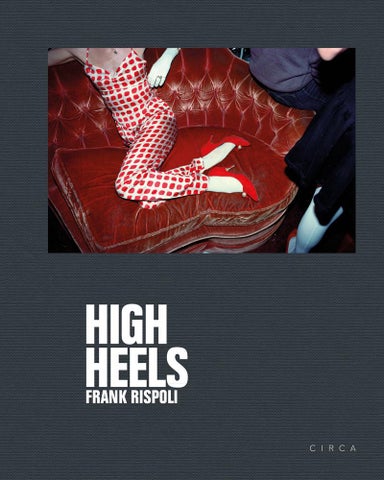
ON PEDESTALS Frank Rispoli has spent a lifetime using his camera to capture aspects of city life that most of us never notice, let alone consider worthy of such expressive documentation. He is, however, far more than a mere recorder of striking images. He is a composer of unexpected serendipity, crafting tableaux that transmute urban grit and squalor into visions of casual elegance. Rispoli’s images reverberate with decadence. Peering through the cracked surfaces of the battered cityscape, he harnesses the inherent power of women’s fashion and its effect on the world around it. He is not only a composer; he is also a conductor, channelling the electricity that courses through the streets of New York City, his camera the exposed wire, shooting sparks and snatching pure moments from thin air. Rispoli was a diffident child who found it difficult to look women in the eye. His tendency to cast his eyes downwards gradually developed into a fixation with women’s shoes, legs and feet. It is said that women dress for other women, but Rispoli noticed too. Their feet were destined to dominate his work. A schism between his conservative Catholic upbringing and his emerging desires was inevitable. And thus, compulsive childhood behaviour and ecstatic art merged into something extraordinary. In the late 1970s, inspired by Guy Bourdin’s groundbreaking photography of Charles Jourdan’s shoes, Rispoli began pounding the sidewalks of New York City, looking for likely subjects. He sought the sultry and the surreal in the shadows, intent on outlining the contours of those who lived on the margins of polite society. Provided, of course, that they strutted around town in a pair of killer heels. Rispoli was then working full-time as an environmental designer, and while his day job paid the rent, it wasn’t until the sun went down, and he was behind the lens, that his creative impulse truly found expression. Downtown haunts such as CBGB, Max’s Kansas City and Danceteria were a living, thriving theatre, tailor-made for Rispoli’s lens. In this realm, fashion doubled as art and he exploited the milieu to the full. ‘The epicentre of everything was Danceteria’, recalls 4
5
Rispoli of the club where Madonna made her debut, LL Cool J worked the elevators and Sade tended bar. Rispoli explored the clubs, ‘six-and-a-half nights a week’, fine-tuning his aesthetic. And as he and his images became better known, he no longer had to search for subjects – they began to find their way to him. One of his signature innovations is that he attaches more importance to the pedestal of the heel than the person who rests atop it. Heels find themselves tangled in spiral phone cords, kept just out of reach by electrical wires on tenement roofs, or framed by taxi door jambs. A washbasin presents a pair of stilettos and mismatched socks as if it were an exquisite dish at an uptown restaurant. In Rispoli’s photographs, there is always a sense of the forbidden at play. Bathrooms serve as ready-made sets, encompassing a particular mix of glamour, decadence, desperation and raw sexuality. The satisfaction comes from framing these obscure objects of desire as if they are works of art in themselves. Until the French Revolution (just imagine Rispoli’s take on all that red!), high heels were worn by both sexes, but when they came back in vogue during the late-nineteenth century, they were the sole preserve of women. After the Second World War, designers such as Roger Vivier and Salvatore Ferragamo took the heel to the pinnacle of decadence – the stiletto, the enduring symbol of the dominatrix and the femme fatale. In a certain sense, Rispoli’s entire photographic output has been a paean to the enduring attraction of the high heel. After a decade when they faded from fashion, stilettos made a roaring comeback in the 1970s. As women sought to subvert the cliché of the femme fatale, the stiletto was a key weapon in their arsenal. At the same time LGBTQ+ activists, among them the Queens Liberation Front, hosted drag balls where the stiletto was not simply a shoe, but a symbol of defiance. This is where Rispoli enters the picture, in the rarefied atmosphere of Manhattan’s fashion and art demi-mondes. As a native son, he has been able to make sense of the non-stop kaleidoscope of New York City. In his mind’s eye, the erotic is always at play with the thrilling chaos of urban living. Harsh backdrops and crumbling infrastructure are transformed into a glorious canvas that has the appeal of modern myth. And what makes the myth plausible is the women. For they are the true stars of Rispoli’s photographs. These portraits reveal just enough about the characters that 6
populate them to ignite the imagination and prompt us to speculate about the hidden elements of each story. There is a kind of magic imprinted on Rispoli’s trusty Kodachrome film. The high contrast, saturated colour and crystal clarity of Kodachrome 25 yields incredible images. Taken at night with a Vivitar flash, the pictures radiate light. The shots come alive, uncanny in their ability to draw the viewer into the scene. This is no easy feat. Through trial and error, Rispoli mastered the art of bracketing until he found the formula that allowed him to frame his portraits just so. Tiny details accumulate and assume significance – a crumpled cigarette pack, a dented dustbin, a bouquet of synthetic flowers. Deprived of the distraction of faces, texture assumes dominance. Leather, lace, mini skirts, fishnets, retro socks, vintage dresses – all are rich material for Rispoli’s lens. Although inspired by advertising, you would never confuse these pictures with the banal offerings on display in the magazine era. They at once comment upon, and wilfully disregard the ubiquitous glossiness of consumer culture. While the photographer acknowledges the agency of his subjects, he does not hide his own gaze. He zeroes in on street-level moments of grace that consist of sharp lines, faceless models and bursts of colour that illuminate a sense of blink-and-you-miss-it glamour. Revelling in an unerring sense of now, Rispoli stretches small gestures into an infinite scroll of beauty that teeters on the edge of obsession. He combines contradictory approaches into a seamless whole of refined yet abstract compositions that teem with questions of identity, belonging and thwarted desire. The high-low duality of Rispoli’s photographs functions as a bridge between aesthetic imperatives that are often at odds with one another: two women meet in the middle of the street, or pose amid the rubble of an abandoned building, and of course, they look fabulous. To see these pictures is to tap into an undercurrent of mutual respect between photographer and model. Even at their most risqué, Rispoli’s portraits venerate their subjects, elevating them to a level that borders on the religious. He presents the women who wear these shoes in their natural habitat, gliding about the city on their pedestals, hovering just above the rest of us. Erick Bradshaw Hughes
7
8
9
8
9
Previous pages: TR3 Club, Tribeca, late 1970s
10
Outside Mudd Club, Tribeca, early 1980s
11
Previous pages: TR3 Club, Tribeca, late 1970s
10
Outside Mudd Club, Tribeca, early 1980s
11
Mudd Club, Tribeca, early 1980s
12
13
Mudd Club, Tribeca, early 1980s
12
13
22
23
22
23
30
31
30
31
Previous pages: Danceteria, Chelsea, early 1980s
32
TR3 Club, Tribeca, early 1980s
33
Previous pages: Danceteria, Chelsea, early 1980s
32
TR3 Club, Tribeca, early 1980s
33
44
45
44
45
Previous pages: Danceteria, Chelsea, early 1980s
46
Danceteria, Chelsea, early 1980s
47
Previous pages: Danceteria, Chelsea, early 1980s
46
Danceteria, Chelsea, early 1980s
47