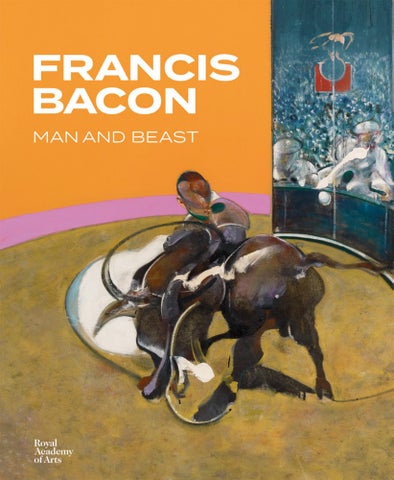
FR A NCIS BACON: M A N A ND BE A S T This catalogue was created in extraordinary times, to accompany and record an exhibition of the same title that had been scheduled to take place in the Main Galleries of the Royal Academy from 30 January until 18 April 2021. However, vital lockdown measures to limit the spread of Covid-19 meant that the Royal Academy had to close its doors during this period. At the time of this book’s publication, the exhibition has been postponed until a later date. Exhibition supported by Petr Aven
H O N O R A RY C O M M I T T E E
Dawn Ades Maria Balshaw Bernard Blistène Hugh Davies Barbara Dawson Catherine Lampert Chris Stephens Karole Vail
CONTENTS
The Magic Trust Ömer Koç Ivor Braka RA International Patrons Catalogue supported by
P R E S I D EN T ’ S FO R E WO R D
6
AC K N OW L ED G EM EN T S
9
F R A N C I S B AC O N : M A N A N D B E A S T
12
M I C H A EL P EP P I AT T T H E A N I M A L T H AT I S N O T O N E
38
S T EP H EN F. EI S EN M A N
This exhibition has been made possible as a result of the Government Indemnity Scheme. The Royal Academy of Arts would like to thank HM Government for providing Government Indemnity and the Department for Digital, Culture, Media and Sport and Arts Council England for arranging the indemnity.
E X H I B I T I O N C U R ATO R S
Michael Peppiatt Anna Testar Sarah Lea assisted by Isabella Boorman S P EC I A L A DV I S ER
Copyright © 2021 Royal Academy of Arts, London Any copy of this book issued by the publisher is sold subject to the condition that it shall not by way of trade or otherwise be lent, re-sold, hired out or otherwise circulated without the publisher’s prior consent in any form of binding or cover other than that in which it is published and without a similar condition including these words being imposed on a subsequent purchaser. All Rights Reserved. No part of this publication may be reproduced or transmitted in any form or by any means, electronic or mechanical, including photocopy, recording or any other information storage and retrieval system, without prior permission in writing from the publisher.
ED I TO R S ’ N OT E S
Unless otherwise stated, all illustrations of works of art are by Francis Bacon (1909–1992).
M A N , WO M A N , B E A S T : B AC O N ’ S N U D E S
Dimensions of works of art are given in centimetres, height before width. C ATA L O G U E P L AT E S
I L LU S T R AT I O N S
Pages 2–3: detail of cat. 35 Page 7: detail of cat. 7 Page 8: detail of cat. 21 Pages 9–10: detail of cat. 39 Pages 64–65: detail of cat. 20 Page 66: detail of cat. 3 Page 78: detail of cat. 9 Page 92: detail of cat. 23 Page 106: detail of cat. 35 Page 114: detail of cat. 38 Page 126: detail of cat. 46
Elana Woodgate Flora Fricker assisted by Nancy Cooper
E X H I B I T I O N C ATA LO G U E
Royal Academy Publications Amelia Collins, Project Editor Florence Dassonville, Production Co-ordinator Carola Krueger, Production Manager Peter Sawbridge, Editorial Director Nick Tite, Publisher
FURIES
2
WILDLIFE
79
3
THE ANIMAL WITHIN
93
4
BODIES IN MOTION
107
5
THE ANIMALISTIC NUDE
115
6
THE BULLFIGHT
1 27
67
137
I S A B EL L A B O O R M A N W I T H R EF L EC T I O N S O N F R A N C I S B AC O N BY DESMOND MORRIS
ISBN 9781-9125-2055-8 Giulia Ariete Caroline Arno
1
C H R O N O L O GY
British Library Cataloguingin-Publication Data A catalogue record for this book is available from the British Library
P H OTO G R A P H I C A N D C O P Y R I G H T C O - O R D I N AT I O N
64
W I T H S EC T I O N I N T R O D U C T I O N S BY A N N A T E S TA R
Francis Outred E X H I B I T I O N O R G A N I S AT I O N
56
C AT H ER I N E H OW E
Distributed outside the United States and Canada by ACC Art Books Ltd, Sandy Lane, Old Martlesham, Woodbridge, Suffolk IP12 4SD Distributed in the United States and Canada by ARTBOOK | D.A.P., 75 Broad Street, Suite 630, New York, NY 10004
141
M AG G I H A M B L I N G
146
S U S A N N A PA I S L E Y
148
C AT H ER I N E L A M P ER T
1 50
EN D N OT E S
152
S EL EC T ED B I B L I O G R A P H Y
154
L EN D ER S TO T H E E X H I B I T I O N
155
P H OTO G R A P H I C AC K N OW L ED G EM EN T S
155
INDE X
156
Design: Kathrin Jacobsen Colour origination and print: Gomer Press, Wales
NEW 2__RA_Francis Bacon_01_Prelims 09___8-12-20.indd 4
15/01/2021 10:49
NEW 3__ENGLISH__RA_Francis Bacon_01_Prelims 09___8-12-20.indd 5
11/12/2020 09:23
Animals in the vast open spaces of untrammelled nature were not to suit Bacon’s temperament or continue to trigger his imagination for long. On his trips to South Africa, the artist had revelled in the experience because it was so new and the polar opposite of everything to which he was naturally drawn. Far from the veld stretching to the distant horizon and the overarching sky, Baconland extended from the cramped studio through Soho backways to the seedy membersonly bar. As the African dusk fell, with the animals
coming out to slake their thirst, Bacon returned to his own favourite watering hole, the Colony Room, a gathering of boozy misfits ruled by a sharptongued lesbian owner, Muriel Belcher, who had become one of his closest friends. Bacon’s foray into the wilds had unleashed a spate of vivid, inventive pictures, a glimpse of nature in the raw by a man more accustomed to the shadows. Then that moment passed and Bacon returned instinctively inside. The artist rarely ventured of his own accord beyond interiors thereafter, with the countryside becoming a kind of exile, a comic horror ‘with all those things singing outside the window’.22 Life, people, everything grew more vivid, not wandering around the landscape, but trapped within four walls – that airless space to which the asthmatic artist himself was condemned. Enough of the outside had already been let in; as Eliot had written, and Bacon knew in his bones: ‘Human kind cannot bear very much reality.’ 23 The question now was how to ‘nail down’ that reality so that it could be ‘returned onto the nervous system more violently’.24
Fig. 13
Fig. 14
Fig. 15
Oedipus and the Sphinx after Ingres, 1983. Oil on canvas, 198 x 147.5 cm. Museu Coleçao Berardo, Lisbon
Sphinx I, 1953. Oil on canvas, 199.5 x 137 cm. Private collection
Sphinx – Portrait of Muriel Belcher, 1979. Oil on canvas, 198 x 147.5 cm. Museum of Modern Art, Tokyo
Throughout his career, a deepening interest in mythology led Bacon to incorporate echoes of the art and literature of the ancient world in his allusive imagery. While opening art to contemporary sensation, Bacon would never fail to keep the greatest achievements of the past as his touchstone.
FIRST CAG E D, THE N CRUCIFIE D
24
NEW 2__RA_Francis Bacon_02_Essays_MP 09___8-12-20.indd 24
25
08/12/2020 15:22
NEW 2__RA_Francis Bacon_02_Essays_MP 09___8-12-20.indd 25
08/12/2020 15:22
to focus on something more modest and much closer to hand, the people he knew best: Isabel Rawsthorne (fig. 20), Henrietta Moraes (fig. 21), Lucian Freud and George Dyer (fig. 19). They were the faces and personalities that Bacon had observed with his pale eagle stare closely in every state, in or out of love, drunk and sober, elated or in despair, following them through the Soho afternoon from the posh fish lunch to the depths of the dingiest drinking clubs like the Iron Lung.27 From having become the great mythologiser, Bacon went on to show that he was also the most penetrating of portraitists, leaving behind a gallery of mid-century London characters. Yet Bacon had not left myth behind: it was too closely woven into the fibre of his imagination not to return spectacularly in the second half of his career, with masterpieces ranging from Triptych, 1976 (fig. 22) to Triptych Inspired by
the Oresteia of Aeschylus (1981; cat. 8) and Second Version of Triptych 1944 (1988; cat. 7), each of them highly charged with a distinct, animalistic theme, as well as the ‘Black Triptychs’ (1972; cat. 43) commemorating the death of his lover, George Dyer. ‘Reading translations of Aeschylus’, the artist once explained, ‘opens up the valves of sensation for me.’ 28 If Bacon was moved by images of the Crucifixion as the most poignant example of man’s inhumanity to man, his imagination had been stirred even more deeply by the whole atmosphere and grandeur of Greek tragedy, which came closer to his own conception of human existence and his sense of the implacability of fate. The blood-stained reverberations of Aeschylean drama essentially constituted the ‘long call from Antiquity’ that the artist often said he was following in his work, and nowhere did he give this cherished source
Fig. 19
Fig. 20
Fig. 21
Portrait of George Dyer and Lucian Freud, 1967. Oil on canvas, 198 × 147.5 cm. Destroyed by fire, 1979
John Deakin, Isabel Rawsthorne, c. 1965. Hugh Lane, Dublin
Study of Henrietta Moraes, 1969. Oil on canvas, 35.5 x 30.5 cm. Private collection, Athens
30
NEW 2__RA_Francis Bacon_02_Essays_MP 09___8-12-20.indd 30
31
08/12/2020 15:22
NEW 2__RA_Francis Bacon_02_Essays_MP 09___8-12-20.indd 31
08/12/2020 15:22
S T EP H EN F. EI S EN M A N
THE ANIMAL THAT IS NOT ONE
THE HUMAN CRY
During the years when Francis Bacon emerged as one of Britain’s leading artists, he was focused on representing what he called ‘the human cry’.1 The motif is visible in ‘Fury’ (c. 1944; cat. 3), Figure Study II (1945–46; cat. 6), Head I (1948; cat. 21), Head II (1949; fig. 9), Head VI (1949; cat. 23), Fragment of a Crucifixion (1950; cat. 2), Study After Velázquez’s Portrait of Innocent X (1953; fig. 26), Three Studies for Figures at the Base of a Crucifixion (1944) and Study for the Nurse in the Film Battleship Potemkin (1957; cat. 27). In all of them, Bacon depicted single, distorted figures and heads with open mouths and bared teeth. They are usually set in a kind of space frame or carapace and occupy no particular place in time. The earliest of those mentioned here, ‘Fury’, is dominated by its orange-crimson setting. Figure Study II deploys a similar hue, while the others display cooler and darker colours: purple, blue, brown and grey. All are painted quite freely, with the figures sometimes blending into the background, or vice versa. After 1955, the cry largely disappears from Bacon’s art though the other elements generally remain: the figural and facial distortions, architectural frames, temporal indeterminacy and expressiveness. One of the primary sources for Bacon’s ‘human cry’ motif has long been known: a shot from the Soviet director Sergei Eisenstein’s classic film Battleship Potemkin (1925). In an interview
from 1962, the critic David Sylvester asked Bacon about the significance of the ‘screaming nanny’ shot (fig. 27). Bacon replied: It was a film I saw almost before I started to paint, and it deeply impressed me – I mean the whole film as well as the Odessa
Fig. 26
Fig. 27
Study After Velázquez’s Portrait of Pope Innocent X, 1953. Oil on canvas, 152.1 x 117.8 cm. Des Moines Art Center, Iowa
Sergei Eisenstein, ‘Battleship Potemkin’, 1925. Film still
38
NEW 2__RA_Francis Bacon_03_Essays_SE 08___8-12-20.indd 38
08/12/2020 15:25
NEW 3__ENGLISH__RA_Francis Bacon_03_Essays_SE 08___8-12-20.indd 39
11/12/2020 09:47
BACON’S DA RK V ISION OF HUM AN/A NIM A L
If Bacon denied in his art the false antithesis between human and beast it’s not because he believed that humans must understand and embrace their animal being. Nor is it because he believed that animals by right possessed, or should one day reclaim, their autonomy. It’s because he thought that freedom and bodily integrity are ultimately impossible for both animal and human. ‘I realised when I was seventeen. I remember it very, very clearly. I remember looking at a dog-shit on the pavement and I suddenly realised, there it is – this is what life is like.’ 28 The remark
indicates the self-hatred of a young man regularly abused by his father or surrogates. To be gay for Bacon was to occupy an interface between human and animal – to be a kind of chimera, even a monster. But Bacon did not only direct his loathing inward. When asked by Sylvester if he was ‘disturbed by the kinds of suffering which are endured by some people as a result of social injustice’, Bacon answered:
But I’m not upset by the fact that people do suffer, because I think the suffering of people and the differences between people are what have made great art, and not egalitarianism … Who remembers or cares about a happy society? After hundreds of years or so, all they think about is what a society has left.29 For Bacon, the massacre of the innocents was a daily occurrence and the role of the artist was to register that fact with as much poignancy and violence as he could convey.
It’s quite possible that people could be helped in extremely poor countries …
Bacon’s paintings of humans as animals, and animals as humans, stand in an artistic and literary tradition called the ‘cry of nature’, the main idea of which is that human and non-human animals are more alike than different, especially insofar as both experience pain and empathy, expressed through their outcries. But unlike many previous artists in this lineage – for example William Blake and Chaïm Soutine – Bacon did not deploy the motif of the cry of nature to endorse greater rights or protections for animals or people. Rather, his depiction of open-mouthed outcries and the human/animal interface was the presentiment of a world in which massacres of innocents and anguished outcries are daily and inevitable occurrences. His pessimistic vision was perhaps a response to a physically abusive father and, later, an interwar and post-war era that was deeply repressive – indeed dangerous – for gay men. The artworks that resulted, including the paintings with ‘the human cry’, animals and slabs of meat (as numerous and varied as they are), expose a fundamental darkness: that Bacon himself was a piece of meat, and so are all other humans and animals.
Fig. 41
Triptych – Studies of the Human Body, 1979. Oil and dry transfer lettering on canvas, 198 x 147.5 cm (each). Private collection 54
NEW 2__RA_Francis Bacon_03_Essays_SE 08___8-12-20.indd 54
55
08/12/2020 15:25
NEW 2__RA_Francis Bacon_03_Essays_SE 08___8-12-20.indd 55
08/12/2020 15:25
NEW 2__RA_Francis Bacon_05_Plates_12___8-12-20.indd 64
08/12/2020 15:30
NEW 2__RA_Francis Bacon_05_Plates_12___8-12-20.indd 65
08/12/2020 15:30
NEW 2__RA_Francis Bacon_05_Plates_12___8-12-20.indd 64
08/12/2020 15:30
NEW 2__RA_Francis Bacon_05_Plates_12___8-12-20.indd 65
08/12/2020 15:30
7
Second Version of Triptych 1944, 1988. Oil and acrylic on canvas, 198 x 147.5 cm (each). Tate: Presented by the artist 1991 74
NEW 2__RA_Francis Bacon_05_Plates_12___8-12-20.indd 74
75
08/12/2020 15:30
NEW 2__RA_Francis Bacon_05_Plates_12___8-12-20.indd 75
08/12/2020 15:30
7
Second Version of Triptych 1944, 1988. Oil and acrylic on canvas, 198 x 147.5 cm (each). Tate: Presented by the artist 1991 74
NEW 2__RA_Francis Bacon_05_Plates_12___8-12-20.indd 74
75
08/12/2020 15:30
NEW 2__RA_Francis Bacon_05_Plates_12___8-12-20.indd 75
08/12/2020 15:30
3
THE ANIMAL WITHIN
B
acon’s engagement with portraiture was central to his unravelling of the trappings of decorum and civility that disguise our inner animal. Although selective in his choice of subject-matter, he was liberal in setting the parameters of the genre, portraying all from chimpanzees to friends to the Head of the Catholic Church. Subverting the tradition of portraiture, identity and status meant little, with subjects given generic labels such as Portrait or Head. Nonetheless, essence prevails, with even the most abstracted compositions revealing a strong likeness. Rather than the appearance of the face, it is the physicality of the head and its expression of core drives that betray the fundamental nature of its owner. Stripped of the accoutrements of society, of cultural mores, of speech and polite composure, the head becomes an unmediated outlet for the cry of pain, the grimace of fear, or the moment of sexual release. In the late 1940s Bacon produced six Heads for his first solo exhibition. In these unsettling, anonymous portraits, disparate characters are united by their enclosure within a cuboid structure, a compositional device that appeared here for the first time and was to define Bacon’s work for decades thereafter. Acting like a cage, the structure isolates the figures, containing them within a vacuum in which screams are silenced, contextual details eliminated, and all from the animal to the divine are isolated against a blank, monochrome backdrop. The subject of Head I (1948; cat. 21) is ostensibly human, although its snarling fangs originate in
the same photograph as the animal portrayed in Chimpanzee (1955; cat. 10), and can be traced further back, to ‘Fury’ (c. 1944; cat. 3). An illusion seems to reveal a small chimp nestled within the head, the mouth plausibly belonging to both creatures and a thin white mark denoting the ear of the simian. In the fourth of the series (1949; cat. 22), man and monkey are separate entities, though their bodies merge. The final work, Head VI (1949; cat. 23), marks Bacon’s first reference to Velázquez’s Portrait of Pope Innocent X (c. 1650; Galleria Doria Pamphilj, Rome), although the vast human influence of the Pope is reduced to the helplessness of a caged animal, divine power diminished and replaced by universal suffering. The Pope’s scream shares its source with Study for the Nurse in the Film Battleship Potemkin (1957; cat. 27), in which the nurse’s androgynous features render her genderless: she stands for ‘human’ rather than ‘man’ or ‘woman’. Her anguished cry is lent pitiful desperation by the smashed glasses falling from her face and her vulnerable, unclothed body. Even with the respectability of a business suit, the figure in Study for a Portrait (1953; cat. 29) resembles a marionette. Elsewhere, Bacon’s subjects peer out from behind striations of paint that resemble the bars of a cage (cat. 28), or sit with gracelessly foreshortened limbs and skull-like, simian faces, as in the portraits of Peter Lacy and Isabel Rawsthorne (cats 26, 30). Rather than honouring individuals, Bacon’s ‘portraits’ strip away the powers and pretensions of humanity.
93
NEW 2__RA_Francis Bacon_05_Plates_12___8-12-20.indd 92
08/12/2020 15:31
NEW 2__RA_Francis Bacon_05_Plates_12___8-12-20.indd 93
08/12/2020 15:31
35
36
Two Studies from the Human Body, 1974–75. Oil and dry transfer lettering on canvas, 198 x 147.5 cm. Private collection
Paralytic Child Walking on All Fours (from Muybridge), 1961. Oil on canvas, 198 x 142 cm. Kunstmuseum Den Haag, donation private collection in 1964
1 12
NEW 2__RA_Francis Bacon_05_Plates_12___8-12-20.indd 112
08/12/2020 15:31
NEW 2__RA_Francis Bacon_05_Plates_12___8-12-20.indd 113
08/12/2020 15:31
5
THE ANIMALISTIC NUDE
F
rom the 1960s Bacon’s preoccupation with the body in motion, and his fascination with Muybridge’s photographic experiments, led to an increasing distortion of the human form. Unlike his pitiful figures of the 1950s, cowering away from the viewer in darkened voids, flesh and blood come to the fore, bodies bursting forth against brightly coloured backgrounds that belie the violence of butchered flesh and contorted limbs. For Bacon, the greatest art revealed human vulnerability, and he attempted to communicate this by bringing the figurative ‘up onto the nervous system more violently and more poignantly’. In earlier years, the head had been his primary means of achieving this, but gradually the body became the vessel that conveyed the immediacy of life in all its instinct, emotion and violence. Bacon’s nudes cast aside the tradition of idealisation and desire, instead adopting helplessly twisted poses, clambering on all fours or sprawling defencelessly on beds. Gender is often ambiguous, although he painted more females than males, focusing on a small group of close friends and often working from photographs commissioned from John Deakin. In Triptych – Studies of the Human Body (1970; cat. 39) three ostensibly female figures climb across a narrow rail suspended in space, their bestial quality underlining Bacon’s continual linking of human and animal movement. In Portrait of Henrietta Moraes on a Blue Couch (1965; cat. 37) the sitter’s skin seems to have been flayed to expose
bloodied flesh, revealing with gruesome honesty the messy matter that lies beneath our carefully controlled exteriors. George Dyer had a profound impact on the trajectory of Bacon’s male nudes. His East End gangster exterior disguised a vulnerable, troubled soul. In Three Figures in a Room (1964; cat. 42), Dyer is both sexualised – reclining nude with his arm raised – and unapologetically human, sitting on a lavatory with his back to us, perhaps unaware that he is being observed in this most private of moments. Portrait of George Dyer Crouching (1966; cat. 40), too, treats its protagonist without idealisation. Perching on a plank projecting into a circular structure, Dyer stares blankly ahead, his crumpled shirt in front of him like a skin that has been shed, his head a confusion of marks suggesting horns, bone and flesh. Triptych August 1972 (1972; cat. 43) is one of the ‘Black Triptychs’ that Bacon painted in the aftermath of Dyer’s death. The outer two panels show Dyer seated in front of an ominous black, tomblike aperture, his body fragmented as if whole sections have been cut out. Pink shadows flow down to the floor, giving the impression that he is melting away. In the centre, two figures, their limbs entangled in the chaos of sexual activity, are reminiscent of the ‘wrestling’ figures Bacon had taken from Muybridge. Here, they seem to recede into the void. Painting a memorial to his dead lover, Bacon reminds us of the material facts of life, in which we are firmly part of the animal kingdom, subject to the same mortality as all living creatures.
115
NEW 2__RA_Francis Bacon_05_Plates_12___8-12-20.indd 114
08/12/2020 15:31
NEW 2__RA_Francis Bacon_05_Plates_12___8-12-20.indd 115
08/12/2020 15:31
CATHERINE LAMPERT A R T H I S TO R I A N , C U R ATO R A N D W R I T E R , D I R EC TO R O F T H E W H I T EC H A P E L G A L L E RY I N LO N D O N F R O M 1 9 8 8 U N T I L 2 0 0 1
Four days into 1966 Francis Bacon made a note in his diary about a work he wished to begin: ‘George crouching looking at his shirt’. This ungainly, rather indecent creature first appeared in 1952, a squatting figure seen from the back, perched on a tubular rail raised off the ground. The support was changed to a plank resting on a plinth hovering over a spool-like enclosure that can also be read as a spacious, streamlined banquette, brown with red seams. If you like, the motif is replete with arthistorical references: the crouching figure, now named as George Dyer, is associated with daring works by Michelangelo (male) and by Rodin (female), as well as with Matisse’s 1908 striking, blue-banded painting Bathers with a Turtle, the woman with hand extended to the creature seen from the back. The rusty-coloured circle on the floor recalls the basin occupied by Degas’s crouching bathers with their protruding spines, images that Bacon admired. The egg here? Although in Piero della Francesca’s altarpiece (1472–74) at the Pinacoteca di Brera, Milan, it hangs above the crowd surrounding the Madonna and Child and there stands for fecundity, perhaps it is now merely a light bulb. Portrait of George Dyer Crouching (1966; cat. 40) turned out to be the first of nine large works
bearing Dyer’s name from 1966–68. As Martin Harrison put it, this series conveys Bacon’s ‘impatience with perceived deficiencies in Dyer’. The other pictures are derived from photographs John Deakin provided, Dyer seated, his left leg crossed over his right knee, his strong profile with curved nose signalling his identity. A fundamentally decent man, Dyer was out of his depth in Bacon’s quickwitted, heavy-drinking Soho milieu. The previous summer, 1965, Lucian Freud had brought Dyer to stay at Glenartney, the Scottish hunting lodge where his friend Lady Jane Willoughby spent the summer. In a room above the harness room, Freud made a ‘classic’ portrait of Dyer wearing a blue shirt, his facial muscles conveying introspection, some apprehension. Freud began another, smaller portrait the following summer, Dyer in a black shirt. The two were titled George Dyer I and George Dyer II when exhibited at the Marlborough Gallery in 1968. Bacon, wickedly, goes for something very extreme that he knows about and can pull off – the dehumanising madness of erotic, violent sex. Labelling his own picture a portrait, from the astonishing head comes a green, lizard-like tongue and horn, while an unflinching phantom face is superimposed, maybe with hints of a self-portrait, as if Bacon is
saying, Watch me go into a territory that others do not dare represent. The figure’s buttocks are modelled in segments, with red lines between; the anus could be an upholstery button. If you see it that way, the figure is Janus-like, to be read as a whiteskinned, sculptural torso with big breasts, her legs folded under a heavy stomach placed atop the prominent foot and arm. The art historian Hugh Davies speculated that the funny white cloth tied at the corners might be a handkerchief to protect the head from the sun. Dissolved, shirtless, humiliated. In 1967 Bacon made a double portrait, Dyer’s body disappears into one of the classy suits he was bought, his head swerves; next to him a virile Freud, sleeves rolled up, looks down. The final large painting, Two Studies for a Portrait of George Dyer (1968), has Dyer turning away from a dark green canvas leaning against the wall, where he is now reduced to a soft torso, a rubbery folded leg and a pulverised head. Is Dyer’s only role now to service Bacon’s art?
Right Bruce Bernard, Francis Bacon, 1984. Estate of Bruce Bernard
150
NEW 2__RA_Francis Bacon_06_Chronology 08___8-12-20.indd 150
1 51
08/12/2020 15:39
NEW 2__RA_Francis Bacon_06_Chronology 08___8-12-20.indd 151
08/12/2020 15:39