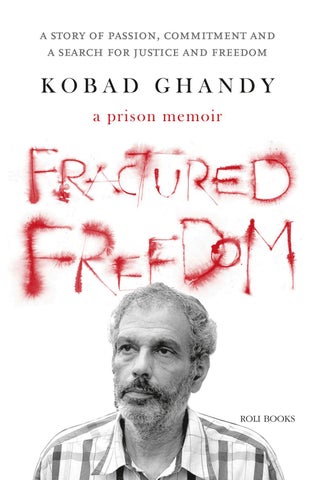
a story of passion, commitment and a search for justice and freedom
Kobad Ghandy
a prison memoir
This book is dedicated to my late wife Anuradha, fondly called Anu, in whom I saw all that was good in society. Her commitment to truth and justice and her idealism could dispel the darkness of a benighted world. Anu’s courage of conviction, simplicity, straightforwardness, her intelligence and honesty, made her the ideal social activist.
FRACTURED FREEDOM: A PRISON MEMOIR
illegal (IB does not have the powers to arrest, I later learnt), they would not openly go to the room where I had been staying in Delhi though they tried to reach the room by other means. By 20 September it appeared that news was leaked to the press that I had ‘disappeared’. I gathered this because in the morning there was a great flurry to urgently produce me before the Special Cell of the Delhi Police. On the way to the Special Cell office I was instructed to not mention that I had been picked up three days ago, and instead say it had just been a few hours. That afternoon, I was deposited at the first floor of the Special Cell office. There was a bit of black comedy to the whole situation, as this was the first time a ‘Naxalite’ had been brought to their office. Having been used to Islamic terrorists, they knew little about what we creatures were. They went through the standard routine of recording my details and then off we went to Rajender Kumar’s house, where I stayed when I came to Delhi. Rajender was not at home when we reached, and the police found nothing of importance. They gathered books, mostly Hindi progressive literature bought from bookshops which my associate who lived there was interested in. The CDs too were mostly ordinary films. This is when the inspector who accompanied me became suspicious and asked me when I had actually been picked up, thinking that the key material had been already taken by the Andhra Pradesh IB. Despite the earlier warning, I decided to tell them the truth: that it had been three days since I was detained. This confirmed to them the feeling (incorrect) that the Andhra Pradesh IB had already visited the site and confiscated all important material. Of course, I did not clarify, nor did they ask. It’s possible they later found out the truth from the landlord. xii
preface
When we returned to the Special Cell office with all the material, I found the senior inspector on the computer googling exactly what Naxalites were. Though they may not have known much, the media, by then, had whipped up the notion that I was a prime catch, worthy of big dividends. When I was produced the next day in the magistrate court, the lady magistrate (a good soul by the name of Kaveri Baweja) saw the condition of my health and refused immediate police custody. She ordered that I be medically examined at once at the nearby government hospital and brought back. After that, when I was reproduced with the doctor’s report, she ordered I be sent to jail. My arrest had apparently got a lot of publicity. At the court was my sister-in-law, Reetha Balsavar, who handed me a sling bag with some toiletries. The human rights organization representative, Rona Wilson, had already made arrangements for senior advocate Rebecca John to appear for me. The sling bag that Reetha gave me then was so sturdy that even though it accompanied me around seven jails it never broke in spite of the weight it carried. I use it to this day. I was driven to jail amidst high security (which was to become the norm during my entire stay in Delhi). There were four commandos with bullet-proof jackets, an inspector, a few sub-inspectors, some fifteen AK-47 wielding commandos and a few others who accompanied me. During this two-hour journey from Tis Hazari Court to jail, I did not know what to expect and I began reflecting on what had transpired these last few days and how suddenly my life had been upturned. Though one expects arrest in our line of activity, given that I had not been arrested in the past forty years, it did come as a shock. Certainly, it was nothing compared to the suddenness and shock of my beloved wife xiii
london 1972: a beginning and an end
GlaxoSmithKline and stayed with them for twenty-nine years, much of that time as managing director. He has since retired, and has been for many years the president of Bombay’s Willingdon Club. In order to become a certified chartered accountant one has to work (article) with a firm of auditors for the entire four-year period of study at a nominal stipend and, through a correspondence course, sit for the three exams. Passing is exceedingly difficult (the pass rate used to be something like 1-2 per cent) and most people repeatedly sit for the exams. Without the articleship one cannot sign up for studying Chartered Accountancy. I was articled to the auditing firm Jackson and Pixley, in the city of London. During my schooling at the Doon School, Dehra Dun, and later college in Mumbai, I was – like most of my peers – devoid of social consciousness or for that matter any knowledge of the social environment beyond my immediate world. In school it was studies and sports, both of which I cruised through with mediocrity; and at college it was studies, and passing time with friends, like Adi Irani (a compulsive card player, chess player and boxer), and at the Willingdon Club playing golf, badminton and swimming. When I came to the UK, it was like any other promising young man on the precipice of building a successful career, which in my case, being a London-returned CA would guarantee. For example, my closest friend and classmate from Doon School, Ishaat Hussain, who was also in the UK doing CA at the same time, went on to become finance director of Tata Sons for over a decade. Within a few months, while staying at the Indian YMCA at Warren Street, I began to notice the racism directed at Indians and others of colour. The derogatory term WOGs (Western Oriental Gentlemen) was one of the abuses often hurled at us. This made me think. The docility of the Indians first angered 5