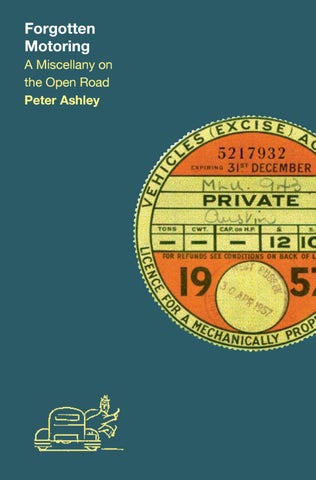
Forgotten Motoring A Miscellany on the Open Road Peter Ashley
Introduction
spent on Dinky Toys I would buy the latest edition of
The Observer’s Book of Automobiles, impressing pals
that my favourite car was a Facel Vega HK500. On the back pages were lists of the two registration letters During my 1950s childhood, motoring was a
mysterious and immense skill undertaken by others. As my father didn’t own a car until he drove an
apple-green Ford Popular somewhat erratically into
our hitherto empty garage, I watched all the steering and gear-changing as others gave us lifts: variously, a Ford Prefect steered with leather driving gloves;
that meant you could see where a vehicle came from: FP for Rutland, FL for the Soke of Peterborough. On the back windows of Austin Devons, Ford Zephyrs and Vauxhall Crestas you could see where the
occupants had been on holiday by noting visionobscuring plastic pennants with legends like ‘Prestatyn’ and ‘Ilfracombe’ on them.
Shopping trips to Leicester meant catching a
the mirror carefully adjusted in a new Humber Hawk;
Midland Red bus outside the Royal Oak or, if we
moved dexterously by long red-painted fingernails.
bus that smelt mildly of disinfectant and had a sign
and a duotone Hillman Minx’s column gear change I stared obsessively at the traffic. The black SS
Jaguar with enormous headlamps reversing out of a drive down the lane, a white-mustachioed man
in a Panama going to see his friend up the lane in a 1920s open-topped Rolls-Royce, which we ran
behind shouting. Every Tuesday I pedalled to the
end of the lane to watch men in thick leather aprons unload barrels of Hole’s Newark Ale from a yellow Leyland brewery dray into the cellar of the Royal
Oak, as I traced a grubby finger over the picture of a castle on the door. When my pocket money wasn’t
missed it, a deep brown and cream City Corporation that said ‘No Spitting’. In ‘town’, as we called it, I
watched Albions arriving with sacks of potatoes in
Market Place with words like ‘Lincolnshire’ on their
sides; cream Bedford ambulances with red blankets
and red Dennis fire engines with chrome bells ringing. Waiting for the bus home I saw Wolseleys dash out
from the neo-Georgian police station, which had two big lights on the roof. If the green one was flashing,
there had been no fatal road accidents in the city. If it was the red one, there had been, and I sat nervously on the bus with my mum telling me not worry.
Being driven out into the countryside in a car
was an adventure up there with a trip into space
with Dan Dare. My eldest brother, who worked on
a farm, leaning forward as he drove his battleship grey Standard Eight down a long straight and
shouting out “We’re doing fifty now!” and one very
memorable Sunday lunchtime when he took me for ‘a spin’ in the farmer’s Ford V8 Pilot and shouted
out “Eighty five!” with me sliding about on the blue leather front bench seat.
I wondered at road signs on black-and-white
striped poles saying things like ‘Major Road Ahead’, which I first thought meant we had to watch out for an army officer on a horse. We stopped at garages with petrol pumps topped-out with illuminated
globes that might say not just ‘Shell’ or ‘Esso’ but
also ‘Regent’ and ‘National Benzole’. AA patrolmen in leather gaiters stood by their motorbikes with
yellow monogrammed sidecars and for some reason saluted as we sped by.
Is all this just a yearning for an irretrievable past?
A nostalgic wallow in a lost time when someone
checked your oil after your petrol tank had been
filled with Cleveland and two shots of Redex? To a degree I suppose, but the main purpose of the
collection of images you will see here is to remind
us that the everyday motoring experience, whilst
not as predictable and certainly not as reliable as we enjoy today, was once full of character and
interest. From the first splutterings of the motor
car until the 1960s, there was an individuality to the
makes of cars, lorries and buses; to the look of road signs, garages, maps and guide books. (Much was characterful in the 1970s but tended to fall to bits quicker.)
Over the last forty years or so we appear to have
endured a depressing homogeneity in the design of vehicles and the services that provide for them.
A BMW morphing effortlessly into a Ford, an Audi
into a Kia. The branding of petrol meaning less and
less as a filling station probably makes more money on Haribo Supermix than a gallon of petrol and nobody studies maps in a road book anymore.
So in our world of hands-free crossovers and
satnav-ed hybrids, here are some oily-ragged,
hand-stitched alternatives: an elegiac gallery of the forgotten pleasures of motoring in another age.
The Wonder Book of Motors, 1940 edition above Wolseley Fourteen with a typically English backdrop complete with village gossips
The Wonder Book of Motors 1926 edition. Note the look of sheer pleasure on the face of the boy in the passenger seat
top Hillman Fourteen with a backdrop of Kenilworth Castle left Detail from the endpapers drawn by Thomas Maybank
An austere family outing involving a c1928 Sunbeam, recorded on a stereoscopic camera like the one opposite. The resultant pair of photographs, mounted on stiff card and placed in a viewer, meant that an image could, rather eerily, be seen in 3D
An austere family outing involving a c1928 Sunbeam, recorded on a stereoscopic camera like the one opposite. The resultant pair of photographs, mounted on stiff card and placed in a viewer, meant that an image could, rather eerily, be seen in 3D
An Alvis 12/50 with a 1598cc engine, capable of 70 mph, and registered in Coventry in June 1924, costing £615. The body was made by another firm, Cross & Ellis. This actual car was used in Ken Russell’s 1962 BBC film Elgar, seen with the composer and his dogs traversing the Malvern Hills in Worcestershire left The Alvis hare mascot. The name ‘Alvis’ was perhaps derived from ‘al’ (aluminium) and the Latin ‘vis’ (strength)
An Alvis 12/50 with a 1598cc engine, capable of 70 mph, and registered in Coventry in June 1924, costing £615. The body was made by another firm, Cross & Ellis. This actual car was used in Ken Russell’s 1962 BBC film Elgar, seen with the composer and his dogs traversing the Malvern Hills in Worcestershire left The Alvis hare mascot. The name ‘Alvis’ was perhaps derived from ‘al’ (aluminium) and the Latin ‘vis’ (strength)
These Rileys enabled dad to assuage his frustration at not being able to hare around in a sports car (they were very quick) but still be able to fit the rest of the family in The RM Series were made from 1945 to 1955, the last models to be developed by the independent company
These Rileys enabled dad to assuage his frustration at not being able to hare around in a sports car (they were very quick) but still be able to fit the rest of the family in The RM Series were made from 1945 to 1955, the last models to be developed by the independent company
Moving Letters above Leyland Tiger Cub motor coach badge centre Maidstone & District bus side, Wrotham, Kent top Dennis badge from the radiator grille of a fire engine opposite Bleriot headlamp, Shuttleworth Collection
Moving Letters above Leyland Tiger Cub motor coach badge centre Maidstone & District bus side, Wrotham, Kent top Dennis badge from the radiator grille of a fire engine opposite Bleriot headlamp, Shuttleworth Collection
The Automobile Association was founded in 1905 above The AA patrolmen helping motorists wore quasi-military uniforms (many were ex-servicemen) and saluted cars bearing their badge. Members had a key to an AA telephone box right 1956 AA Handbook opposite AA sign workshop in London c1955 and car badge
The Automobile Association was founded in 1905 above The AA patrolmen helping motorists wore quasi-military uniforms (many were ex-servicemen) and saluted cars bearing their badge. Members had a key to an AA telephone box right 1956 AA Handbook opposite AA sign workshop in London c1955 and car badge
Do It Yourself The mechanics of a motor car were once relatively simple. Guides with cutaway drawings and diagrams helped motorists to spend entire weekends with their feet sticking out from under their cars above This handbook for Austins was first published in 1954 and was written (really) by T.B.D. Service
Practical Motorist magazine ran from 1934 to 1997. The promise given by a fabulously illustrated, luridly coloured cover was dissipated inside with no-nonsense line drawings showing you how to remove a cylinder head or adjust your hydraulic valve tappets. Still wearing a tie to do oily jobs appeared de rigeur, but it had to be kept away from a revolving fan blade
Forgotten Motoring takes us on a journey into the past when road travel in Britain was a particular if unpredictable pleasure. Roads filled with bulbous Austin Somersets, rakish Rileys and unique road signs. Together with beautifully signed commercial vehicles, motoring guides, maps and roadside cafes, here is an inspirational collection with delightful images at every turn of the road. No satnavs here.
ISBN: 978-1-78884-093-4
ËxHSLHSIy840934zv;:,:(:&:! £12.00/$17.50
www.accartbooks.com