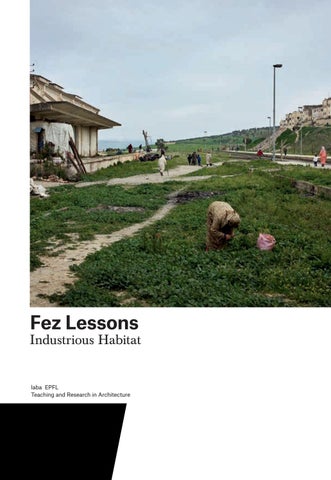
The infamous Scramble for Africa at the turn of the twentieth century disrupted the entire African continent with enduring repercussions. Morocco—standing at a geographical crossroads between Sub-Saharan Africa, the Maghrebi Arab-Muslim world, and Mediterranean Europe—has ever since struggled to withstand the resulting cultural and sociopolitical clashes. Fez Lessons: Industrious Habitat investigates how these clashes have marked the socioeconomic structure and the urban fabric of Fez, and whether or not the resulting morphology offers alternative and relevant means of human association and community. Alongside a growing stream of large-scale international investment, the constant enticement of tourism, and a worldwide revival of nationalism, we are looking for tiny cues, nagging doubts, and signs of the fusion between form and life, raising questions about identity, authenticity, tradition, the globalization of culture, and the use of local resources. laba has been operating in Basel since September 2011 and is directed by Professor Harry Gugger. Fez Lessons is the 11th volume in a series entitled [Place] Lessons: Teaching and Research in Architecture that documents laba’s academic work. Laboratoire Bâle (laba) Institut d’Architecture et de la Ville (IA) Faculté de l’Environment Naturel, Architectural et Construit (ENAC) École Polytechnique Fédérale de Lausanne (EPFL)
Fez Lessons — Industrious Habitat
ISBN 9783038601692 Printed in Germany ISBN 978-3-03860-169-2
9
783038 601692
Fez Lessons
Industrious Habitat
laba EPFL Teaching and Research in Architecture
Introduction
Storytelling for a Borderless Habitat
Storytelling for a Borderless Habitat 1. Ontological Choreographies 2. Webs of Significance
8
9 10
3. Sustained Remembrance
12
4. Lessons from Fez
13
One of the most heavily patrolled and militarized borders in the European Union (EU) lies in Africa.1 Placed at the northwestern tip of the continent, it separates the Spanish exclaves of Ceuta and Melilla from Moroccan territory. [Fig. 1] Such apparatus is a fingerprint left behind by the so-called Scramble for Africa, an outcome of the rise of nationalism in the 19th century that resulted in the distribution of the entire continent among the European powers as a sort of appeasing strategy to accommodate economic growth and expansion. [Fig. 2] As a consequence, Morocco’s territory was split with a French and Spanish administration being imposed, something which was maintained until 1956, the year the country regained its formal independence.2 The 20th-century shift from land-based, neo- colonial, and imperial occupations towards the more ethereal imposition by financial investment strategies makes it harder now to read those hierarchies and strategies of domination, but echoes of such control can still be traced. One clear indicator is Morocco’s trade balance, which still heavily depends on France and Spain both in imports (36 percent) and in exports (44 percent).3 Perhaps even more telling is the way the country has, since its independence, struggled to forge a new national identity. First by carrying out a process of “Arabization”4 that relied on Arab-Islamic culture to fight back all traces of French presence, including the teaching of the French language, which was gradually discontinued. Then, by moving away from such “Arabization” once it became clear that political and economic ties with Europe would be badly affected by those policies. The country opened itself to foreign investment and established French as a lingua franca, which the elites—nearly all French- educated—adopted as a symbol of education and culture. More recently, in 2011, as a reaction to the Arab Spring protests, a new constitution was approved by the parliamentary monarchy that reduced King Mohammed VI’s power in favor of the Parliament and recognized the indigenous Berber / Amazigh culture as a “common patrimony of all Moroccans.” 5 Tamazight, the Amazigh’s language, was not only acknowledged but also declared, together with Arabic, as one of the two official state languages. Instabilities have further increased in recent times given how the widespread crisis spurred by fi nancial markets started to produce a ubiquitous revival of neo-nationalist policies and Far Right agendas. In an attempt to defend established economic privileges, such tendencies are disguised as resistance to global neo-liberalism and sometimes—like in ecofascism— even as ecological policies.6 As always, such political
ideologies trundle onwards by highlighting “otherness”—the Jews, the Gypsies, Muslims, refugees, migrants, terrorists, etc.—as a looming threat. A threat which is then used to legitimize the sovereign’s main role: to protect from danger. Following the 2015 migrants crisis, European border control has doubleddown on such protection and is assuming an ever more aggressive stance. Within such context, Morocco —which stands at a crossroads of migrant flows from Africa to Europe—has been extensively financed by the EU and forced to cooperate with Frontex (the European Border and Coast Guard Agency) as a strategic border-defense ally in a process that has been criticized for focusing more on defense mechanisms than on human rights.7 Ultimately, and beyond their geostrategic nature, these developments end up emphasizing the way in which all communities are a product of imagination 8 and how borders—from the national to the domestic scale—still stand as a fundamental element to help manipulate and give consistency to such imagination. Along this multi-lingual, pluri-cultural, and prejudiced context, the city of Fez stands out as the built form of an amalgamation of incongruent narratives that still strive for unity. Looking at the city one could languidly engage with previous “stories of separation,” searching for its “Morocanness” or dwelling on what makes it picturesque, allowing ourselves to slowly falter toward the insidious siren songs of orientalism. But why do so? Why reinforce separation? What binds us together is far greater than what spreads us apart.
1. Ontological Choreographies “The frontier indicates the line of power because wherever there is a frontier, there are two kinds of creatures walking on Allah’s earth, the powerful on one side, and the powerless on the other.” I asked Mina how would I know on which side I stood. Her answer was quick, short and very clear: “If you can’t get out, you are on the powerless side. — Fatima Mernissi 9
The terms “Neolithic Revolution” and “Urban Revo lut ion” were coined in the 20th century by the archeo logist Gordon Childe, and they are still used today to denote two crucial transitions in community-making. The first, referring to the passage from “savagery” to “barbarism,” describes the transition from a hunter- gatherer society based on foraging to an agrarian one.
Introduction
9
Introduction
Storytelling for a Borderless Habitat
Storytelling for a Borderless Habitat 1. Ontological Choreographies 2. Webs of Significance
8
9 10
3. Sustained Remembrance
12
4. Lessons from Fez
13
One of the most heavily patrolled and militarized borders in the European Union (EU) lies in Africa.1 Placed at the northwestern tip of the continent, it separates the Spanish exclaves of Ceuta and Melilla from Moroccan territory. [Fig. 1] Such apparatus is a fingerprint left behind by the so-called Scramble for Africa, an outcome of the rise of nationalism in the 19th century that resulted in the distribution of the entire continent among the European powers as a sort of appeasing strategy to accommodate economic growth and expansion. [Fig. 2] As a consequence, Morocco’s territory was split with a French and Spanish administration being imposed, something which was maintained until 1956, the year the country regained its formal independence.2 The 20th-century shift from land-based, neo- colonial, and imperial occupations towards the more ethereal imposition by financial investment strategies makes it harder now to read those hierarchies and strategies of domination, but echoes of such control can still be traced. One clear indicator is Morocco’s trade balance, which still heavily depends on France and Spain both in imports (36 percent) and in exports (44 percent).3 Perhaps even more telling is the way the country has, since its independence, struggled to forge a new national identity. First by carrying out a process of “Arabization”4 that relied on Arab-Islamic culture to fight back all traces of French presence, including the teaching of the French language, which was gradually discontinued. Then, by moving away from such “Arabization” once it became clear that political and economic ties with Europe would be badly affected by those policies. The country opened itself to foreign investment and established French as a lingua franca, which the elites—nearly all French- educated—adopted as a symbol of education and culture. More recently, in 2011, as a reaction to the Arab Spring protests, a new constitution was approved by the parliamentary monarchy that reduced King Mohammed VI’s power in favor of the Parliament and recognized the indigenous Berber / Amazigh culture as a “common patrimony of all Moroccans.” 5 Tamazight, the Amazigh’s language, was not only acknowledged but also declared, together with Arabic, as one of the two official state languages. Instabilities have further increased in recent times given how the widespread crisis spurred by fi nancial markets started to produce a ubiquitous revival of neo-nationalist policies and Far Right agendas. In an attempt to defend established economic privileges, such tendencies are disguised as resistance to global neo-liberalism and sometimes—like in ecofascism— even as ecological policies.6 As always, such political
ideologies trundle onwards by highlighting “otherness”—the Jews, the Gypsies, Muslims, refugees, migrants, terrorists, etc.—as a looming threat. A threat which is then used to legitimize the sovereign’s main role: to protect from danger. Following the 2015 migrants crisis, European border control has doubleddown on such protection and is assuming an ever more aggressive stance. Within such context, Morocco —which stands at a crossroads of migrant flows from Africa to Europe—has been extensively financed by the EU and forced to cooperate with Frontex (the European Border and Coast Guard Agency) as a strategic border-defense ally in a process that has been criticized for focusing more on defense mechanisms than on human rights.7 Ultimately, and beyond their geostrategic nature, these developments end up emphasizing the way in which all communities are a product of imagination 8 and how borders—from the national to the domestic scale—still stand as a fundamental element to help manipulate and give consistency to such imagination. Along this multi-lingual, pluri-cultural, and prejudiced context, the city of Fez stands out as the built form of an amalgamation of incongruent narratives that still strive for unity. Looking at the city one could languidly engage with previous “stories of separation,” searching for its “Morocanness” or dwelling on what makes it picturesque, allowing ourselves to slowly falter toward the insidious siren songs of orientalism. But why do so? Why reinforce separation? What binds us together is far greater than what spreads us apart.
1. Ontological Choreographies “The frontier indicates the line of power because wherever there is a frontier, there are two kinds of creatures walking on Allah’s earth, the powerful on one side, and the powerless on the other.” I asked Mina how would I know on which side I stood. Her answer was quick, short and very clear: “If you can’t get out, you are on the powerless side. — Fatima Mernissi 9
The terms “Neolithic Revolution” and “Urban Revo lut ion” were coined in the 20th century by the archeo logist Gordon Childe, and they are still used today to denote two crucial transitions in community-making. The first, referring to the passage from “savagery” to “barbarism,” describes the transition from a hunter- gatherer society based on foraging to an agrarian one.
Introduction
9
The second, from “barbarism” to “civilization,” traces the stage of urbanity usually described as the beginning of life in cities. Still, as admitted by Childe, the concept of “city” is “notoriously hard to define” so the emergence of cities was coupled with the advent of writing as a “criterion of civilization.” 10 This decision—purely related to archeological convenience— thus established that writing (and consequently cities) announces the foundational passage from Pre-History to History. Regrettably, such focus on writing to chrono logically situate the Urban Revolution ends up under mining the triad “savagery-barbarism-civilization” that had previously been used by a series of writers —notably social scientist Friedrich Engels—to postulate a renewed way of understanding the interconnected mutations of social structures. An unsettling record is Engels’s 1884 book The Origin of the Family, Private Property and the State. Engels describes how the surplus produced by animal and plant domestication in the “barbarism” stage was the decisive factor in forcing the transition from an original “group marriage” society to a “pairing marriage” one, in which the will to establish a father lineage instigated the establishment of patriarchal authority. Domination over the “production of the means of subsistence” and the drive to safeguard blood-based inheritance of the generated surplus are what, according to Engels, led to the institut ion of “private property”—including women, slaves, and children—as a way to manage all the labor activities necessary for surplus accumulation (production) and family maintenance (reproduction). Epitomizing this argument, he states: The first class antagonism which appears in history coincides with the development of the antagonism between man and woman in monogamian marriage, and the first class oppression with that of the female sex by the male. Monogamy was a great historical advance, but at the same time it inaugurated, along with slavery and private wealth, that epoch, lasting until today, in which every advance is likewise a relative regression, in which the wellbeing and development of the one group are attained by the misery and repression of the other. It is the cellular form of civilized society, in which we can already study the nature of the antagonisms and contradictions which develop fully in the latter.11
In city terms, Engels’s proposition frames the forthcoming of the first-known urban typology—the courtyard house—which simultaneously inaugurates the dawn of the city and the total seclusion of the private realm from the public one. This primeval typology, first found in the ancient Sumerian cities, thus presents itself not only as ecological attunement—ingeniously adapting itself to the hot and dry climates from which it originates—but, very decisively, as an economic
10
tool. It is hence not surprising to see it prolifically reappear throughout history in different cultures, as in the Greek peristyle, the Roman atrium, the Islamic sahn, or, as found in Fez, the Moroccan riad and dar. The emergence of the courtyard house established the base for recurrent and complex ontological choreographies in which its literal and allegorical ramifications—like the enduring indoctrination of enclosure as a “terrestrial paradise”12 —staged, from the very onset, a coincidence between contradictory feelings that fuse privacy with segregation, oppression with freedom, kinship with animosity, coercion with love. A fusion that can still be traced in some etymological roots like the Latin word familia (family), which in Ancient Rome was used to designate “the totality of slaves belonging to one individual.” In a similar way, such a link is also found in the opposition between the Greek oikos (home)—designating the place of the oikonomia (household management)—and the polis, the place of the politikos (politics) where citizenship was carried out. Here, similarly to the monogamic condition described by Engels, the oppression of the oikos through slavery and forced labor was the pre-condition for the experience of the Aristotelian “good life” in the polis.
2. W ebs of Significance All of the blood that was bled for these cities to grow. All of the bodies that fell. The roots that were dug from the earth so these games could be played. I see it tonight in the stains on my hands. — Kate Tempest 13
The Urban Revolution and its main attribute—cities— allow us to see in more palpable terms the different ways through which communities domesticated and gave a formal body to their unifying principles. P rinciples whose scale and complexity were propelled by ever more strenuous demands related to moral (how to balance), social (how to live with), economic (how to manage), scientific (why), religious (the big why), and political (the big how) principles. Together, they inform an unfolding urban system that, to our days, still keeps on growing and expanding at an exponential and seemingly uncontrollable speed. To urbanize—and thus to domesticate—means to control and interfere with the communities of living organisms around us and leave a manufactured proof of such meddling; to create something through the sheer use of our hands and intellect, to be the God of our own things. How ecstatically delusional such primordial revelation must be, of suddenly believing that there are no limits to our creation. Then, to take
this awe and wish to bring it everywhere, to civilize everything, to turn everything into a city. To surpass the simple bewilderment before the intensity of life and the unfathomable mystery of its reproduction. To not only understand but finally master the process of creation. Man becomes God, God becomes Man. This is how we have evolved. It is not surprising then, and hardly accidental, that the majority of religions appearing after domestication and the invention of cities—notably the urban Abrahamic religions of Judaism, Christianity, and Islam—are fundamentally anthropocentric and patriar chal. Given the scale that cities quickly reached, one expects to see how religion and politics subsequently tried to transform ritual into law, expression (insideout) into commandment (outside-in). One such early example—evidencing how our roots are much closer than what we are willing to accept—is the treaty Politics from the Greek philosopher Aristotle whom the West claims to be its “philosophical father” and the East—where he was known as Aristutalis—its “first teacher.” In Politics he described his ideal citystate and indirectly underlined how cities are nothing more than ancient operations revolving around the idea of community: We see that every city-state is a community of some sort, and that every community is established for the sake of some good (for everyone performs every action for the sake of what he takes to be good). Clearly, then, while every community aims at some good, the community that has the most authority of all and encompasses all the others aims highest, that is to say, at the good that has the most authority of all. This community is the one called a city-state, the community that is political.14
After defining the “city-state” Aristotle proceeds to oppose “production” (poiesis) to “action” (praxis) safe guarding the latter despite it requiring slavery: “life consists in action, not production.”15 His words starkly emphasize how the Greek polis formalizes from the onset one center, a fixed hierarchy, which it does not wish to question. Consequently, it also expresses an elitist and permanent distrust in the troublesome compulsions of the masses. In a contradictory way we are offered the image of a community that displays a certain dread of community; a community that, by allowing some citizens to remain sovereign to the detriment of the sovereignty of society at large, refuses to accept that everything can be a center, that order can be achieved without power. Power. Is it not, in part, a synonym for simplifi cation? Aware of the latent contradictions within such standpoint, Aristotle mentions antipathetic opinions which stated that the idea of “master” was contrary to “nature,” “for it is by law that one person is a slave and another free, whereas by nature there is no difference
between them.” 16 Still, in defiance of those arguments, he wholeheartedly holds his ground by defending the right to “action” through the liberating qualities of “property,” regardless of what sustains it: What are commonly called tools are tools for production. A piece of property, on the other hand, is for action. … [A]nyone who, despite being human, is by nature not his own but someone else’s is a natural slave. And he is someone else’s when, despite being human, he is a piece of property. 17
The words “despite being human” are eerily revealing. Nevertheless, time and time again, we seem to take Aristotle’s claims too lightly. In the 1867 multi-volume Capital: A Critique of Political Economy, social scientist Karl Marx excuses Aristotle’s penchant for inequality and blames such tyrannical proclivity to “the peculiar conditions of the society in which he lived.” 18 A problematic assertion. How can a society whose merit resides in enabling the very possibility of individual sovereignty now be to blame for the excesses of the sovereigns it produces? Aren’t they, as well, part of the properties of “property”? Marx tries to tackle this issue referring to the “absence of any concept of value” in Ancient Greece’s status quo: The secret of the expression of value, namely, that all kinds of labor are equal and equivalent, because, and so far as they are human labor in general, cannot be deciphered, until the notion of human equality has already acquired the fixity of a popular prejudice.19
Marx’s words appear condescending. They deny Aristotle the agency to recognize “human equality” when in fact, as we have shown, he was faced with the opportunity to acknowledge it and, “despite” that, chose not to do so. Today, more than 2 thousand years later, we stand with Aristotle on the same grounds from which he refused to move. If presented the possibility, we gladly accept the guilt-free formulation that we are just a consequence of the “peculiar conditions of the society” in which we live. The fact remains that we are still not ready to let go of our privileges and much less of our “property.” In his 2016 article “The Rise of Cheap Nature,” environmental historian Jason Moore tackles this topic and expands on the ramifications of such a mindset regarding our contemporary condition of globalized exploitation: The story of Humanity and Nature conceals a dirty secret of modern world history. That secret is how capitalism was built on excluding most humans from Humanity —indigenous peoples, enslaved Africans, nearly all women, and even many white-skinned men (Slavs, Jews, the Irish). From the perspective of imperial administrators, merchants, planters, and conquistadores, these
Introduction
11
humans were not Human at all. They were regarded as part of Nature, along with trees and soils and rivers— and treated accordingly. … The symbolic, material, and bodily violence of this audacious separation—Humanity and Nature—performed a special kind of “work” for the modern world. Backed by imperial power and capita list rationality, it mobilized the enslaved—in service to transforming landscapes with a singular purpose: the endless accumulation of capital.20
Growing out of this seemingly never-ending chain of analogous behaviors, the old “city-state” morphed into an earth-encompassing cosmo-polis of “nationstates.” Carrying the legacy of the ancient local-polis, our constant empathetic inability to recognize “human equality” modeled a global village where interconnec tivity has not necessarily led to intersubjectivity. What’s more, our 2-thousand-year-old stubbornness shaped an economic system still widely reliant on slavery—albeit in most cases a more modern debt and wage-based type—which has fossil-fueled a spiraling ecological havoc that, like a fractal, replicates itself at all scales, from macroclimate change to microplastic contamination.21 In urban terms, its impact is also clear: land becomes property, homes become assets, and people become simple consumers, to the point where gentrification has now arguably become the most pervading urban condition of our times. Such possibly dismal sets and settings are, never theless, not to be taken numbingly as lethargic pes simism but, on the contrary, as stable ground for open change. In her 2016 book Staying with the Trouble, scholar Donna Haraway advocates for the need to let grief soak in and allow new storytelling practices to go from “thinking” to “thinking-with.” Combining her own words with some personal correspondence, she writes: Mourning is about dwelling with a loss and so coming to appreciate what it means, how the world has changed, and how we must ourselves change and renew our relationships if we are to move forward from here. In this context, genuine mourning should open us into an awareness of our dependence on and relationships with those countless others being driven over the edge of extinction. … The reality, however, is that there is no avoiding the necessity of the difficult cultural work of reflection and mourning. This work is not opposed to practical action, rather it is the foundation of any sustainable and informed response. … Grief is a path to understanding entangled shared living and dying; human beings must grieve with, because we are in and of this fabric of un doing. Without sustained remembrance, we cannot learn to live with ghosts and so cannot think. Like the crows and with crows, living and dead “we are at stake in each other’s company.” 22
12
3. Sustained Remembrance If you hold a stone Hold it in your hand If you feel the weight You’ll never be late To understand — Caetano Veloso 23
To put forward such mourning demands, above all, a difficult revisiting of sedimented truths. One of the most pressing is the way in which a sort of Western canon continues to project itself onto the Eastern world. A behavior that literary scholar Edward Said famously referred to in his 1978 book Orientalism as the West’s “will to govern over the Orient,” 24 which molded an essentialization of the latter’s identity and fabricated a set of prejudiced cultural projections. According to Said, such behavior prompted “a scholarly discourse” that eventually evolved into “an imperial institution” of domination.25 A mentality that Said traces back to the disruption of Classical Antiquity and subsequent incorporation of a set of “barbarian ways” that precipitated the transition from the Greco- Roman to a Roman-Germanic world whose center then shifted northwards, away from the Mediterranean basin. This shift proved to be a decisive moment that propelled the division between the Christian and Islamic communities and, above all, was the stepping stone “against which the whole of European civili zation from the Middle Ages on was founded.” 26 For Said, this attests to nothing less than a persecutory delusion: “orientalism is a form of paranoia.” 27 In the case of Fez such paranoia gave body to different manifestations. First and foremost through the urban form implemented by the French administration’s management plan. [Fig. 3] But as well, and perhaps even more strikingly, in the way that it produced an academic body of work that recurrently used the city as the backdrop for an idealized construction of what is usually referred to as the ancient “Islamic city” or medina. The mesmerizing extent to which this took place was underlined by sociologist Janet Abu-Lughod in her 1997 text The Islamic City—Historic Myth, in which she detailed the existence of a constantly echoed and revisited “chain” of knowledge that was responsible for the production of a series of descriptions and “gene ralizations about all cities of North Africa” which, for the most part, bear as a common trace “a suspicious resemblance to Fez.”28 Most of such descriptions speak about a sort of “religious urbanism” deemed to be responsible for a perceived lack of order and the inexistence of formal civic and public institutions—such as townhalls and theatres—the majority of which are congregated and replaced by the communal mosque where members of the Ummah (the religious community)
gather under one unifying faith. One cannot, of course, deny the importance of such elements in the city of Fez itself but, widening our scope, it is possible to question if they really present the most defining qualities of the “Islamic city” or, ultimately, if something as clear as that truly exists. As we have seen, since the early Sumerian cities—such as Ur and Uruk— a specific urban figure exists, based on the courtyard house, that recurrently reappears in different cultures. Many times, the allusion to such a figure is carried out through the use of the mythical image of the “labyrinth,” which deftly fits the “chaotic” and “backward” narratives so many times imprinted onto the so-called Islamic city as a means to simplify it and, in a way, “exclude it from Humanity.” But could it be that, in the end, Fez’s tormented fascination is related not exclusively to paranoia but, as well, to a more naive reawakening of a sort of spatial genetic code, similar to the wonder which the initial cities inflicted upon their first witnesses? Architect Jan Pieper addresses such a link in his 1987 book Das Labyrinthische, where he proposes that the figure of the labyrinth [Fig. 4–5] could be nothing more than “an expression of the rural Indo-German encounter” with the “otherness” of “urban life”: The legends of Theseus, the Minotaur, Daedalus, and the labyrinth are evidence of early reflections on architecture. The myth articulates the brand new city as a brilliant spectrum of unprecedented architectural elements con sidered to be both terrible and wonderful, disturbing and compelling, things of beauty that attract and repel. 29
Regardless of its “otherness,” the Medina of Fez ulti mately refers to aspects of community-making which, as we tried to point out, have been present in different geographies since the advent of the first cities. C ommunities which—even if embodying a number of contradictory and opposing emotions and producing inequality through what they, as Aristotle referred, “took to be good”—still stand as a valid reference. A reference to be considered not for its picturesque or photogenic qualities but for the way in which it decisi vely shaped one of the most fundamental attributes of what we usually refer to as “vernacular”: the existence of a neighbor. These were communities that produced cities which, despite still allowing for oppressive mechanisms to exist, were an attempt at pro ducing something collectively built, collectively interpreted, and collectively managed. Cities which were readable, relatable, and, even if flawed, perhaps longed for. Today, the imposition of an unembedded financial urbanism constantly reduces architecture’s possibility to relate to the three collective spheres of the “built,” the “interpreted,” and the “managed,” constraining it to the marketing stage of spectacle or the financial stage of speculation. Seemingly unable to address the challenges of a community without propinquity, we
are in most cases incapable of standing up to a reality in which—as starkly seen in Fez’s contemporary f ragmentation—urbanization increasingly becomes the very antonym of citizenship. Nevertheless, this paradox might enclose in itself the key for change. Our “alienation” has certainly enhanced a different and broader sense of community; one that is defined by its own void. A void that has generated a feeling of urgency which, as such, holds in itself a strong revolutionary potential. Only within this context might the architectural object reaffirm its value as a symbol and catalyst for change. More than simply providing a sensuous or atmospheric alternative to protect us from the harshness of reality, to resist would then mean to actively and collectively parti cipate in the renovation of the political and economic system which the built environment would necessarily become a reflection of. Only then, and not before, will we be able to return to our fabled vernacular home in which building, dwelling, and thinking are inextricable from one another. Only then, and not before, will we be able to guarantee that the individual rationality of the Carte sian proposition of “I think, therefore I am” will not give rise—in the transition from individual to social—to an absentminded or even paranoiac “I am, therefore you other.”
4. Lessons from Fez Now it is time that gods emerge from things by which we dwell. — Rainer Maria Rilke 30
The present book presents the results of the studio course offered in the 2018–2019 academic year by laba (Laboratoire Bâle), the architecture and urban design studio of the École Polytechnique Fédérale de Lausanne (EPFL). Fez Lessons: Industrious Habitat is the second in a new cycle of studio courses dedicated to researching an approach to environmental aesthetics in architecture that focuses on modes of ecological contextualism. The book’s three-part structure reflects the academic method employed in the studio. Part 1, “Territory,” presents a regional reading based on cartography. Part 2, “Field,” shows photographs of a trip to Fez that took place in February 2019. Part 3, “Architecture,” presents the design projects produced by laba’s students as critical syntheses and proof of concept of the analysis generated in the preceding phases. By expanding the field of architecture onto the scale of the territory, laba aims to claim the urban- environmental system as part of the architectural
Introduction
13
Oued Fez
72
Place Lalla Yeddouna Project, Mossessian Partners, Oued Fez
Field
73
Oued Fez
72
Place Lalla Yeddouna Project, Mossessian Partners, Oued Fez
Field
73
Es Saâda neighborhood
74
Field
75
Es Saâda neighborhood
74
Field
75
Es Saâda neighborhood
This and right page: New Fez
76
Field
77
Es Saâda neighborhood
This and right page: New Fez
76
Field
77
Mezzanine floor
1
2
4
First floor
1
2
4
Detail section
Ground floor
180
1
2
4
Longitudinal section
1
2
4
Cross section
1
2
4
Architecture: Informal Settlements
181
Mezzanine floor
1
2
4
First floor
1
2
4
Detail section
Ground floor
180
1
2
4
Longitudinal section
1
2
4
Cross section
1
2
4
Architecture: Informal Settlements
181