Sommario / Contents
18 19
Michelina Eremita Una mostra e le sue ragioni An exhibition and its reasons
Letizia Modena 34 “Le rarefatte impalcature della felicità”: parola e immagine tra Italo Calvino e Fausto Melotti 35 “The rarefied scaffolding of happiness”: word and image between Italo Calvino and Fausto Melotti Riccardo Castellana 54 Immagine e regola nelle Città invisibili di Italo Calvino 55 Image and rule in Italo Calvino’s Invisible Cities
68 69
Michelina Eremita Circa Fausto Melotti Ici arrivés, n’est plus question de sculpture : c’est l’art About Fausto Melotti Ici arrivés, n’est plus question de sculpture : c’est l’art
76
Esposizione / Exhibition
120
Regesto delle opere in mostra / List of exhibited works
Giovanni Marzari 136 Profilo biografico di Fausto Melotti 137 Biographical profile of Fausto Melotti Ilaria Muoio 152 Biografia di Italo Calvino 153 Biography of Italo Calvino 154
Appendice documentaria
Tra una sala e l’altra, le due sculture imponenti I Dioscuri5 ricordano la tematica del mito molto cara all’artista e da argonauti conducono nell’ambiente successivo dove sono esposte le opere realizzate da Melotti nel periodo che va dal 1935 al 1985. Il percorso6 è ricostruito attraverso sculture, opere su carta e alcuni progetti preparatori come quelli per I Dioscuri. L’approccio artistico degli anni trenta è testimoniato da due opere: Scultura n. 21 (1935), in cui l’elemento geometrico è assoluto – la composizione è data da una griglia con delle sfere sospese – e Costante uomo (1936), una scultura in gesso7 il cui richiamo alla figura umana è alluso e mai dichiarato riuscendo così, per l’essenzialità nell’evocazione, a racchiudere emblematicamente l’enigma dell’essere e dello scibile. Da queste due opere, fondamentali per comprendere il punto di partenza dell’artista, si dipanano nel percorso i lavori testimoni del ritorno8 alla scultura di Melotti a partire dagli anni sessanta mostrando come il metallo (bronzo, ottone e acciaio) negli anni venne, sempre con armonia, diversamente dispiegato nello spazio. Le strutture filiformi della fine degli anni cinquanta e sessanta divennero più piane negli anni settanta, arricchendosi via via, molto spesso, di elementi di stoffa che aggiunsero lievità all’insieme. La costante della regola compositiva è data dall’armonia creata dal ritmo impresso tra il pieno e il vuoto, il quale partecipa, a pieno titolo, alla resa finale dell’opera. L’opera, infatti, esiste nella modulazione del vuoto e del pieno: “Non la modellazione ha importanza ma la modulazione. I fondamenti dell’armonia e del contrappunto si trovano nella geometria”9. E su questa breccia si affacciano le parole di Italo Calvino quando scrive ne I segni alti che “l’importante è non aspettarsi di raggiungere un al di là ma un al di qua”; uno spazio in cui le prospettive si azzerano per far convivere gioiosamente le assenze con le presenze. Nella quarta sala si presentano tre diversi nuclei di disegni (cinquantasei in totale) dedicati agli alfabeti10. Melotti li realizzò negli anni e, con estrema efficacia, riportano sulla carta i tratti distintivi dell’artista. I primi, quelli del 1956 hanno esiti formali più descrittivi e più analitici, gli altri, al contrario, sono più sintetici ma tutti evidenziano come lo spazio del foglio sia vissuto come quello assegnato all’opera scultorea nell’ambiente: il vuoto equivale pariteticamente al pieno.
20
Gli effimeri / The ephemerals, 1978 Tre quarti di luna / Three-quarters moon, 1970
Le torri della città invisibile / The towers of the invisible city, 1976 (1980)
thing is not to expect to reach an al di là, a Great Beyond, but an al di qua, a Great Here”; a space in which perspectives are reset to zero in order to make absences coexist joyfully with presences. Three different nuclei of drawings (for a total of fifty-six) dedicated to the Alphabets are presented in the fourth room.10 Produced by Melotti over the years, they are extremely effective in bringing the artist’s distinctive traits to paper. The first, those from 1956, appear more descriptive and more analytical; the others, on the contrary, are more concise, yet all of them highlight how the space of the paper is experienced similarly to the space assigned to the sculptural work in the environment: emptiness stands in equivalent parity to fullness. In addition, there are five works on paper dedicated to Lucio Fontana after the death of that artist in 1968. The temperas (in goauche) represent an important moment in time, for Melotti established a relationship marked by friendship and esteem with Fontana that lasted as long as both their lives allowed. Memorable in this regard is the page he wrote for the magazine NAC,11 in the issue dedicated to Lucio Fontana12: “Intuition told us that an insurmountable wall, the wall of poetry, closed off the citadel of art. In there, ideas walk naked”.13 The exhibition concludes on the forms of expression that Fausto Melotti cultivated on an equal footing with sculpture: music and writing. Only a few scores remain from his experience at the conservatory, one of which is dedicated to children. The relationship between music and sculpture is intimate; his drawings traced on the staff are surely eloquent and revealing. Writing, through poetry and aphorisms, was an important and fluent practice for him as evidenced by the notebooks Lines (I, II). As an epilogue, there is a video by Antonia Mulas in which Fausto Melotti, through his voice and face, transports us into his memories, narrating his quest with extreme lucidity.14
Italo Calvino and Fausto Melotti | Resilient threads Contact between Italo Calvino and Fausto Melotti dates back to the late 1960s, effectively to the period in which the sculptor experienced the surprising (re)discovery of his work, thanks to the Venice Biennale and the exhibitions that became increasingly frequent and widespread both in Italy and abroad.
21
dire la pena”. Nella stessa pagina Melotti scrisse una nota autobiografica che concludeva sullo spazio musicale: Durante una guerra lunga e crudele e un dopoguerra sconvolto senza pace, mi trovai su strade non mie. Giustifico queste lunghe pause pensando che l’artista partecipi con lo spirito, anche e soprattutto inconsciamente, alle vicende della società in cui vive: ma non avrei mai potuto partecipare in sintonia a quei movimenti, d’altronde i soli a giustificarsi nei periodi feriti dalla guerra come l’espressionismo che, sotto varie latitudini si esauriva in tanti e tanti linguaggi intellettualistici. Lentamente la musica mi ha richiamato, disciplinando con le sue leggi, distrazioni e divagazioni, in un discorso equilibrato. Così, pur delineando in alcune mie opere una elementare situazione melodica, ho cercato di dare in altre un valore sempre maggiore alla scansione contrappuntistica, valendomi delle forme dei canoni, delle imitazioni, delle variazioni, che sempre si devono presentare in numero esatto e non vanno confuse, per abbaglio critico, con le infinite possibilità del caleidoscopio… Vi è uno spazio musicale strutturato nell’edificio dell’armonia e un tempo musicale nella scansione del contrappunto: imitazione, canone, variazione, anche semplice svolgimento della melodia. Cercando di collegarmi a questi principi, nelle opere astratte del 1934-35 coinvolgendo in esse anche la rinuncia ai torbidi piaceri della materia33.
A bond of thin yet strong threads unites the two minds, similar in intent and manifestation. What they have in common is certainly lightness, speed, exactitude, visibility, multiplicity and coherence, words chosen by Calvino to define the topics and key concepts of the lectures that he planned to deliver at Harvard. Words that could, in fact, also define/encapsulate Melotti’s work. Both artists were gifted, in a formidable way, with the ability to experience the space of the ineffable with such familiarity as to render it, with the acrobatic ability of a tightrope walker, domestic and intelligible. The notions that Calvino wrote about in I segni alti [High Signs], he reiterated briefly in an article in the daily newspaper L’Adige,32 highlighting the auditory aspect of Melotti’s works. The title read Percussioni e trilli di zufolo per dire la pena [Percussion and the trill of flutes to pronounce the punishment]. On the same page, Melotti wrote an autobiographical note that concluded in a musical space: During a long and cruel war and an unsettled post-war period without peace, I found myself on paths that were not mine. I justify these long pauses by thinking that the artist participates with his spirit, also and above all unconsciously, in the events of the society in which he lives. But I could never have participated in tune with those movements, after all, the only ones to justify themselves in war-wounded periods such as expressionism, which, under various latitudes was exhausted in so very many intellectualistic languages. Slowly, music drew me back, disciplining me with its laws, distractions and digressions, into a balanced discourse. Thus, while outlining an elementary melodic situation in some of my works, in others I have tried to give greater and greater value to the contrapuntal scansion, making use of the forms of canons, imitations, variations, which must always be presented in exact numbers and must not be confused, through critical blundering, with the infinite possibilities of the kaleidoscope... There is a musical space structured in the building of harmony, and a musical time in the scansion of counterpoint: imitation, canon, variation, even simple unfolding of the melody. Trying to connect to these principles, in the abstract works of 1934–35, I also involved in them the renunciation of the murky pleasures of the material.33
Disegno, anni cinquanta / Drawing, 1950s
Nel 1981, sui bastioni della Fortezza Belvedere di Firenze, Fausto Melotti presenta una mostra personale. In quell’occasione, in tutta evidenza, le opere di Melotti si mostrano arricchite di nuove sperimentazioni legate ai materiali. Sempre di più compaiono stralci di tessuto e stoffe povere. Italo Calvino, collaboratore del quotidiano “la Repubblica”, dedica una pagina all’artista e fa precedere il suo affondo nell’arte di Melotti da un breve racconto: Dialogo tra una fortezza e uno sciame di insetti34, in cui coglie l’aspetto precipuo delle opere: l’ineffabilità della leggerezza. Opera fondamentale e chiave di volta dell’intero articolo è la scultura Gli effimeri, realizzata nel 1978 e descritta da Calvino con parole che sembrano ritagliarla con l’esattezza di una lama: “Una partitura d’ideogrammi senza peso come insetti acquatici che sembrano volteggiare su di una spalliera d’ottone schermata da un filtro di garza”; con queste parole lo scrittore ci trasporta nell’universo dell’artista in cui “la scultura è un disegno nell’aria”35, come Melotti spesso affermava. La scultura, infatti, è composta non solo “dalla partitura di ideogrammi” (cit. Calvino) che sembrano seguire
In 1981, Fausto Melotti presented a solo exhibition on the ramparts of the Belvedere Fortress in Florence. On that occasion, Melotti’s works were clearly enriched with new material-related experiments. More and more scraps of fabric and poor textiles appeared. Italo Calvino, a contributor to the daily newspaper Cartolina di / Postcard of Castiglione della Pescaia, fronte / front, 1982
28
Cartolina di / Postcard of Castiglione della Pescaia, retro / back, 1982
29
“Le rarefatte impalcature della felicità”: parola e immagine tra Italo Calvino e Fausto Melotti
“The rarefied scaffolding of happiness”: word and image between Italo Calvino and Fausto Melotti
Letizia Modena
Letizia Modena
“Era diventato un po’ come un diario che seguiva i miei umori e le mie riflessioni; tutto finiva per trasformarsi in immagini di città: i libri che leggevo, le esposizioni d’arte che visitavo, le discussioni con gli amici”1. Nel 1972 Calvino pubblica Le città invisibili, apogeo della sua scrittura visiva e insieme testo suggestionato da fatti figurativi, distillato di impressioni iconiche in cui il pensiero del narratore era rimasto impigliato2. Di questo patrimonio, forse il lascito più affascinante confluito nell’immaginativa delle Città è quello scultoreo di Fausto Melotti3. È Calvino stesso a raccontarci la presenza di suggestioni melottiane nelle sue Città:
“It became a bit like a diary that followed my moods and reflections; everything ended up turning into images of the city: the books I read, the art exhibitions I visited, the discussions with friends”.1 In 1972, Calvino published Invisible Cities, the apogee of his visual writing and at the same time a text influenced by figurative facts, a distillation of iconic impressions in which the narrator’s thought had become entangled.2 From this patrimony, perhaps the most fascinating inheritance to flow into the imagery of Cities is the sculptural legacy of Fausto Melotti.3 Calvino himself tells us of the presence of Melottian suggestions in his Cities:
34
Canal Grande / The Grand Canal, 1963
35
Il sogno di Wotan / The dream of Watan, 1958
visuality, reveals thin tubes, slender “flamingo legs", supporting dry raised planes that in turn support the little poles of signposts, and again spider webs of thread, tiny pentagrams, embroideries of diaphanous fabric or light metal grids, lattices of cords, graceful vertical rods or hints of spirals, and often metal balls hanging from delicate, swinging chains, recreating the notes of short melodies. “These sculptures", it has been observed, “seem to be drawings realised in space with something vibrant in the light scaffolding as if they were participating in the motions of the air, with a rapid play of clues, hints, and metamorphoses that is very suggestive".22 At the end of the journey, the urban and architectural thinking underway during the years of preparation for Cities converges with the images created by the narrator,23 and the tension towards the thinning out, the dematerialisation of an over-saturated urban reality, takes on the same hues of Melottian lightness in Cities,24 especially, but not only, in the “Thin Cities”. Among them, Isaura begins to rise, like an air bubble at the bottom of a jar, spiralling towards the surface. From the wells, some say, rise the gods of the city, animating the scene with a lively and reckless vertical and light movement that echoes Melotti: […] in the buckets that rise, suspended from a cable […] in the revolving pulleys, in the windlasses of the norias, in the pump handles, in the blades of the windmills […] in the trestles […] in the reservoirs perched on stilts over the roofs, in the slender arches of the aqueducts, in all the columns of water, the vertical pipes, the plungers, the drains, all the way up to the weathercocks that surmount the airy scaffoldings of Isaura, a city that moves entirely upward.25
L’habitat delle palafitte, del sottile che s’inerpica festoso verso l’alto, tornerà sotto il segno della leggerezza nel successivo saggio di Calvino scritto per l’opera di Melotti, Le effimere nella fortezza, steso in occasione dell’esposizione antologica di Melotti al fiorentino Forte Belvedere (4 aprile - 8 giugno 1981). Tra tutte le “aeree sculture di Fausto Melotti”, quella su cui Calvino si concentra si chiama appunto Gli effimeri, un’opera del 1978 che Calvino vede e trascrive così: “una partitura d’ideogrammi senza peso come insetti acquatici che sembrano volteggiare su di una spalliera d’ottone schermata da un filtro di garza”. Nel dialogo immaginato da Calvino tra le effimere e la fortezza nella quale s’imbattono volando, il contrasto tra leggerezza e pesantezza, e tra finezza vibrante e solidità della forma, si conclude con la battuta delle effimere: “Noi guizziamo nel vuoto così come la scrittura sul foglio bianco e le note del flauto nel silenzio. Senza di noi, non resta che il vuoto onnipotente e onnipresente, così pesante che schiaccia il mondo, il vuoto il cui potere annientatore si riveste di fortezze compatte, il vuoto-pieno che può essere dissolto solo da ciò che è leggero e rapido e sottile”17. Il “regno visionario di splendori e meraviglie”18 avvince Calvino nel 1981 tanto quanto dieci anni prima lo scultoreo microcosmo di leggerezza e fantasia lo aveva affascinato al punto che, intento alla stesura delle sue Città, leggeva nelle astrazioni di Melotti “i segni alti” di un “precario stare al mondo”, e trovava in quei nuclei visivi gli emblemi dell’habitat umano possibile nell’impossibile del reale: il viaggiatore Calvino, in questo senso, raccoglie da Melotti quello che Kublai Kan assorbirà dai resoconti e dalle emblematiche pantomime di Polo. Tra i cinque diversi generi della scultura di Melotti (astrazioni in gesso o in metallo, sculture filiformi, ceramiche, Canoni, Variazioni e Contrappunti, e Teatrini)19 sono le filiformi di Melotti l’eccezionale fondaco immaginativo che più Calvino ha rievocato in costrutto verbale. “Tipiche di questo periodo”, scrive Letizia Lodi riferendosi agli anni sessanta, “le sue sculture metalliche, quasi ‘mobiles’ alla Calder, in cui il filo d’ottone saldato compone impreviste geometrie, stilizzate figure zoomorfe e biomorfe. Sono queste sculture ad attirare la mente di Calvino”20. Figure filiformi, rarefatte e sospese composizioni di materiali semplici quali lamine, sfere, stagnola, spago, fil di ferro, veli e stracci, in cui Fausto Melotti, l’“acrobata invisibile”21, dipana
42
Canone variato I / Varied canon I, 1967
If the architectural traits of Isaura characterise much of Melotti’s sculpture, the city is offered as a transcription of one work in particular, Gli dei (Case, alberi, nuvole) [The gods (Houses, trees, clouds)], from 1968: a slim brass frame with a slender and transitory appearance, truly a scaffolding area, composed of a pentagram of thin horizontal planes on which houses, trees and clouds are lightly placed in a stylised manner. Penultimate towards the top, a lamella resembling a piece of moth-eaten cloth, telling of clouds; above the level of the clouds, three slight tubular figures, fixed on vertical rods, extend their undulation towards the infinite sky (the gods?). With Isaura, the limestone sky is broken through, and the variations of cities suspended in heights begin: Zenobia, Armilla, Sophronia, Octavia. The stylistic features of lightness that most relate to Melotti: in Zenobia, the “high pilings”, the “many platforms and balconies”, the stilts of different heights on which the houses stand “linked by ladders and hanging sidewalks”;26 in Armilla, its
43
La scultura non esaurisce la ricca personalità e il genio pacato di Fausto Melotti che, questa volta con grande successo, si dedicò alla ceramica realizzando delle irraggiungibili creazioni, impalpabili come le ali di una farfalla. L’artista, dopo una volontaria lunga eclissi iniziata prima della Seconda guerra mondiale, tornò negli anni sessanta sulle scene ricevendo riconoscimento di critica (soprattutto quella giovane) e tutto quel successo prima negato. La Biennale di Venezia del 1966, con la mostra Aspetti del primo astrattismo italiano: Milano-Como 1930-40, curata da Nello Ponente9, punta i fari ad un pubblico internazionale su quanto fatto dal gruppo degli artisti della Galleria il Milione di Milano e gli artisti e architetti di Como. Probabilmente è proprio il contesto intellettuale ed artistico di quegli anni che ben ammetteva, per gli sviluppi e diffusione dell’Arte concettuale e dell’Arte povera, uno dei punti fondamentali del pensiero di Fausto Melotti “L’arte non nasce plasmata o forgiata nella materia: come Minerva nasce dal cervello”10. Scrive Nello Ponente circa gli artisti che aderirono al primo Astrattismo:
Sculpture did not exhaust the rich personality and quiet genius of Fausto Melotti who, this time with great success, devoted himself to ceramics, creating impossible creations, as impalpable as the wings of a butterfly. After a long voluntary eclipse that began before the Second World War, the artist returned to the scene in the 1960s, receiving critical recognition (especially from young critics) and garnering the full success that had previously been denied him. The 1966 Venice Biennale, with the exhibition Aspetti del primo astrattismo italiano: Milano-Como 1930-40 [Aspects of Early Italian Abstractionism: Milan-Como 1930–40], curated by Nello Ponente,9 spotlighted for an international audience all that had been accomplished by the group of artists from the Galleria il Milione in Milan, as well as artists and architects from Como. It is likely the intellectual and artistic context of those years that thoroughly acknowledged, for the development and diffusion of Conceptual Art and Arte povera, one of the fundamental points of Fausto Melotti’s thought: “Art is not born moulded or forged in matter; like Minerva it is born from the brain”.10 In reference to the artists who adhered to early Abstractionism, Nello Ponente wrote:
La particolare vicenda degli artisti lombardi fu prima di tutto una vicenda di coraggio e di sacrificio. Fu la protesta contro la mania degli “archi” e delle “colonne”, contro i presunti valori della tradizione italiana assunti a pretesto da chi, avendo abbandonato ogni spirito di ricerca, cercava in un classicismo di maniera la giustificazione della propria incapacità di espressione.
The particular story of the Lombard artists was first and foremost one of courage and sacrifice. It was a protest against the craze for “arches” and “columns”, against the alleged values of Italian tradition taken as a pretext by those who, having abandoned all spirit of research, sought in mannered classicism the justification for their inability to express themselves.
La XXXIII Biennale internazionale d’arte di Venezia del 1966 ebbe il merito di far conoscere a tutti Fausto Melotti, uno dei pilastri dell’arte del XX secolo. Da lì il successo e le esposizioni nazionali ed
The 33rd International Art Biennale in Venice in 1966 had the merit of making Fausto Melotti known to all as one of the pillars of 20th-century art. From then on, success along with national and international
Spartito Il Moro / Score Il Moro, 1920-1929
70
Senza titolo / Untitled, 1933-1934
71
sala / hall 1 nelle teche i libri di Italo Calvino, pubblicati da Mondadori, con le copertine illustrate con opere di Fausto Melotti, sulla destra Le scale, 1975 / in the display cases, books by Italo Calvino, published by Mondadori, with the covers illustrated with works by Fausto Melotti, on the right The ladders, 1975
78
79
84
85
84
85
a sinistra / side view, left, Contrappunto libero / Free counterpoint, 1972, a destra / right La pioggia / The rain, 1966 (1972) p. 100 veduta laterale, in primo piano / side view, foreground Omaggio a Scheiwiller / Homage to Scheiwiller, 1962, in secondo piano / background Miti / Myths, 1961 pp. 102-103 da sinistra / from left: Tre tempi / Three times, 1971 (1986), La pioggia / The rain, 1966 (1972), Scultura (La clavicola) / Sculpture (The collarbone), 1971
100
101
116
117
116
117
Silvana Editoriale
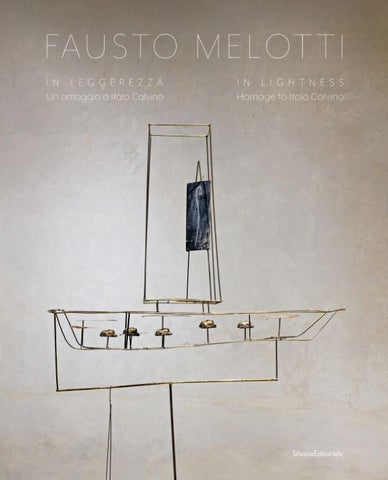
In copertina / Cover Fausto Melotti, Il viaggio, 1961
Direttore generale / General Director Michele Pizzi Direttore editoriale/ Editorial Director Sergio Di Stefano Art Director Giacomo Merli Coordinamento redazionale / Editorial Coordinator Maria Chiara Tulli
Crediti fotografici / Photo Credits Bibliothèque Nationale de France Foto Scala, Firenze Studio Fotografico Luca Carrà / Scala, Firenze Studio Ghibli Per gentile concessione di Adelphi Edizioni Per gentile concessione di Einaudi Per gentile concessione di Mondadori Libri
Redazione / Copy Editing Filomena Moscatelli Impaginazione / Layout Claudia Brambilla Coordinamento di produzione / Production Coordinator Antonio Micelli Segreteria di redazione / Editorial Assistant Giulia Mercanti Ufficio iconografico / Photo Editor Silvia Sala Ufficio stampa / Press Office Alessandra Olivari, press@silvanaeditoriale.it Diritti di riproduzione e traduzione riservati per tutti i paesi All reproduction and translation rights reserved for all countries © 2025 Silvana Editoriale S.p.A., Cinisello Balsamo, Milano © Fausto Melotti, by SIAE 2025 © René Magritte, by SIAE 2025
ISBN 978-88-366-5811-4 A norma della legge sul diritto d’autore e del codice civile, è vietata la riproduzione, totale o parziale, di questo volume in qualsiasi forma, originale o derivata, e con qualsiasi mezzo a stampa, elettronico, digitale, meccanico per mezzo di fotocopie, microfilm, film o altro, senza il permesso scritto dell’editore. Under copyright and civil law this book cannot be reproduced, wholly or in part, in any form, original or derived, or by any means: print, electronic, digital, mechanical, including photocopy, microfilm, film or any other medium, without permission in writing from the publisher.
Silvana Editoriale S.p.A. via dei Lavoratori, 78 20092 Cinisello Balsamo, Milano tel. 02 453 951 01 www.silvanaeditoriale.it Le riproduzioni, la stampa e la rilegatura sono state eseguite in Italia Reproductions, printing and binding in Italy Stampato da / Printed by Esperia S.r.l., Lavis (Trento) Finito di stampare nel mese di maggio 2025 Printed May 2025